TL;DR
An AI BDC handles dealership conversations and follow-up, but the job changes with the lead. For dealer groups buying used cars, seller outreach to service-drive customers and private-party owners belongs on a different shortlist from inbound buyer appointment setting.
- AutoAcquire and AVA suit groups evaluating acquisition outreach to service-drive customers and private sellers.
- BDC.AI handles buyer-lead follow-up, service campaigns, and inbound calls; its published site does not show private-party seller sourcing.
- Conversica focuses on buyer, service, and F&I conversations over email, SMS, and chat.
- VinSolutions gives Cox CRM users a familiar place to manage leads, but a separate voice agent needs its own evaluation.
- Impel combines sales, service, and voice engagement for enterprise groups; sellers and offers need a separate demo.
- Numa fits service calls and routing, with private-party acquisition still to be shown.
Named DMS integrations do not establish read/write access. The comparison marks undocumented sync and cross-rooftop details unknown.
What multi-rooftop groups need from an AI BDC
A multi-rooftop group needs a voice-agent layer that can work across stores with different DMS instances, vehicle inventories, and staff. If each store runs a separate deployment without shared identity and reporting, staff must reconcile customer records and acquisition results across rooftops.
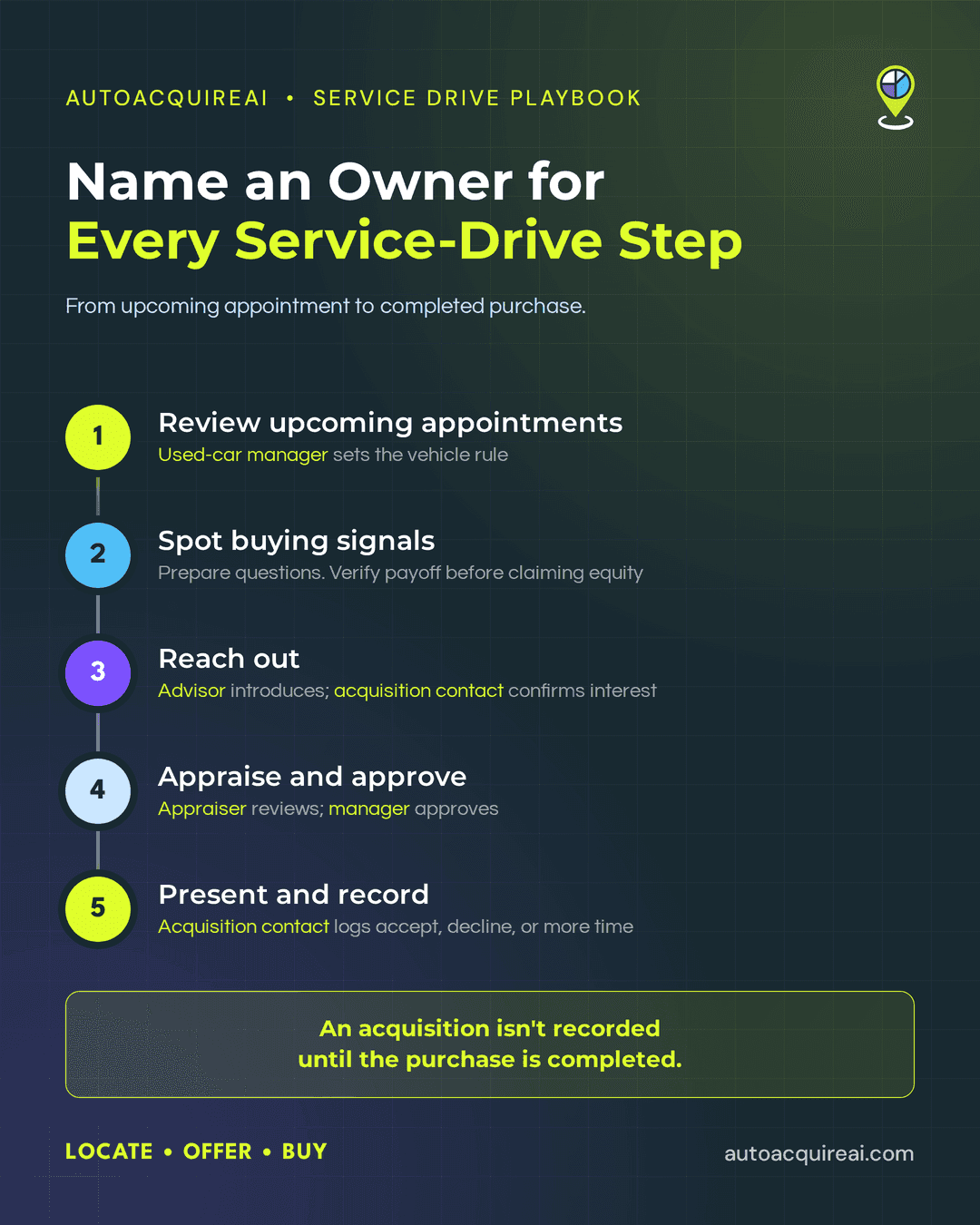
Outbound seller acquisition and inbound buyer follow-up require different workflows. A seller-acquisition agent contacts service-drive customers or private-party owners about vehicles the group might buy. A buyer-follow-up agent responds to shoppers and books sales appointments. A tool that handles buyer inquiries well may still lack a way to select seller prospects, manage acquisition outreach, or pass an interested owner to a used-car manager.
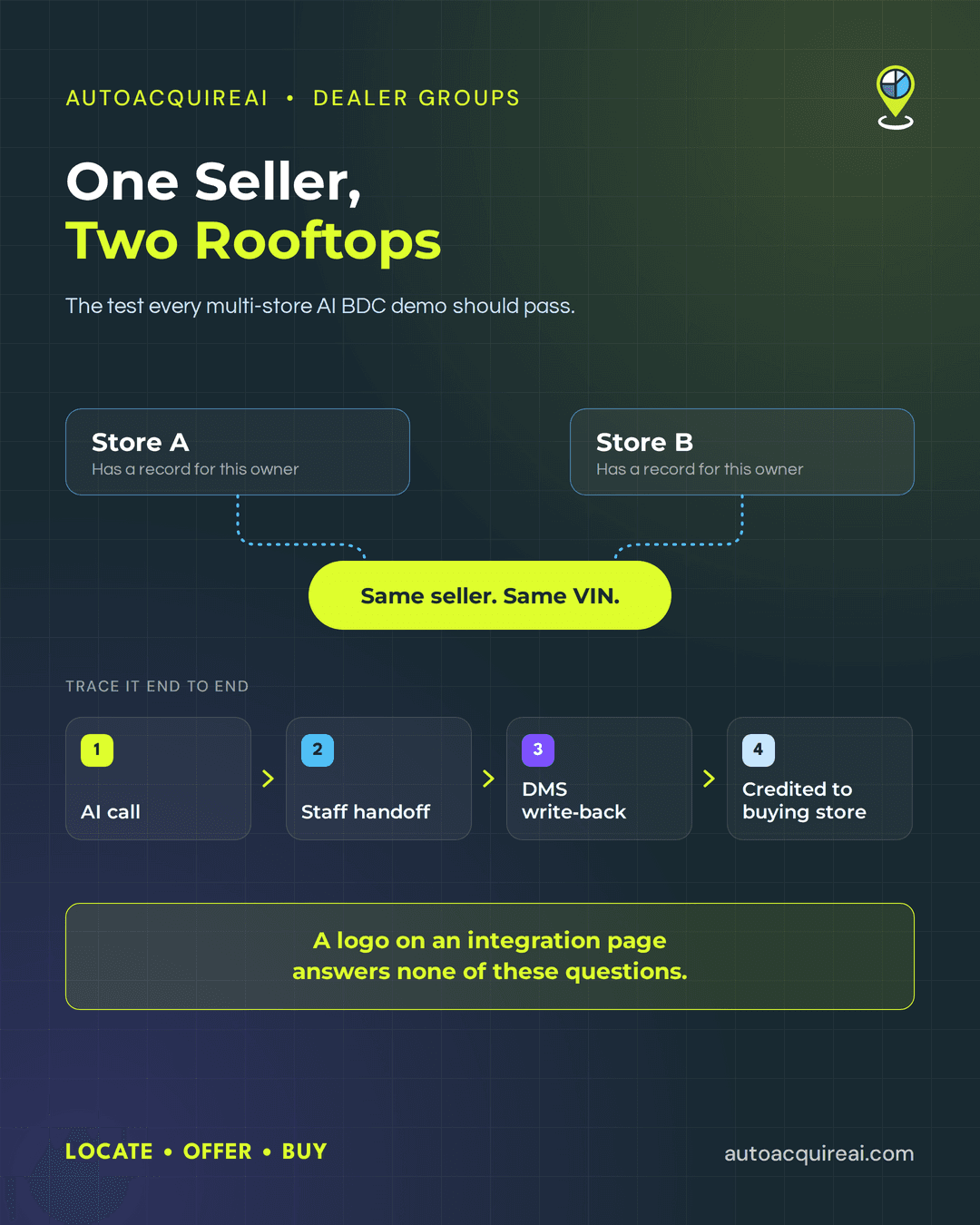
The same owner may appear in two store records. A group needs rules to prevent duplicate calls and keep the seller tied to the buying rooftop. Managers also need to see whether a call led to an offer and a purchased vehicle at that store. Otherwise, staff spend the time saved on dialing by untangling records and handoffs.
How this comparison was evaluated
The tables cite vendor pages for published capabilities and mark missing implementation details “unknown.” That label signals a documentation gap, not a missing product feature.
A dealer group needs a field map, a sync schedule, and a live write-back test for each DMS. The vendor also needs to show how it matches a customer or VIN across stores without merging records that belong to separate rooftops. A logo on an integration page answers none of those questions.
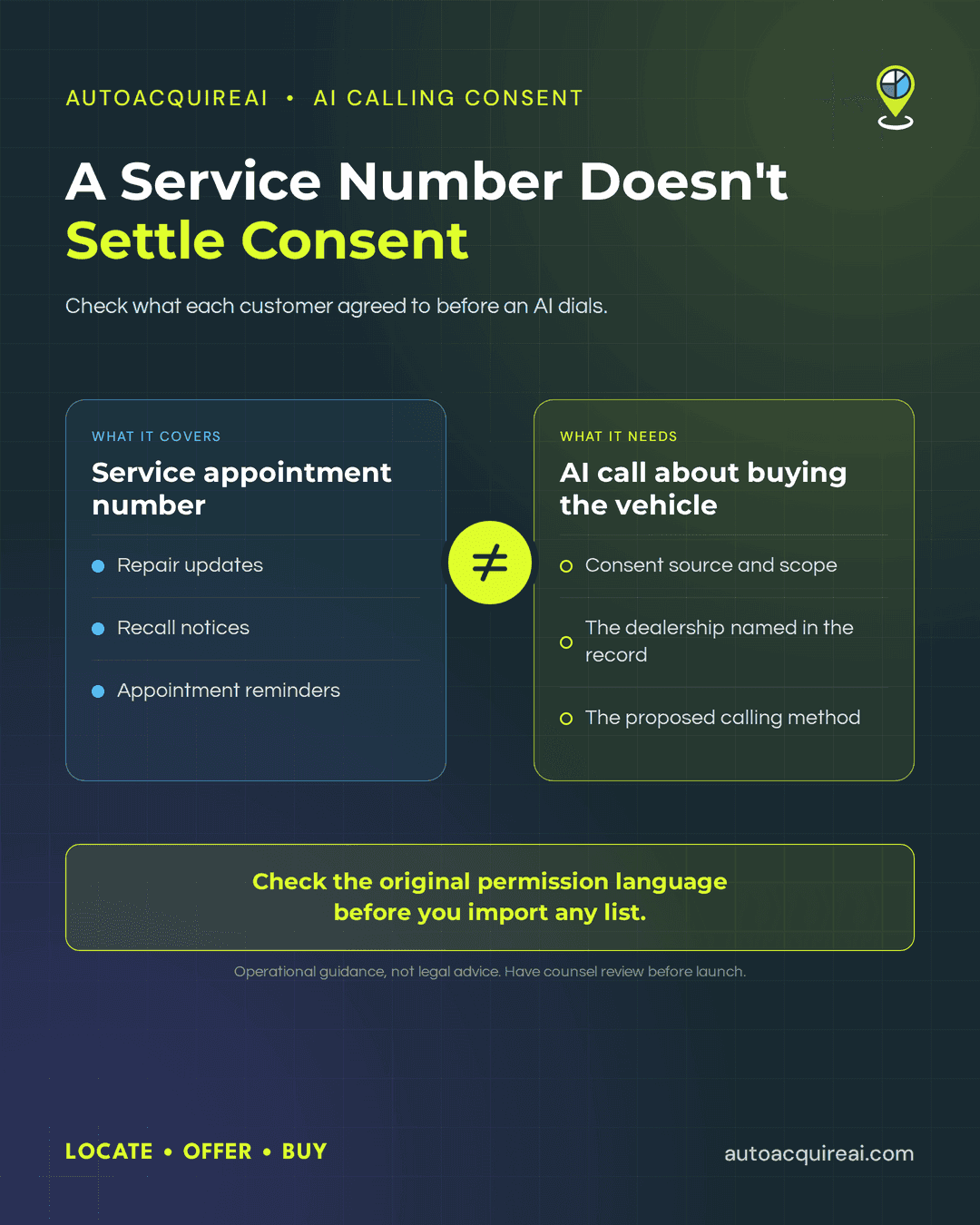
Seller outreach and buyer follow-up require different prospect lists and staff handoffs, so the comparison treats them as separate jobs. For call permissions and opt-outs, use the outbound-calling consent guide and have counsel review the proposed campaign.
AVA by AutoAcquire
Best for: AutoAcquire is the acquisition-native pick for dealer groups seeking seller leads from service-drive customers and private-party owners. Groups focused on inbound buyer appointments should evaluate a buyer-follow-up tool instead.
What it is: AVA runs voice outreach and follow-up cadences for vehicle acquisition. AutoAcquire pairs that outreach with iOffer instant cash offers and Remote Inspection. Its platform names CDK, Reynolds, and Dealertrack integrations and an open API. Dealers should trace an interested seller into an offer and inspection during a demo.
Pros: The acquisition workflow gives used-car managers a more relevant starting point than a voice agent built primarily to answer buyer inquiries. AVA can run approved service-drive outreach cadences, while iOffer and Remote Inspection support the next steps after a seller responds. Named DMS connections give groups a concrete starting point for an integration demo.
Cons: AutoAcquire names DMS connections, but its cited pages do not specify AVA's field-level access, sync cadence, or customer matching across rooftops. The group should test a seller record from call through staff assignment and purchased-vehicle reporting on its own DMS instances before a wider rollout.
Pricing: The cited pages do not list per-store or group contract rates. Ask what a group trial includes before comparing quotes.
bdc.ai
BDC.AI covers buyer follow-up, service campaigns, and inbound calls with separate Sales, Service, and Receptionist agents. Sales calls, texts, and emails leads; Service follows up on recalls and declined work; Receptionist answers and transfers incoming calls. The published workflows do not show private-party seller sourcing.
- Best for: Groups seeking buyer-lead follow-up, service campaigns, and inbound phone coverage.
- Group decision: BDC.AI's separate agents could cover several customer-contact queues. A group buying vehicles should test whether a service contact can become a seller lead without losing the owner, VIN, or store assignment.
- Group fit: BDC.AI advertises multi-rooftop scale and CRM/DMS syncing, but does not name CDK, Reynolds, or Dealertrack or document group-level reporting and field-level write-back on its home page.
- Acquisition gap: A recall campaign is not a vehicle-purchase campaign. Ask for a private-seller sourcing and offer handoff demo before using it to acquire cars.
- Pricing: The site says pricing begins at $595 per month; confirm per-rooftop and usage terms.
Conversica
Conversica’s automotive offering centers on sales-lead reengagement, test-drive scheduling, service inquiries, maintenance and recall appointments, and F&I qualification. The company describes email, SMS, and chat conversations for dealership groups; its automotive page does not document outbound AI voice calls to vehicle sellers.
Best for: Groups reactivating buyer leads, booking service, and qualifying F&I interest across stores. Conversica names DealerSocket, CDK, and VinSolutions connections and says activity syncs across the CRM, calendar, and DMS. Its automotive page lists email, SMS, and chat, not an outbound seller voice agent. A group that needs phone outreach to vehicle owners should ask for that call and its DMS record in the same demo. The page does not list group pricing.
VinSolutions
Best for: Dealer groups already using VinSolutions as their Cox Automotive CRM and evaluating how a separate AI voice agent would use existing lead records.
What it is: VinSolutions sells a dealership CRM with AI shopper insights, 24/7 automated follow-up, and messaging recorded in the CRM. Its site also describes DMS integrations for desking. Neither the CRM's AI messaging nor desking connectivity establishes a native outbound seller-calling voice agent; groups evaluating voice need to identify the actual calling provider.
Evaluation advantage: Groups already using VinSolutions can test the calling provider against their existing lead records. A useful demo ends with the call, seller response, and employee assignment visible in the correct store's CRM record.
Cons: VinSolutions' CRM and desking connections do not answer what a separate voice provider can write to a mixed-DMS group. Test one seller at two stores, then inspect the updated fields and employee assignment in each system. The cited VinSolutions page does not document a native outbound seller voice agent.
Pricing: Unknown.
Impel
Best for: Groups buying a broader sales-and-service engagement suite, rather than a tool dedicated to buying cars from consumers. Impel lists Sales AI, Service AI, Voice AI, Chat AI, and merchandising products, and explicitly markets an enterprise dealer-group offering. Its Voice AI positioning focuses on turning calls into tracked opportunities; its sales positioning focuses on booking showroom appointments.
Impel brings sales, service, and voice products into one dealer-group evaluation. Its published overview does not describe a private-party acquisition path from prospect selection to accepted offer. For a sourcing rollout, ask Impel to run that path live and show the DMS fields exchanged and the rooftop credited in the report. Public pricing is not listed on the cited page.
Numa
Best for: Groups with high fixed-ops call volume that need service booking, call routing, and a shared conversation history. Numa documents Voice AI, appointment booking, a Smart Inbox, and Operator routing, and describes deployment across multi-rooftop groups. Its site names CDK, Reynolds & Reynolds, Dealertrack, and Tekion connections and states that its voice agent writes service requests back to the DMS.
Numa's documented service-request write-back gives fixed-ops buyers a concrete test case. Acquisition teams need a different test: can Numa call a private seller, transfer the conversation to the buying store, and record the vehicle purchase? Its service documentation does not answer those acquisition questions.
DMS integration depth across the six providers
Dealer groups should separate a named connection from proof of acquisition write-back. AutoAcquire names CDK, Reynolds, and Dealertrack. Conversica names CDK alongside DealerSocket and VinSolutions, while Numa names CDK, Reynolds & Reynolds, Dealertrack, and Tekion and describes service-request write-back. Each group still needs to inspect the exact fields, sync timing, and cross-store matching for the workflow it plans to buy.
| Provider | Named DMS Integrations | Read/Write Access | Data Objects Synced | Sync Frequency | Cross-Rooftop Identity |
|---|---|---|---|---|---|
| AutoAcquire / AVA | CDK, Reynolds, Dealertrack | Acquisition field access unknown | unknown | unknown | unknown |
| bdc.ai | CRM/DMS sync claimed; vendors unnamed | Field-level access unknown | unknown | unknown | unknown |
| Conversica | CDK named; DealerSocket and VinSolutions also named as connections | Acquisition field access unknown | Activity sync claimed; objects unspecified | unknown | unknown |
| VinSolutions | DMS integration for desking; vendors unnamed on cited page | Voice-agent access unknown | Desking data; acquisition objects unknown | unknown | unknown |
| Impel | Integration claimed; DMS vendors unnamed on cited page | Field-level access unknown | unknown | unknown | unknown |
| Numa | CDK, Reynolds & Reynolds, Dealertrack, Tekion | Service-request write-back claimed; acquisition access unknown | Service requests; acquisition objects unknown | Real-time DMS context claimed; write-back cadence unknown | unknown |
For mixed-DMS groups, the service-drive DMS integration checklist covers the store-level field-mapping questions in more detail. In this comparison, the deciding test is whether one seller call and its outcome reach the correct store without duplicate entry.
Centralized reporting and store-level handoffs
Vendor pages describe several useful handoff and group features, but none of the cited pages traces an acquired vehicle from AI call to a group report. AutoAcquire's platform describes Dealer Group Control for routing VINs to stores, while BDC.AI describes call transfers and Numa describes caller routing. Those features need a seller-acquisition test at the intended rooftops.
| Provider | Centralized Reporting | Store-Level Routing | Staff Handoff Mechanism |
|---|---|---|---|
| AutoAcquire / AVA | VRM lead and transaction visibility described; group rollup detail unknown | Dealer Group Control claims VIN-to-store routing; seller-lead rule unknown | Seller-to-staff transfer details unknown |
| bdc.ai | Multi-rooftop scale claimed; rollup detail unknown | Lead-to-rooftop rules unknown | Qualified-call hot transfer claimed; store selection unknown |
| Conversica | 80-store deployment described; group report detail unknown | Buyer-to-finance routing described; seller routing unknown | Ready F&I buyers routed to finance; seller handoff unknown |
| VinSolutions | CRM reporting described; acquisition rollup unknown | Seller routing through a separate voice agent unknown | Separate voice-provider handoff unknown |
| Impel | Enterprise group offering described; acquisition rollup unknown | Seller routing unknown | Seller-to-buyer handoff unknown |
| Numa | Multi-rooftop deployment described; acquisition rollup unknown | Operator routes callers; seller-to-buying-store rule unknown | Call routing described; seller acquisition handoff unknown |
A seller who answers an AI call should reach the buying store, not a shared queue with no owner. If the call lands at the wrong rooftop, staff must recover the vehicle context before making an offer. A group report must also connect that conversation to the store that acquired the car. The service-drive acquisition ROI scorecard explains how to measure those outcomes consistently across stores.
In a live demo, each provider should route a qualified lead to a named employee, show what that employee receives, and display the same lead in store-level and group-level reports.
Comparison table: best-for and evidence status
For seller acquisition across rooftops, AutoAcquire is the clearest acquisition-specific fit in this group. BDC.AI handles buyer, service, and inbound calls; Conversica engages buyers and service customers in written channels; VinSolutions supplies CRM context; Impel spans engagement workflows; and Numa concentrates on service and call routing. The table separates each documented fit from the acquisition features a dealer still needs to test.
| Provider | Best For | Key Features | Pricing/Trial | Evidence Status |
|---|---|---|---|---|
| AVA by AutoAcquire | Service-drive and private-party seller acquisition | AVA voice outreach; iOffer available in the acquisition workflow | Pricing and trial terms require confirmation | Partially documented |
| bdc.ai | Voice-workflow evaluation; channel fit unverified | Outbound and inbound capabilities unverified here | Unknown | Unknown |
| Conversica | Automotive buyer-follow-up evaluation | Buyer and seller voice capabilities unverified here | Unknown | Unknown |
| VinSolutions | Groups evaluating a CRM-centered BDC workflow | AI voice capability unverified here | Unknown | Unknown |
| Impel | Buyer-engagement evaluation | Voice and seller-acquisition scope unverified here | Unknown | Unknown |
| Numa | Service-department communication evaluation | Outbound acquisition voice and private-party seller outreach unverified here | Unknown | Unknown |
“Unknown” means the supplied research lacks a primary source for the claim, not that the provider lacks the capability. Before rollout, dealers need a live test of outbound voice, store routing, and DMS write-back for each provider they intend to use.
Live-demo proof checklist for multi-rooftop buyers
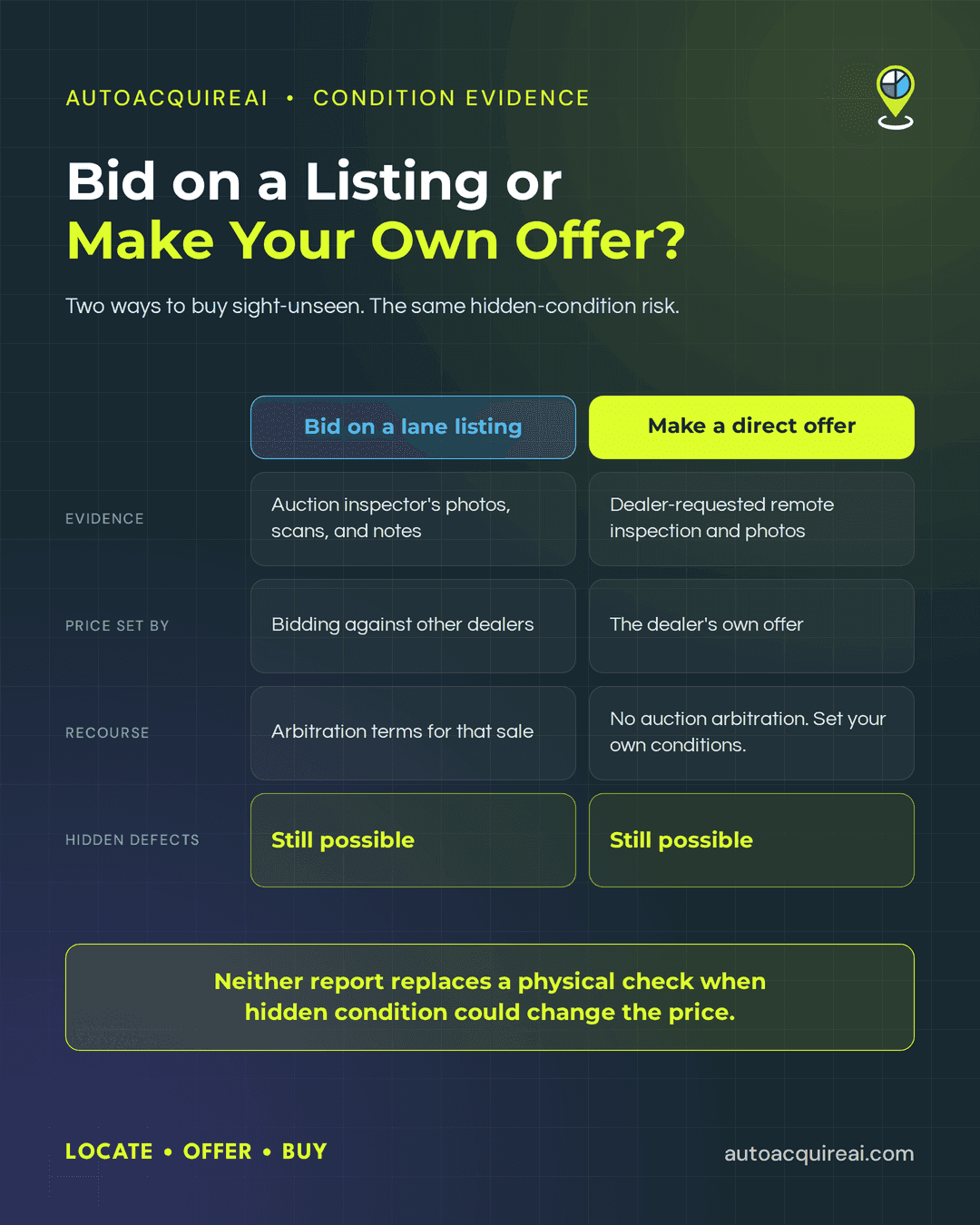
A two-rooftop test with exported results should establish whether each vendor preserves store attribution through outreach, handoff, and acquisition. A configuration screen cannot show whether a seller record, call, and purchased vehicle stay tied to the correct store.
- DMS data. Which customer and vehicle fields can the agent read, and which can it write back? Request a field-level mapping and a live record update. If the update fails, how does the platform alert staff and prevent a stale record from driving another call?
- Cross-store identity. What happens when both stores have a record for the same seller or VIN? Request the matching rules and an audit trail showing which store owns the outreach.
- Consent and suppression. Can the vendor show the consent record used for a test call and demonstrate how an opt-out stops subsequent outreach across rooftops? Request the event log and have counsel assess it against applicable requirements using the published outbound-calling consent guide.
- Routing and handoff. Where does a qualified seller lead go when its assigned store has no available staff member? Have the vendor demonstrate the fallback, staff notification, and full conversation history available to the person taking over.
- Store attribution and outcomes. Can a group report separate outreach, appointments, offers, and acquired vehicles for each rooftop? Request an export that traces one purchased vehicle back to its source contact and assigned store.
Buyer’s guide FAQ
- How does outbound seller acquisition differ from inbound buyer follow-up? Seller acquisition starts with identifying service-drive customers or private-party owners who may sell a vehicle. Inbound buyer follow-up responds to shoppers who have already contacted the dealership. AVA by AutoAcquire focuses on the seller-acquisition workflow.
- What should DMS integration mean for a dealer group? A named integration establishes connectivity, not which records a vendor can read or update. Groups need a field-level demonstration for each rooftop’s DMS, including how the vendor identifies the same customer across stores and attributes an acquired vehicle to the right store.
- Can one AI BDC vendor cover both jobs? One vendor can cover both jobs only if a demo establishes both workflows. The agent must select seller prospects, follow up with inbound buyers, and route each conversation to the appropriate store employee.
- Where should dealers assess outbound-calling consent? The published outbound-calling consent guide covers the legal and operational questions. In the vendor demo, request records showing how consent, suppression, and opt-outs apply across rooftops, and have counsel review the proposed process.
Choosing the right AI BDC layer for a dealer group
Dealer groups should choose an AI BDC layer based on whether they need to acquire used vehicles or follow up with buyers. AutoAcquire’s AVA fits groups prioritizing outreach to service-drive customers and private-party sellers. Groups focused on inbound buyer appointments should evaluate buyer-follow-up tools for that job. Groups pursuing both goals should test whether one product handles both workflows before contracting for a second tool.
A group rollout should follow a live test that traces one seller from the outreach record through DMS write-back, staff handoff, and an acquired vehicle attributed to the correct store.