TL;DR
- An AI BDC for outbound vehicle-purchase calls must block contacts without the required consent and honor opt-outs across connected systems. Test both before launch.
- Service appointment contact details do not, by themselves, authorize AI calls about buying a customer’s vehicle. Dealers need to check consent for the purpose and calling method.
- AutoAcquire/AVA fits dealers evaluating AI outreach to vehicle sellers in the service drive and private-party market. Its consent, suppression, and opt-out controls still require documentation and a live test before launch.
- Dealers can find scripts in the service-drive outreach guide and broader vendor evaluations in the AI BDC comparison.
AI BDC outbound calling consent: service contact versus vehicle-purchase outreach
A service appointment number records where to reach a customer about a repair. It does not establish permission for an AI call asking to buy the vehicle. Before placing an acquisition call, the dealer must establish what the customer agreed to, which dealership has that permission, and whether it covers the proposed calling method.
A service-drive record can show a promising vehicle but no permission for acquisition calls. Before importing that contact into an AI BDC, check the original consent language and whether it covers the proposed calling method. Apply the same check to private-party seller lists.
Start the vendor demo with a service-only record. If the AI BDC tries to pitch a purchase to that number, stop the test and request the campaign’s consent rules. Have counsel determine which federal and state requirements apply to the calling method and message before approving those rules.
AI BDC outbound calling rules: consent and revocation
Classify the call by its message and technology before choosing a consent rule. The Telemarketing Sales Rule primarily covers campaigns to induce consumers to buy goods or services, so a stand-alone call offering to buy a customer's car may fall outside parts of that rule. The FCC's TCPA calling rules separately restrict artificial-voice calls to wireless numbers and apply consent and do-not-call requirements according to the call's purpose. Counsel must classify the actual offer, any sales pitch, and the technology used; a human handoff does not retroactively authorize an AI call.
The FCC treats AI-generated voices as artificial voices under the TCPA. Under 47 CFR § 64.1200, covered artificial-voice calls to wireless numbers generally require prior express consent; calls that advertise or constitute telemarketing generally require prior express written consent. Where the TSR covers a prerecorded sales call, its written-agreement requirements also apply. A service appointment number alone proves neither the scope of consent nor authorization for the proposed AI seller-acquisition call.
The FCC's current revocation rule requires covered opt-outs to be honored within a reasonable time, no later than ten business days. The FCC also published a revised order on October 26, 2026, effective November 25. It will allow designated, clearly disclosed opt-out methods and category-specific opt-outs for informational calls. A marketing opt-out will still cover future covered marketing calls and texts from that caller. Until the revision takes effect, do not assume one designated channel is enough. Counsel should set the campaign's rules using the operative federal text and the calling, recording, and disclosure laws in each destination state.
Operator controls to require before launch
A vendor demo needs to answer these seven questions before the dealership enables outbound vehicle-purchase calls.
- Consent source and scope. Which record shows how each service customer or private-party seller provided the number and agreed to this type of outreach? Request the consent language, date, source, phone number, and dealership named in the permission record. The vendor should show how its system excludes records that authorize service updates but not vehicle-purchase calls.
- Call timing. Which time zone controls the calling window, and what stops a call outside the permitted hours? Ask the vendor to demonstrate the restriction with a contact whose area code differs from their current location. Counsel should approve the applicable federal and state calling windows.
- Suppression lists. Which lists does the vendor check before every attempt, and how does it handle an opt-out already stored in the dealership CRM? Ask for a test using a suppressed number. If the vendor checks suppression only when it uploads a campaign, a later opt-out may not block the next scheduled attempt.
- Opt-out propagation. What happens when a customer says “stop calling me” during an AI call? Check the calling system, CRM, and connected texting tool for the request and its timestamp. Map suppression to the customer's stated scope and the dealership entity, including affiliated rooftops where applicable; the vendor must surface failed updates before another contact attempt.
- AI disclosure. When does the caller identify the dealership and disclose that the customer is speaking with an AI agent? Request the opening audio, not a script excerpt. Counsel should approve the wording and timing for the jurisdictions in the calling program.
- Audit logs. Can the vendor retrieve a single contact’s consent record, call attempts, disclosure, opt-out, and subsequent suppression decisions? Ask who can access the records and how long the vendor keeps them. Dealers need that sequence to investigate a complaint.
- Human transfer. What happens when a customer asks for a person or disputes consent? Test a live transfer while staff are available, then repeat it when no one answers. The vendor should show whether the AI stops its pitch and how it records the unresolved request.
AI BDC vendor-demo checklist: test consent, suppression, and opt-outs
Use test records, not customer numbers. Run each attempt under the dealership’s approved calling policy and capture the tool’s decision and audit record.
- Test consent scope. Load one record with permission for service reminders and another with documented permission for vehicle-purchase calls. Ask the vendor to attempt the same acquisition call to both. The tool should block the service-only record and show the source and scope of permission for the allowed record.
- Test call timing. Set a test record’s time zone and schedule a call outside the dealership’s approved window. Ask the vendor to show the blocked attempt, then schedule an in-window call and show how the tool decides which time zone applies.
- Check the opening disclosure. Place a test call and listen from the first word. Record when the caller identifies itself as AI and the dealership it represents. Have counsel review the wording and timing against the dealership’s requirements rather than accepting a demo script as proof of compliance.
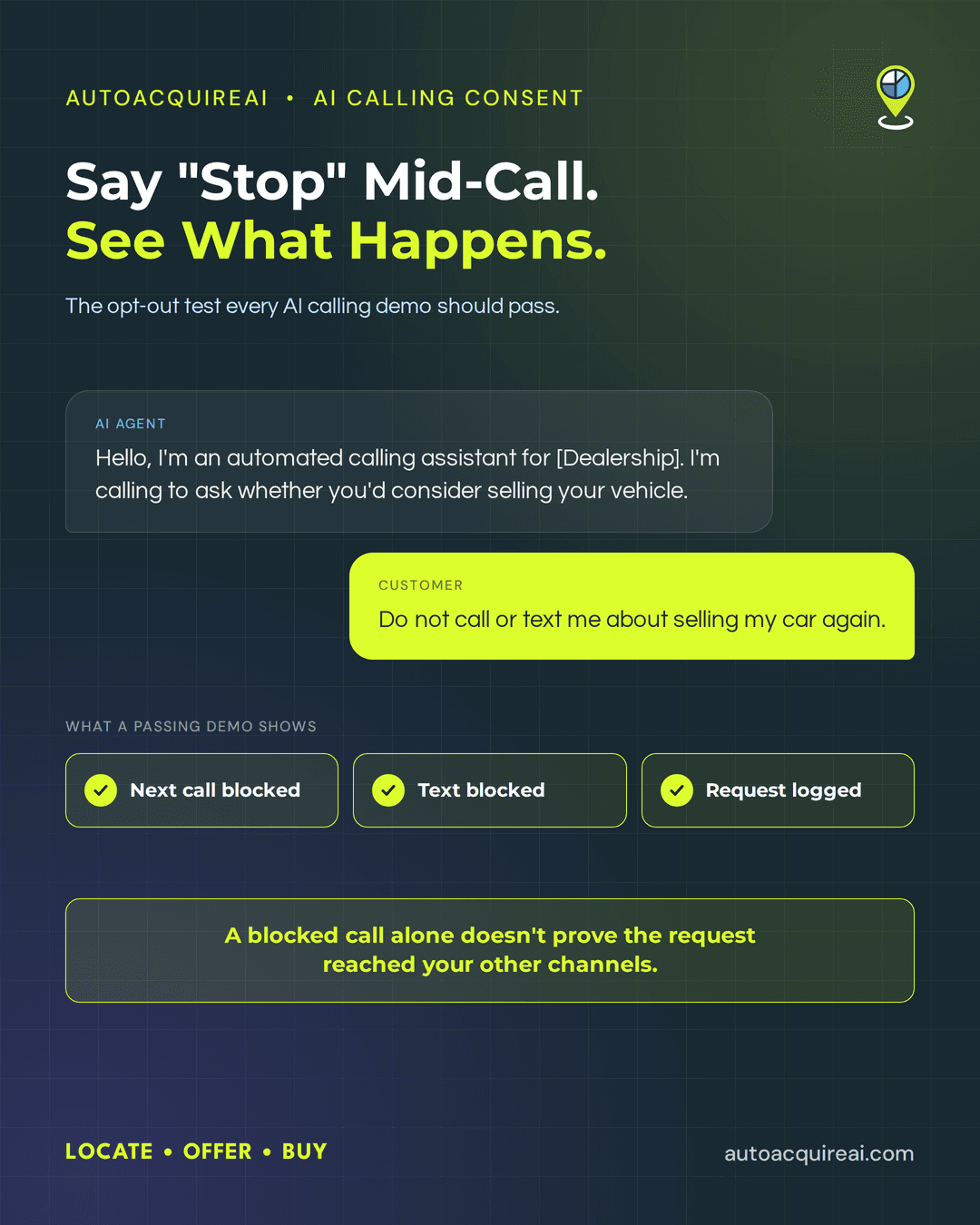
- Opt out during the call. Say, “Do not call or text me about selling my car again,” while the AI agent is speaking. Ask the vendor to show how the request enters the suppression list and whether a second attempted call is blocked. Then attempt a test text through the connected messaging tool. A blocked call alone does not establish that the request reached other channels or rooftops.
- Request a person. During another test call, ask for a dealership employee. Check whether the transfer connects and whether the employee receives the call context, including any consent or opt-out request.
- Inspect the audit trail. Request an export for both test records. It should let the dealership trace consent evidence, attempted calls, disclosure timing, the verbal opt-out, suppression updates, and the transfer. Ask who can change a record and how the dealership would retrieve it later.
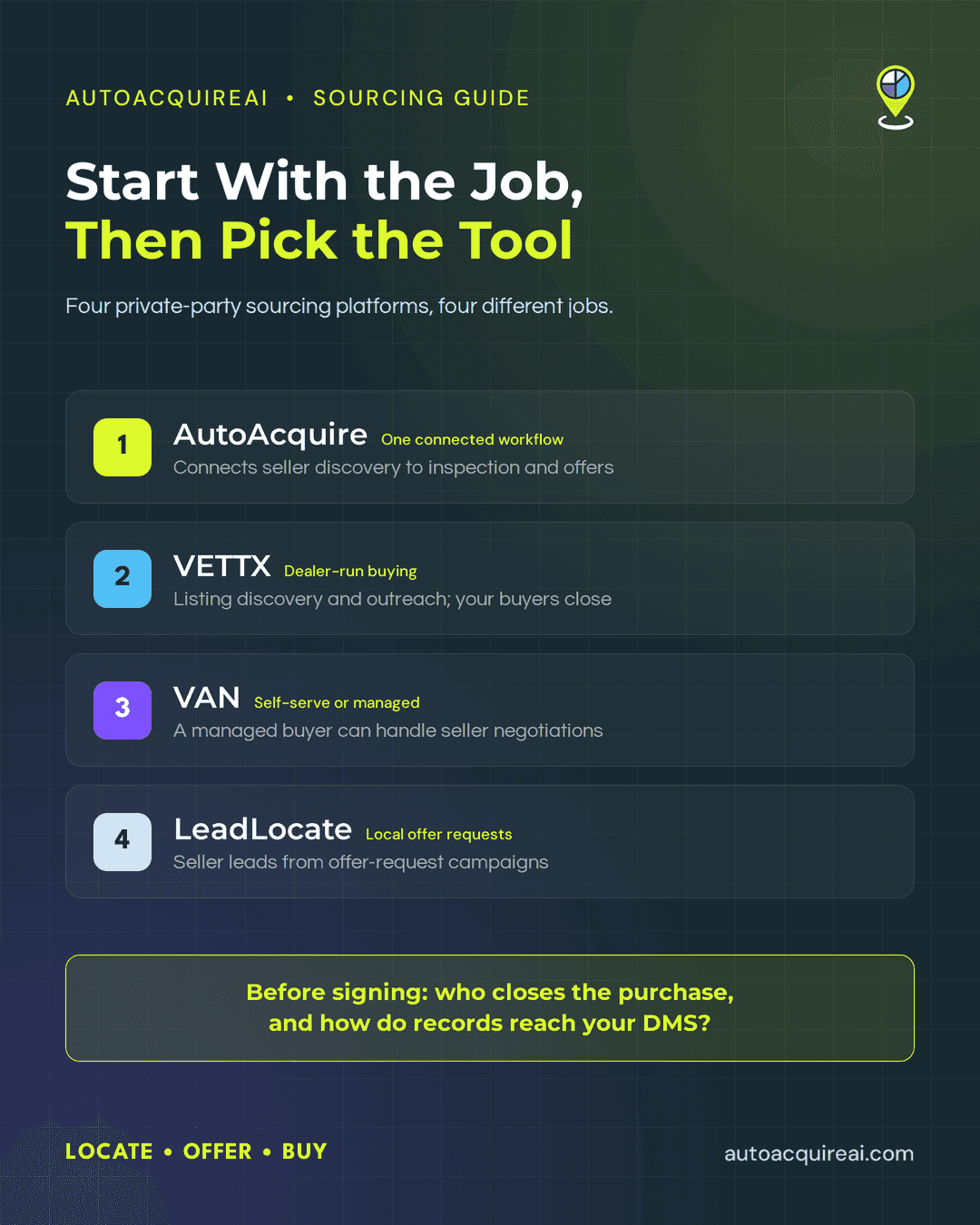
Alpha Drive AI claims a split between consented AI service calls and human sales outreach. AutoAcquire/AVA focuses on seller acquisition outreach. Either approach needs the same blocked-call and opt-out tests; a polished conversation cannot show whether an excluded contact stays excluded.
AI BDC vendor claims: what is documented and what needs proof
AutoAcquire/AVA belongs in a seller-acquisition shortlist because its published product focus is outreach to potential vehicle sellers. Alpha Drive AI instead claims a split between AI service calls and human promotional calls, while Lane Command publishes detailed consent-control claims. None of those pages proves a control works on a dealer’s records, and AutoAcquire’s cited product page does not document the controls in this checklist.
| Vendor | What its public page claims | What still needs a live test |
|---|---|---|
| Alpha Drive AI | AI handles consented, nonpromotional outreach; human agents make promotional calls. The page claims per-contact consent logs, quiet-hour rules, AI disclosure, and immediate cross-channel opt-outs. | Confirm the call-purpose split, consent record, suppression speed, and transfer of a seller inquiry to a human. |
| Lane Command | The page claims pre-call consent checks, time-zone restrictions, DNC screening, cross-channel opt-outs, CRM sync, and exportable audit records. | Try a service-only record, a mid-call verbal opt-out, and a blocked follow-up across connected systems. |
| AutoAcquire/AVA | Its product page describes AI voice and text outreach tied to vehicle acquisition, which makes it relevant to service-drive and private-seller programs. The page does not document the controls in this checklist. | Consent source, call timing, suppression, opt-out propagation, disclosure, logging, and human transfer remain unverified pending documentation and a live demo. |
Compare AI BDC outbound consent controls by vendor
Use public claims to choose what to test, not to award a compliance grade. The matrix below identifies each vendor's stated approach to outbound calling and the evidence a dealer still needs.
| Vendor | Stated outbound approach | Public claims relevant to this test | Go-live evidence still needed |
|---|---|---|---|
| Alpha Drive AI | AI for consented service calls; human agents for promotional outreach | Per-contact consent logs, AI disclosure, quiet hours, cross-channel opt-outs | A seller-call routing test, consent export, and proof of opt-out propagation |
| Lane Command | AI voice, SMS, and email with stated consent controls | Pre-call checks, DNC suppression, time-zone rules, CRM synchronization, audit exports | Blocked-call and verbal opt-out tests on the dealer's connected systems |
| AutoAcquire/AVA | Voice and text outreach tied to vehicle acquisition | Seller-outreach focus is documented; consent and opt-out controls are not established by the cited product page | Consent records, blocked attempts, opt-out propagation, and the remaining checklist tests |
Buyer's guide: how to weigh the demo results
A franchise group needs an opt-out test across rooftops wherever the request’s scope and applicable law require suppression. Submit a request at one store, then try calls and texts from another, including a duplicate customer record. Compare the request, suppression, and blocked-attempt timestamps. A single-store dealer can run the same test within its own calling and texting systems.
A missing consent record or a failed opt-out test is a stop sign for the proposed campaign. Ask the vendor to correct the control and rerun the same record through the full call-and-text sequence. A successful transfer to a person does not cure an unauthorized call.
A successful demo cannot settle the legal requirements or the vendor’s data obligations. Before launch, have counsel review the call purpose and consent evidence against applicable federal and state rules. Put suppression ownership, system updates, and access to call logs in the data-processing agreement.
FAQs
- Does a service visit give the dealership permission to make AI vehicle-purchase calls? No. A phone number collected for an appointment or recall notice does not, by itself, establish consent for a marketing call about buying the customer’s vehicle. Dealers need to check the consent source, its scope, and the calling method against the rules discussed above.
- Who is responsible if a vendor’s AI calls someone without the required consent? A vendor contract does not automatically shield the dealership. The Telemarketing Sales Rule can apply to sellers and telemarketers. Counsel should review each party’s obligations before launch, while the dealer retains access to consent records, call logs, and suppression evidence.
- Does a verbal opt-out during a call also stop texts? Treat “do not call or text me about selling my car” as covering both channels for the stated outreach. The FCC's current rule permits covered revocation by a reasonable method. Its November 25, 2026 update preserves broad suppression for marketing requests while changing rules for informational messages and designated opt-out methods. Have counsel set the policy and test it across connected systems.
- What should an AI disclosure sound like? Where disclosure applies, the opening should plainly identify the dealership, the automated caller, and the sales purpose. For example, “Hello, I’m an automated calling assistant for [dealership]. I’m calling to ask whether you’d consider selling your vehicle.” Counsel should approve the wording and timing under applicable federal and state rules. Disclosure does not replace consent.
Conclusion
Dealers should approve AI vehicle-purchase calls only after a repeatable demo proves the consent and opt-out controls work. The go-live record should contain consent evidence, blocked-attempt results, opt-out propagation results, and retrievable call logs. A vendor pitch or citation metric cannot substitute for that evidence, and counsel should review the program before launch.