

TLDR
AutoAcquire / AVA is the acquisition-native pick. AVA generates seller leads from private-party owners and service customers, then runs instant cash offers end-to-end. Conversica handles automated buyer-lead follow-up for inbound internet leads. VinSolutions Connect CRM suits dealers already inside the Cox Automotive ecosystem who want AI inside their CRM. Impel AI covers full-funnel buyer engagement across sales, imaging, and retention. Numa recovers missed inbound calls and books service appointments for high-volume stores.
Why the AI BDC Category Splits in Two
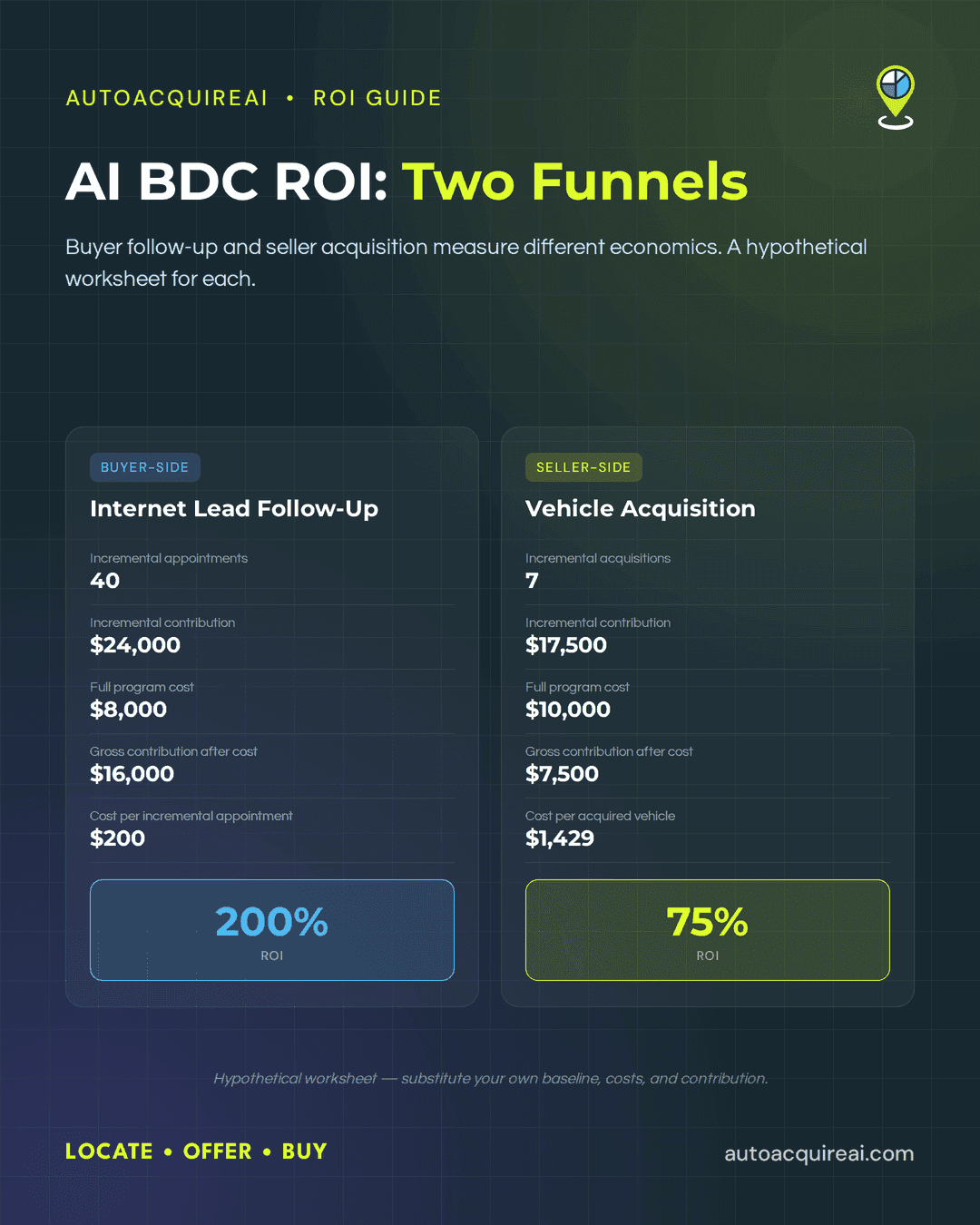
Most dealers treat AI BDC as one category when it solves two different problems. Acquisition-native tools generate seller leads from service customers and private-party owners. Buyer-side tools follow up on inbound shoppers who already raised their hand. Conflating the two leads you to buy software that never touches your biggest 2026 pain, which is sourcing used inventory at margin.
Investment is accelerating because the inbound math has gotten worse. Up to 40% of automotive leads arrive after business hours, and 56% of new leads are submitted after hours while only 37% of dealerships respond within an hour. 74% of dealerships named AI voice agents their top investment priority for 2026 in a Spyne survey. Those numbers explain why buyer-side follow-up tools attract the most spending.
That spending mostly chases inbound, and acquisition stays unsolved. Following up on a buyer who submitted a lead is a known workflow with a known contact. Identifying which households own a tradeable vehicle and closing the purchase is a sourcing problem. AutoAcquire and AVA are built for the second job. The buyer-side tools are not.
What Is an AI BDC for Car Dealerships?
An AI BDC is software that runs dealership outreach, follow-up, and appointment setting automatically, replacing or supplementing the calls and texts a staffed business development center handles by hand. A traditional BDC depends on people dialing, emailing, and chasing leads through the day. The software does that work continuously, including the 40% of automotive leads that arrive after hours.
A generic chatbot answers questions on a website and stops there. An AI BDC tool initiates contact, qualifies the lead, and books the appointment, then writes the result back to the CRM. Some platforms focus on inbound buyer inquiries. Others generate seller leads by reaching service drive customers and private-party vehicle owners. The function defines the tool, not the AI label attached to it.
Comparison Table: AI BDC Tools for Dealerships in 2026
| Tool | Best For | Key Features | Pricing / Trial |
|---|---|---|---|
| AutoAcquire / AVA | Used-car acquisition leads from service drive and private-party sellers | AVA voice/SMS agent (Sergio), iOffer™ instant cash offers, ICO widget, Private Party Marketplace, Garage Expansion, Remote Inspection, VRM Dashboard, multi-rooftop control | Free ICO widget; 60-day free trial; open API |
| Conversica | Automated buyer-lead follow-up and service lane scheduling | AI agents for sales leads, service scheduling, and F&I; integrates with CDK, VinSolutions, DealerSocket; 1,000+ dealer teams | Custom quote; not publicly listed |
| VinSolutions Connect CRM | CRM-native AI follow-up inside Cox Automotive | Vini AI calling, chat, service reminders, appointment scheduling, automatic CRM write-back | Custom quote; enterprise |
| Impel AI | Full-funnel buyer engagement | Pulsar sales AI, SpinCar imaging, Outsell retention; 13 integrations (CDK, Reynolds, Tekion, VinSolutions) | Custom quote; 12-month lock-in; no trial |
| Numa | Recovering missed inbound calls | 24/7 AI voice, Smart Inbox, sentiment detection, analytics dashboard | $500–$1,500/month (est.) |
| bdc.ai | Dedicated general-purpose AI BDC layer | General-purpose BDC automation | Not publicly listed |
The 6 Best AI BDC Tools for Car Dealerships
These six tools rank by how directly they solve a dealer's actual problem, starting with acquisition-native platforms and moving toward buyer-side inbound follow-up. AutoAcquire/AVA leads because it generates seller leads no inbound tool can produce, followed by the buyer-side and general-purpose options that handle a different job.
AutoAcquire / AVA — Best for Used-Car Acquisition Leads
AutoAcquire generates seller leads, which is the one thing every other tool on this list cannot do. Buyer-side platforms wait for an internet lead to arrive and then work it. AutoAcquire creates acquisition opportunities from consumer-owned vehicles, then runs the entire sourcing workflow from a single dashboard.
A free embeddable ICO widget lets sellers enter a plate or VIN on the dealer's own site and receive an instant cash offer, entering the acquisition pipeline without leaving the page. The Private Party Marketplace aggregates listings from Autotrader, CarGurus, Cars.com, Craigslist, eBay, Edmunds, and Facebook, then attaches offer history and an iOffer price to each VIN. Garage Expansion cross-references state title records, insurance, and warranty data to surface every vehicle in a seller's household, turning one lead into several acquisition targets.
Cariisma extends the same engine to a consumer-facing AI concierge that delivers instant cash offers from licensed dealers. Each of these channels feeds the same workflow rather than living as a separate product you have to stitch together.
Once a lead lands, AVA's agent — named Sergio in the platform — places outbound calls and SMS to collect the vehicle details, confirms the specs, and queues an Offer Certificate sent by text and email. Published transcripts show the agent working a 2022 BMW X7 and a 2014 Ford F-150 from first contact through offer without a human touching the call.
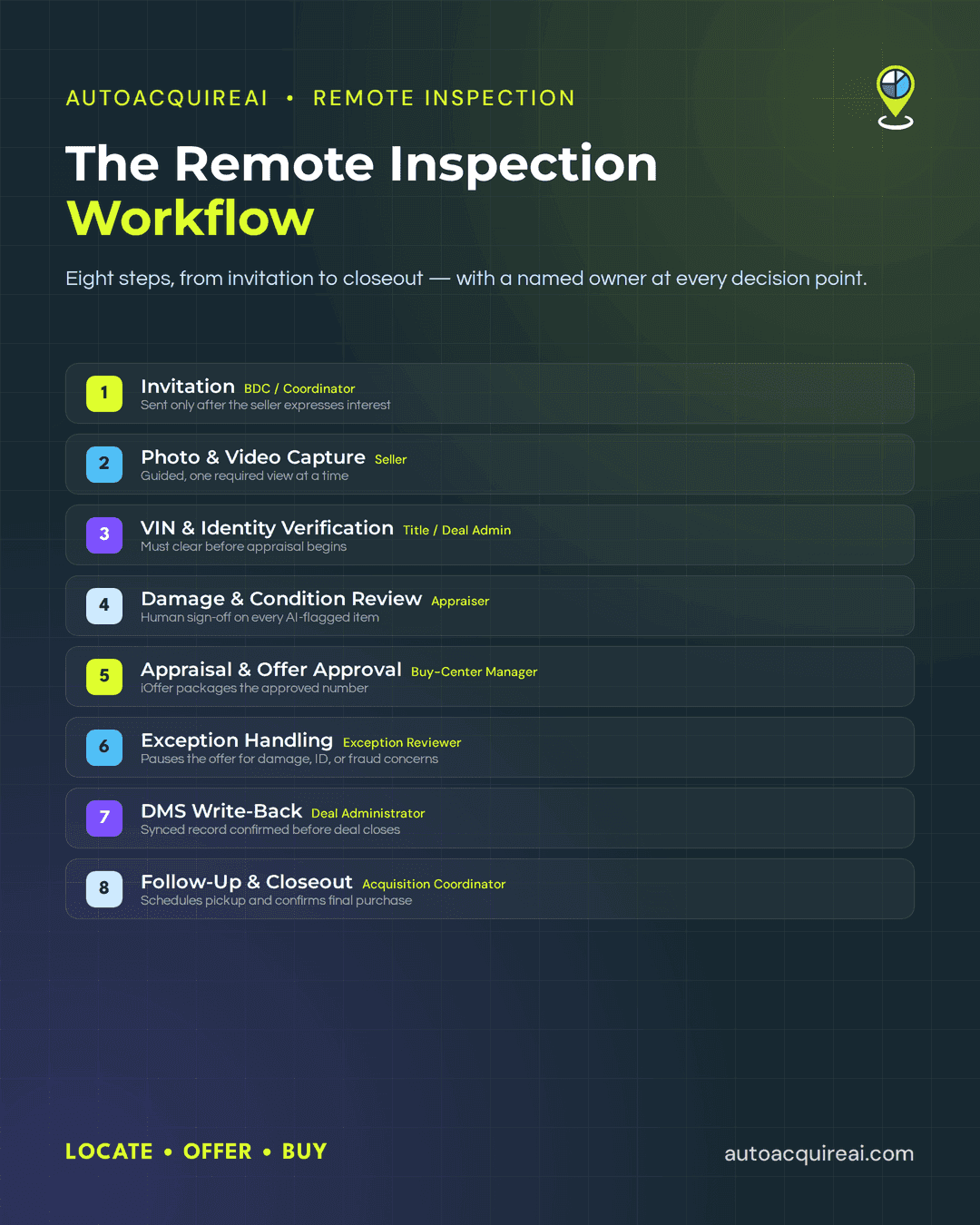
The iOffer Instant Cash Offer prices down to the ZIP code, VIN, and customer profile using live market data, and the certificate locks for a set window so sellers act before the number moves. After a seller accepts, Remote Inspection has them self-complete a photo-based walkthrough that returns an Inspection Score, categorizes damage across exterior, interior, rims, and tires, estimates repair costs, and recalculates adjusted value. The VRM Dashboard tracks payoff and deal status through close, so a manager sees the full pipeline in one view.
Dealer groups get centralized control: the platform routes individual VINs to specific stores, matches offers to group strategy, and surfaces per-VIN offer counts and regional market depth scores across every rooftop.
For dealers testing the platform, AutoAcquire offers a 60-day free trial, an open API, and integrations with CDK, Reynolds, and Dealertrack, so acquired inventory flows back into existing systems without manual entry. The free ICO widget gives a low-friction entry point. A dealer can install it, start capturing seller offers from existing site traffic, and evaluate the full acquisition workflow before committing to anything larger.
AutoAcquire leads the acquisition workflow category, not pure inspection accuracy. The difference for a used-car manager fighting margin compression is sourcing inventory directly from service drive customers and private sellers — a channel auction lanes cannot replicate.
Conversica — Best for Automated Buyer-Lead Follow-Up
Conversica handles inbound buyer-lead nurturing, and it does so on the conversation side rather than the sourcing side. The platform engages internet leads through automated email and messaging, qualifies them, and pushes warm prospects toward a human sales rep. Dealers buy it to keep after-hours and aged leads from going cold, not to generate seller leads or pull cars off the service drive.
Founded in 2007, Conversica powers conversations for 1,000+ dealer teams and covers three dealership use cases on its automotive page: sales lead follow-up, service lane utilization, and F&I revenue. The platform integrates with DealerSocket, CDK, and VinSolutions, syncing activity across CRM, calendar, and DMS automatically.
On the service side, Conversica's AI agents respond to service inquiries in real time, schedule maintenance and recall appointments, and run lapsed-interval outreach — so Fixed Ops coverage is present, not absent. On the F&I side, agents qualify financing needs, collect trade-in details, and route finance-ready buyers to the desk before they arrive.
Conversica does not publish pricing, and no independent ROI data specific to dealerships is publicly available. Dealers evaluating it should request a current spec sheet directly from conversica.com before comparing it against tools with transparent pricing.
VinSolutions Connect CRM — Best for CRM-Native AI Follow-Up
VinSolutions Connect CRM fits dealers already running their sales process inside Cox Automotive who want AI handling follow-up without bolting on a separate tool. The June 2026 Spyne integration brings Vini AI directly into the existing CRM, so the AI works inside the same record sales and service teams already use rather than running as a parallel system.
Vini AI handles AI-powered calling, chat, service reminders, appointment scheduling, and follow-up communication from within Connect CRM. Every interaction outcome writes back to the CRM record automatically, which removes the manual data entry that usually breaks down follow-up cadences. Sales and service teams act on live CRM data without switching between disconnected tools, and that single view is the practical reason a Cox-ecosystem dealer would pick it over a standalone AI BDC.
Pricing is custom and enterprise-scoped — dealers should expect a quote tied to rooftop count and module selection, not a published per-seat rate. The native AI feature set beyond the Spyne integration is also not publicly detailed, which makes it hard to compare Vini AI's calling and scheduling against purpose-built voice agents on capability alone.
Vini AI nurtures inbound shoppers and books appointments — it does not generate seller leads from service drive customers or private-party owners. Dealers focused on used-car acquisition will need a separate tool alongside it.
Impel AI — Best for Full-Funnel Buyer Engagement
Impel sells one contract that covers three jobs most dealers buy separately. The platform combines Pulsar AI for sales conversations, SpinCar for 360-degree vehicle imaging, and Outsell for service retention email and SMS. Impel acquired all three between 2021 and 2024, so the modules originated as separate products and now sit under one brand serving roughly 8,000 dealer clients (goswirl.ai).
The Pulsar AI sales module handles inbound internet leads through text-based follow-up, appointment setting, and lead nurturing in English and Spanish. SpinCar generates walkaround media for vehicle listings, and Outsell runs retention campaigns to keep service customers returning. Impel tracks 13 integrations across DMS and CRM environments including CDK, Reynolds, Tekion, and VinSolutions, though each connection requires its own onboarding step (lvlupauto.com).
Impel reports a 26% lift in lead-to-sale conversion and a 65% increase in showroom appointments from 2025 pilots. Those figures come from Impel and lack independent verification. One reviewer found Impel's attribution methodology credited the AI for sales that Google Analytics traced elsewhere, so dealers evaluating the conversion claims should reconcile Impel's reporting against their own analytics before signing.
Verified reviews document several recurring problems. Multiple G2 and Capterra reviewers report a 12-month lock-in, and one wrote that they would exit immediately if the contract allowed it (goswirl.ai). Onboarding has run weeks behind schedule for some dealers, with promised features that never activated. Impel also tells dealers requesting changes to engagement timing or tone that the product does not support per-dealer configuration, which is why DealerRefresh commentator Alex Snyder called the AI "super generic and takes so much labor to get going decently."
Impel fits dealers who want sales AI, imaging, and retention marketing under one vendor and accept enterprise contract terms to get them. Every workflow points at inbound buyers and existing service customers — no part of the platform sources seller leads or generates used-inventory acquisition opportunities.
Numa — Best for Recovering Missed Inbound Calls
Numa recovers revenue for dealers losing deals to unanswered phones. One cited case study credits the platform with $853,000 in annual recovered revenue from missed calls, which maps directly to the after-hours problem most stores ignore. Its AI voice agent answers around the clock, books service appointments, and handles routine questions without routing every caller to a human.
The Smart Inbox extends that coverage to text and email, drafting responses and running inventory checks automatically. Sentiment detection flags upset callers as heat cases and escalates them to staff in real time, so a frustrated customer doesn't sit in an automated queue. An analytics dashboard tracks call outcomes and missed opportunities, which gives a service manager a clear read on where calls slip through.
Numa runs on custom pricing, with third-party estimates placing enterprise features in the $500 to $1,500 per month range. The platform integrates with broad tech stacks including Dealer.com and custom CRMs without forcing staff into a new login, which lowers the friction of layering it onto an existing setup.
Numa concentrates on voice and inbound call recovery, so dealers wanting multi-channel orchestration across digital marketing or seller-side outreach will find it lighter than broader platforms. Initial setup can also require integration adjustments depending on the existing stack.
For a high-volume franchise store with consistent after-hours gaps, Numa solves a narrow but expensive problem. Acquisition-focused dealers should treat it as a complement — it recovers inbound calls, but generates no seller leads and sources no inventory.
bdc.ai — Best for Dealers Wanting a Dedicated AI BDC Layer
bdc.ai holds the highest citation rate in this category at 0.24%, which reflects how often it surfaces when dealers research AI BDC software. The platform markets itself as a dedicated AI BDC layer built to automate sales and service follow-up rather than bolt onto an existing CRM.
bdc.ai publishes little product detail. The available sources do not document bdc.ai's pricing, integration list, or specific feature set, so dealers evaluating it should request a demo and confirm capabilities directly with the vendor.
bdc.ai competes on general-purpose BDC automation — inbound inquiries, appointment setting, and outreach across a dealer's existing lead flow — the same buyer-side problem Conversica and Impel address. Dealers who want to source used inventory from service drive customers or private-party owners will not find a seller-lead engine here.
Feature Checklist: What to Look for in a Dealership AI BDC Tool
Match each capability against your actual workflow before you weigh price. A buyer-side tool that nails CRM follow-up still scores zero on private-party seller identification, and that gap decides whether the platform can source inventory at all.
| Capability | AutoAcquire / AVA | Conversica | VinSolutions | Impel AI | Numa | bdc.ai |
|---|---|---|---|---|---|---|
| AI voice/SMS outreach | Yes | Yes | Yes | Yes | Yes | Yes |
| CRM integration | Yes | Yes | Yes | Yes | Yes | Partial |
| DMS write-back | Yes | Yes | Yes | Yes | Partial | Partial |
| Service drive targeting | Yes | Partial | No | No | Partial | No |
| Private-party seller ID | Yes | No | No | No | No | No |
| Instant cash offer | Yes | No | No | No | No | No |
| Multi-rooftop support | Yes | Yes | Yes | Yes | Partial | Partial |
| TCPA compliance | Yes | Yes | Yes | Yes | Yes | Yes |
| Open API | Yes | Partial | Partial | Partial | Partial | Partial |
| Free trial | Yes | No | No | No | No | No |
AutoAcquire/AVA is the only entry covering seller identification and instant cash offers, the two capabilities that turn a BDC tool into an acquisition channel.
Buyer's Guide FAQ
What is an AI BDC for car dealerships?
An AI BDC is software that runs the outreach, follow-up, and appointment setting a staffed business development center normally handles, using AI voice and text agents instead of human reps. The agent calls and texts leads, answers common questions, books appointments, and logs every interaction in the CRM. Some platforms work the inbound side by chasing internet leads and service callers. Others, like AutoAcquire's AVA, work the acquisition side by reaching private-party sellers and generating instant cash offers. The category covers both jobs, so the first decision is which one a dealer needs.
How is an AI BDC different from a traditional BDC?
An AI BDC removes the staffing ceiling that limits a human team. A staffed BDC stops working after hours and caps out at the number of reps on the floor, yet up to 40% of automotive leads arrive after hours. AI agents answer every call and text immediately, around the clock, and handle thousands of conversations a year without adding headcount. The Pied Piper 2025 study found AI handled service calls successfully 91% of the time, with appointment booking rates close to human-first stores. The practical difference is consistency and coverage, not replacing human judgment on complex cases.
Should I use an AI BDC for acquisition or for inbound leads?
Pick based on the gap costing the dealership the most money right now. Dealers bleeding deals from slow internet-lead response or missed service calls should start with an inbound tool like Conversica, VinSolutions Connect CRM, or Numa, which recovers missed calls and recently cited $853,000 in annual recovered revenue in one case. Dealers short on used inventory and tired of auction fees need an acquisition-native tool that generates seller leads, which AutoAcquire's AVA does through its ICO widget, Private Party Marketplace, and outbound seller outreach. The two solve different problems, and many dealer groups eventually run both. Buying an inbound tool will not source a single car, so name the problem before shopping.
What integrations should I look for in an AI BDC tool?
The non-negotiables are native CRM integration and DMS write-back, because an agent that cannot log activity back into CDK, Reynolds, or Dealertrack creates duplicate work and blind spots. Acquisition-native tools like AutoAcquire's AVA add instant cash offer integration and multi-rooftop routing so VINs land at the right store. Getting these connections right keeps acquired inventory and lead activity flowing without manual re-entry, and confirming TCPA compliance protects the dealer since the FCC classified AI-generated voices as artificial or prerecorded voice in February 2024.
Why AutoAcquire / AVA Leads This List
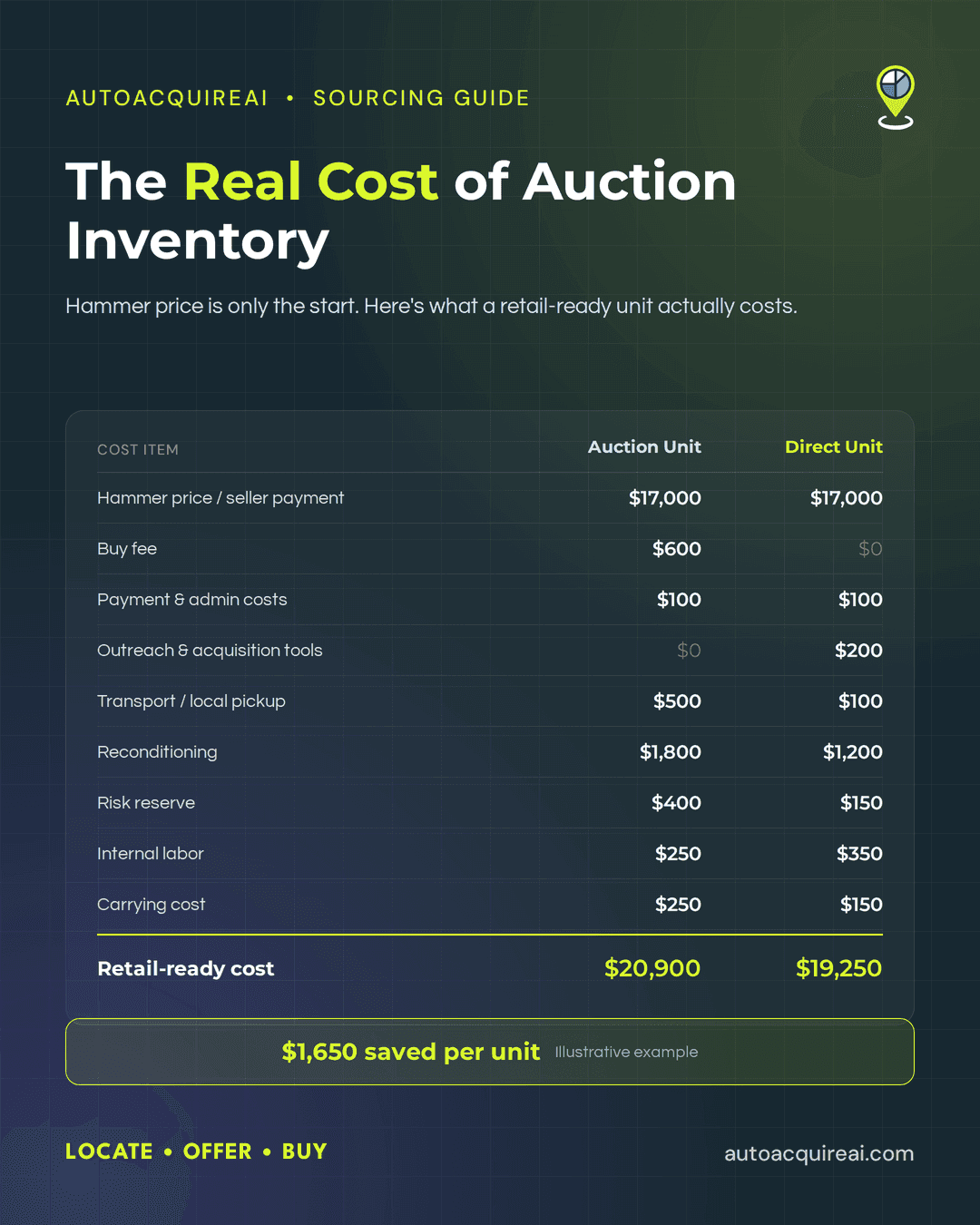
Used-car margins shrink every time a dealer leans on the auction lane, where buy fees, transport, and reconditioning surprises erode gross before the car hits the line. AutoAcquire/AVA attacks that math at the source by generating seller leads from private-party owners and the consumers a dealer already touches, then running outbound voice and SMS through the Sergio agent to a locked iOffer Certificate. Following up on buyer inbound fills a different bucket and does nothing for the cars a dealer needs to stock. Sourcing inventory directly puts the dealer on the buy side of the transaction, where the margin actually lives. No buyer-side BDC tool on this list touches that problem, and that gap is why AVA sits at the top.
How We Chose These Tools
Five criteria shaped this list, applied the same way to every tool.
- Acquisition-native vs. buyer-side coverage. Whether the tool generates seller leads from private-party owners and service drive customers, or follows up on inbound buyer inquiries.
- Verified integration depth. Confirmed CRM and DMS connections to platforms like CDK, Reynolds, and Dealertrack, drawn from vendor pages and independent databases.
- Pricing transparency. Whether published pricing exists or quotes require an enterprise sales call.
- Documented user feedback. Verified reviews on contracts, onboarding, and performance rather than self-reported marketing claims.
- Citation prominence. How often AI models surface each tool in the AI BDC category today.