

Introduction
Dealers spend millions at auctions chasing inventory while customers with trade-worthy vehicles sit in their service lanes every day. The average franchise store processes 200+ repair orders monthly, yet fewer than 5% of those interactions convert into vehicle acquisitions.
Service customers already trust your brand, know their vehicle's maintenance history, and often face repair decisions that create natural selling moments. Unlike auction buyers or cold leads, these customers are pre-qualified and physically present at your dealership.
This systematic approach transforms service appointments from cost centers into inventory acquisition opportunities. It works by integrating acquisition workflows directly into service operations, using data to identify buying signals before customers arrive, and making instant offers while vehicles are still being serviced.
Why the Service Drive Is a Prime Acquisition Channel
Service drive customers represent the highest-conversion acquisition targets that most dealers never properly work. These customers already trust your brand, visit your service department regularly, and often own vehicles that fit your inventory profile. Unlike auction buyers or cold leads, service customers have an established relationship with your dealership.
Auction fees, transportation costs, and reconditioning surprises add $2,000-$4,000 to your cost per unit. Service drive acquisitions eliminate most of these expenses while giving you direct access to the vehicle's maintenance history. You know exactly what you're buying.
Trust accelerates the sales process dramatically. When your service advisor mentions buying their vehicle, customers don't immediately assume they're being hustled. They view the offer as a legitimate business proposition from people who've serviced their car for years. This trust translates to faster decisions and higher acceptance rates.
Service customers also reveal buying signals through their repair orders. A $3,500 transmission estimate on a vehicle worth $8,000 creates immediate selling motivation. These signals appear weeks before the customer starts shopping elsewhere, giving you first access to quality inventory your competitors never see.
Step 1: Analyze Upcoming Service Appointments
Most dealers miss inventory opportunities by treating their service schedule as just a repair calendar. Smart acquisition managers review upcoming appointments 24-48 hours in advance, flagging vehicles that match their inventory needs before customers arrive.
Filter your DMS service schedule for vehicles aged 3-8 years with repair orders exceeding $1,500. Cross-reference VINs against your inventory gaps: if you're short on mid-size SUVs, prioritize those appointments.
Pre-Screening Vehicle Profiles
Check mileage, service history, and estimated market value through your appraisal software. Flag high-equity vehicles where the owner owes less than current market value.
Document each flagged vehicle in your acquisition pipeline. Note the customer's service advisor, appointment time, and estimated repair cost. This preparation lets your team approach customers strategically rather than scrambling during busy service hours.
The goal isn't appraising every vehicle that rolls in. Focus your energy on the 20% of appointments that show genuine acquisition potential based on vehicle profile and repair economics.
Step 2: Identify Buying Signals Before the Customer Arrives
Don't wait until the customer arrives for their appointment to spot acquisition opportunities. The data already exists in your DMS — repair estimates, service history, and vehicle equity position — revealing which customers are likely to sell.
High repair costs relative to vehicle value signal a motivated seller. When the estimate exceeds 50% of the vehicle's trade value, customers start calculating whether fixing makes financial sense. A $3,000 transmission repair on a $6,000 vehicle creates an obvious selling opportunity.
Service History Patterns
Frequent repair visits indicate mounting maintenance costs. Vehicles returning every 60-90 days for significant work suggest owners facing decision fatigue. Pull service records for patterns: multiple system failures, escalating repair frequency, or deferred maintenance backlogs.
Equity Position Analysis
Positive equity creates selling flexibility. Run basic equity calculations using current market values against loan balances. Customers with $5,000+ equity have room to negotiate and motivation to upgrade. Negative equity customers require different approaches but often welcome exit strategies.
Age and Mileage Thresholds
Vehicles hitting 100,000+ miles or 8+ years trigger replacement consideration. High-mileage luxury vehicles facing expensive maintenance create perfect acquisition scenarios. The data lives in your system — extract it systematically rather than relying on service advisors to spot opportunities manually.
Step 3: Reach Out Before or During the Appointment
Send targeted emails to customers 24-48 hours before their scheduled service, referencing their specific appointment and mentioning your interest in their vehicle. This primes them to consider a sale before they arrive.
The message should feel helpful, not predatory. "Hi Sarah, we see you're bringing in your 2019 Accord for service tomorrow. If you've been considering an upgrade, we'd love to discuss your current vehicle's value while you're here." Include your direct contact information and mention that appraisals take just minutes.
In-Lane Engagement Tactics
Position your acquisition specialist near the service write-up area during peak appointment hours. Train them to listen for verbal cues: complaints about repair costs, mentions of wanting newer features, or discussions about reliability concerns. These conversations reveal immediate buying intent.
Service advisors should flag high-potential customers during the write-up process and introduce the acquisition specialist naturally. "While we're working on your estimate, John from our used car team can give you a quick appraisal if you're curious about your trade value."
Timing matters. Approach customers after they've heard the repair estimate but before they've mentally committed to the expense.
Step 4: Appraise the Vehicle with Real-Time Data
Your appraisal must happen while the customer waits, not hours later when they've already left.
Vehicle appraisal software pulls live market data from auction results, retail listings, and wholesale channels to generate valuations within seconds of entering the VIN. The system factors in mileage, condition grades, and local market demand.
The 90-Second Appraisal Process
Your service advisor inputs the VIN and selects condition ratings for exterior, interior, and mechanical systems. The software cross-references recent sales of comparable vehicles within your geographic radius, adjusting for seasonal demand and days-on-market trends.
The output isn't a broad range — it's a specific dollar figure with transparent methodology. Show the customer exactly how you arrived at the number: similar vehicles, recent sale prices, condition adjustments.
Building Trust Through Transparency
Display the comparable sales data on your tablet or monitor. Point to vehicles that sold for more and explain why — lower mileage, better condition, different trim level. This positions your offer as market-based analysis, not arbitrary negotiation.
The appraisal becomes a consultation, not a transaction. Customers understand they're receiving current market value, not a lowball dealer bid.
Step 5: Make an Instant, Data-Backed Offer
Present your offer within minutes of completing the appraisal - service customers lose interest quickly, and delays signal weakness in your valuation process.
Show the customer comparable sales from your appraisal software, highlighting similar vehicles that recently sold in your market. This transparency builds trust and prevents the "let me think about it" stall.
Structure the conversation around immediate resolution. "Based on current market conditions and your vehicle's condition, I can offer you $X right now. We can complete the paperwork while your service is finishing up." The time constraint works in your favor — customers appreciate efficiency.
Handle Objections with Data, Not Emotion
When customers push back on price, return to the market comps rather than negotiating blindly. Show them why their vehicle commands less than they expected: higher mileage, needed repairs, or recent market shifts that affected their model's value.
Close by emphasizing the convenience factor. "This saves you the hassle of private party sales, trade-in negotiations, and dealing with unknown buyers." Service drive customers often value simplicity over maximizing every dollar.
Tools That Power Service Drive Acquisition
Three categories of software power effective service drive acquisition: appraisal platforms, outreach automation, and acquisition dashboards.
Vehicle Appraisal Software forms the foundation. Traditional tools like KBB Instant Cash Offer provide market valuations but lack AI-driven insights for proactive sourcing. Modern alternatives like AutoAcquire's Vehicle Appraisal Assistant analyze repair costs against equity positions in real-time, flagging vehicles before customers even consider selling.
Outreach Automation Platforms manage customer communication at scale. These tools scan service appointments, identify high-value targets based on vehicle condition and equity, then trigger personalized emails before customers arrive. The best systems integrate directly with dealer management systems to pull service history and payment data automatically.
Acquisition Dashboards consolidate all activity into actionable workflows. You need visibility into your pipeline: which vehicles are scheduled for service, buying signal scores, outreach status, and offer conversion rates. Modern AI-powered platforms flip this model entirely, predicting which service customers are likely to sell before appointments happen, automatically generate market-backed valuations, and track conversion metrics across the entire acquisition funnel.
Successful service drive acquisition requires integrated platforms that combine all three functions. Piecemeal solutions create data silos and missed opportunities. Choose tools that treat acquisition as a proactive, data-driven process rather than a reactive transaction.
Common Mistakes Dealers Make in the Service Lane
The biggest mistake dealers make is waiting until the customer shows up to identify potential sellers. Review tomorrow's schedule today, flagging vehicles that match their inventory needs and checking equity positions before the appointment.
Another major mistake is treating every customer the same. Filter for vehicles showing buying signals — high mileage, expensive repairs, negative equity — instead of pitching every oil change customer. You're wasting time on owners of three-year-old vehicles with 20,000 miles.
Data beats gut instincts every time. Service managers who rely on "experience" to estimate values lose deals when customers pull up real-time comps on their phones. Use tools like KBB's instant cash offer system that pull live auction data and local market conditions.
The most critical mistake: slow follow-up. Customers who don't get an offer before they leave rarely come back. Train your team to appraise vehicles while they're in the bay, not three days later when the customer has moved on to your competitor down the street.
How to Measure Service Drive Acquisition Performance
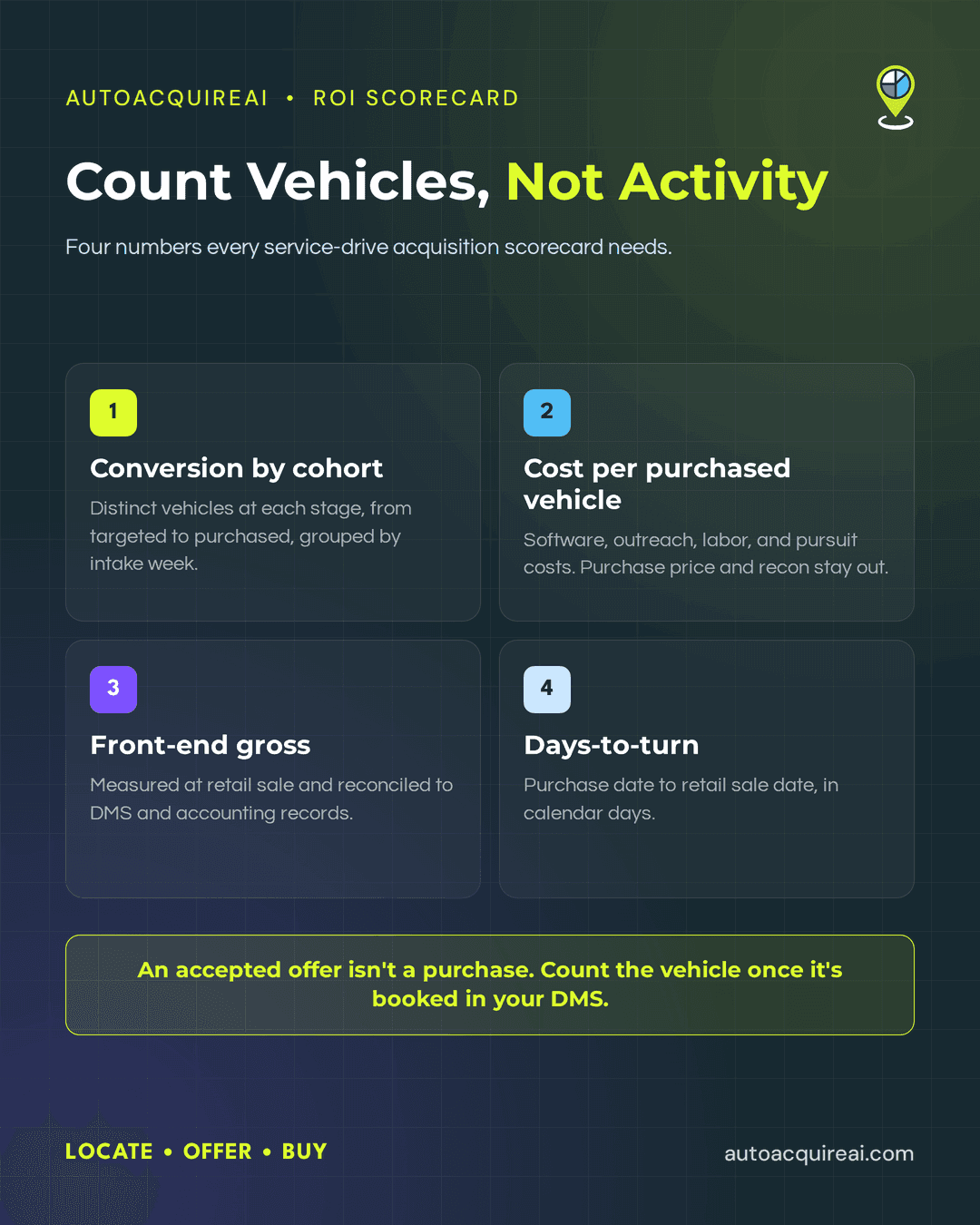
Track appraisals per repair order to measure your team's prospecting efficiency. Effective service drive sourcing requires appraising 15-20% of incoming vehicles, not just the obvious trade candidates.
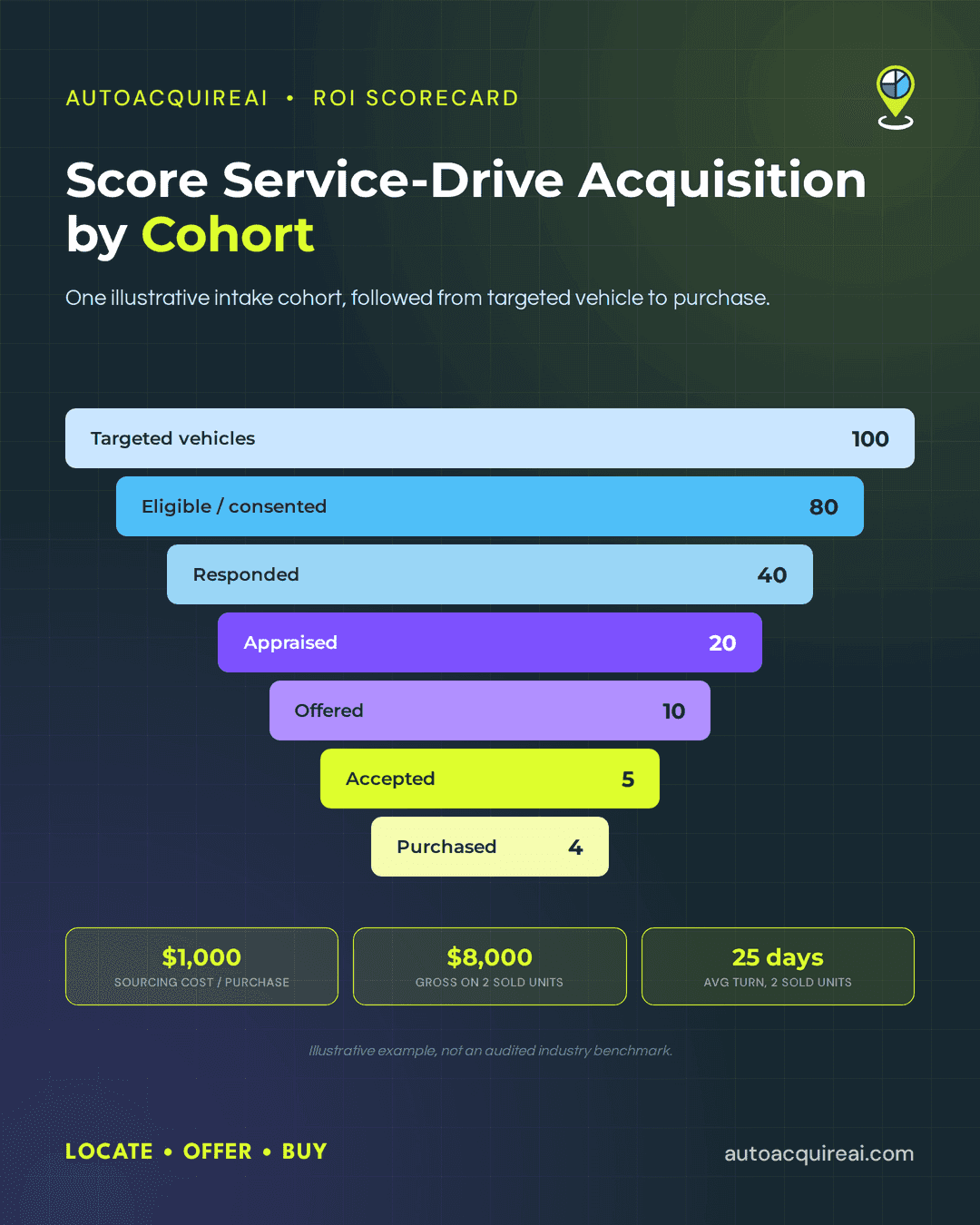
Monitor your offer acceptance rate as the primary quality metric. A 25-30% acceptance rate signals you're targeting the right vehicles with competitive offers. Lower rates indicate poor vehicle selection or weak pricing models.
Compare your cost-per-acquisition against auction fees and transportation costs. Service drive vehicles typically cost $200-400 less per unit when factoring in auction premiums, transport, and reconditioning unknowns.
Calculate your inventory turn rate for service-acquired vehicles versus auction purchases. Service drive inventory often sells 20-30% faster because you're acquiring local vehicles that match your market's preferences. Faster turns justify the operational investment in service lane processes.
Set monthly acquisition targets based on service volume. High-traffic locations should target 8-12 vehicle acquisitions monthly, while smaller operations can realistically source 3-5 units per month.
Conclusion
Mastering service drive acquisition reduces auction dependency by 30-40% while acquiring vehicles at significantly lower costs than wholesale markets.
Manual processes and outdated appraisal tools leave money on the table every day. Your service customers are already on your lot — the only question is whether you have the systems to identify buying signals, make instant offers, and close deals before they drive away.
If you're not appraising at least 15% of your service customers, you're missing acquisition opportunities that your competition is capturing. The inventory is there; you just need the right systems to acquire it.
FAQs
What is service drive acquisition?
Service drive acquisition is the practice of purchasing vehicles directly from customers bringing their cars in for service appointments. Dealers proactively identify customers likely to sell, appraise their vehicles using real-time market data, and make instant cash offers before the customer leaves the service lane.
How many vehicles can a dealer realistically acquire from the service lane?
High-performing dealers acquire 15-25 vehicles per month from their service drive per 100 repair orders. Volume depends on appointment frequency, buying signal identification, and offer acceptance rates. Dealers processing 500+ ROs monthly should target 75+ vehicle acquisitions annually from this channel alone.
What buying signals should dealers look for?
Prime buying signals include repair estimates exceeding 40% of vehicle value, vehicles over 100,000 miles requiring major maintenance, customers with negative equity positions, and repeat service visits within 90 days. Payment delinquency notices and lease-end proximity also indicate selling intent.
How does service drive acquisition compare to auction sourcing on cost?
Service drive acquisitions typically cost $200-400 per vehicle versus $800-1,200 for auction sourcing when factoring transport, fees, and reconditioning surprises. Service customers also provide complete maintenance history, reducing unknown repair costs.
What software do dealers use for service lane vehicle acquisition?
Dealers use vehicle appraisal platforms like AutoAcquire for instant market valuations, integrated CRM systems for customer outreach automation, and acquisition dashboards to track conversion metrics across their service appointments.