TL;DR
- The decision: KBB Service Drive Acquisition helps dealers identify vehicles on upcoming service appointments and invite those customers to get offers. AutoAcquire fits stores that want AVA to contact potential sellers and connect those conversations to iOffer and Remote Inspection. Choose by the sourcing work the store needs, not the offer screen alone.
- Best for active seller acquisition: AutoAcquire connects AVA outreach, iOffer cash offers, and Remote Inspection condition capture. The dealership still approves and completes each purchase.
- Best for an appointment-led instant-offer program: KBB reviews upcoming service visits, supports email invitations, and offers optional buying signals and RE-ENGAGE follow-up. Add-on availability depends on the dealer's package.
- Cost: KBB charges for ICO participation, though its service-drive integration is available at no additional cost to eligible dealers. Neither vendor publishes comparable total pricing. Compare written quotes for the same stores, add-ons, and expected volume.
KBB Instant Cash Offer vs AutoAcquire: What Each Platform Does
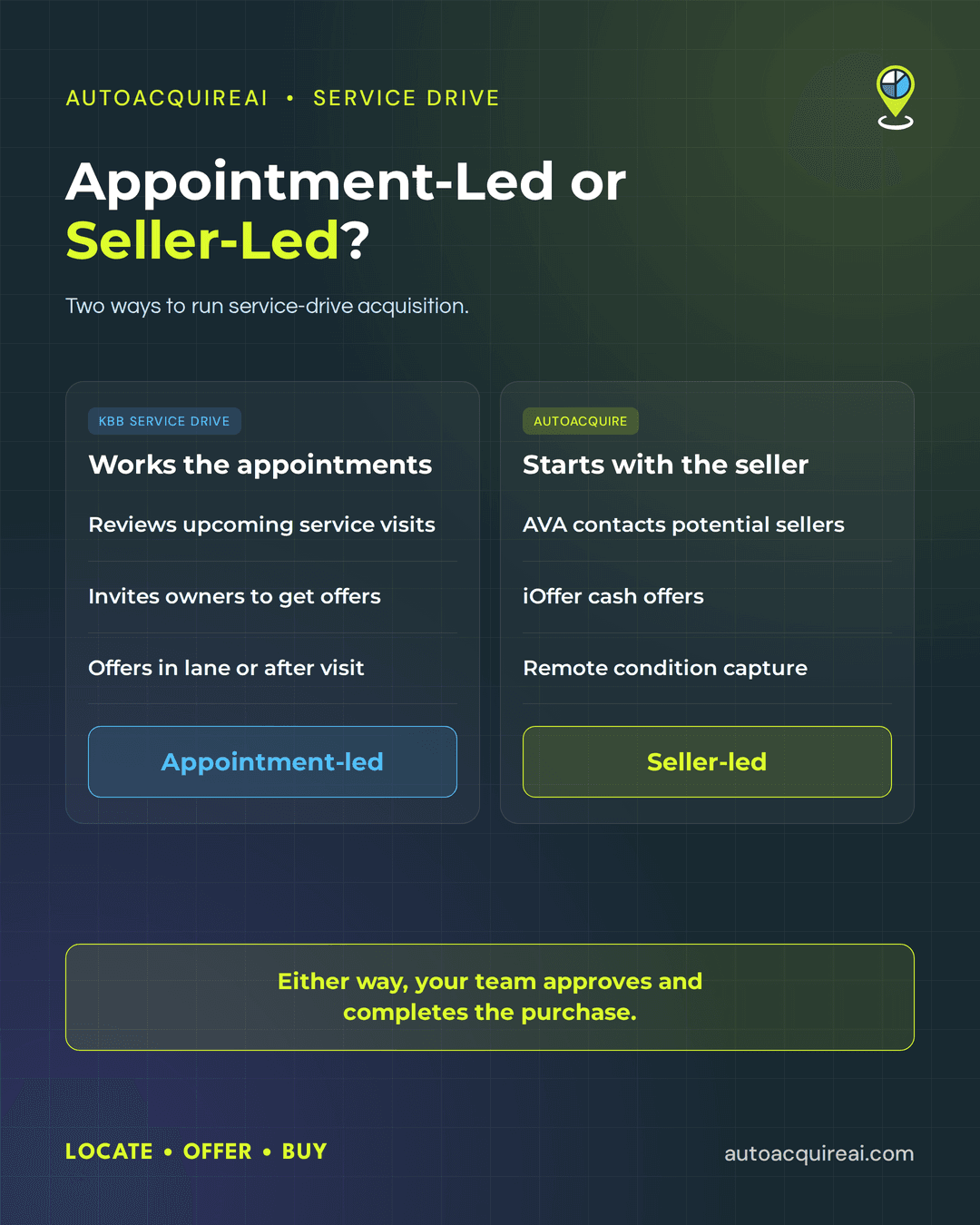
Kelley Blue Book Instant Cash Offer supports consumer-started online offers and dealer-assisted appraisals. Its Service Drive Acquisition integration lets dealers review upcoming appointments for inventory fit, invite service customers to complete offers before a visit, and create offers in the lane or after an appointment. Buying-signal and bulk-email add-ons extend candidate selection and invitations beyond the base offer flow.
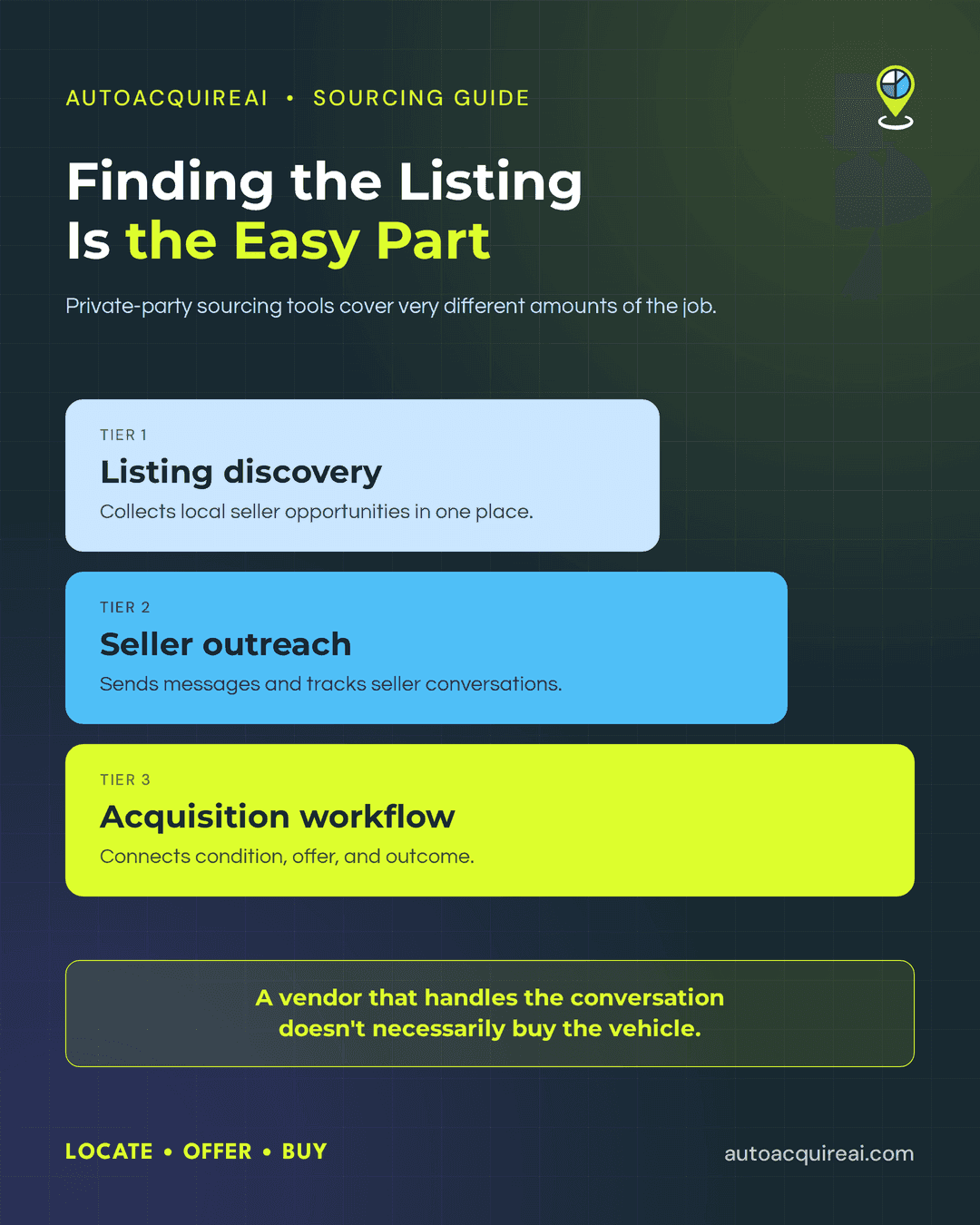
AutoAcquire starts with the seller conversation. AVA supports voice and text outreach to service-drive customers and other potential sellers, iOffer generates cash offers, and Remote Inspection collects seller-submitted condition information. KBB organizes offers around service appointments; AutoAcquire connects outreach and offers for dealers building a direct-acquisition program beyond that list.
How Each Service-Drive Acquisition Platform Finds Sellers
KBB Service Drive Acquisition helps dealers review upcoming appointments and identify vehicles that fit their inventory needs before an appraisal. Its listed add-ons include Cox buying signals, requested-service details, and filters for appointment type or service history. Dealers can send offer invitations before an appointment, create an offer in the lane, or invite a customer afterward. KBB therefore gives stores an appointment-based prospect list rather than requiring advisors to discover every opportunity at check-in.
AutoAcquire uses AVA to identify potential sellers and support voice and text outreach, including to service-drive customers and private owners. A store seeking vehicles beyond booked service visits can use that outreach to start seller conversations. AutoAcquire does not publish AVA's targeting criteria on the cited page, so stores should examine a sample of selected records before projecting lead volume.
Vehicle Appraisal and Instant Cash Offers
Kelley Blue Book Instant Cash Offer bases a seven-day offer on vehicle options, reported condition, and local market demand. A customer can submit details online, or dealership staff can guide the appraisal. The dealer inspects the vehicle before redemption, and KBB says the offer may decrease if the submitted details differ from the inspection. KBB also describes a post-acquisition option to sell the vehicle to Cox Automotive for the full offer amount within seven days.
AutoAcquire connects the AVA seller conversation to iOffer and a Remote Inspection condition report. The used-car manager can review that information before deciding what the store will pay. AutoAcquire has not published iOffer's pricing formula or documented automatic revisions after inspection, so the dealer must set a clear process for changing an offer when the vehicle differs from the report.
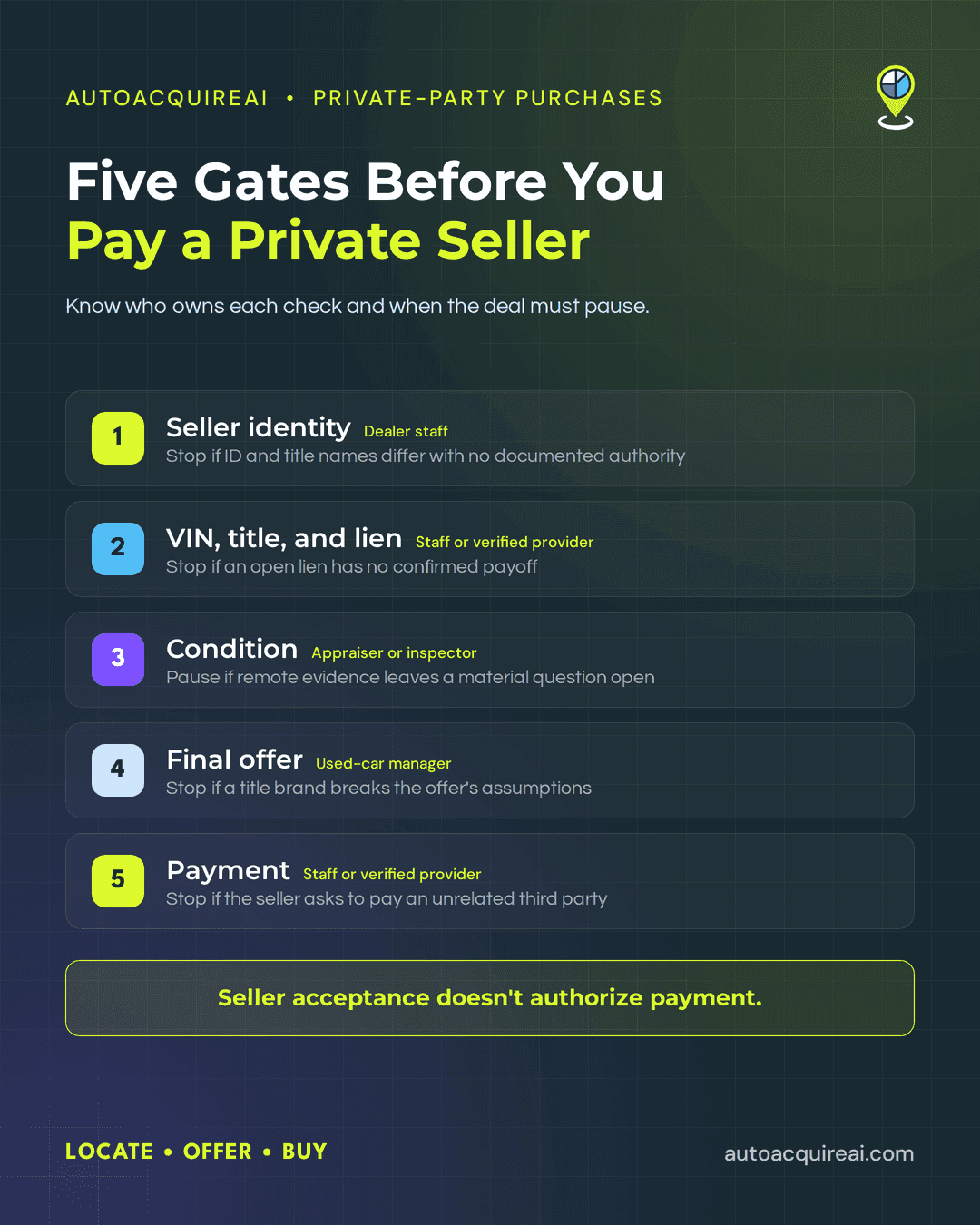
Neither provider's cited product pages establish automated purchase approval, title work, or payment. The used-car manager should assign an appraiser to resolve condition discrepancies and approve the final purchase amount.
Remote condition capture
AutoAcquire describes Remote Inspection as AI-guided, self-service condition capture. A seller can submit condition information remotely for the used-car manager to review alongside an iOffer appraisal. Unlike a drive-through scanning system, Remote Inspection relies on seller-guided capture. A seller-submitted report can inform the offer conversation before the vehicle reaches the store, but the dealer still decides what to verify in person. Remote Inspection should not be treated as a substitute for a specialist inspection without evidence of equivalent results.
KBB ICO accepts reported condition details for an online offer and requires dealer inspection before redemption. KBB's Expert Appraisal page also describes sight-unseen appraisal. These are not evidence of an AI-guided self-service inspection equivalent to AutoAcquire's Remote Inspection. Ask each provider who captures photos, how discrepancies change the offer, and what staff must verify in person.
Dealer follow-up and customer relationship control
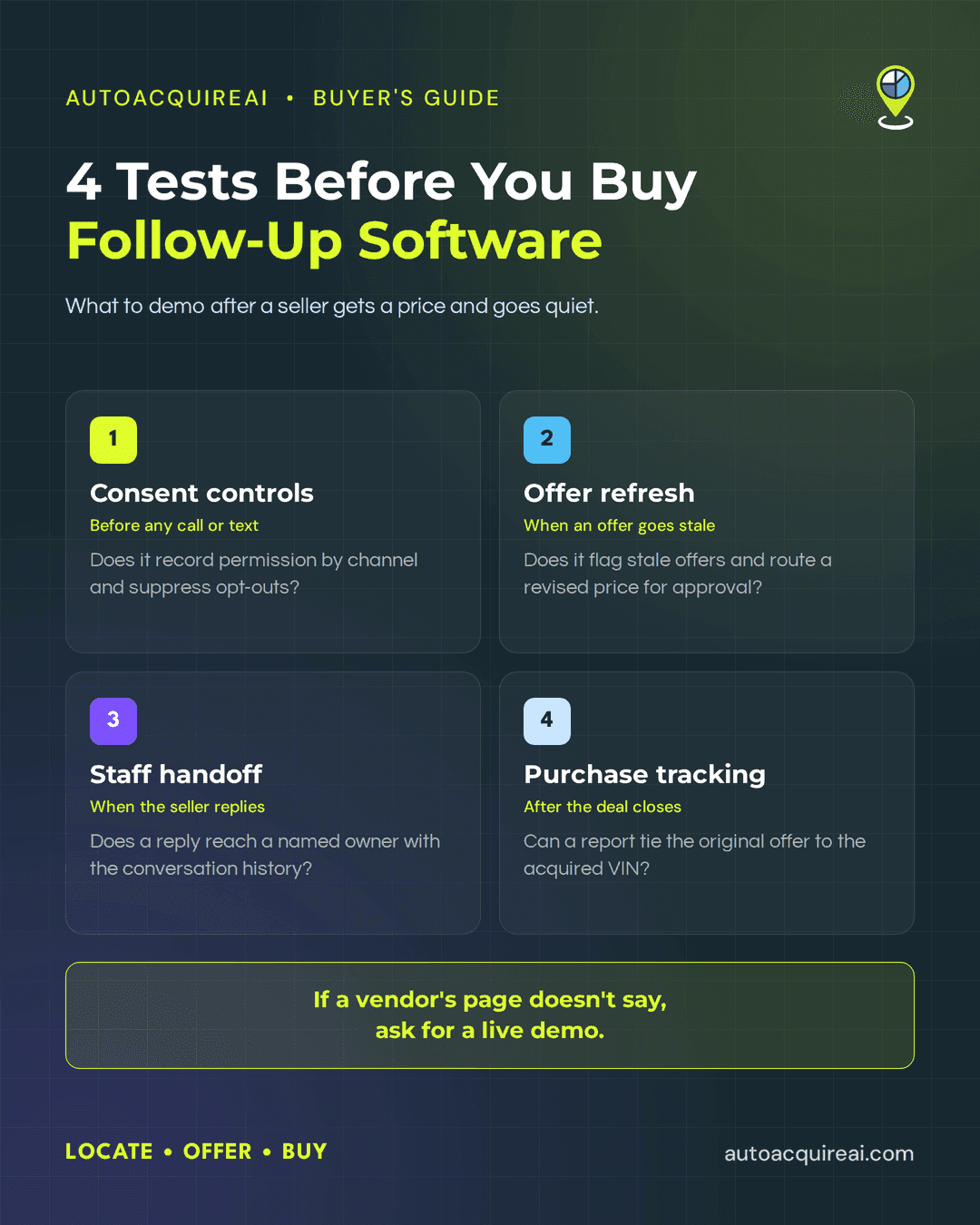
KBB Service Drive Acquisition supports email invitations before or after service visits, as well as offers created in the lane. For expired offers, the separate RE-ENGAGE add-on sends personalized emails for up to 90 days and alerts staff to renewed engagement. RE-ENGAGE handles email follow-up on expired offers, but staff still handle seller replies that call for a conversation. Its availability depends on the dealer's package.
AutoAcquire gives the store a voice and text outreach workflow through AVA, rather than relying only on an advisor to start the seller conversation. That distinction matters when a service customer leaves without discussing a sale. The cited product information does not define what AVA does after a declined iOffer, so staff should own the next response until a specific handoff is confirmed.
A used-car manager should assign a person to handle seller replies after an offer and check whether staff can see prior exchanges in each product. The vendor contract, not the feature page, determines customer-data rights and contact permissions.
DMS connections and workflow integration
AutoAcquire reports an open API and connections to CDK, Reynolds, and Dealertrack. Its public homepage does not specify the integration scope, and naming a DMS connection alone does not establish write-back. A store should test which vehicle and customer fields move, in which direction, and how quickly updates appear before counting on fewer manual entries.
KBB Service Drive Acquisition describes integration with dealership car-buying software and the KBB API. Its eligibility description names Xtime, with certain configurations also using vAuto ProfitTime GPS or VinSolutions. Those connections should not be described as DMS write-back. Dealers need a demonstration showing which records flow into their own DMS and when.
A DMS integration earns its keep when vehicle and offer data reach the right record without staff re-entering them. Have each vendor follow one VIN from appraisal through inventory entry. If the purchased vehicle appears only in a separate acquisition dashboard, the store still has reconciliation work.
Pricing and cost considerations
KBB says dealers pay to participate in Instant Cash Offer but does not publish a fee schedule. Its Service Drive Acquisition page describes the integration as available at no additional cost for eligible dealers with specified ICO and Xtime configurations. AutoAcquire does not publish comparable pricing or current trial terms on its homepage. Obtain written terms for each product and add-on before comparing total cost.
Dealers need written quotes for the same service-drive volume and number of stores before comparing costs. Each quote should specify setup fees, integration charges, usage limits, and what happens when a trial ends. Dealers should also account for staff time spent entering appraisals and following up with sellers, since a subscription price alone will not capture that work.
KBB Instant Cash Offer vs AutoAcquire: Comparison Table
| Dimension | KBB Instant Cash Offer | AutoAcquire |
|---|---|---|
| Best for | Dealers targeting upcoming service appointments with KBB-backed offers and optional email invitations | Dealers running voice and text seller outreach tied to direct acquisition, offers, and condition capture |
| Lead identification | Reviews upcoming appointments for inventory fit; optional buying signals, service details, and filters support selection. | AVA identifies seller opportunities and supports outreach; selection criteria need a product demonstration. |
| Appraisal and offers | Generates an Instant Cash Offer through its appraisal process. | iOffer handles instant cash offers within the acquisition workflow. |
| Condition capture | KBB accepts reported condition for online offers and requires dealer inspection before redemption; AI-guided seller inspection is not documented. | Remote Inspection guides sellers through self-service condition capture; dealers still determine final verification. |
| Follow-up and relationship control | Before- and after-visit email invitations; optional RE-ENGAGE sends expired-offer emails. Dealer data-control terms require contract review. | AVA supports voice and text seller outreach. Dealer data-control terms and post-offer handoff details require contract and workflow review. |
| DMS integration | KBB describes car-buying software and API connections, with Xtime and certain vAuto/VinSolutions configurations named; DMS write-back depth is unspecified. | AutoAcquire reports CDK, Reynolds, and Dealertrack connections plus an open API; its homepage does not document sync fields, direction, or timing. |
| Operational tradeoffs and limitations | Appointment targeting and invites are documented. Confirm add-on availability, staff handoff, and final inspection workload; the base ICO program has a participation fee. | Staff still review and complete purchases. Confirm integration scope, post-offer triggers, and trial terms; automated title transfer or payment is not established. |
Which fits a service-drive acquisition program
For a store already working its service appointment list, KBB Service Drive Acquisition is the better-fit offer program. Staff can review upcoming vehicles, invite owners before a visit, and make KBB-backed offers in the lane. Optional buying signals and RE-ENGAGE extend that workflow; the store should price only the add-ons it plans to use.
For a store building a direct-seller acquisition channel, AutoAcquire is the better fit. AVA supports outreach beyond booked service appointments, while iOffer and Remote Inspection keep offer and condition information in the acquisition workflow. Staff still approve purchases. Judge the program by seller conversations, offers, acquired vehicles, and staff time, not the number of messages sent.
Buyer's guide: questions to ask before choosing
- What must connect to the DMS? Ask each vendor to demonstrate the workflow on the store’s DMS. Check whether the connection reads records, writes them back, or does both. Ask which customer and vehicle fields sync, whether updates are immediate or batched, how each rooftop is mapped, and when an acquired vehicle appears in inventory.
- Does the store need more seller conversations or faster offers for customers already in the lane? Set separate targets for contacted owners, completed appraisals, and acquired vehicles. A demo should show how the product supports the target the store actually needs.
- Who owns follow-up after a customer leaves without selling? Name the advisor or BDC staff member responsible, then ask what activity they can see and which steps remain manual. If nobody owns follow-up today, account for that staffing work before buying.
The service-drive software comparison covers additional products. The service-drive outreach scripts guide addresses staff execution after the store assigns follow-up ownership.
FAQs
- Is KBB Instant Cash Offer a lead-generation tool or an appraisal tool? KBB ICO does both through different entry points. It generates offers online or with dealership staff, while Service Drive Acquisition identifies opportunities from appointments and supports email invitations. Buying signals and automated expired-offer follow-up are separate options.
- Does AutoAcquire replace a dealership’s DMS or appraisal process? AutoAcquire complements the DMS rather than replacing it. Its offer and condition-capture tools support appraisal, but dealers still need to review the vehicle and make the purchase decision.
- Can either platform automate title, payment, or logistics? The available product documentation does not verify end-to-end automation of those steps for either platform. Dealers should establish who handles each step before treating an accepted offer as a completed acquisition.
- What’s the difference between AVA, iOffer, and Remote Inspection? AVA identifies seller opportunities and supports outreach to service-drive customers and private owners. iOffer generates instant cash offers. Remote Inspection guides sellers through self-service vehicle condition capture. None of those names, by itself, establishes automated purchase approval or transfer of the vehicle.
Conclusion
Choose KBB's service-drive program to work the appointment list with KBB-backed offers and optional email follow-up. Choose AutoAcquire when the store's acquisition plan calls for voice and text seller outreach connected to iOffer and Remote Inspection. Both may have a role in one store, but do not budget for a connection between them without seeing it work on a real record.