

Service Drive Vehicle Acquisition Software: Platform Comparison
TL;DR
AutoAcquire ranks first overall for combining service drive acquisition, private-party sourcing, and AI-powered instant cash offers in one workflow, with AVA scoring VINs before the car arrives and iOffer generating priced offers on a single advisor screen. AccuTrade is the strongest runner-up for franchise groups already committed to a CDK Drive or Reynolds ERA stack, given its native DMS write-back depth. VETTX fits high-volume franchise stores that want fast advisor-driven service drive appraisals above broader acquisition features. TradePending works for independent stores that need a website trade-in widget and light lead capture rather than a full advisor sourcing platform.
Why the service drive is becoming the sourcing channel that matters
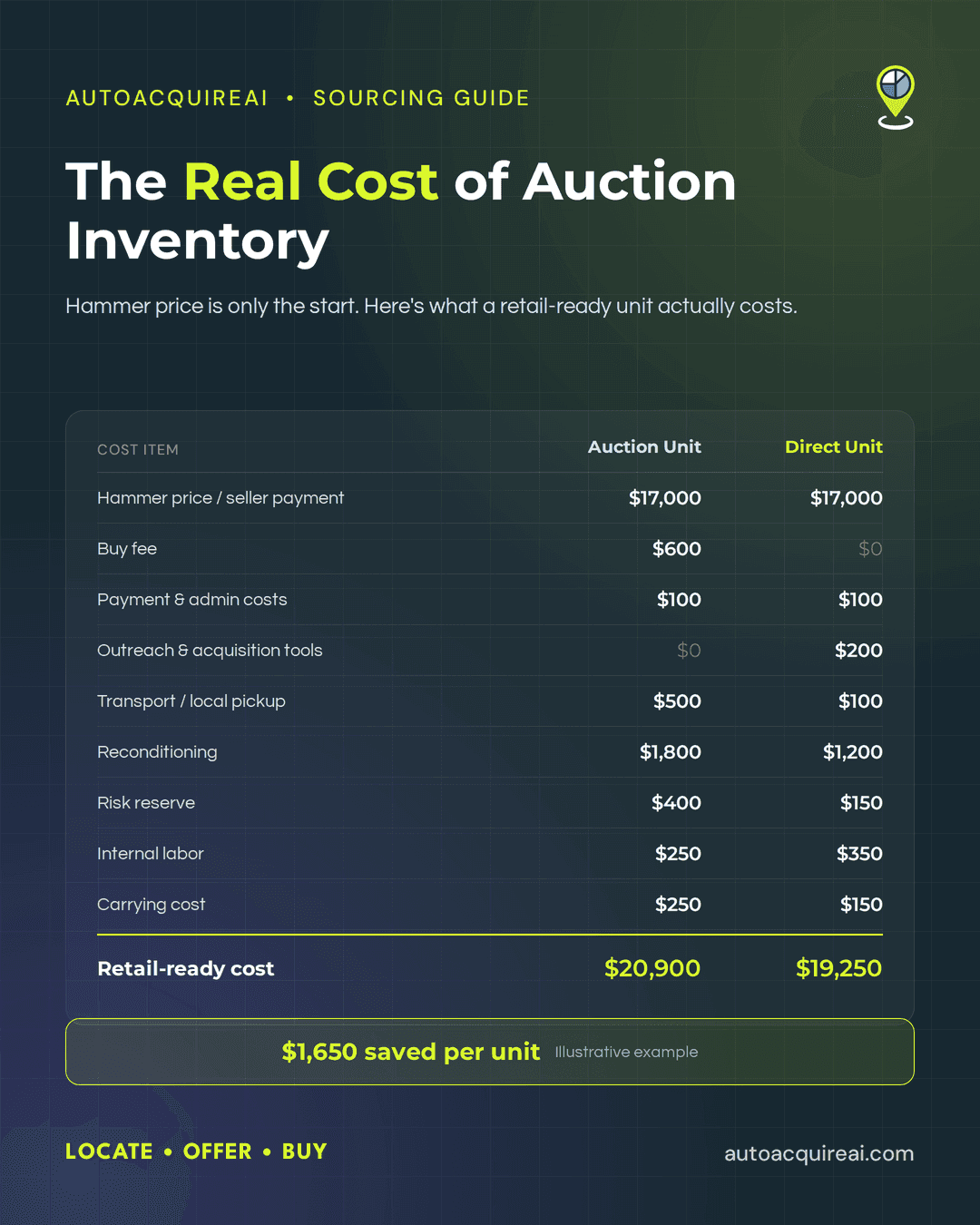
Auction fees and transportation costs have climbed to the point where wholesale sourcing now eats into front-end gross before a unit even hits the lot. Buy fees, transport, and reconditioning stack on top of a purchase price that already reflects tight supply, which leaves less margin per turn than dealers saw three years ago. That math pushes franchise and independent operators to look for units they can acquire without a middleman.
Carvana and CarMax have made the problem worse by intercepting trade-ins upstream. A customer who gets an instant offer from either one often sells before ever mentioning the vehicle to a dealer, so the trade never enters the negotiation. The service drive closes that gap because a customer already sitting in the waiting room with a serviceable vehicle is the cheapest lead a dealer will ever get, and the advisor is the one person positioned to make the offer first.
Turning service check-ins into a repeatable sourcing channel takes software that handles the specific friction that kills these deals, so this comparison scores each platform on six criteria. Offer accuracy against live wholesale demand determines whether advisors quote numbers that hold. DMS integration depth, specifically CDK Drive and Reynolds ERA, decides whether the workflow fits daily operations. Advisor adoption and time-to-offer, title and lien payoff automation, same-day ACH payment, and ROI reporting that ties sourced units back to front-end gross and days-to-turn round out the set. Each platform below is measured against those same standards.
What service drive vehicle acquisition software actually does
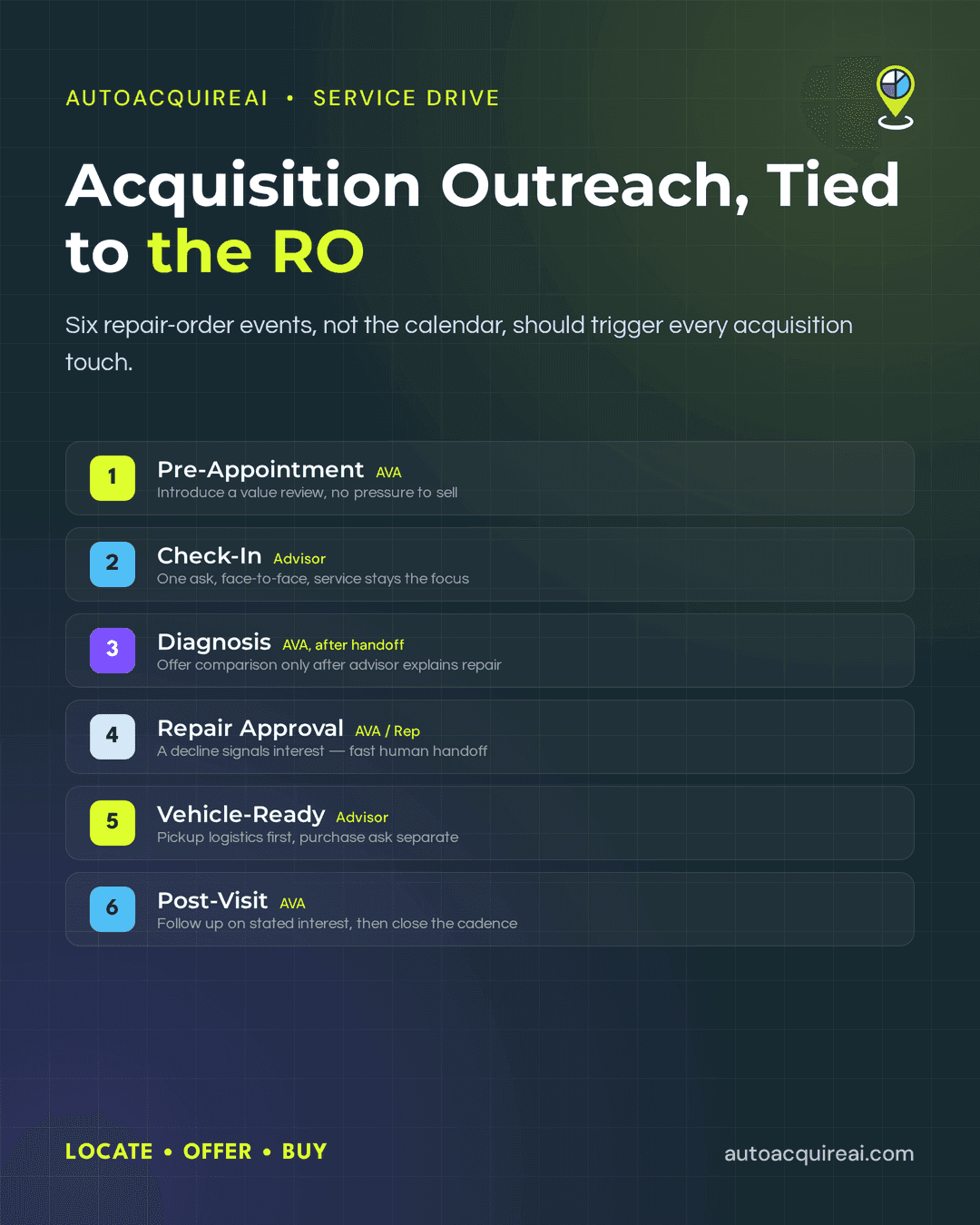
Service drive vehicle acquisition software turns routine service check-ins into a used car sourcing channel. This shift is explored in how dealers source used inventory from the service drive. When a customer drops off a vehicle for repair, the platform scores that VIN against live wholesale demand, generates a cash offer, and hands the service advisor a workflow to present it before the customer leaves.
Real platforms differ from imitators in who they serve and what they connect to. True dealer sourcing platforms are advisor-facing, integrate with the DMS to pull repair-order data and write back deals, and support title, lien payoff, and ACH payment inside one flow. Consumer-facing trade-in valuation tools, by contrast, generate a price estimate for shoppers on a website. They lack the advisor workflow, DMS write-back, and payment rails that make service drive acquisition repeatable at the store level.
AutoAcquire
AutoAcquire scores a vehicle before the customer parks. Household garage data feeds pre-arrival VIN scoring, so when a repair order opens, an advisor already knows which check-ins hold cars worth chasing. That timing changes the conversation, because instead of reacting to a walk-in trade the store targets the right vehicles while the customer is still in the waiting room.
The advisor workflow lives on one screen. AVA scores the vehicle and surfaces the households most likely to sell, and iOffer generates a cash number the advisor can present without leaving the tool or flipping between systems. Advisors adopt tools they can run in the time it takes to close out a service visit, and a single screen removes the friction that kills adoption in busier stores.
Reporting is built for operators running more than one rooftop. A dealer principal can see sourced units, offer-to-acquisition conversion, and how those cars tie back to front-end gross and days-to-turn across every store from one dashboard. Group operators lose visibility when each rooftop tracks acquisition its own way, and one central dashboard closes that gap.
AutoAcquire fits regional groups and franchise operations pushing 200 or more repair orders a week that want a single acquisition layer covering both the service drive and private-party sellers. Independent stores use it too, but the multi-rooftop reporting earns its keep once a dealer runs several locations and needs one view of acquisition performance.
The platform runs alongside CDK Drive and Reynolds ERA rather than replacing either. AutoAcquire handles sourcing, scoring, and the cash-offer workflow, then hands clean data back to the DMS a dealer already runs its accounting and inventory on. Dealers keep their existing system of record and layer acquisition on top, which matters to operators wary of ripping out core software.
AutoAcquire separates itself on scope. VETTX and AccuTrade run strong service-drive appraisal workflows, and ACV owns wholesale market data. AutoAcquire combines service drive acquisition, private-party sourcing, and AI-powered instant cash offers in one system, which suits dealers trying to build a direct-to-consumer channel that reduces how often they lean on auction lanes. For a store that only needs faster appraisals at the service lane, a narrower tool may cover the job.
VETTX
Franchise stores adopt VETTX for one reason, advisor-driven appraisal speed. Service advisors can appraise a vehicle at the drive without waiting on a used car manager, which keeps the customer engaged during the check-in window when a trade conversation actually converts. Stores that measure appraisal completion rates tend to see advisors stick with VETTX because the workflow requires little training.
Its DMS approach reads repair-order and customer data to surface acquisition candidates, though the write-back depth varies by store and integration tier. Dealers running CDK Drive or Reynolds ERA should confirm how VETTX handles two-way sync before assuming appraisals flow back automatically into inventory and desking.
VETTX concentrates on appraising units already in the service lane and does not generate seller leads from private-party owners or score vehicles before they arrive. A single-rooftop store focused on turning more service visits into acquired units gets clear value, but a regional group wanting one platform that spans service drive, private-party outreach, and centralized multi-rooftop reporting will find VETTX covers one segment of that workflow rather than the full acquisition layer.
A dealer choosing VETTX needs faster appraisals at the drive and accepts pairing it with separate tools for upstream sourcing.
TradePending
TradePending built its reputation on a website trade-in widget that pulls consumer trade estimates during the browsing stage. That origin limits its service drive fit. The tool captures interest and generates a valuation, but it stops short of the advisor workflow a heavy service lane demands.
A service advisor using TradePending gets a customer-facing estimate, not a payoff-integrated offer ready for same-day ACH funding. Title and lien handling, DMS write-back, and centralized multi-rooftop reporting sit outside its core design. Advisors juggling 40 repair orders a day rarely have time to work around a tool built for the website, not the service counter.
Dealers still get real value from TradePending when the goal is top-of-funnel lead capture on their own site. Independent stores and franchises that want to convert online trade curiosity into a phone call or appointment will find it does that job well. Groups looking for a repeatable service drive sourcing channel with advisor adoption, payment automation, and unit-level ROI reporting will find the gap between a valuation widget and an acquisition platform too wide to close with TradePending alone.
ACV Auctions
ACV Auctions prices vehicles against wholesale market data, and that depth shows up directly in offer accuracy. Because ACV runs a large dealer wholesale marketplace, its appraisal tools price a vehicle against live auction demand rather than a static book value. For a used car manager deciding whether a service-drive trade clears a real number at the block, that connection to actual transaction data is a real strength for wholesale pricing decisions.
The appraisal engine ties directly into ACV's own selling lanes, so a vehicle a dealer chooses not to keep can move into wholesale without leaving the platform. Franchise groups that already sell heavy volume through ACV auctions get a tight loop between appraisal and disposition.
The same auction anchor works against ACV in service drive settings, since the platform is built to price and move wholesale inventory, not to run an advisor through a customer conversation at check-in. The workflow assumes a dealer buying or selling at auction, not a service writer generating a same-day cash offer for a car sitting in the bay. Dealers get accurate wholesale pricing and a disposition path, but title payoff, advisor prompts, and ROI reporting that ties sourced units to front-end gross sit outside ACV's core design. For dealers whose priority is converting repair-order traffic into retail units, ACV supports the pricing decision without owning the acquisition workflow around it.
AccuTrade
AccuTrade fits franchise groups that already run CDK Drive or Reynolds ERA and want appraisal accuracy backed by real transaction data. Its offer engine draws on Cox Automotive's wholesale and retail datasets, so advisors quote numbers that hold up against live market movement rather than guesswork. Groups invested in the Cox ecosystem get appraisal, valuation, and reconditioning estimates in one tool their advisors already recognize.
The DMS integration runs deeper than most competitors on this list. AccuTrade writes appraisal data back into CDK and Reynolds without forcing advisors into a separate system, which keeps time-to-offer short during a busy service lane. Advisor tooling stays clean enough that a service writer with no appraisal background can generate a defensible number in a few minutes.
Where AccuTrade falls short is cross-rooftop reporting. A dealer principal running six or ten stores gets appraisal activity per location, but tying sourced units back to front-end gross and days-to-turn across the whole group takes manual work outside the platform. The tool was built to appraise trades and drive Cox's instant-offer flow, not to run a multi-rooftop acquisition program with centralized ROI visibility. Independent stores outside the Cox stack also see less value, since much of the pricing advantage depends on those datasets and DMS connections working together.
CarEdge
CarEdge gives car buyers and sellers data to argue price with dealers, and that consumer-side focus sets the boundary on what it can do for a dealer's sourcing program. It has no advisor-facing service drive workflow, no DMS write-back to CDK Drive or Reynolds ERA, and no title, lien payoff, or same-day ACH automation. A service advisor cannot generate a firm offer from a VIN scan and close a purchase on one screen.
The narrow case for a dealer is competitive intelligence rather than acquisition. Because CarEdge shows sellers the pricing they expect to see, a used car manager can check it to understand what a walk-in customer already believes their vehicle is worth before an appraisal conversation starts. That helps frame an offer, but it does nothing to source, value, or pay for the unit itself.
Weighing CarEdge against the other platforms here means comparing tools built for opposite sides of the transaction. A consumer research site is not a dealer sourcing platform, and treating it as one wastes evaluation time.
How the platforms compare
Scored against six criteria, the platforms split cleanly into acquisition tools and consumer tools. Those criteria are offer accuracy against live wholesale demand, CDK Drive and Reynolds ERA write-back depth, advisor time-to-offer, title and lien payoff automation, same-day ACH, and ROI reporting that ties sourced units to front-end gross and days-to-turn.
| Platform | Offer accuracy | CDK/Reynolds depth | Advisor adoption / time-to-offer | Title & payoff automation | Same-day ACH | ROI reporting (gross + turn) |
|---|---|---|---|---|---|---|
| AutoAcquire | High | Deep write-back | One-screen, fast | Yes | Yes | Multi-rooftop, unit-level |
| VETTX | High | Moderate | Fast, advisor-driven | Partial | Limited | Store-level |
| TradePending | Moderate | Shallow | Widget, not advisor flow | No | No | Lead-level only |
| ACV Auctions | High (wholesale-anchored) | Moderate | Slower, auction-oriented | Partial | Yes | Wholesale-focused |
| AccuTrade | High | Deep write-back | Fast, franchise tooling | Partial | Limited | Store-level |
| CarEdge | Consumer estimate | None | Not advisor-facing | No | No | None |
AutoAcquire and AccuTrade lead on DMS write-back depth. ACV anchors offers to wholesale transaction data. TradePending and CarEdge score low because neither runs an advisor workflow or moves payment. Among the platforms reviewed here, AutoAcquire pairs deep DMS write-back with reporting that rolls sourced units up across every rooftop against front-end gross and days-to-turn.
Best for quick reference
- Best for high-volume franchise groups: AutoAcquire centralizes acquisition across every rooftop, so a 200+ RO operation tracks sourced units against front-end gross and days-to-turn from one dashboard rather than reconciling store-by-store spreadsheets.
- Best for independents without a dedicated used car manager: AutoAcquire's one-screen advisor workflow lets a service writer generate an iOffer without appraisal expertise, closing the gap a single-point store feels most when nobody owns used-car sourcing.
- Best for CPO and luxury sourcing: VETTX suits franchise stores that need fast advisor-driven appraisals on higher-value units where offer speed decides whether the customer sells to the dealer or Carvana.
- Best for DMS depth: AccuTrade fits franchise groups already committed to that ecosystem, with CDK Drive and Reynolds ERA write-back that pulls appraisal and RO data without manual re-entry.
Dealers weighing more than one profile should start with AutoAcquire, since it combines service drive acquisition, private-party sourcing, and AI-powered ICO in a single layer that complements CDK and Reynolds rather than replacing them.
Buyer's guide: choosing a service drive acquisition platform
Start with the DMS write-back depth your store actually needs. This DMS integration guide breaks down what CDK Drive and Reynolds ERA each expose to third-party tools. A platform that only reads vehicle data forces advisors to key deals back into CDK Drive or Reynolds ERA by hand, which kills the time savings that justified the software. Confirm whether the tool pushes appraisals, payoff figures, and completed acquisitions into your DMS, not just pulls RO data out of it. AccuTrade and AutoAcquire go deeper here than the consumer-rooted options.
Weigh advisor workflow friction next, because a service advisor already balances repair orders against clock time. Any offer process that adds screens or logins gets skipped during a busy Saturday. A one-screen workflow that scores a VIN before the customer arrives beats a faster appraisal engine buried behind three menus, because time-to-offer only counts if advisors actually generate the offer.
Then decide whether the goal is to complement auction lanes or cut spend on them, a tradeoff covered in more depth in this auction alternatives comparison. Dealers happy with their wholesale supply but wanting a few extra front-line units treat these platforms as a supplement, and ACV's auction-connected data fits that use. Dealers watching transportation and buy fees erode gross want a direct-to-consumer channel that produces units at a lower cost basis. AutoAcquire suits that second group, pairing service drive outreach with private-party sourcing through AVA and iOffer so the acquisition volume comes from customers already in the lane.
FAQs
What makes an offer "accurate" against wholesale demand?
An accurate offer prices a vehicle against live wholesale transaction data, not stale book values. Platforms like ACV Auctions and AutoAcquire tie offers to current lane pricing so advisors quote numbers that hold up when the unit hits the market. That accuracy protects front-end gross and keeps units from sitting past their days-to-turn target.
How does service drive acquisition differ from trade-in appraisal tools?
Trade-in appraisal tools value a vehicle a customer already decided to sell. Service drive acquisition finds sellers earlier, scoring vehicles at check-in before the customer considers Carvana or CarMax. AutoAcquire uses household garage data and AVA to flag high-value VINs before arrival, turning routine ROs into sourcing opportunities.
Do these platforms replace a used car manager or auction lanes?
Service drive acquisition software gives advisors a structured workflow and centralized reporting rather than replacing the people or lanes a dealer relies on. Platforms like AutoAcquire add a direct-to-consumer channel while a used car manager still sets strategy and approves deals. The practical benefit is lower auction dependence without giving up the lanes dealers need for specific segments.
What is AutoAcquire?
AutoAcquire is an AI-powered vehicle acquisition platform that sources used inventory directly from service drive customers and private sellers. AVA scores VINs against live wholesale and retail demand before a vehicle arrives, and iOffer generates a priced cash offer that a service advisor presents on one screen. The platform integrates with CDK Drive and Reynolds ERA and centralizes reporting across every rooftop in a dealer group, tying sourced units back to front-end gross and days-to-turn.
How is pricing structured for service drive acquisition platforms?
Most platforms in this category price by rooftop count and monthly repair-order volume rather than a flat rate, since the workload of scoring VINs and supporting advisors scales with both. Single-point stores sourcing under 50 units a month typically land in a lower tier than franchise groups running 200 or more ROs a week across multiple locations. AutoAcquire and AccuTrade both scale pricing to rooftop count, while VETTX and TradePending price closer to a per-store subscription. Dealers should ask any vendor for a quote tied to actual RO volume rather than a published list price, since none of these platforms post public pricing.