
TL;DR
- Wholesale auctions such as ACV Auctions, Manheim, OPENLANE, and ADESA provide scalable inventory, but buyer fees, transport, arbitration exposure, reconditioning, and staff time raise the cost beyond hammer price.
- Salvage channels such as Copart and IAA suit dealers with rebuild, parts, or export capabilities. Branded titles, limited recourse, and uncertain repair scope add risk for frontline retail inventory.
- Direct sourcing through AutoAcquire can lower fee and transport exposure. AVA, iOffer, and Remote Inspection connect seller outreach, offers, and condition review while complementing auction volume.
- Dealer auction fees and protections vary by membership, location, vehicle, and sale type. Dealers should confirm current amounts and policies against each platform’s primary sources before bidding.
Why hammer price hides the real cost of auction inventory
The total cost per retail-ready unit answers the dealer question, “What does auction inventory cost once retail-ready?” Dealers can calculate it with a practical formula. Retail-ready cost equals purchase price + transaction charges + transport + recon + internal labor + carrying cost + risk reserve.
Car auction fees extend beyond the buyer fee. Online bidding or administrative charges can raise the transaction total, while payment method and late-payment rules may add further expense. Transport then varies with distance, vehicle condition, carrier availability, and pickup deadlines. A low hammer price can lose its advantage before the vehicle reaches the dealership.
Reconditioning and delay often create the largest unknowns. Condition reports help dealers estimate recon, but they cannot remove the possibility of missed damage or mechanical faults. Arbitration policies may cover qualifying problems within a limited claim window. Dealers still need a risk reserve for uncovered repairs, title delays, and unsuccessful claims. Carrying cost also grows while capital remains tied up before the vehicle reaches the frontline.
Internal labor belongs in the calculation as well. Employees spend time sourcing and bidding, then coordinating payment and transport. Title follow-up, claim documentation, and recon oversight add more hours after purchase.
Dealer-focused wholesale marketplaces generally provide condition information and defined arbitration rights for standard used inventory. Salvage-oriented channels primarily serve damaged, total-loss, rebuild, parts, and export use cases. Those vehicles can require deeper inspection, specialized repairs, and more title review. Dealers should compare the two channel types by expected retail-ready cost rather than hammer price alone.
Fee and risk comparison across auction and direct-sourcing channels
Car auction fees reveal only part of what auction inventory costs once retail-ready. Dealers should calculate each unit as purchase price + transaction charges + transport + recon + internal labor + carrying cost + risk reserve.
| Channel | Best For | Fee Structure | Inspection Coverage | Arbitration Protection | Transport Exposure | Principal Buyer Risks | Total-Cost Considerations |
|---|---|---|---|---|---|---|---|
| ACV Auctions | Online wholesale volume. Not ideal for dealers requiring physical inspection. | Buyer and transaction charges | Digital condition report | Policy and deadline limits | Often regional or national | Missed damage and report variance | Fees, shipping, recon, and claims labor |
| Manheim | Broad physical and digital access. Not ideal for occasional buyers. | Layered buyer and service charges | Condition reports plus in-lane review | Policy-based protection | Varies by location | Competitive bidding and recon variance | Membership, fees, transport, and labor |
| OPENLANE | Late-model and program inventory. Not ideal for in-person buyers. | Digital transaction charges | Digital condition reports | Time-limited claims | Often regional or national | Consignment quality varies | Shipping and recon can offset price |
| ADESA | Physical-lane buyers near an auction. Not ideal without local access. | Location and transaction charges | In-lane and report-based review | Sale-specific policies | Lower when inventory is nearby | Location limits and condition variance | Travel, fees, transport, and recon |
| Copart and IAA | Rebuild, parts, or export operations. Not ideal for routine frontline stock. | Buyer, gate, and service charges | Limited salvage-focused information | Often restricted | Frequently significant | Title brands, severe damage, and parts delays | Heavy recon, storage, towing, and labor |
| AutoAcquire | Local service-drive and private-party sourcing. Not ideal for urgent volume or scarce configurations. | Platform cost without auction buy fees | Remote Inspection | Direct purchase terms | Usually local | Weak seller supply and inaccurate disclosures | Outreach labor, appraisal, recon, and carrying cost |
Fee schedules and policy terms vary by membership, location, and transaction. Verify each platform’s current published terms before purchase.
ACV Auctions
ACV Auctions best serves dealers seeking online wholesale volume with structured condition reporting and arbitration recourse. Its digital buying model lets dealers source beyond local lanes, while the latest condition report and grade provide a common basis for comparing vehicles before bidding.
ACV applies tiered buyer fees based on transaction value, so car auction fees rise as the purchase price moves through the schedule. Payment method, title handling, transportation, and other transaction charges can increase the amount due beyond the winning bid. Dealers should calculate each unit with a consistent formula.
Retail-ready cost = purchase price + transaction charges + transport + recon + internal labor + carrying cost + risk reserve
ACV’s condition reports can lower inspection uncertainty, but they cannot remove it. Automated analysis and standardized grading depend on the quality of captured images, scans, and inspector inputs. A missed mechanical issue or understated cosmetic defect can turn an apparently competitive purchase into an expensive reconditioning job.
Arbitration gives buyers a defined path for eligible discrepancies between the listing and the received vehicle. Claims must meet ACV’s policy thresholds and reach the platform within the applicable window. Late claims, excluded conditions, and normal wear remain with the buyer, so dealership staff must inspect arrivals promptly and document discrepancies.
Best for: Dealers wanting digital wholesale volume with condition reports and structured arbitration.
Not ideal for: Dealers that cannot inspect deliveries quickly or absorb recon costs when defects fall outside arbitration coverage.
Manheim car auction fees and retail-ready cost
Manheim offers broad wholesale access across physical auctions, Simulcast sales, and the OVE digital marketplace. High-volume franchise groups can use those channels to search beyond local lanes and buy across multiple locations. That inventory breadth supports fast volume acquisition, but remote purchases add transport, payment, and administrative costs before reconditioning begins.
Manheim car auction fees follow a layered structure rather than one flat charge. Membership or access terms can sit alongside vehicle-level buy fees and other transaction charges. Dealers should apply the current fee schedule to each planned purchase because the hammer price alone cannot answer what auction inventory costs once retail-ready.
Condition Reports provide a current grade and documented observations for many units. Dealers should review the latest available report before bidding because updates can change the information supporting a valuation. A CR grade helps compare overall condition, but it does not guarantee that every defect qualifies for arbitration. Arbitration depends on the sale type, disclosed information, policy thresholds, and filing deadline. Internal inspection after arrival remains necessary.
Best for. High-volume franchise groups that need broad inventory selection, physical lane access, and Simulcast buying across a large network.
Not ideal for. Dealers that lack staff to review reports, arrange transport, track titles, and inspect arrivals within applicable arbitration windows.
For each unit, dealers should calculate purchase price plus transaction charges, transport, recon, internal labor, carrying cost, and a risk reserve. Manheim’s scale can solve an inventory shortage quickly, but the retail-ready total determines whether that reach produces acceptable margin.
OPENLANE
OPENLANE works best for dealers seeking late-model off-lease and program inventory through a digital buying process. The company consolidated its former ADESA digital marketplace operations under the OPENLANE brand, while its listings also include dealer and independent consignments. For dealers asking what auction inventory costs once retail-ready, that inventory mix affects risk as much as the winning bid.
OPENLANE adds buyer and service charges to the purchase price. The applicable car auction fees depend on the sale and services used. Digital condition reports and condition grades help dealers estimate reconditioning, but seller announcements and exclusions still require review. Program and off-lease listings may provide more standardized disclosures than independent consignments, which can carry greater variation in condition and documentation.
OPENLANE arbitration covers qualifying discrepancies under its current terms. Dealers must meet claim deadlines and provide supporting evidence. Damage or mechanical issues outside the report, policy thresholds, or eligible claim categories remain with the buyer.
Best for. Dealers wanting late-model off-lease and program vehicles with digital condition reports.
Not ideal for. Dealers that require an in-person inspection before bidding or lack capacity to review condition reports and seller disclosures.
Dealers should calculate each unit as purchase price plus transaction charges, transport, recon, internal labor, carrying cost, and risk reserve.
ADESA
ADESA’s U.S. physical auction locations operate under Carvana, which acquired the business from KAR Global in 2022. KAR Global later became OPENLANE and retained its digital marketplace operations. Dealers should therefore evaluate ADESA as a physical auction channel rather than treating it as another name for OPENLANE.
ADESA fits dealers near an active location that want to inspect vehicles before bidding. In-lane access can reveal tire wear, odors, interior damage, and cosmetic issues that condition reports may not fully convey. Physical inspection can reduce the recon risk built into car auction fees, but it adds travel, staff time, or third-party inspection expense. Buyers still need to review sale announcements and arbitration eligibility because visible or disclosed defects may receive limited protection.
Best for. Dealers with a nearby ADESA location and staff who can inspect inventory in person.
Not ideal for. Dealers buying across a wide radius or relying entirely on remote bids. For those buyers, transport, inspection labor, and uncertain recon can push retail-ready cost above the apparent purchase price.
Copart and IAA: salvage-channel economics and risk
Copart and IAA sell primarily damaged, total-loss, recovered-theft, and salvage vehicles. Their inventory model changes what auction inventory costs once retail-ready. A low winning bid can precede substantial spending on transportation, teardown, parts, structural repairs, diagnostics, title processing, and compliance.
Car auction fees in salvage channels commonly combine a buyer fee tied to the sale price with online bidding, payment, gate, loading, storage, or late-pickup charges when applicable. Inoperable vehicles may also require specialized transport. Buyers need pickup plans in place because storage charges can accumulate while a carrier or suitable trailer is arranged.
Photos and listing details help buyers assess visible damage, but they do not provide the same coverage as a dealer-wholesale condition report. Hidden structural, electrical, mechanical, and water damage may appear only after teardown. Vehicles generally sell as-is with limited arbitration options, so dealers carry more of the estimate risk than they would in a wholesale lane with defined condition-report guarantees.
Title status creates another cost layer. A vehicle may come with a salvage title, nonrepairable document, or another state-specific designation that limits registration or resale. Dealers must confirm the document type, rebuilding requirements, inspection rules, and retail eligibility before bidding.
For these purchases, calculate retail-ready cost as purchase price + transaction charges + transport + recon + internal labor + carrying cost + risk reserve. The risk reserve should reflect uncertain teardown findings, parts delays, and the possibility that a unit cannot be retailed as planned.
Best for. Copart and IAA fit dealers with rebuilding, dismantling, parts-sourcing, or export capability.
Not ideal for. Typical retail dealers seeking predictable frontline units may find that title restrictions, limited recourse, and variable repair scope outweigh the lower purchase price.
Service-drive and direct-to-consumer acquisition with AutoAcquire
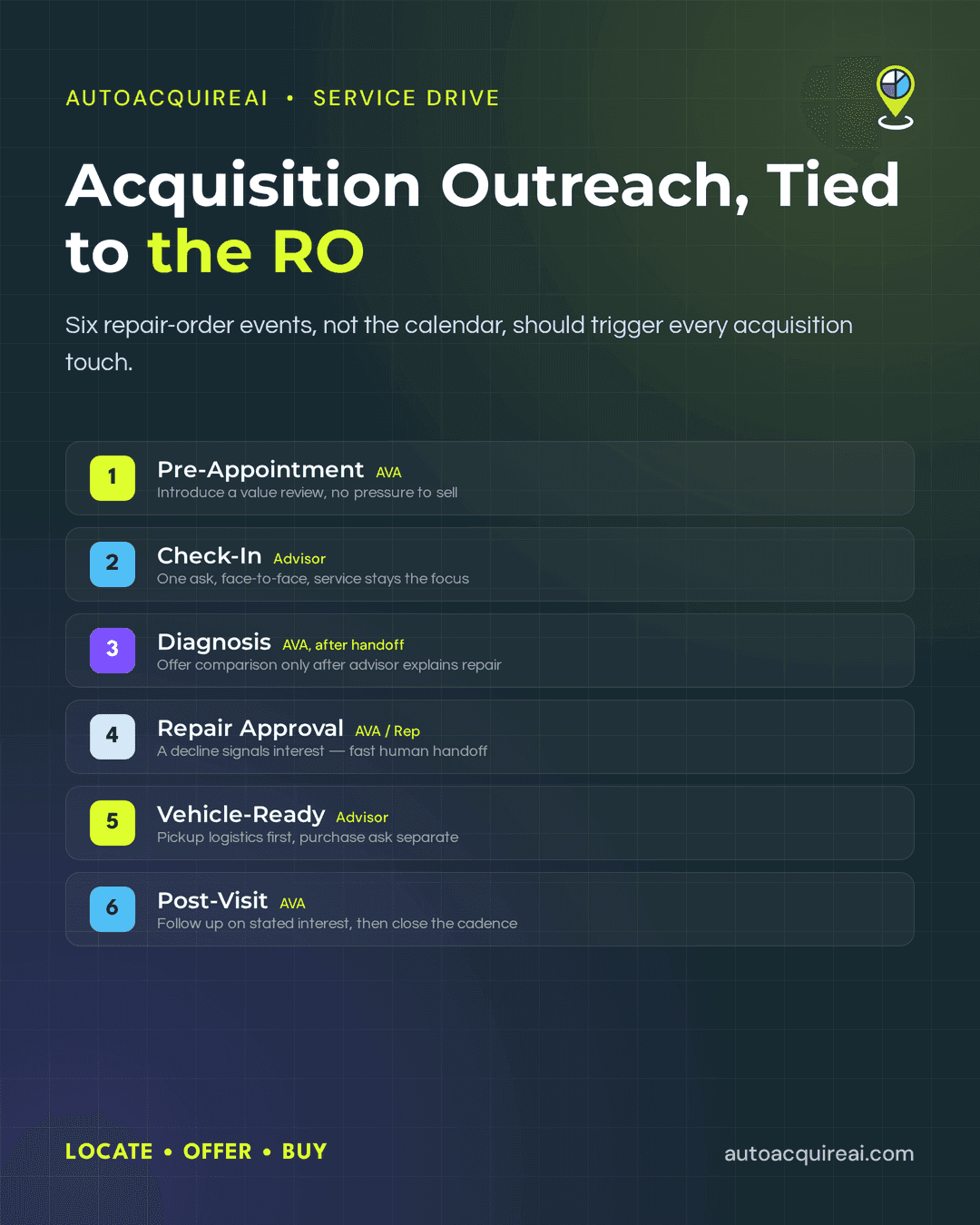
AutoAcquire is best for dealers that want to acquire more service-drive and private-party vehicles without adding car auction fees. A direct purchase carries no auction buy fee or auction arbitration deadline. When a service customer completes the transaction at the dealership, the dealer also avoids inbound auction transport.
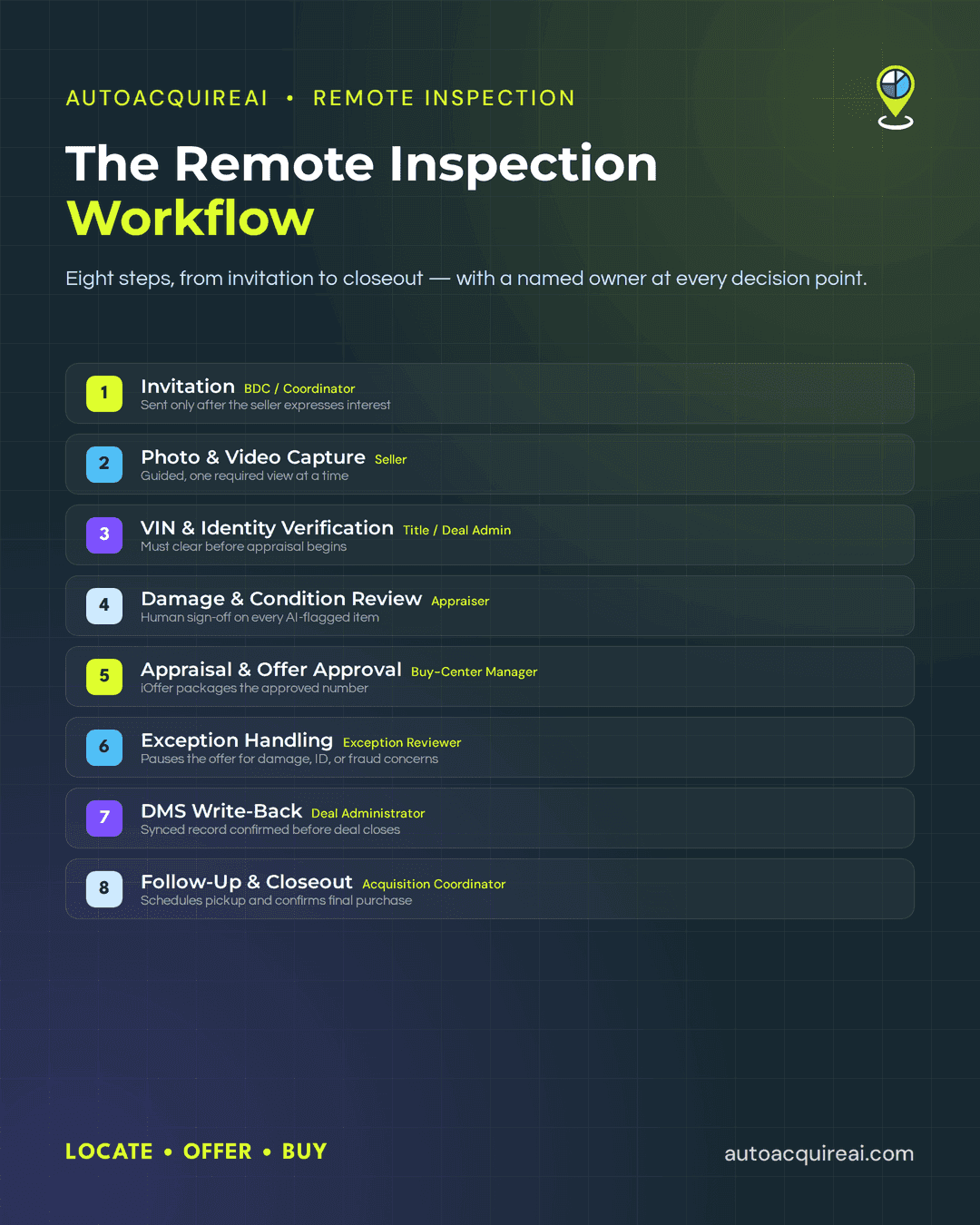
AutoAcquire connects seller outreach with appraisal and acquisition execution. AVA contacts service customers and private-party owners using approved follow-up sequences. iOffer provides instant cash offers, while Remote Inspection collects an AI-guided condition report before the vehicle reaches the store. Earlier condition data helps managers identify likely reconditioning needs and reject unsuitable vehicles before staff spend time on an in-person appraisal.
Service-drive vehicles can offer another operational advantage. The dealership may already hold service records that clarify maintenance history and recurring repair needs. Local possession can also shorten the interval between purchase, reconditioning, and merchandising. Direct acquisition still requires title review, payoff handling, appraisal judgment, internal labor, and recon.
AutoAcquire works best as a complement to auction lanes. Auction marketplaces provide faster access to large inventory pools, while Copart and IAA serve specialized salvage, rebuild, parts, and export needs. Auction lanes remain the better fit for an urgent volume need or a scarce configuration. Direct sourcing also underperforms where local seller supply cannot support the stocking plan.
Best for. Dealers seeking local inventory with lower auction-related transaction and transport exposure.
Not ideal for. Dealers that need immediate wholesale volume, rare configurations, or specialized salvage inventory.
Total cost per retail-ready unit: auction fees versus direct acquisition
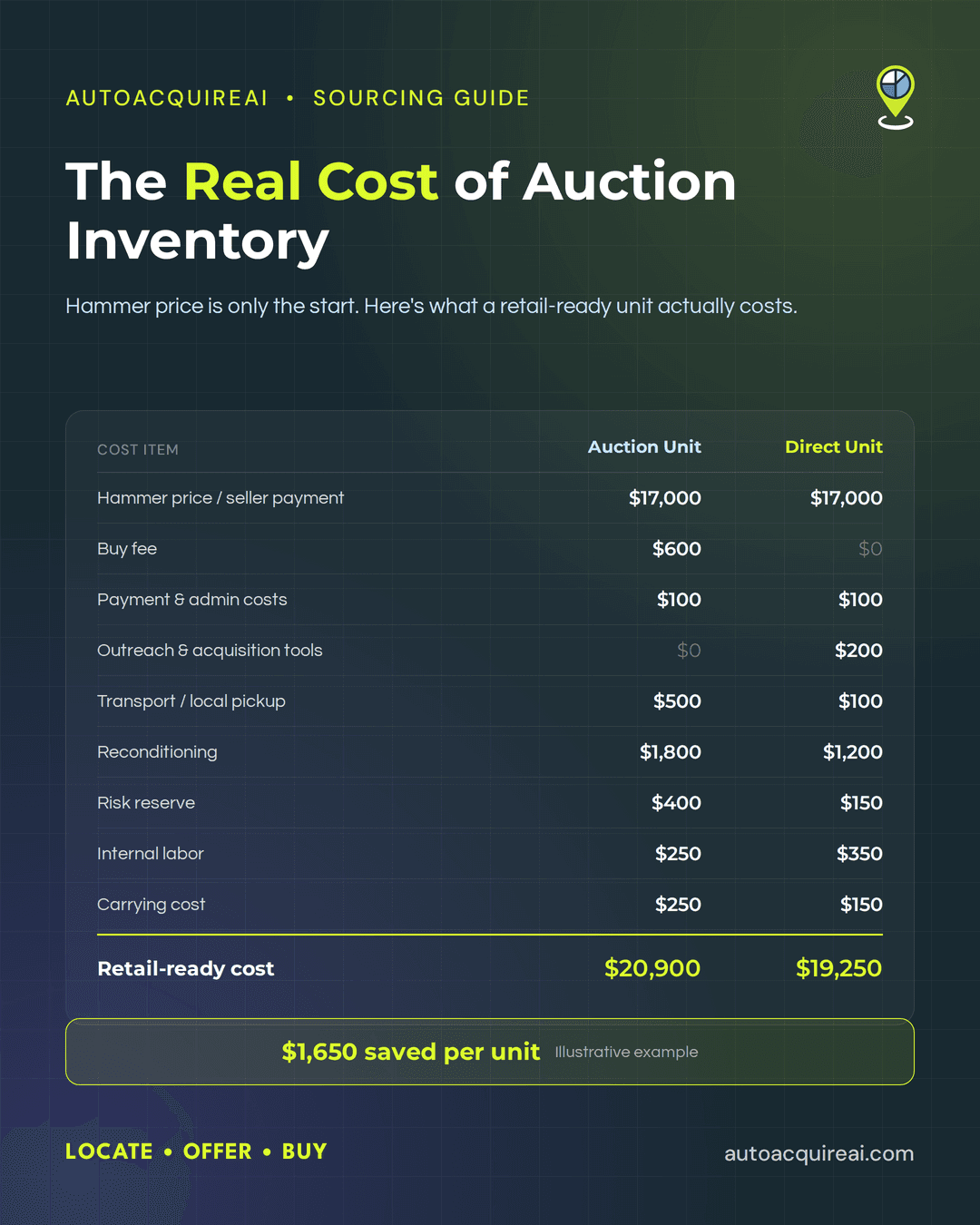
A comparable purchase price can produce different frontline costs because each channel adds a different cost stack. Auction inventory carries buyer fees, transport, and arbitration exposure. Direct acquisition shifts more expense toward outreach, appraisal, and seller handling.
HYPOTHETICAL EXAMPLE
These illustrative round numbers are examples, not market averages.
| Cost item | Wholesale auction unit | Directly acquired unit |
|---|---|---|
| Hammer price or seller payment | $17,000 | $17,000 |
| Buy fee | $600 | $0 |
| Payment and administrative costs | $100 | $100 |
| Outreach and acquisition tools | $0 | $200 |
| Transport or local pickup | $500 | $100 |
| Reconditioning | $1,800 | $1,200 |
| Condition and arbitration risk reserve | $400 | $150 |
| Internal labor | $250 | $350 |
| Carrying cost before frontline | $250 | $150 |
| Retail-ready cost | $20,900 | $19,250 |
Under these assumptions, direct acquisition saves $1,650 per retail-ready unit. Most savings come from removing the buy fee, limiting transport, and shortening the assumed reconditioning runway. A service-drive vehicle may also have maintenance history already recorded by the dealership. Remote Inspection and iOffer can support condition review and seller offers before purchase.
Wholesale auctions retain an operational advantage when a dealer needs inventory volume quickly. Direct supply depends on local vehicle availability and seller response, while auction marketplaces can present hundreds or thousands of units at once. Dealers can compare channels by applying their own fee schedules, labor rates, recon assumptions, and carrying costs to this model.
Decision framework: matching sourcing channel to inventory need
- Inventory type. Dealer-focused wholesale auctions suit standard retail inventory and scarce configurations that local sellers cannot supply. Copart and IAA fit rebuildable, parts, or export inventory. Direct sourcing fits service-drive vehicles and private-party units within the dealer’s buying profile. For scarce or specialized inventory, choose wholesale auctions. For rebuildable units, choose salvage channels. For locally available retail vehicles, choose direct sourcing.
- Risk tolerance. Wholesale condition reports and arbitration offer defined recourse, though coverage has limits. Salvage buyers accept title, damage, and repair uncertainty. AutoAcquire supports Remote Inspection and can pair service-drive history with seller outreach. Dealers seeking lower condition uncertainty should favor direct sourcing or dealer-focused wholesale channels.
- Sourcing radius. National auction access expands selection but adds transport cost and delivery variability. Local acquisition reduces transport exposure, though weak local seller supply can restrict volume. Use auctions for a broad radius and direct sourcing for a local radius.
- Acquisition speed. Auctions can fill multiple inventory gaps quickly when suitable units are available. Direct sourcing depends on an active pipeline, so it can underperform during urgent volume needs. Use wholesale auctions for immediate scale and AVA with iOffer for steady local acquisition.
- Target total cost. Calculate retail-ready cost as purchase price + transaction charges + transport + recon + internal labor + carrying cost + risk reserve. Compare channels by completed retail-ready units rather than apparent car auction fees. Use the channel that meets the store’s gross target after every cost enters the calculation.
Best for: matching each channel to a dealer profile
- Best for dealers reducing auction fee exposure. AutoAcquire sources vehicles through service-drive and private-party outreach. AVA, iOffer, and Remote Inspection support local acquisitions without auction buy fees and may reduce long-distance transport.
- Best for franchise groups needing scalable multi-channel sourcing. Manheim, ACV Auctions, and OPENLANE provide broad wholesale access, while AutoAcquire adds direct acquisition for units available within the dealer’s customer base and local market.
- Best for independent dealers with limited auction access. AutoAcquire offers a direct path to local inventory, while online car auctions such as ACV Auctions and OPENLANE provide supplemental wholesale reach without requiring routine travel to physical lanes.
- Best for multi-rooftop groups wanting centralized acquisition workflows. AutoAcquire gives dealerships a shared workflow for outreach, instant cash offers, remote condition collection, and acquisition tracking. Manheim and OPENLANE remain useful for filling inventory gaps across rooftops.
- Best for rebuilders, exporters, and parts-focused buyers. Copart and IAA provide specialized access to salvage and total-loss vehicles, but branded titles, limited buyer protection, and variable repair scope make them a poor fit for routine frontline inventory.
Frequently asked questions
What counts toward true car auction fees beyond the buy fee?
True auction cost includes payment and administrative charges, transportation, inspection expenses, reconditioning, title delays, internal labor, and carrying cost before the vehicle reaches the frontline. Dealers also need a reserve for claims that fall outside arbitration coverage.
How do arbitration deadlines typically work?
Auction policies require buyers to report eligible defects within a defined period after the sale, delivery, or vehicle release. The deadline and coverage depend on the marketplace, sale type, disclosure, defect category, and transaction terms.
How does buying through Copart or IAA differ from wholesale auction buying?
Copart and IAA primarily serve salvage, total-loss, rebuild, parts, and export needs. Buyers face greater title-brand, damage, parts-sourcing, and repair-cost exposure than they typically encounter with dealer-focused wholesale inventory.
Can direct sourcing fully replace auction lanes?
Direct sourcing rarely replaces auctions for dealers that need consistent volume or specialized inventory. AutoAcquire can supplement auction purchases by helping dealers acquire vehicles through service-drive and private-party outreach.
Is ACV cheaper than Manheim?
Neither platform is consistently cheaper across every transaction. The lower-cost option depends on the vehicle price, buyer account, sale channel, location, transport distance, and applicable service charges.
What is the cheapest way for dealers to source used cars?
Service-drive and private-party acquisition can produce the lowest total cost when a dealer controls appraisal, outreach, inspection, and local pickup. Wholesale auctions may cost less when immediate access to volume prevents missed retail demand or prolonged inventory shortages.
The bottom line on total acquisition cost
Total cost per retail-ready unit should govern sourcing decisions. Dealers asking what auction inventory costs once retail-ready should calculate purchase price + transaction charges + transport + recon + internal labor + carrying cost + risk reserve.
Used car managers and dealer principals can lower blended acquisition cost by pairing auction access with direct sourcing through AutoAcquire. Auction lanes supply volume and scarce configurations, while direct acquisition can reduce car auction fees and exposure to transport or arbitration risk. The right mix depends on actual frontline-ready cost, inventory needs, and local seller supply.