TL;DR
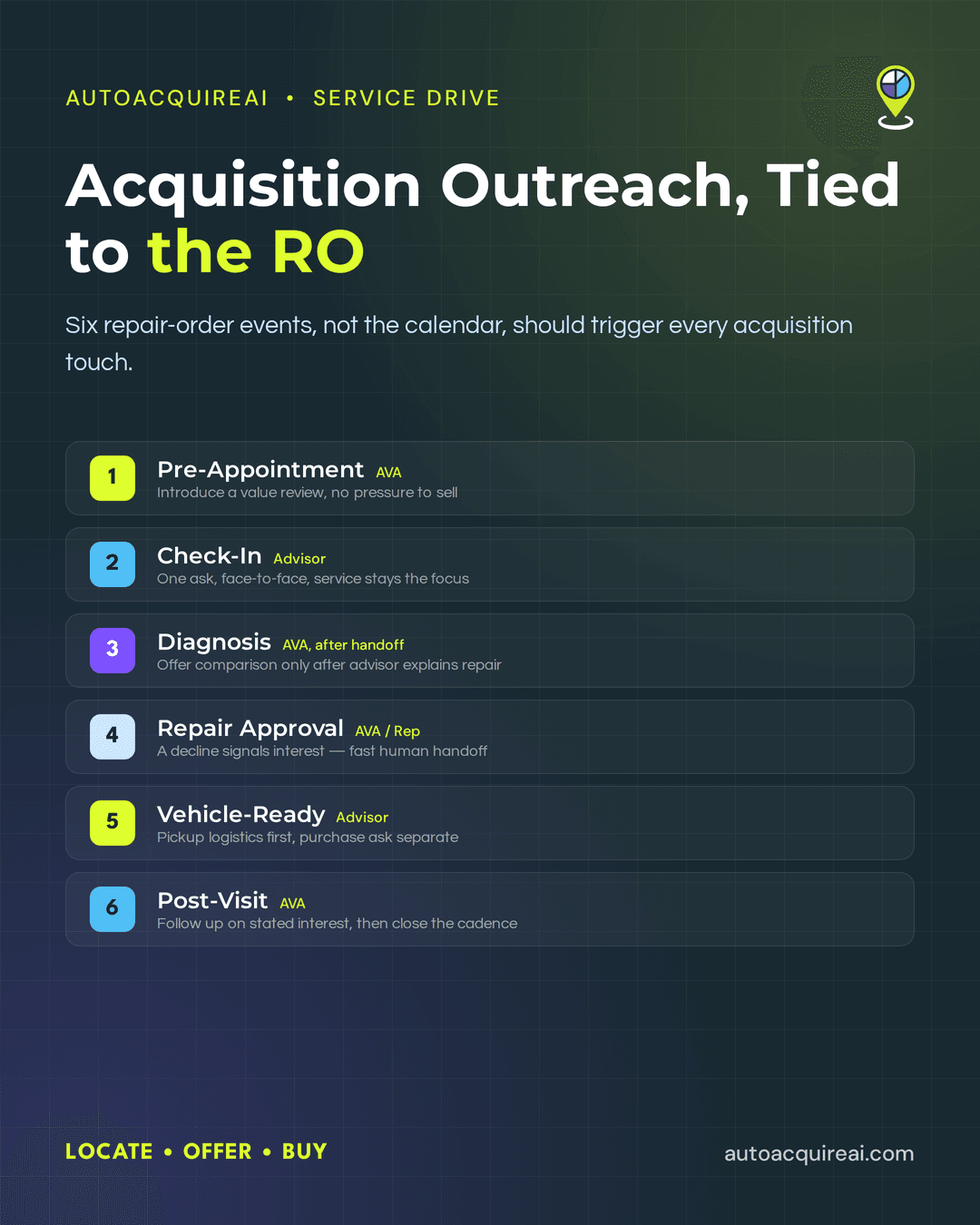
- Dealers should tie acquisition touches to six repair order events. Those events are pre-appointment, check-in, diagnosis, repair approval, vehicle-ready, and post-visit.
- Event timing should control the cadence. Dealers should pause automated outreach when a service concern, negative reply, or high-intent seller signal requires human attention.
- AutoAcquire and AVA can run approved call and text sequences, personalize messages, record outcomes, and route qualified sellers. Staff retain control over exceptions, appraisals, negotiations, and purchase decisions.
- Managers should track response, appointment, appraisal, offer, and acquisition KPIs across the full cadence.
- This guide is best for dealerships that want repeatable service-drive acquisition outreach without handing appraisals or purchase decisions to automation.
Mapping outreach to the repair order lifecycle
Repair order events provide better outreach triggers than calendar dates because each event changes what the customer knows and what the dealership can say. A message sent two days after booking lacks the context available when an inspection identifies a costly repair.
Pre-appointment outreach uses appointment details and known vehicle data to introduce the possibility of an offer without assuming sale interest. At check-in, the customer focuses on transportation and service timing. An advisor can note current mileage, confirm vehicle condition, and ask whether the customer would consider an offer.
Diagnosis creates a specific decision point. The dealership now knows the repair type and estimated cost, while the customer weighs whether to invest more in the vehicle. Repair approval then separates customers who authorize the work from those who decline it. A declined repair can signal stronger sale interest and should prompt a quick human handoff.
Vehicle-ready outreach must lead with pickup logistics. Staff should send any acquisition message separately so a purchase request does not obscure the completion notice. Post-visit outreach fits customers who expressed interest but left without an appraisal or offer. Dealers can reference the recent visit and close the cadence if the customer does not engage.
Each stage supports different language because the available facts and customer priorities have changed. Dealers lose trust when they disguise purchase outreach as a repair update or insert a sales pitch into a message the customer expects to contain service information.
Service communication vs. acquisition outreach
Service threads should contain information required to complete the repair visit. Appointment confirmations, approval requests, status updates, and pickup instructions belong in that conversation. A request to appraise or purchase the vehicle belongs in a separate acquisition thread with a clear sender and purpose.
Poor
“Your vehicle is ready for pickup at 4 p.m. We urgently need vehicles like yours and can make an offer today. Reply YES to sell.”
The message buries the pickup information and turns an expected service notice into an unrequested sales pitch.
Better
“Your vehicle is ready for pickup after 4 p.m. Reply here with any service questions.”
When the dealership has appropriate acquisition consent, a separate message can follow.
“Hi Jordan, this is Maya with Northside Motors. Based on your recent service visit for the 2019 Accord, our acquisition team would like to offer a no-obligation appraisal. Would you like the details?”
Dealers should not treat permission for repair updates as automatic permission for acquisition marketing. Consent requirements vary by channel and jurisdiction, so dealerships should have counsel review their opt-in language, message timing, and recordkeeping rules. AVA can execute approved sequences and record outcomes, but dealership policy should determine which customers enter an acquisition cadence.
Call scripts, SMS templates, and voicemail examples by stage
Effective outreach connects the purchase conversation to a specific repair-order event. Dealership and vehicle details can make the message relevant to the current visit. Staff should reference a diagnosis, repair estimate, or approval status only after the service advisor has explained it to the customer. AVA can insert approved dealership and vehicle fields into each message, record the response, and route interested sellers to acquisition staff.
Each RO stage below includes a call script, SMS template, and voicemail example where the channel fits. Strong and poor examples show how specific, low-pressure language differs from generic sales outreach.
Pre-appointment outreach
Pre-appointment outreach should offer optional value information without assuming that the customer wants to sell. AVA can personalize the approved message with appointment, dealership, and vehicle data when the customer has consented to acquisition outreach.
Call opener:
“Hi [First Name], this is [AVA or Rep Name] calling for [Dealer Name]. Your [Year Make Model] is scheduled for service on [Appointment Date]. Our acquisition team can prepare a no-obligation value review while the vehicle is here. Would that information be useful to you?”
If the customer declines, AVA should acknowledge the answer, record the outcome, and end the acquisition conversation.
SMS template:
“Hi [First Name], [Dealer Name] has your [Year Make Model] scheduled for service on [Appointment Date]. If helpful, our acquisition team can review its current value during the visit. Reply YES if interested or STOP to end acquisition texts.”
Voicemail script:
“Hi [First Name], this is [AVA or Rep Name] with [Dealer Name] regarding your [Appointment Date] service appointment for the [Year Make Model]. We can provide an optional vehicle value review during the visit, with no obligation to sell or trade. Please call [Callback Number] or reply to our text if interested.”
Poor example:
“We urgently need your car and can make a great offer when you come in.”
Corrected version:
“While your [Year Make Model] is here for service, [Dealer Name] can prepare an optional value review if you would like one.”
Check-in outreach
The service advisor owns the check-in touch because the customer is standing in the lane. AVA cannot conduct this face-to-face conversation. The advisor should ask once, use known vehicle details, and keep the service visit moving.
Advisor script
“While the [Year Make Model] is here, our used car manager may be interested in reviewing it based on its [Mileage] miles. Would you be open to hearing what the dealership might offer? The review will not affect today’s service.”
A positive response should route immediately to the acquisition staff. The advisor should record the customer’s interest but should not estimate value, negotiate, or promise an offer.
If lane traffic prevents the conversation, AVA can send a separate acquisition SMS where the dealership has documented the required consent.
Follow-up SMS
“Hi [First Name], this is [Name] with [Dealership]. While your [Year Make Model] is in service today, our used car team would like to review it for a possible purchase. Would you be open to a no-obligation appraisal? Reply YES if interested or STOP to opt out.”
Service updates should remain in the service thread. The acquisition message should not suggest that an appraisal will change repair timing or priority.
Poor message
“We need your car and can make a strong offer today. Stop by sales before you leave.”
Better message
“Our used car team may be interested in reviewing your [Year Make Model]. Would you like an appraisal while it is already here?”
Inspection and diagnosis outreach
A diagnosis-triggered message may reference the repair estimate after the service advisor has explained it. The message can then offer an appraisal as another option before the customer approves or declines the work. The acquisition message must remain separate from the advisor’s repair recommendation. AVA can trigger approved outreach when the repair order records a qualifying estimate, then route interested customers to acquisition staff.
Call opener
“Hi [First name], this is [Name] with [Dealership]. Your advisor will review the recommended [repair] totaling about [$ amount]. Separately, our acquisition team would be interested in evaluating your [year, make, model] if selling or trading it would help you compare options. Would you like an appraisal while the vehicle is here?”
SMS
“Hi [First name], [Dealership] identified approximately [$ amount] in recommended repairs for your [year, model]. Your service advisor can answer repair questions. If you would also like to compare that repair decision with a purchase offer, reply YES and our acquisition team will arrange an appraisal.”
Voicemail
“Hi [First name], this is [Name] at [Dealership]. Your service advisor will contact you about the recommended repairs. Our acquisition team may also be interested in purchasing your [year, model]. If an appraisal would help you compare options, call us at [number].”
Poor example
“Your vehicle needs [$ amount] in work, so trading it today probably makes more sense.”
Corrected version
“Your inspection identified about [$ amount] in recommended work. Repairing the vehicle remains one option. If useful, the acquisition team can also provide a purchase offer for comparison.”
Repair approval outreach
Repair decisions determine the next outreach path. After a customer declines a repair, acquisition staff can offer an appraisal as an optional point of comparison. An approved repair calls for a lower-pressure message, preferably after pickup or on the next business day.
Declined repair call
“Hi [First name], this is [Rep name] with [Dealership]. Our service team noted that you declined the [Repair type] estimated at [Amount] for your [Year Make Model]. Would you consider an appraisal before deciding what to do next? I can connect you with [Acquisition rep] now.”
AVA should pause automation when the customer agrees, asks about value, or requests an appraisal. A live acquisition rep should take ownership immediately and arrange the appraisal. AVA should not estimate value or negotiate an offer.
Declined repair voicemail
“Hi [First name], this is [Rep name] at [Dealership] calling about your [Year Make Model]. Since you decided not to complete the [Repair type], our acquisition team can appraise the vehicle and explain another option. Please call or text us at [Number].”
Approved repair SMS
“Hi [First name], your approved [Repair type] is moving forward. Separately, [Dealership] would be interested in appraising your [Year Make Model] if you are open to discussing its current value. Reply YES for details or STOP to opt out.”
Poor example
“You declined an expensive repair, so sell us your car today.”
Corrected version
“Since you declined the [Repair type], would an appraisal help you compare repairing the vehicle with selling it?”
Vehicle-ready notification outreach
Pickup logistics take priority over acquisition outreach. The service advisor should first confirm that the vehicle is ready, state the balance, explain pickup hours, and answer service questions. Only after the customer acknowledges those details should the advisor or AVA raise a purchase conversation.
Call script:
“Ms. Lee, your 2020 Honda CR-V is ready. Your balance is $642, and pickup is available until 6 p.m. Do those arrangements work for you?”
After confirmation, the advisor can continue.
“Our acquisition manager is interested in appraising your CR-V based on its mileage and service history. Would you like a no-obligation estimate while you are here? Your pickup will proceed normally either way.”
SMS sequence:
Service message
“Your 2020 Honda CR-V is ready for pickup at Northside Honda. The balance is $642, and the service lane closes at 6 p.m. Reply here with any pickup questions.”
Separate acquisition message after the customer acknowledges the pickup details, or after pickup if the customer does not respond
“Northside Honda may be interested in purchasing your CR-V. May our acquisition manager prepare an appraisal during pickup? The appraisal will not affect pickup timing.”
Voicemail script:
“Hi, Ms. Lee. Your Honda CR-V is ready for pickup at Northside Honda. Please call the service department at [number] for pickup details. After those arrangements are set, our acquisition manager can also provide a purchase estimate if you are interested.”
Poor example:
“We want to buy your CR-V today and can make an offer when you come in. Your vehicle is also ready, so call us.”
The sales pitch obscures the ready status, balance, hours, and next step. Dealers should never delay key handoff details to create an appraisal opportunity.
Post-visit follow-up outreach
Send the post-visit follow-up two or three business days after pickup, but only when the customer previously expressed interest. The repair order has closed, so the message should reference the earlier conversation and offer a simple next step without creating urgency.
Call script
“Hi [First Name], this is [Rep Name] from [Dealership]. You mentioned that you might consider selling or trading your [Year Make Model]. Would you still like us to prepare an appraisal, or should we close the conversation for now?”
If the customer declines, thank them and end the acquisition cadence. If the customer agrees, schedule the appraisal and route the record to acquisition staff.
SMS template
“Hi [First Name], following up on our conversation about your [Year Make Model] after its recent service visit. We can prepare a no-obligation appraisal if you are still interested. Reply YES and [Rep Name] will contact you. Reply STOP to opt out of acquisition messages.”
Voicemail script
“Hi [First Name], this is [Rep Name] from [Dealership]. I’m following up on your interest in an appraisal for your [Year Make Model]. Call or text us at [Number] if you would like to continue. Otherwise, no action is needed, and we will close the follow-up.”
Poor message
“We still need your vehicle. When can you bring it back?”
The poor version treats prior interest as a commitment. A final touch should preserve the customer relationship by offering a choice, respecting silence, and closing the cadence when interest has faded.
Multi-touch cadence and timing table
Repair-order events should control acquisition timing because each event changes the customer’s context. A declined repair calls for a fast human response, while an approved repair supports a softer follow-up. Dealers should also keep acquisition outreach separate from appointment reminders, repair updates, and pickup instructions.
| Stage | Trigger | Channel | Timing offset | Owner |
|---|---|---|---|---|
| Pre-appointment | Appointment booked and acquisition consent confirmed | SMS or voice | At least 24 hours before arrival. Skip this stage when the appointment is booked less than 24 hours in advance. | AVA |
| Check-in | Vehicle written up and customer present | Advisor conversation | During write-up after service needs are documented | Service advisor |
| Inspection or diagnosis | Estimate entered and diagnosis explained | SMS or voice | 30 to 60 minutes after advisor confirmation | AVA after human release |
| Repair approved | Customer approves recommended work | SMS | Next business day or after pickup | AVA |
| Repair declined | Advisor explains the repair and records the customer's decision | Call | Within 15 minutes after advisor confirmation, when purchase-outreach consent is documented | Acquisition representative |
| Vehicle ready | Customer acknowledges pickup details | SMS or advisor conversation | After acknowledgment, or after pickup if the customer does not respond | Advisor or acquisition representative |
| Post-visit | Customer showed interest but did not schedule an appraisal | SMS, voice, then voicemail | Two business days after visit, with a final touch five to seven days later | AVA |
AVA can advance approved pre-appointment, approved-repair, and post-visit sequences when the prior touch receives no reply. Diagnosis outreach requires a human release because the advisor must explain the repair before acquisition staff reference it. Declined repairs, customer frustration, appraisal requests, and purchase questions should pause automation immediately.
Spacing protects the service experience. If a service update goes out on a given day, the acquisition touch should usually move to the next suitable window unless the customer has already expressed selling interest. Dealers should suppress remaining touches after an opt-out, completed appraisal, active negotiation, or vehicle purchase.
Objection responses
Acquisition staff should acknowledge the objection, remove pressure, and offer one specific next step. Staff should not debate the customer or imply that an appraisal already guarantees a purchase price.
- Objection “I’m not selling.”
Response “Understood. I’ll close the purchase conversation. If your plans change, the dealership can provide an appraisal while the vehicle is already here.” - Objection “I already have an offer.”
Response “That makes sense. If you would like another figure for comparison, our acquisition manager can appraise the vehicle. You can decide whether either offer works for you.” - Objection “I need my car.”
Response “We can schedule the appraisal around your service pickup so it does not hold up the vehicle. Any transportation arrangement would need confirmation from the dealership before you make a decision.” - Objection “Send me something in writing.”
Response “I can send a written summary of the next step. A purchase figure requires the dealership to review the vehicle and confirm its condition.” - Objection “Just tell me what it’s worth.”
Response “The acquisition manager needs to review the mileage, condition, and vehicle history before giving a figure. Would an appraisal during pickup work?” - Objection “I just approved the repairs.”
Response “No problem. The repair will continue as authorized. The appraisal is optional and does not change the service work.” - Objection “Stop contacting me about selling.”
Response “Understood. We will stop vehicle-purchase outreach.”
Staff should record the opt-out immediately and suppress every remaining acquisition touch.
Ownership, staff handoff, and escalation rules
AutoAcquire uses AVA to run approved outreach, qualify interest, record outcomes, and route opportunities. Human staff take ownership when a customer requests a value, signals intent to sell, raises a complaint, or reaches an appraisal decision.
Dealerships that want repeatable service-drive acquisition outreach without handing appraisals or purchase decisions to automation are the best fit for this operating model.
| Signal | Action | Owner |
|---|---|---|
| Customer asks to sell, trade, discuss value, or schedule an appraisal | AVA pauses automated outreach, marks the lead as high intent, and routes it under the dealership’s response standard. | The assigned acquisition representative contacts the customer. |
| Customer declines a recommended repair | AVA ends the automated sequence and sends the repair amount, vehicle details, and customer response to a live representative. | The acquisition representative handles outreach, while the service advisor retains control of the repair order. |
| Customer appears angry, disputes the repair, or complains about service | AVA suppresses acquisition messages and alerts dealership staff. Purchase outreach remains paused until staff resolve the service issue. | The service manager or customer care manager owns recovery. |
| Customer requests an appraisal or written offer | AVA confirms the request and schedules or routes the next step without estimating a value. | The used car manager or appraiser evaluates the vehicle and presents the offer. |
Service advisors own face-to-face check-in and all repair-order communication. Acquisition representatives own qualified seller conversations after handoff. Used car managers control appraisals, negotiations, exceptions, and final purchase decisions. AVA never appraises a vehicle, negotiates terms, or finalizes an acquisition.
Each handoff should record the trigger, assigned employee, acceptance time, and disposition. A BDC or acquisition manager should review unaccepted high-intent leads and reassign them when the response deadline passes.
Consent and compliance guardrails
Dealers should manage acquisition outreach under a permission policy separate from routine service communication. Permission to send appointment reminders or vehicle-ready notices should not automatically place a customer into a vehicle-purchase cadence. Separate message threads and clear sender identification help customers understand whether a message concerns service or a potential sale.
Every stop request should suppress further acquisition calls and texts promptly. Staff should avoid moving an opted-out customer into another automated list, even when a new repair order opens. Service messages that remain necessary should stay limited to the repair visit and follow the dealership’s approved policy.
Dealership policies should define permitted calling and texting hours using the customer’s local time. The policy should also cover weekends, holidays, prerecorded or artificial voice calls, and any state-specific restrictions. Dealers should have qualified counsel review consent language, outreach rules, and retention practices for every jurisdiction where they operate. This guidance supports operations and does not provide legal advice.
AVA can support record keeping by capturing consent status, outreach timestamps, message outcomes, and opt-out events. Those records help managers audit cadence execution, but software logs alone do not establish legal compliance. Dealers remain responsible for approved scripts, staff behavior, data accuracy, suppression controls, and counsel-reviewed policies.
KPI scorecard for service-drive acquisition
A useful scorecard follows each opportunity through the full acquisition funnel. Managers should calculate every rate from a defined denominator and segment results by repair-order stage, channel, and assigned employee.
| KPI category | Calculation | What it measures | Review cadence |
|---|---|---|---|
| Response rate | Customers who answer or reply divided by customers receiving an acquisition touch | Whether timing, channel, and message earn engagement | Daily by stage and weekly by campaign |
| Appointment rate | Appraisal appointments booked divided by customers who express possible interest | Whether responders receive a clear next step | Daily for open leads and weekly by owner |
| Appraisal rate | Completed appraisals divided by appraisal appointments booked | Whether appointments arrive and reach an appraiser | Weekly, with missed appointments reviewed daily |
| Offer rate | Written offers issued divided by completed appraisals | Whether appraised vehicles receive a documented purchase decision | Weekly by appraiser and vehicle segment |
| Acquisition rate | Vehicles purchased divided by customers receiving an acquisition touch | How often outreach opportunities become purchased units across the full cadence | Weekly and monthly |
| Offer acceptance rate | Vehicles purchased divided by written offers issued | How often customers accept documented purchase offers | Weekly by appraiser and monthly by vehicle segment |
Managers should pair each rate with counts and median response time. A high percentage based on four opportunities carries less operating value than the same percentage across 100 opportunities. Channel and stage splits also expose problems hidden by a storewide average.
When response rate meets the dealership’s target but appointment rate does not, managers should check whether interested customers received a timely callback and a clear appraisal option. Managers should inspect qualified replies that lacked a timely human callback. A low appraisal rate should trigger a review of missed appointments, scheduling delays, and declined-repair leads that never reached acquisition staff.
Monthly reviews should examine conversion by repair-order trigger and vehicle segment. Daily reviews should focus on exceptions that still need action rather than waiting for the monthly scorecard.
How AVA executes the cadence while staff stay in control
AutoAcquire serves as the execution layer for the approved service-drive acquisition cadence. AVA runs authorized voice and text sequences based on repair-order events. Dealership and vehicle data can personalize each touch with details such as the customer name, model, mileage, and repair status.
AVA records responses and outcomes so staff can see whether a customer declined, requested an appraisal, asked for written information, or needs follow-up. Qualified sellers route to the assigned acquisition representative based on dealership rules. High-intent replies, declined repairs, appraisal requests, and customer complaints should pause automation and trigger a staff task.
Dealership staff retain control over message approval, suppression rules, exceptions, appraisals, negotiations, and final purchase decisions. AVA qualifies interest and manages routine follow-up, but it does not determine vehicle value or commit the dealership to an offer.
This guide is best for dealerships that want repeatable service-drive acquisition outreach without handing appraisals or purchase decisions to automation. Consistent execution keeps opportunities from going untouched, while staff apply judgment at each valuation and purchase decision.
FAQs
- How soon after check-in should acquisition outreach start? Dealers should wait until check-in is complete and confirm that the customer is eligible for acquisition messaging. Avoid sending an acquisition text while the service advisor is still explaining pickup logistics or repair concerns.
- What happens when a customer requests no further contact? Staff or AVA should stop the applicable acquisition sequence immediately and record the opt-out with a timestamp. Dealers should not treat an acquisition opt-out as permission to suppress necessary service updates unless the customer also requests that change.
- How should exceptions get logged? The customer record should identify the exception, time, source, assigned owner, and required next action. Common exceptions include complaints, disputed vehicle data, special communication requests, and manager review.
- Who responds when a customer asks what the dealership will pay? AVA should route the request to the designated acquisition employee. A staff member must review the vehicle, complete the appraisal, and communicate any offer.
- Should every repair order enter the same cadence? No. Approved rules should exclude customers without suitable consent, active complaints, duplicate opportunities, or other dealership-defined restrictions.
- Can service and acquisition messages share one conversation thread? Dealers should keep the purposes distinct whenever possible. Service updates cover the repair order, while acquisition messages request permission to discuss selling or trading the vehicle.