TL;DR
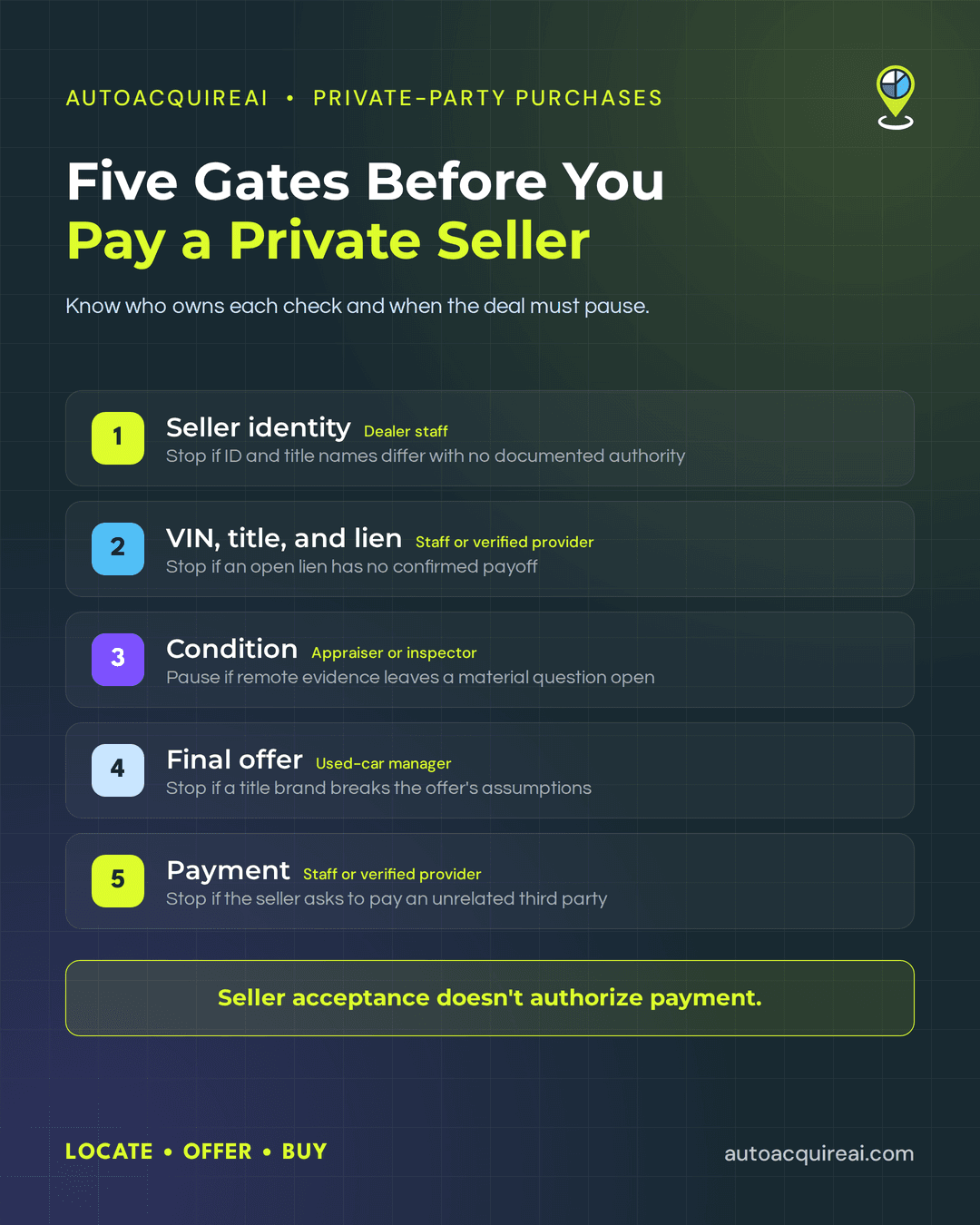
Dealerships buy cars from private sellers by verifying who can sell the vehicle, checking its VIN and title, inspecting its condition, approving a final price, and controlling payment and pickup. Use the stop/go table below to identify who owns each check and when a deal must pause.
- Seller contact can start with AutoAcquire AVA outreach. Dealer staff then verify the seller’s identity and ownership.
- Staff check the VIN, title, and lien status before the purchase proceeds. Unresolved ownership or payoff details stop the deal.
- AutoAcquire Remote Inspection provides AI-guided self-service condition capture. Staff request an independent inspection when that evidence leaves a material concern unresolved.
- iOffer generates an instant cash offer. Staff document the conditional offer and approve the final offer after the evidence reconciles.
- Staff or verified providers verify title and liens, approve the purchase, control payment and pickup, and send the closed deal to recon.
Private-party vehicle purchase workflow: stop/go decisions
| Stage | Choice | Required Evidence | Owner | Failure Point | Stop/Go Action |
|---|---|---|---|---|---|
| Seller contact | Use AVA for outreach, then have staff take over the transaction. | Seller contact record and vehicle details | Buy-center staff | The seller will not identify who owns the vehicle. | Stop offer preparation until staff establish the seller’s relationship to the owner. |
| Identity and ownership vetting | Confirm the seller can authorize the sale. | Seller ID, title or registration, and any required authorization | Dealer staff | The ID name differs from the title name. | Stop until staff verify the owner’s participation or valid authority to sell. |
| VIN, title, and lien check | Compare vehicle records with the seller’s documents. | Vehicle VIN, title record, history report, and lien or payoff confirmation | Dealer staff or verified provider | An open lien has no confirmed payoff amount. | Hold the purchase until the lienholder confirms how the lien will be satisfied. |
| Inspection path | Use Remote Inspection for AI-guided self-service condition capture, or request an independent inspection. | Condition report, images, and any independent inspection findings | Appraiser or verified inspector | The remote submission omits a reported damage area, or the vehicle has new damage at pickup. | Request an independent inspection for unresolved remote evidence. At pickup, pause acceptance and final pricing until staff document new damage. |
| Conditional and final offer | Use iOffer to generate an instant cash offer, subject to staff review. | Offer terms, condition findings, title and lien status, and approval record | Used-car manager | The offer assumes a clean title, but the title carries a brand. | Revise or withdraw the offer. Release no funds without final approval. |
| Payment and pickup | Confirm payees, payment instructions, and possession arrangements. | Approved purchase agreement, verified payment instructions, payoff instructions, and pickup record | Dealer staff or verified providers | The seller requests payment to an unrelated third party. | Stop payment until staff verify the payee and resolve the request. |
| Recon handoff | Transfer the closed deal’s condition record to recon. | Final inspection report, purchase record, keys, and vehicle receipt | Acquisition staff and recon lead | The vehicle arrives without the documented condition report. | Request the missing record before approving condition-based recon work. |
How do dealerships verify a private seller owns the car?
AutoAcquire’s AVA handles initial seller outreach and follow-up. Buy-center staff record the seller’s contact details, VIN, and inspection location, then establish who has authority to sell the vehicle.
A staff member should compare the seller’s photo ID with the name on the title and check the registration for inconsistencies. Registration alone does not establish ownership. If someone else holds title, staff should identify the titled owner and review the documents authorizing the seller to act, such as a power of attorney where applicable. Staff must confirm that the authorization meets local requirements before proceeding.
An address mismatch needs an explanation, not an automatic rejection. A third-party intermediary who cannot connect the seller to the titled owner, or a seller who refuses to provide ID, puts the purchase on hold. Staff should document the discrepancy and resume offer discussions only after the ownership record and seller’s authority reconcile.
How do dealers check the VIN, title, and lien before buying?
Compare the vehicle’s VIN with the title and the VIN used for its history report. Until staff see the vehicle, mark a seller-supplied VIN as unverified. A VIN decode identifies vehicle attributes; a history report may flag reported title brands, odometer discrepancies, or prior damage, depending on the provider’s records. A VIN mismatch or conflicting history entry stops final approval until staff check the underlying records. AutoAcquire’s VIN and vehicle-history tools guide covers the available checks, while its private-party acquisition guide covers broader sourcing decisions.
Next, staff should read the title itself and compare the named owner with the seller’s verified identity. They should record any brand, odometer notation, listed lienholder, or missing ownership document in the deal file. A clean vehicle-history report does not establish that the seller can transfer ownership. A title in someone else’s name calls for documented authority and review under the applicable jurisdiction’s rules, not an assumption that the seller can sign for the owner.
For a listed or suspected lien, staff should confirm the lien status with the appropriate title record or verified title provider. If a lien remains, they should obtain a current payoff amount and confirm the lienholder’s release instructions through an independently verified contact channel. The purchase file should show who receives the payoff, what remains payable to the seller, and what evidence will confirm lien satisfaction. If the seller’s payoff figure conflicts with the lender’s or no release path is clear, staff should hold payment until the parties reconcile the figures.
Keep the VIN, ownership, title, and lien findings with the offer so a changed finding triggers a price review or approval hold. Those records do not establish physical condition, which the inspection must assess. Lien-release, notarization, and transfer rules vary by jurisdiction; confirm local requirements with the motor vehicle agency or a verified title provider before closing.
When should dealers use remote capture or a third-party inspection?
Dealers can use AutoAcquire Remote Inspection for AI-guided seller capture when a vehicle falls within the buy center’s approved value, distance, and conditional-offer limits. Staff should set those limits before reviewing a deal. The seller’s submitted condition evidence can inform a conditional offer. Staff should compare the submitted VIN and visible condition with the seller’s description, then confirm the vehicle VIN in person before final approval.
An independent third-party or in-person inspection is the escalation path when the vehicle exceeds an approved limit or remote evidence leaves a material question unanswered. For example, staff should request an inspection if photos do not show a reported damage area, the seller cannot complete the capture, or a distant pickup would commit the dealer to transport before anyone examines the car. The inspector’s assignment should name the concern and specify what the report must document.
Remote capture can miss mechanical faults, structural repairs, and concealed damage. Compare the VIN and vehicle at pickup with the remote capture or independent inspection report. If a newly found defect changes the appraisal, pause payment and seek a revised offer or reject the purchase.
How should dealers document a conditional and final offer?
The used-car manager should treat the instant cash offer number generated by iOffer as a proposed price until staff approve its terms. An appraiser records the VIN, mileage, equipment, disclosed damage, and condition evidence used to assess the number. The written conditional offer states what could change the price, including inspection findings or a different lien payoff. The manager approves those terms before staff sends the offer to the seller. Seller acceptance does not authorize payment.
Before approving a final offer, the assigned buyer matches the inspection report to the VIN and compares its findings with the seller’s disclosures. The buyer also records the title holder and lien status, including a confirmed payoff amount if a lien remains. If inspection reveals an undisclosed transmission fault, the manager reviews a repair estimate and either approves a revised offer for the seller to accept or stops the purchase. A title-name mismatch or unconfirmed payoff keeps the offer conditional.
The transaction file should retain the conditional terms, inspection report reference, title and lien findings, seller acceptance, and the manager’s signed approval of the final amount. Staff document each price change and its reason rather than replacing the original offer. The manager releases the approved file to the payment owner only after staff reconcile the final price with the amounts payable to the seller and any lienholder.
How should dealers pay a private seller and take possession?
Payment authorization requires a separate review of the approved deal file. The payment owner checks the final price, titled owner, lien status, and amount due to each payee against verified instructions. A request to pay someone other than the owner or lienholder stops disbursement until staff document that person’s authority and approve the change.
An open lien requires a controlled payoff. Staff or a verified settlement provider should obtain the payoff amount and remittance instructions directly from the lender, then document the amount due to the lender and any balance due to the seller. Staff should independently confirm changed payment instructions. If the payoff amount or recipient cannot be confirmed, staff should hold payment and transfer of possession until the discrepancy is resolved. The dealer should arrange the lien payoff before or alongside release of the seller’s balance under its approved settlement procedure.
Pickup staff should confirm the vehicle’s VIN and location, identify the person handing it over, and record keys, mileage, condition, and documents received. If the vehicle or documents differ from the approved deal file, staff should pause acceptance and payment for review. Staff or a verified provider must handle payment processing, transport, and title-transfer filing. Local rules may change the required title documents, payment method, or filing sequence, so the dealer should confirm the applicable requirements before scheduling the exchange.
When should a private-party purchase stop?
A seller whose ID does not match the title cannot proceed on the standard purchase path. The buyer escalates the file to the used-car manager, who checks whether the titled owner will sign or whether the seller holds valid authority to act. If staff cannot verify ownership or authority under the applicable jurisdiction’s rules, the manager stops the deal.
An open lien without a confirmed payoff amount blocks payment. The buyer sends the file to the title clerk, who contacts the lender through a verified channel for a written payoff tied to the VIN and valid through the planned settlement date. If the lender cannot confirm the amount or payment instructions, the title clerk holds the deal until it can.
Damage found at pickup requires a new appraisal when it differs from the seller’s remote condition capture. The pickup agent records the discrepancy and refers it to the appraiser and used-car manager. They compare the arrival photos with the original report, obtain an independent inspection if the damage remains unclear, and document any revised offer. If the seller rejects the revised terms, the dealer does not take possession.
A request to pay someone other than the titled owner, or to split payment into unusual cash amounts, stops disbursement. The payment clerk escalates to the controller or compliance lead. Payment resumes only after staff verify the payee’s authority, document the reason for the requested method, and approve a payment path permitted by dealership policy and applicable rules.
Reconditioning handoff
Once the purchase closes, the buy center should send recon a work order tied to the vehicle’s VIN. Attach the Remote Inspection condition report or independent inspection report, along with photos, disclosed defects, and any differences staff found at pickup. Record the arrival mileage and keys received so recon can compare the vehicle in the bay with the condition used to approve the final offer.
Send recon the signed purchase documents, final offer approval, and status of title transfer, lien release, and payment. Name the owner of any outstanding document. If recon finds unrecorded damage, the recon manager documents it and seeks approval before adding work that changes the expected cost. Dealer staff own and manage the recon work order.
FAQs
- What documents should a dealer check before buying a car from a private seller? Staff should compare the seller’s photo ID with the title and confirm that the vehicle VIN matches the documents. They should check the applicable title record and review any lien or brand before final approval. Registration can support the review but does not replace title evidence. If a representative is selling the vehicle, staff must verify that person’s authority under the applicable jurisdiction’s rules.
- How does a dealer confirm a car loan payoff before buying from a private seller? Staff should obtain a current payoff amount directly from the lender and confirm who will receive the payoff. Staff or a verified title provider must document the applicable lien-release process. An unresolved balance or unclear release instructions stops payment.
- When should a dealer get an in-person inspection before buying a private-party car? An independent inspection is appropriate when remote images leave material damage unclear, reported condition conflicts with vehicle history, or the offer exceeds the dealership’s remote-purchase limit. Staff should resolve the discrepancy before approving a final offer.
- Which payment requests require escalation? A request to pay someone other than the verified owner or lienholder requires escalation. Changed payment instructions and requests to split payments to avoid controls also require review. Staff should not release funds until the payees and instructions reconcile with the purchase documents.
- Who gives final sign-off on a purchase? The dealership’s written approval policy should name an authorized manager and any required second approver. That person must review the final offer, inspection findings, ownership and lien evidence, and payment instructions before funds move.
Conclusion
Before authorizing payment, the buy-center manager should confirm that the approved offer matches the verified owner, title and lien findings, inspected condition, and payment instructions. The stop/go table assigns each check an owner. AutoAcquire’s AVA supports outreach, Remote Inspection guides seller condition capture, and iOffer generates an instant cash offer; staff or verified providers remain responsible for transaction approval and closing.