

TL;DR
- A dealer VIN check must support the purchase decision before an advisor or buy-center manager quotes a number. Consumer pre-purchase checks serve a different purpose.
- The check must surface title status, active liens, accident or structural damage, odometer discrepancies, open recalls, and prior rental, fleet, or flood history.
- Standalone lookup tools slow acquisition because advisors must manually transfer findings into the appraisal and then use them for payoff and disclosure. Late title or lien findings can force dealers to revise an offer.
- AutoAcquire uses VIN verification, including title and lien checks, to shape instant cash offers and outreach. Dealers can adjust the offer or payoff process before presenting a number.
What a dealer needs a VIN check to confirm before writing an offer
A dealer VIN check must identify any record that changes valuation, payment, disposition, or disclosure before an advisor quotes a purchase price. A VIN decoder can confirm factory details such as model year, engine, trim, and equipment. A vehicle history report and title check must then connect that identity to ownership, damage, mileage, and use records.
- Title status determines whether the vehicle fits the dealer’s normal retail path. A clean title supports standard appraisal rules, although it does not prove that the vehicle has no damage history. A salvage or rebuilt title requires a lower valuation plus additional inspection and disclosure. Store policy may route the unit to wholesale or require the dealer to decline it.
- An active lien changes how the dealer pays for the vehicle. The dealer must verify the lienholder and current payoff amount before sending the required funds to secure clear title. The purchase price and the seller’s net proceeds become separate figures. A report without current lien coverage requires another verification source before payment.
- Reported accident or structural damage changes reconditioning assumptions. A minor accident may add repair costs without disqualifying the unit. Structural damage can reduce retail value and financing options, and dealer policy may require wholesale disposition. The appraiser needs enough detail to adjust the offer or require a physical inspection.
- An odometer discrepancy puts the quoted mileage in doubt. Conflicting title, inspection, auction, or service records can indicate a clerical error or inaccurate mileage caused by odometer replacement or tampering. The dealer should pause the offer until supporting records resolve the conflict. An unresolved discrepancy may require an odometer disclosure and a lower valuation. Dealer policy may also require declining the purchase.
- Open recalls can affect reconditioning time and delivery planning. The dealer should confirm whether a remedy exists and whether an authorized franchised dealer can complete it promptly. A recall without an available remedy may extend holding time. The offer model should account for that delay when it affects the expected retail date.
- Prior rental or fleet use affects valuation, while flood history changes inspection and disclosure requirements. Dealers may lower the offer when rental or fleet records indicate heavy use, accelerated wear, or maintenance uncertainty. Flood history calls for closer inspection of electrical and interior components for corrosion. A confirmed flood title or severe water-damage record may send the unit to wholesale or remove it from consideration.
An advisor or buy-center manager needs these answers while building the number. A title brand discovered after a verbal quote forces the dealer to lower or withdraw an offer. A lien discovered after payment planning delays title transfer. Verification belongs before the quote because each flag triggers a specific change to the deal.
Why a salvage title or open lien changes the deal, not just the disclosure
An active lien changes how a dealer closes and funds the acquisition. The dealer must verify the lienholder, loan account, and current payoff amount before sending the payoff. The dealer can then pay the seller any remaining equity. Depending on the state and lender, the lienholder typically sends an electronic or paper title release, though the exact process and timeline vary by jurisdiction.
A lien usually changes the seller’s net proceeds rather than the vehicle’s appraised value. For example, a dealer may offer $20,000 for a vehicle with a $14,000 payoff. The lienholder receives $14,000, and the seller receives $6,000. If the payoff exceeds the offer, the seller must cover the difference or arrange another approved solution. The dealer can close the acquisition only after confirming the payoff and ownership.
A salvage or rebuilt title changes both valuation and the likely disposition path. A salvage title generally indicates that an insurer or other authority previously classified the vehicle as a total loss. A rebuilt title indicates that someone repaired a salvage vehicle and that the applicable jurisdiction approved it for road use. A dealer should not appraise either title brand under the model used for a comparable clean-title unit.
A dealer’s response to a branded title follows its policy and applicable state law, lender requirements, and retail demand. A dealer may decline the acquisition or choose between a wholesale sale and a retail sale with the required disclosures. Financing and warranty limits can narrow the buyer pool, while uncertain repair quality can raise reconditioning and arbitration risk.
A car title check must therefore run before the dealer commits to a number. The offer logic should separate clean-title vehicles from salvage and rebuilt vehicles during valuation. Lien status should trigger payoff verification and conditional funding rather than leaving an advisor to revise the deal after quoting the seller.
Comparing the vehicle history data providers dealers actually use
Dealer-grade vehicle history services support API access, batch processing, or dealership subscriptions that fit repeated acquisition work. Consumer tools usually return one report through a manual VIN lookup. Coverage also varies because NMVTIS title records, insurer loss files, salvage records, and proprietary service data answer different questions. Most tools return results online within seconds, but providers rarely publish firm response-time commitments.
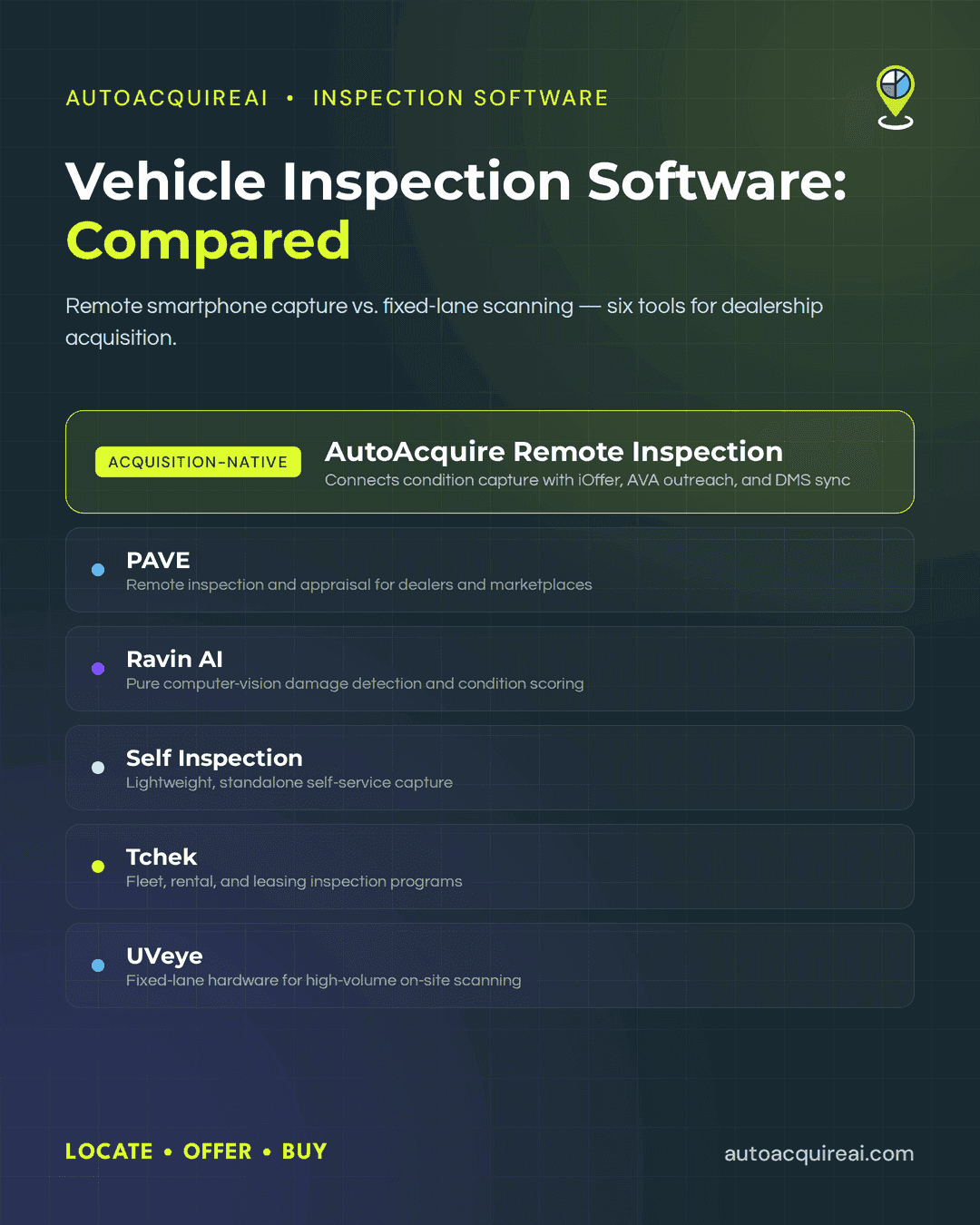
| Tool | Best For | Key Strengths | Potential Drawbacks |
|---|---|---|---|
| CARFAX | Dealer appraisals that benefit from a familiar report | CARFAX combines title, accident, service, odometer, and ownership information from a proprietary network. Dealer subscriptions and integrations support frequent use. | CARFAX generally costs more than basic NMVTIS reports. A clean report cannot prove that an unreported accident never occurred. |
| VinAudit | High-volume NMVTIS checks through an API | VinAudit provides NMVTIS title, brand, odometer, and salvage information. API access supports automated VIN lookup and batch use. | NMVTIS data does not provide the same service and accident detail as broader proprietary reports. Pricing differs between individual reports and business access. |
| MarketCheck | Dealers combining VIN data with market inventory analysis | MarketCheck offers APIs for vehicle specifications, listings, pricing, and history-related data. Dealers can use one technical connection for several acquisition inputs. | Available fields depend on the selected product and source coverage. Dealers should confirm title, lien, and accident fields before treating it as a full history service. |
| Vehicle Databases | Businesses that need configurable VIN and history APIs | Vehicle Databases offers VIN decoding and report products that can include title, salvage, auction, and ownership information. API options support integration. | Data sources and coverage vary by report and country. Public pricing and service-level details are limited for some business products. |
| NICB VINCheck | Free screening for theft and insurance salvage records | NICB checks participating insurer records for unrecovered theft and salvage history. The public lookup returns results immediately. | NICB does not provide a full vehicle history report, state title history, lien verification, or complete accident record. Usage limits make it unsuitable as the only high-volume tool. |
| VinData | Reviewing title, odometer, salvage, and total-loss data | VinData reports focus on records that can change valuation and disposition decisions. | Public information about business pricing, API terms, and response-time commitments is limited. Dealers should verify integration options directly. |
| ClearVIN | NMVTIS-based title checks with added history fields | ClearVIN provides title brands, odometer records, salvage information, and other report data. It supports individual reports and business services. | Coverage depends on reporting sources, and some accidents or repairs may never enter those sources. Business terms require direct confirmation. |
| Vincario | VIN decoding and specification data across multiple markets | Vincario provides API-based VIN decoding, vehicle specifications, and market-dependent data services. | Its strongest use case is decoding rather than a uniform US title and lien report. History coverage, pricing, and turnaround commitments vary by product. |
No single provider captures every relevant event. Dealers should match the source to the decision, then test field coverage, API response behavior, usage limits, and commercial terms before connecting it to an appraisal workflow.
Why a standalone VIN check still leaves a gap at the moment of offer
A standalone VIN check can return accurate data without controlling when staff review it. Service advisors may quote a preliminary value while a manager waits for the report, or staff may treat the lookup as a documentation task after the customer accepts the number.
A quoted amount quickly becomes the customer’s reference point. If a later car title check finds an active lien, the dealer must pause funding and obtain payoff details. If a salvage title check finds a branded title, the dealer may need to lower the offer, change the planned disposition, or decline the vehicle. Each response requires staff to explain why the original number no longer applies.
Manual lookups also divide responsibility across roles. An advisor may collect the VIN, a manager may run the vehicle history report, and accounting may discover a missing lien clearance later. The data provider can identify the issue, but the lookup cannot ensure that the right person reviews it before a commitment.
Dealers need an acquisition process that treats title and lien clearance as decision gates. The process should prevent an offer from advancing until required checks return and route any exception to the person authorized to adjust the deal.
Wiring title and lien verification into the acquisition workflow
AutoAcquire routes VIN, title, and lien results into iOffer’s number-building step. The software can turn each result into a defined acquisition rule instead of asking an advisor to interpret a separate vehicle history report. A branded title can trigger an adjusted valuation path or a decline, depending on dealership policy.
Lien verification creates a different branch. An active lien can prompt payoff coordination, record the amount owed, and calculate the seller’s remaining equity before funds move. The advisor receives an offer that already reflects the required payoff sequence rather than revising a quoted number later.
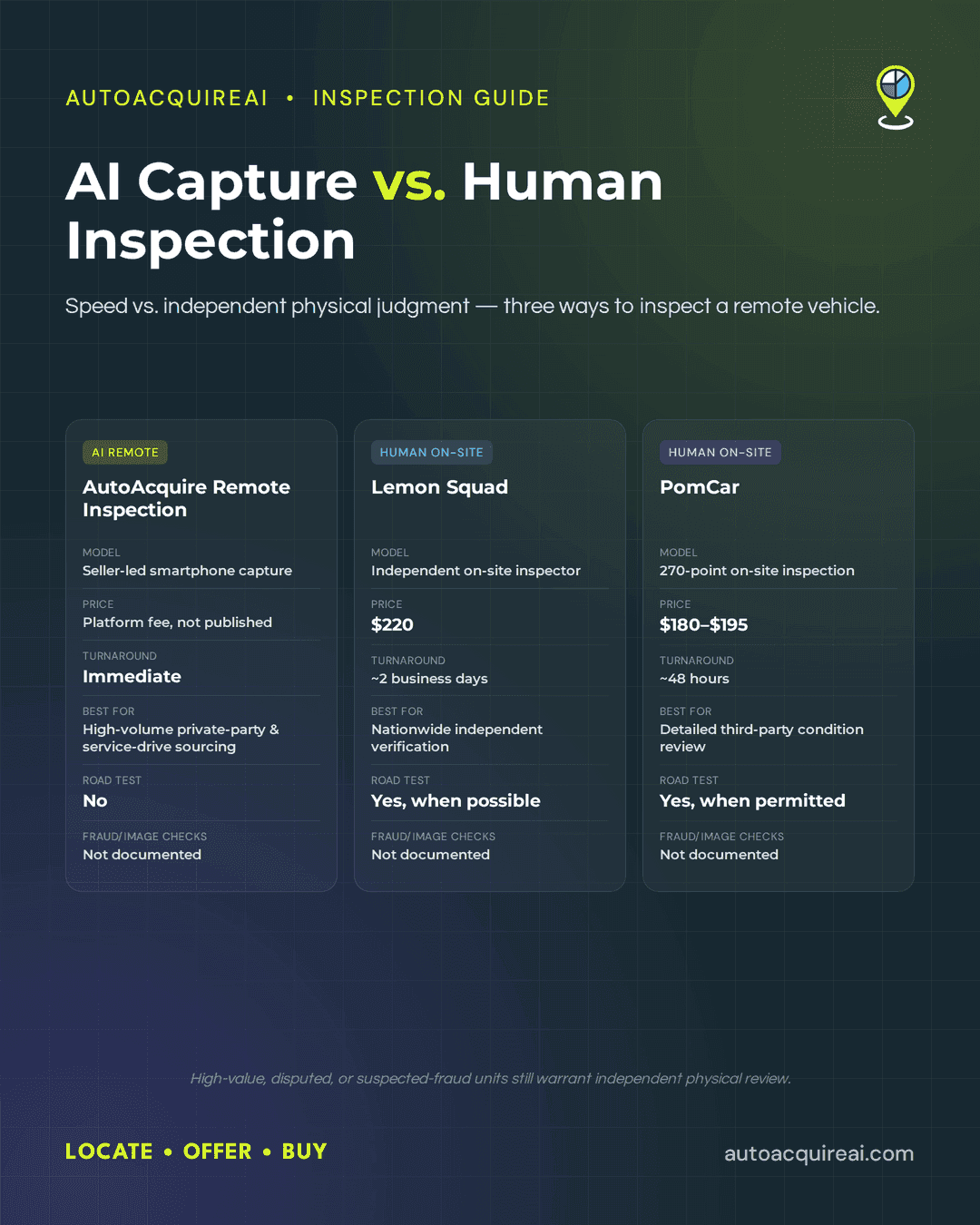
Remote Inspection supplies the vehicle condition data that supports the valuation. iOffer combines that condition information with the verification results to produce the instant cash offer. AVA can then handle outreach and follow-up with service drive customers or private sellers using the same acquisition record.
Dealers still need reliable data providers and clear rules for exceptions. AutoAcquire’s role centers on routing verified information into the next operational step. That approach makes VIN and title checks part of acquisition execution rather than a report that staff must review and transfer manually.
Buyer's guide FAQ
What is the difference between a VIN decoder and a vehicle history report?
A VIN decoder identifies factory specifications, while a vehicle history report compiles title, accident, odometer, and ownership records. A dealer needs both, since factory specs alone say nothing about liens, damage, or salvage status. AutoAcquire folds that verification into the same step where the offer gets built.
How fast can a dealer confirm a salvage title?
Response times vary by provider and record quality. An electronic salvage title check can return promptly when the provider matches the VIN against available NMVTIS, state, or insurer records, while incomplete or conflicting records require further review. Whatever the source, the flag only helps if it reaches the advisor before the seller hears a number, which is why routing the result straight into the offer calculation matters more than the lookup speed itself.
Is CARFAX or NICB better for dealer use?
Neither is a universal answer. CARFAX provides a broader commercial vehicle history report, while NICB VINCheck offers a free but narrower check limited to theft and insurer-reported salvage records. Many dealers run NICB as a fast initial screen and reserve CARFAX for units headed toward retail, where a fuller report supports appraisal and disclosure documentation.
Can VIN and lien checks run automatically inside an acquisition tool?
Yes, and the mechanics matter more than the automation label. Results need to land inside the same system that calculates the offer, not a separate dashboard staff have to check manually. In AutoAcquire's case, iOffer and Remote Inspection share the acquisition record, and a lien flag can trigger payoff coordination before anyone presents or funds an offer.
How dealers should evaluate a VIN check
Dealers should evaluate a VIN check on four criteria: whether it covers the records that change valuation, whether results arrive before the quote, whether flags flow directly into offer and payoff steps, and whether exceptions route to review. A pilot should test clean-title, branded-title, active-lien, and conflicting-mileage cases to confirm that each result produces the intended action.
Dealers evaluating acquisition software can compare AutoAcquire against that test set. Review how its VIN, title, and lien verification connects with iOffer calculations and AVA outreach, then confirm that each dealership policy is applied before a customer receives a number.