
TL;DR
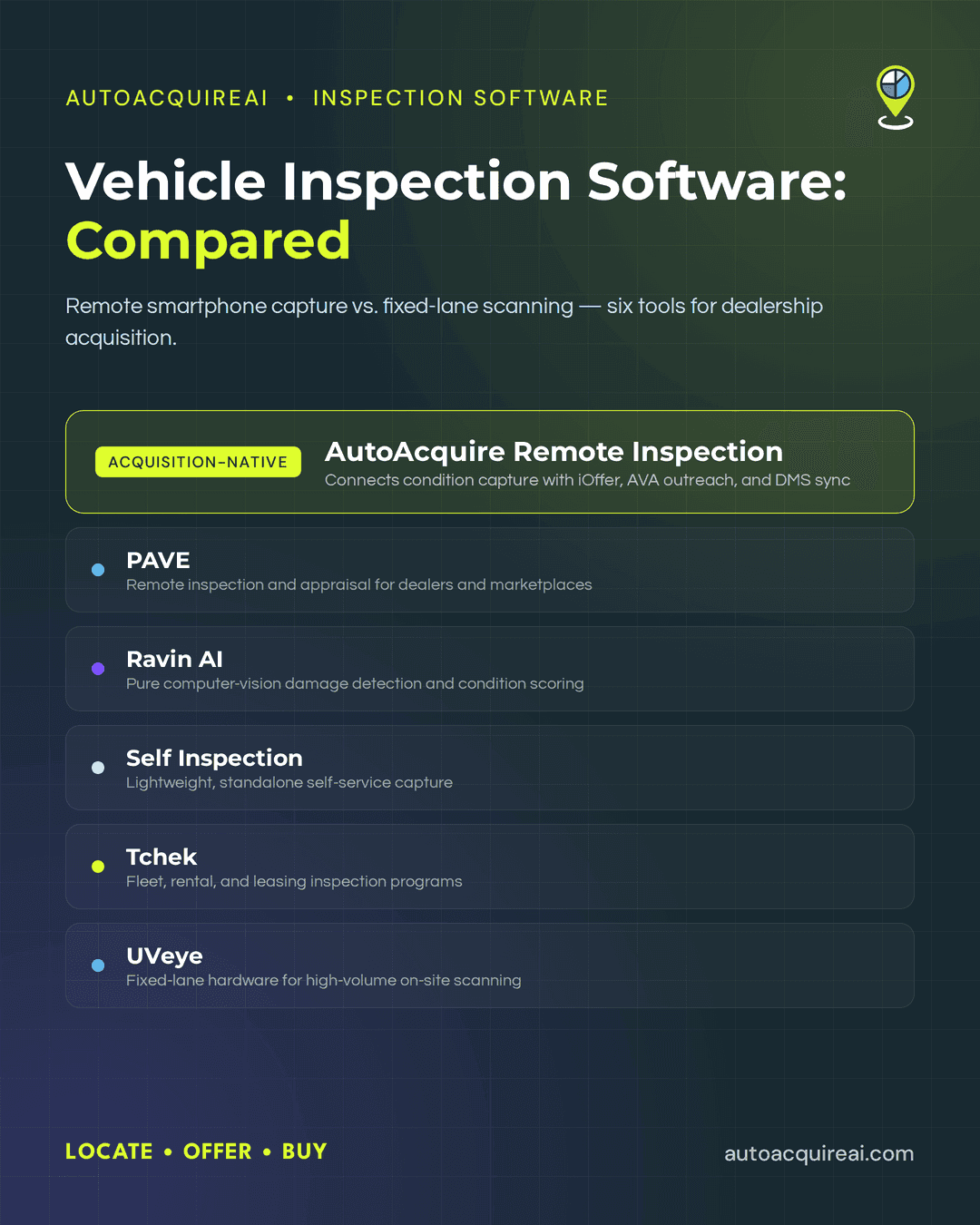
Smartphone-guided tools inspect vehicles anywhere, while fixed-lane systems require vehicles to pass through on-site hardware.
- AutoAcquire best fits dealers connecting remote inspection with AVA outreach, iOffer, and acquisition workflows.
- PAVE best fits dealers and marketplaces needing remote smartphone inspections and appraisals.
- Ravin AI best fits pure computer-vision damage detection and condition scoring.
- Self Inspection best fits lightweight, standalone customer-led inspections.
- Tchek best fits fleet, rental, and leasing inspection programs.
- UVeye best fits high-volume dealerships and auctions using fixed-lane scanning hardware.
Remote inspection versus fixed-lane scanning
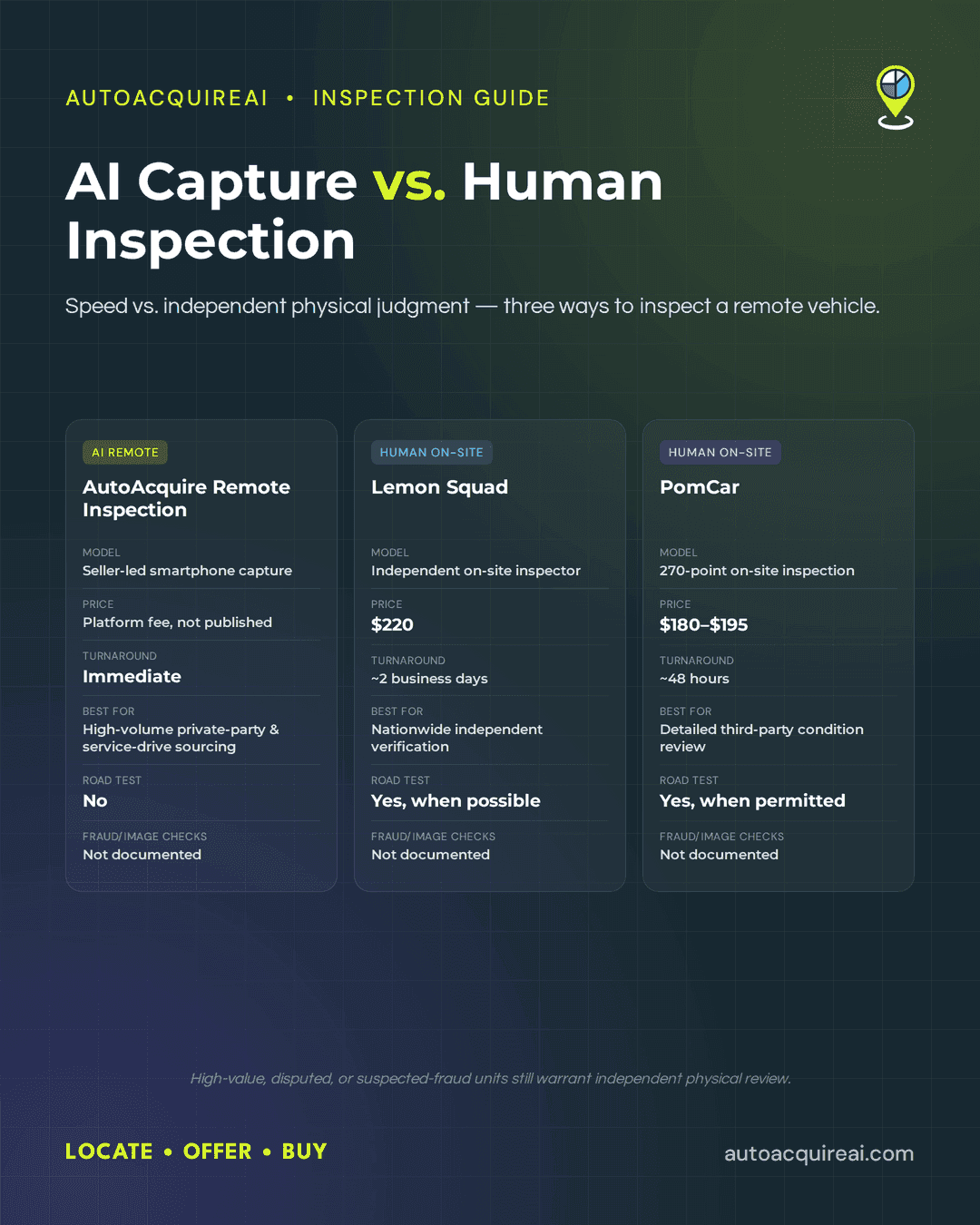
AI-guided remote inspection lets dealers collect consistent condition evidence before a vehicle reaches the store, reducing travel and manual photo chasing. Smartphone-guided vehicle inspection software prompts a seller or employee to capture required angles with a phone. AI car damage detection then reviews those images for visible defects. Remote capture favors private-party and trade-in inspection workflows, but dealers need clear retake prompts when users submit incomplete or unusable images.
Fixed-lane scanning uses installed cameras and sensors to inspect vehicles as they drive through a lane or tunnel. The vehicle must reach the dealership, auction, or fleet facility before inspection. Fixed hardware suits high-volume locations that need repeatable on-site scanning, while smartphone capture serves dealers acquiring vehicles across a wider area. Installation requirements and staff training make fixed lanes a larger operational commitment.
Dealers should evaluate both categories on image-integrity and fraud checks, VIN verification, and repair cost estimation. An instant cash offer gives a seller a preliminary purchase price based on submitted vehicle data and condition evidence. A service drive workflow identifies acquisition candidates among customers already visiting the dealership and routes them into outreach, appraisal, and offer steps. Dealer acquisition software also needs API or DMS access so inspection outputs can reach appraisal tools and reconditioning systems, while approved images can support merchandising. Privacy terms, image-retention controls, inspection completion rates, and exception handling determine whether either category works reliably in daily use.
AutoAcquire Remote Inspection
AutoAcquire Remote Inspection fits dealerships that want remote condition capture to feed directly into seller outreach, appraisal, and purchase workflows.
Best for. Used car departments and dealer groups acquiring vehicles from service drive customers and private sellers.
What it is. AutoAcquire provides AI-guided smartphone inspections as part of its broader acquisition platform. A seller follows capture instructions remotely, which lets dealership staff collect consistent vehicle images and condition information without arranging an initial store visit.
AVA connects inspection requests with automated outreach and follow-up. For example, a dealership can contact selected service customers, invite interested owners to complete an inspection, and continue the acquisition conversation without relying on manual BDC calls at every step.
iOffer adds instant cash offers to the workflow. The dealer can move from seller engagement and condition capture into an offer process within the same product set. The VRM Dashboard gives staff a central place to manage acquisition activity rather than tracking inspection links, seller responses, and offers across separate tools.
DMS sync with CDK, Reynolds, and Dealertrack helps carry vehicle and customer information into the dealership’s existing records. AutoAcquire complements those systems as an acquisition layer rather than replacing the DMS.
Pros.
- Remote Inspection, AVA, and iOffer connect seller outreach with condition capture and offer delivery.
- Smartphone-guided capture works for vehicles that have not reached the dealership.
- Service drive outreach helps dealers source potential inventory from existing customer relationships.
- The VRM Dashboard and DMS connections give managers more visibility after a seller completes an inspection.
- Open API access supports additional connections for groups with their own technology stack.
Cons.
- AutoAcquire focuses on dealership acquisition rather than standalone inspection deployments.
- The platform does not replace fixed-lane hardware for high-volume drive-through scanning.
- Dealers seeking forensic-grade condition scoring or specialized undercarriage and tire scans may need a pure inspection provider such as Ravin AI or UVeye.
- The broader acquisition toolset may exceed the needs of a business that only wants self-service photo collection.
Pricing. AutoAcquire does not publish standard Remote Inspection pricing in the available product information. Dealers need to request current terms based on their workflow and rooftop requirements.
PAVE
PAVE fits dealerships and marketplaces that need sellers or staff to document vehicle condition remotely before an in-person handoff.
Best for: Smartphone-guided remote inspections and appraisals.
What it is: PAVE guides users through vehicle image capture and applies AI to produce condition information for appraisal workflows.
Pros: Remote capture lets dealerships inspect vehicles outside the store and gives appraisers a consistent set of images to review. The smartphone workflow also suits marketplace transactions where neither party can access fixed scanning equipment.
Cons: Available information does not establish a complete dealership acquisition workflow covering seller outreach, instant cash offers, and service drive sourcing. Dealerships that need those functions may require additional software and manual handoffs.
Pricing: Public pricing and package details were unavailable in the provided research. Buyers need a direct quote and current feature confirmation.
Ravin AI
Best for
Dealers and OEMs that prioritize AI-guided condition assessment and computer-vision damage detection over a connected vehicle acquisition workflow.
What it is
Ravin AI analyzes guided vehicle images to identify visible damage and produce standardized condition records. Its inspection-focused approach suits organizations that need consistent assessments across vehicles or locations.
Pros
Ravin AI offers specialized computer-vision damage detection and guided image capture. Standardized records can reduce variation between manual inspections.
Cons
Ravin AI does not connect inspection results to seller outreach, service drive sourcing, or instant cash offers in the acquisition workflow described here. Dealers may need separate tools and manual handoffs to turn a completed inspection into an offer and acquired vehicle.
Pricing
No verified public pricing was available for this comparison. Buyers need a direct quote based on deployment requirements.
Self Inspection
Best for
Dealers that need a lightweight, self-service inspection step without a broader acquisition platform.
What it is
Self Inspection is a standalone vehicle inspection tool built around remote, customer-led condition capture. Its focused scope suits dealerships that already have separate appraisal, offer, and seller outreach systems.
Pros
The self-service model lets sellers document a vehicle remotely, which can reduce the need to bring every vehicle on-site for initial review.
Cons
Self Inspection functions as a point solution rather than an acquisition platform. Dealers may need another system to turn inspection results into an instant offer, manage seller follow-up, and track the vehicle through acquisition. That handoff can add manual work when the existing software stack lacks a suitable connection.
Pricing
Self Inspection does not provide enough verified public pricing detail for a useful estimate. Buyers need a vendor quote based on deployment requirements.
Tchek
Best for: Tchek fits fleet, rental, and leasing operators that need repeatable vehicle condition inspections across multiple locations or markets.
What it is: Tchek provides AI-assisted damage detection and vehicle inspection tools. Its focus on international fleet use cases separates it from dealership acquisition platforms built around seller outreach and vehicle offers.
Pros: The platform supports condition capture for rental returns, lease inspections, and fleet operations. AI damage detection can help operators apply a more consistent review process across vehicles.
Cons: Tchek does not center the workflow on dealership sourcing. A dealer may need separate systems for seller communication, instant cash offers, and acquisition tracking, which adds handoffs between inspection and appraisal.
Pricing: Verified public pricing was unavailable in the supplied research. Buyers will need a direct quote based on deployment size and use case.
UVeye
Best for: Dealerships and auctions that need high-volume, on-site vehicle scanning.
What it is: UVeye uses fixed drive-through hardware to scan vehicles for exterior damage, tire condition, and undercarriage issues. Vehicles must pass through an installed inspection lane, unlike smartphone-guided tools that sellers can use remotely.
Pros: Automated lane scanning supports consistent condition capture without requiring staff to photograph each vehicle manually. The installed hardware suits auction sites, service lanes, and large dealerships that inspect a steady flow of vehicles on location.
Cons: UVeye cannot inspect a private seller’s vehicle at home through a smartphone workflow. Dealers also need physical space, installed equipment, and a process for connecting scan results with appraisal and acquisition tools. Those requirements make it less practical for remote sourcing or lower-volume rooftops.
Pricing: UVeye does not provide enough public pricing detail for a reliable estimate. Buyers need a direct quote that accounts for hardware, installation, software, and site requirements.
Comparison table
Smartphone-guided tools support off-site seller inspections. Fixed-lane scanning uses installed hardware to inspect vehicles driven through a dealership or auction lane.
| Tool | Best For | Key Strengths | Potential Drawbacks |
|---|---|---|---|
| AutoAcquire Remote Inspection | Dealership acquisition workflows | Connects remote condition capture with iOffer, AVA outreach, and DMS sync | Does not provide fixed-lane scanning or forensic-grade condition scoring |
| PAVE | Remote inspection and appraisal | Smartphone-guided capture supports dealers and marketplaces | Pricing and acquisition workflow depth require vendor confirmation |
| Ravin AI | Pure AI car damage detection | Computer vision supports detailed condition assessment | Dealers may need separate seller outreach and instant cash offer tools |
| Self Inspection | Lightweight self-service inspections | Simple remote capture for standalone deployments | Point solution with limited acquisition workflow coverage |
| Tchek | Fleet, rental, and leasing inspections | Supports remote damage detection across distributed vehicles | Dealership acquisition integrations remain unclear |
| UVeye | High-volume on-site inspection | Fixed-lane hardware scans damage, tires, and undercarriages | Requires physical infrastructure and cannot inspect remote seller vehicles |
Feature checklist across platforms
An instant cash offer automatically prices a purchase offer from submitted vehicle data. A service drive workflow identifies and contacts service customers whose vehicles may fit inventory needs.
| Tool | AI-guided smartphone capture | Fraud/image integrity checks | VIN verification | Repair cost estimation | Instant cash offer integration | Service drive workflow | API access | DMS integration |
|---|---|---|---|---|---|---|---|---|
| AutoAcquire | Yes | Unclear | Yes | Unclear | Yes | Yes | Yes | Yes |
| PAVE | Yes | Unclear | Unclear | Unclear | Unclear | Unclear | Unclear | Unclear |
| Ravin AI | Yes | Unclear | Unclear | Unclear | Unclear | Unclear | Unclear | Unclear |
| Self Inspection | Yes | Unclear | Unclear | Unclear | Unclear | Unclear | Unclear | Unclear |
| Tchek | Unclear | Unclear | Unclear | Unclear | Unclear | Unclear | Unclear | Unclear |
| UVeye | No | Unclear | Unclear | Unclear | Unclear | Unclear | Unclear | Unclear |
“Unclear” means available research did not verify the capability. Before purchase, dealers should test incomplete image handling, completion rates, privacy controls, retention periods, and routing into appraisal, reconditioning, and merchandising systems.
Why AutoAcquire leads for dealership acquisition
AutoAcquire suits dealerships that need remote condition capture inside a direct acquisition workflow. Remote Inspection lets sellers document a vehicle by smartphone, while iOffer connects that condition report to an instant cash offer. Fewer handoffs between inspection and appraisal can shorten the time required to present an offer.
AVA extends the workflow into the service drive by automating approved outreach and follow-up with potential sellers. Dealers can identify acquisition opportunities, request inspections, issue offers, and track activity through the VRM Dashboard. DMS connections with CDK, Reynolds, and Dealertrack reduce duplicate entry after a seller accepts.
Specialists such as Ravin AI and UVeye may fit dealers that prioritize pure condition analysis or fixed-lane scanning. AutoAcquire fits used-car departments seeking more inventory directly from service customers and private sellers while complementing auction purchases. Dealers evaluating that model can review AutoAcquire’s acquisition workflow against their current inspection, outreach, and offer process.
Buyer's guide: choosing the right fit
Dealers should first decide where vehicles will be inspected. Smartphone-guided software fits private-party and service-drive acquisition because sellers or staff can capture condition data anywhere. Fixed-lane scanners suit rooftops and auction sites that process high on-site volume, but each location needs installed hardware.
The next choice concerns what happens after inspection. Standalone inspection platforms provide condition scoring for an existing workflow. AutoAcquire connects Remote Inspection with iOffer instant cash offers and AVA outreach, which suits dealers that need to move a seller through inspection, appraisal, follow-up, and purchase.
Dealer groups also need consistent deployment across rooftops. Buyers should assess whether each store can use the same inspection rules, user permissions, and reporting. DMS or API access should transfer vehicle and seller data without duplicate entry, while centralized visibility should let group managers compare activity across locations.
A pilot should test the workflow under real operating conditions. Track seller completion rates, staff intervention, image quality, and time to appraisal. Contract review should also cover data retention, customer consent, integration scope, support responsibilities, and any hardware or usage fees.
FAQs
- What is the difference between AI vehicle inspection software and fixed-lane scanning systems? Smartphone software guides a seller or employee through image capture anywhere. Fixed-lane scanning uses on-site hardware to inspect vehicles driven through a dedicated lane, which suits high-volume locations.
- Can remote inspection software replace an in-person appraisal entirely? Remote inspection can support routine purchase decisions, but uncertain damage, incomplete images, or mechanical concerns may require physical review. Dealers should track completion rates and set rules for failed capture.
- Does AI inspection software integrate with a dealership's DMS? Integration varies by vendor. AutoAcquire supports CDK, Reynolds, and Dealertrack, while its open API can route outputs into appraisal and related dealership systems. Dealers should review data retention, privacy controls, and connections to reconditioning or merchandising tools.
- Is AutoAcquire's Remote Inspection a standalone inspection tool or part of a larger acquisition platform? Remote Inspection operates within AutoAcquire’s dealer acquisition software. Dealers can connect condition reports with AVA outreach, the VRM Dashboard, and iOffer.
- How do dealers use instant cash offers alongside remote inspection? An instant cash offer gives a seller an automated purchase estimate. iOffer can use captured vehicle details to support an offer, then route accepted opportunities into appraisal and acquisition follow-up.