TL;DR
- Equity-mining tools identify customers who may sell or trade. Acquisition platforms manage outreach, appraisal, inspection, offers, follow-up, and purchase.
- Dealers should move each opportunity through a defined workflow that covers signal scoring, lead routing, seller contact, appointment setting, appraisal, title and payoff work, and outcome logging.
- AutoAcquire can act as the execution layer. AVA handles approved outreach, iOffer supports instant cash offers, and Remote Inspection captures vehicle condition. It complements DMS, CRM, and equity-identification products.
- The playbook provides scripts, objection responses, compliance controls, and stage-level KPIs.
- A clearly labeled hypothetical funnel and ROI example shows how to calculate acquisition rate, cost per acquired vehicle, and gross contribution.
Why equity mining fails without an execution layer
Equity-mining software identifies customers whose vehicles may be viable trade or purchase candidates. DMS, CRM, service, payoff, mileage, and market-demand data can surface valuable opportunities. An alert alone does not assign an owner, start outreach, collect condition details, produce an offer, or track the purchase.
Service-to-sales programs lose vehicles when responsibility shifts between departments without clear routing. Fixed operations may flag a repair event, but the BDC may receive the record too late. Appraisal staff may complete a valuation without a scheduled follow-up. The used car manager may never see why the customer declined or where the opportunity stalled.
Dealers need an identification layer and an execution layer. The identification layer ranks customers by factors such as equity position, service activity, vehicle desirability, and ownership status. The execution layer routes each opportunity and manages contact attempts, appraisal, inspection, offer approval, title or payoff work, follow-up, and final outcome reporting.
AutoAcquire can serve as that acquisition execution layer for service-drive and private-party opportunities, including signals produced by other dealership systems. It complements DMS, CRM, and equity-mining products rather than replacing them. Clear ownership and one tracked workflow turn a useful alert into a measurable acquisition process.
Data signals that actually predict a sellable or tradeable vehicle
A quality equity mining signal identifies a customer who may consider selling or trading and a vehicle the dealership wants to acquire. Records that meet only one condition waste outreach capacity. A customer with substantial equity offers little value when the vehicle already exceeds the dealership’s supply target or lacks enough data for a credible appraisal.
Dealers need separate scores for seller timing and acquisition fit. Equity mining software can combine the following inputs.
- Ownership and payoff data estimate equity by comparing the vehicle’s current value with its remaining balance. Dealers need a verified payoff before presenting a final purchase figure because stored loan data may not reflect the current balance.
- CRM history shows prior appraisal activity, replacement interest, previous outreach, and unresolved complaints. Recent engagement raises the value of a signal, while repeated nonresponse lowers its priority.
- Service and repair events create timely openings for service to sales outreach. A costly repair estimate may prompt replacement interest, but a completed repair may reduce the owner’s immediate motivation.
- Mileage trends help estimate value and ownership stage. Mileage works best when paired with service recency and expected payoff rather than treated as a stand-alone trigger.
- Market demand tells the used car department whether the vehicle fits current inventory needs. Local sales pace, available supply, and expected reconditioning cost prevent staff from pursuing vehicles with weak retail prospects.
Composite rules keep the daily queue manageable. For example, a recent service customer with positive estimated equity, a high repair estimate, valid contact information, and an in-demand vehicle deserves faster outreach than an owner selected only because the odometer passed 60,000 miles. The score connects customer timing with dealership demand.
Single-variable triggers generate noise because they ignore context. Mileage alone says nothing about payoff, condition, customer intent, or retail demand. A repair order alone may identify an owner who has already approved the work and plans to keep the vehicle. Managers can control volume by requiring one seller-timing signal, one acquisition-fit signal, current contact data, and no disqualifying CRM status before a record enters the outreach queue.
Prioritization rules and lead routing
Equity mining software needs a capacity-based threshold before it creates a daily work queue. A store that can complete 30 outreach attempts per day gains little from releasing 200 records. Managers can rank every eligible record, release the highest-scoring 30, and hold the remainder for later review.
A practical 100-point model might assign weights as follows.
- Equity position, 35 points. Give higher scores to owners with enough estimated equity to support a credible purchase or trade conversation.
- Local market demand, 25 points. Favor vehicles that match current stocking needs and recent retail demand. A strong customer signal has limited acquisition value when the store does not need the unit.
- Repair-event severity, 20 points. A costly repair estimate may increase interest in selling. The appraisal team still needs to account for the vehicle’s condition and expected reconditioning cost.
- Service visit recency, 10 points. Recent visitors receive priority because the dealership has current mileage and service information. A vehicle still on-site warrants immediate review.
- Payoff proximity, 10 points. Favor records with a verified payoff that leaves workable equity. Missing or stale payoff data lowers the score until staff confirm it.
Managers need separate queues for immediate action, scheduled nurture, and suppression. Set the daily threshold by available BDC and appraisal capacity. Review conversion by score band each week. If low-scoring records rarely reach appraisal, raise the threshold rather than asking staff to make more calls.
Routing rules assign one owner and one next action to every released record.
- Fixed operations confirms the visit status, repair context, mileage, and whether the customer remains on-site.
- The BDC owns approved calls and texts, records disposition, and books the appraisal appointment.
- Appraisal staff owns condition capture, valuation inputs, and the preliminary offer.
- The used car manager approves acquisition parameters, negotiation limits, and the final purchase decision.
Each record needs a named owner, due time, current status, and escalation rule. A live service-lane opportunity might require BDC action within minutes, while an older ownership signal may enter a scheduled cadence. Records that miss the deadline return to a manager queue instead of remaining under a department name with no accountable person.
Outreach execution: cadences, scripts, and objection handling
A short, approved cadence keeps viable opportunities moving without flooding customers with repeated messages. Dealers should define permitted contact windows, consent rules, opt-out handling, and channel limits before loading records into a BDC or automated outreach queue.
A practical cadence can use five touches over two weeks.
- Day 0. The assigned representative calls after the signal enters the queue. For an active repair order, the representative should coordinate with the service advisor before contacting the customer.
- Day 0 follow-up. If the customer does not answer, the representative sends an approved text where consent and applicable rules permit.
- Day 2. The representative sends an email that explains the purchase inquiry and offers remote or in-store appraisal options.
- Day 5. A second call uses a different approved daytime window.
- Day 10. A final text or email asks whether the customer wants an appraisal or no further contact. Unresponsive records then leave the active queue until a new qualifying event occurs.
Dealers should suppress outreach during applicable quiet hours and stop all automated sequences immediately after an opt-out. Managers should also cap total attempts across service, sales, and BDC systems so separate departments do not contact the same customer on the same day.
The opening script should explain why the dealership called and separate a vehicle purchase from a replacement sale.
“Hi, [Name], this is [Representative] with [Dealership]. Your [year and model] came up during our inventory review, and our used car department may be interested in purchasing it. Would you be open to a no-obligation appraisal during your service visit? We can also buy the vehicle without requiring another purchase.”
An approved text can make the same request with less detail.
“Hi [Name], this is [Representative] at [Dealership]. We are interested in purchasing your [year and model]. Would you prefer an appraisal at the store or a remote estimate? Reply STOP to opt out.”
The representative should book a specific appraisal path instead of ending with a vague promise to follow up. An in-store appointment needs a named appraisal owner and an expected duration. A remote appointment needs a condition-capture link and a deadline. The confirmation should list any required payoff or title information without asking the customer to send sensitive data through an unapproved channel.
Common objections need approved response patterns rather than improvised sales pressure.
- “I am not buying another vehicle.” The representative can explain that the dealership can make a straight purchase offer with no trade requirement.
- “I owe too much.” The representative should offer to review the current payoff before discussing proceeds. Staff should avoid estimating equity without a verified payoff.
- “Just give me a price over the phone.” The representative can collect the VIN, mileage, condition details, and equipment information for a preliminary offer. Any amount should remain subject to inspection and record verification.
- “I need the vehicle every day.” The representative can offer a remote inspection or schedule an appraisal during an existing service visit.
- “I am not interested.” The representative should acknowledge the response, record the disposition, and end the sequence. Staff should not convert a clear refusal into another sales pitch.
Managers should review recordings, message logs, appointments, and opt-outs by representative. Coaching should focus on accurate explanations and clean appointment handoffs rather than call volume alone.
From opportunity to purchase: the full acquisition workflow
A qualified equity mining lead needs a defined path through appraisal, inspection, approval, and purchase. Each department owns one stage and records its work before passing the opportunity forward.
- Fixed operations confirms the opening. The service advisor verifies the vehicle and customer at check-in, then routes an interested owner to the BDC or acquisition desk. The record carries the VIN, reported mileage, service history, contact notes, and any available payoff estimate.
- The BDC qualifies the seller. The BDC confirms ownership, selling interest, expected timing, and whether another decision-maker appears on the title. A qualified seller moves to appraisal staff with an appointment or a remote inspection request.
- Appraisal staff sets a preliminary value. The appraiser reviews equipment, mileage, service and damage history, local demand, and current market values. Any instant cash offer generated at this point remains conditional on inspection and title verification.
- The seller completes an inspection. Remote inspection works well when the seller cannot visit immediately. Guided photos and condition questions give the appraiser enough information to refine the estimate. An in-store inspection lets staff verify condition directly and may suit vehicles already in the service lane.
- The used car manager approves the offer. Appraisal staff submit the inspection findings and proposed purchase range to the used car manager. The manager reviews expected recon costs and inventory demand before setting the approved offer and negotiation limit.
- The acquisition representative presents and negotiates the offer. Staff explain any adjustment between the preliminary estimate and the inspected value with specific condition findings. Offers above the approved limit return to the used car manager rather than relying on informal verbal approval.
- Accounting resolves title and payoff requirements. Staff verify the titled owners, lienholder, payoff amount, and required documents before funding. Positive equity goes to the seller after lien handling. Negative equity requires a documented payment arrangement or a separate retail transaction if the customer buys another vehicle.
- The used car department accepts the vehicle and closes the record. Staff record the purchase price, acquisition source, inspection outcome, recon estimate, funding status, and final disposition. Lost opportunities also need a reason such as rejected offer, title issue, unreachable seller, or competitor purchase.
Handoff leakage usually appears when an appointment stays in BDC notes, an inspection result reaches the appraiser by text, or a manager approval remains verbal. A shared opportunity record reduces those losses by keeping each status, document, owner, and next action attached to the same vehicle. The dealership still retains its DMS and CRM, but the service to sales workflow needs one visible record that tracks the equity mining opportunity through purchase.
Where AutoAcquire fits as the execution layer
AutoAcquire carries prioritized service-drive and private-party opportunities through the acquisition workflow. A dealership can use signals detected within AutoAcquire or supplied by another dealership system. The platform then gives each selected record a path through outreach, qualification, condition capture, offer generation, and follow-up.
AVA runs dealership-approved outbound calls and follow-up cadences for selected sellers. Interested sellers can move to iOffer for an instant cash offer based on the dealership’s appraisal inputs. Remote Inspection collects an AI-guided, self-service condition report when the seller cannot visit immediately. Appraisal staff can review the submitted condition information before approving or adjusting the offer.
Dealership employees retain control over exceptions and purchase decisions. A BDC agent can take over a qualified conversation, an appraiser can resolve condition questions, and a used car manager can approve negotiation limits. Dealership staff also complete title, payoff, and purchase documentation under existing policies. The shared acquisition workflow helps managers see where a seller stopped instead of relying on disconnected notes and department handoffs.
AutoAcquire complements equity-mining software, the DMS, and the CRM. It does not replace customer records, repair-order history, or the identification products that may surface an equity opportunity. AutoAcquire offers an open API and integrations with CDK, Reynolds, and Dealertrack. Available data fields, write-back behavior, and automation depth can vary by connection and dealership configuration, so dealers should define the required routing and reporting before launch.
AutoAcquire best fits dealers that already identify promising vehicles but need a managed route to contact owners and complete acquisitions. Dealers seeking only equity alerts may not need the added execution workflow.
Equity-mining identification tools compared
Equity mining software differs most in the signals it uses and the dealership workflow it serves. Product packaging and integrations differ by deployment, so dealers need to test each tool against their actual DMS, CRM, and service data before purchase.
| Tool | Primary Function | Data Signals | DMS/CRM Connectivity | Outreach Capability | Best For | Operational Limitations |
|---|---|---|---|---|---|---|
| AutoAlert | Identifies sales and trade opportunities within the customer database | Ownership, equity, payment, service, and customer history signals | Uses dealership system data, with connection details tied to the installed configuration | Supports customer engagement around identified opportunities | Dealers building a structured service to sales program around existing customers | Dealers still need staff and connected appraisal processes to turn alerts into purchased vehicles |
| Total Customer Connect | Mines customer and service records for retention and sales opportunities | Service activity, ownership records, and customer history | Works with dealership data sources, subject to product configuration | Supports campaigns and customer follow-up | Fixed operations departments connecting service activity with sales opportunities | Campaign activity does not remove the need for appraisal, inspection, title, payoff, and purchase coordination |
| Solera | Provides dealership data and workflow products that may surface customer and vehicle opportunities | Available signals depend on the Solera product and connected dealership systems | Connectivity depends on the specific Solera product and dealer technology stack | Outreach functions depend on the selected product | Dealers already using Solera products and seeking connected customer data | Buyers must evaluate the named module rather than treat Solera as one equity mining product |
| DealerSocket RevenueRadar | Creates CRM alerts for customer sales and retention opportunities | CRM history, ownership timing, service events, and other configured triggers | Operates within the DealerSocket CRM environment | Routes alerts into CRM follow-up activity | DealerSocket users seeking equity mining inside an existing CRM workflow | Dealers outside DealerSocket face added system work, while purchase steps still require separate tools or manual handoffs |
| VINCUE | Supports vehicle acquisition decisions and inventory sourcing | Vehicle, valuation, inventory, and market-demand data | Connectivity depends on the dealership systems and purchased configuration | Supports acquisition activity, with workflow scope tied to the selected products | Used car departments connecting sourcing decisions with inventory demand | Dealers need to confirm whether outreach, condition capture, offers, and purchase reporting remain in one record |
These tools help identify likely equity opportunities. Most dealership configurations still require separate processes for outreach, appraisal, inspection, offer approval, and vehicle purchase.
Identification tools versus execution platforms
Equity mining software and acquisition platforms solve different operating problems. Identification tools rank customers who may sell or trade. Acquisition platforms move those opportunities through contact, appraisal, inspection, offer, and purchase. Dealers may need both categories when existing alerts produce viable names but staff lack a consistent service-to-sales workflow.
| Category | Appraisal & Offer Support | Inspection Workflow | Handoff Requirements | Reporting | Best For |
|---|---|---|---|---|---|
| Identification-focused equity mining tools | These tools surface likely equity opportunities, but appraisal and offer capabilities depend on the product and connected systems. | Most tools require staff to move the customer into a separate inspection or appraisal process. | The BDC or service advisor passes qualified interest to appraisal staff and the used car department. Every system change creates another status update for staff to record. | Reports typically cover identified opportunities and outreach activity. Purchase attribution weakens when staff complete later steps elsewhere. | Dealers that need better targeting from DMS, CRM, ownership, payoff, service, or mileage data. |
| AutoAcquire acquisition workflow | iOffer supports instant cash offers after the dealership gathers the required vehicle and seller information. | Remote Inspection collects seller-provided condition information before an in-store review when appropriate. | AVA handles approved outreach and follow-up, while dealership staff retain control of appraisal approval, negotiation, title work, and purchase decisions. | Workflow reporting follows progress beyond the initial signal, which gives managers more visibility into offers and acquisition outcomes. | Dealers that already have service-drive or private-party opportunities but need a consistent path to purchased inventory. |
AutoAcquire complements equity mining tools rather than replacing them. Identification software remains useful when a dealership needs sharper opportunity selection. AutoAcquire fits when the operational constraint sits after identification, especially when manual outreach, disconnected inspections, and separate offer tools slow acquisition.
Integration paths: DMS, CRM, APIs, and manual workarounds
Integration method determines how quickly an equity mining signal becomes a usable service-to-sales opportunity. It also determines whether managers can trace that opportunity through contact, appraisal, offer, and purchase. Feature lists reveal little about the delay and data loss between those steps.
| Integration path | Operating effect | Reporting consequence |
|---|---|---|
| Native connection | Records move between approved systems with limited staff intervention. Updates can reach the acquisition queue quickly. | Shared identifiers and timestamps support cleaner funnel reporting. |
| Open API | Dealers control which records and status changes pass between systems. The initial field mapping and authentication require technical work. | Reporting remains accurate when every stage writes back to the same opportunity record. |
| Middleware | A third-party connector translates records between systems. Mapping changes or connector failures can delay updates. | Added translation points make missing fields and duplicate records harder to diagnose. |
| Scheduled export | Staff transfer files on a fixed schedule. A morning export may omit a repair event or status change recorded later that day. | Reports reflect batch timing rather than current activity. |
| Manual re-keying | Employees copy customer, vehicle, and appointment details between screens. Staff time and input errors rise with volume. | Managers lose reliable attribution when record names, stages, or timestamps differ. |
AutoAcquire offers an open API and connections with CDK, Reynolds, and Dealertrack. Those connections still require clear field mapping. Dealers need to define which platform owns contact consent, lead status, appraisal values, and final acquisition outcomes.
Reporting degrades when the DMS records the service visit, the CRM records outreach, and another platform records the offer without a shared opportunity ID. Managers may see completed calls and purchased vehicles but cannot connect them to the original equity mining signal. Acquisition rate, days to purchase, and handoff leakage then require spreadsheet reconciliation.
Before selecting equity mining software, dealers need to inspect update frequency, write-back support, duplicate handling, failure alerts, and record ownership. A fast connection with incomplete write-back may move leads quickly while leaving the service-to-sales funnel impossible to audit.
Compliance and operating controls for outreach
Dealership outreach requires documented rules before staff or software contacts the first customer. The rules should define which records qualify for calls or texts, which consent supports each channel, and how long the dealership retains proof. A consent record should include the source, language presented, timestamp, customer identifier, and permitted communication methods.
Opt-out handling should stop future messages without relying on manual cleanup. The CRM or outreach platform should record the request, suppress the customer across active campaigns, and preserve an audit trail. Managers should test common opt-out language and establish a process for requests received by phone.
Quiet-hour controls should use the recipient’s local time and reflect the rules that apply in the relevant jurisdiction. Campaign settings should prevent scheduled messages and automated calls outside approved windows. Staff also need instructions for customers who request contact at a different time.
Call recording requires its own operating policy. Dealers should determine when disclosures or consent are required, place approved language at the correct point in the call, and control access to stored recordings. Recording rules vary by jurisdiction, so a dealership’s legal counsel must review the policy.
Approved script libraries keep automated and human outreach within the same boundaries. Legal and operational reviewers should approve claims about equity, estimated values, payoff status, and offer conditions before deployment. Platforms such as AutoAcquire can run approved AVA outreach cadences, but dealership managers remain responsible for script approval and campaign controls.
Data controls should limit each employee and vendor to the customer information needed for their assigned task. Dealers should document retention periods, vendor access, data exports, and deletion procedures. Regular audits should compare access logs with current job responsibilities and vendor agreements.
Human escalation rules should identify when automation stops and an employee takes over. Examples include disputed consent, customer complaints, title complications, sensitive financial questions, and requests to negotiate. The system should assign each escalation to a named role and track resolution time.
These controls provide an operating framework, not legal advice. Federal, state, and local requirements can differ by channel, location, consent method, and recording practice. Each dealership should obtain jurisdiction-specific legal review before launching or expanding call and text outreach.
KPIs to track at every stage
Equity mining reports need fixed stage definitions and denominators. Otherwise, managers cannot tell whether service-to-sales volume disappeared during targeting, outreach, appraisal, or purchase.
- Queue volume. Eligible records meet the basic data and policy requirements for review. Prioritized opportunities pass the dealership’s scoring threshold and enter the daily outreach queue. The ratio between them shows how tightly equity mining software filters the available customer base.
- Outreach performance. Contact rate divides reached customers by attempted contacts. Qualified conversation rate divides customers who express a credible interest in selling or trading by reached customers. Opt-out rate divides opt-outs by customers contacted through the applicable channel.
- Appointment performance. Appointment rate divides booked appointments by qualified conversations. Show rate divides completed visits or remote inspection sessions by booked appointments. Managers need separate reporting for in-store and remote appointments because each path creates different follow-up work.
- Appraisal and offer performance. Appraisal completion divides completed appraisals by vehicles presented for appraisal. Offer acceptance divides accepted offers by offers delivered. A completed appraisal requires enough condition, mileage, payoff, title, and market information for an approved offer.
- Purchase performance. Acquisition rate divides purchased vehicles by prioritized opportunities. Dealers may also track purchases against accepted offers, but reports must name the denominator. Median days from signal to purchase measures cycle time without allowing a few old records to distort the result.
- Economics. Cost per acquired vehicle divides program costs by completed purchases. Gross contribution needs a documented dealership definition, such as realized retail gross less acquisition and reconditioning costs. Managers must separate projected contribution from realized gross.
- Workflow control. Handoff leakage divides records that miss the next assigned action within the service-level window by all records routed to that stage. Each record needs an owner, timestamp, outcome code, and next action for this metric to reveal where work stopped.
Different drop-offs require different fixes. A low contact rate points toward poor data, timing, or channel strategy. A low show rate points toward weak appointment confirmation or excessive delay. A low appraisal completion rate exposes inspection or staffing friction, while a low offer acceptance rate calls for review of valuation, vehicle fit, and seller expectations. Managers gain a usable diagnosis only when each stage records the reason for loss.
Hypothetical funnel and ROI example
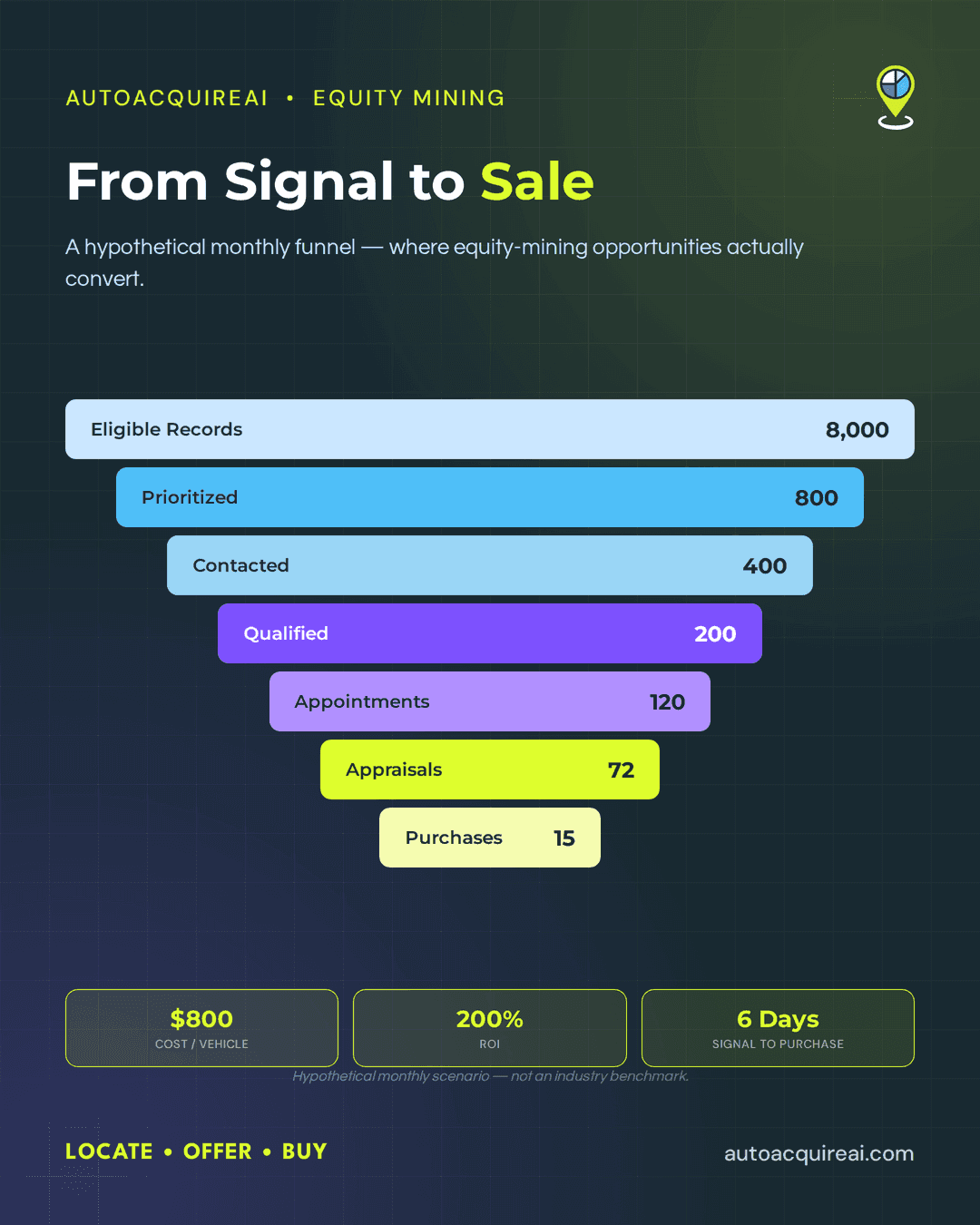
The following monthly scenario illustrates the funnel math and does not represent an industry benchmark. A dealership starts with 8,000 eligible service records and prioritizes 800 opportunities based on equity, vehicle demand, service activity, and estimated payoff.
All 800 prioritized opportunities receive at least one approved outreach attempt, and 400 customers respond live, producing a 50% contact rate. Half of those contacts produce 200 qualified conversations. The BDC books 120 appointments for a 60% appointment rate, and 84 customers arrive for a 70% show rate.
Appraisers complete 72 appraisals, which produces an 85.7% appraisal completion rate among customers who arrive. Six of the 12 incomplete appraisals lacked an assigned appraiser, creating a 7.1% handoff leakage rate among shown appointments. Eighteen customers accept an offer, and 15 purchases close after title and payoff processing. Offer acceptance reaches 25%, while completed purchases represent 1.9% of prioritized opportunities and 0.19% of eligible records.
The dealership also records 16 opt-outs, equal to 2% of the 800 customers who received outreach, and a median of six days between signal selection and purchase. Managers can compare both figures across campaigns to detect overly aggressive outreach or slow processing.
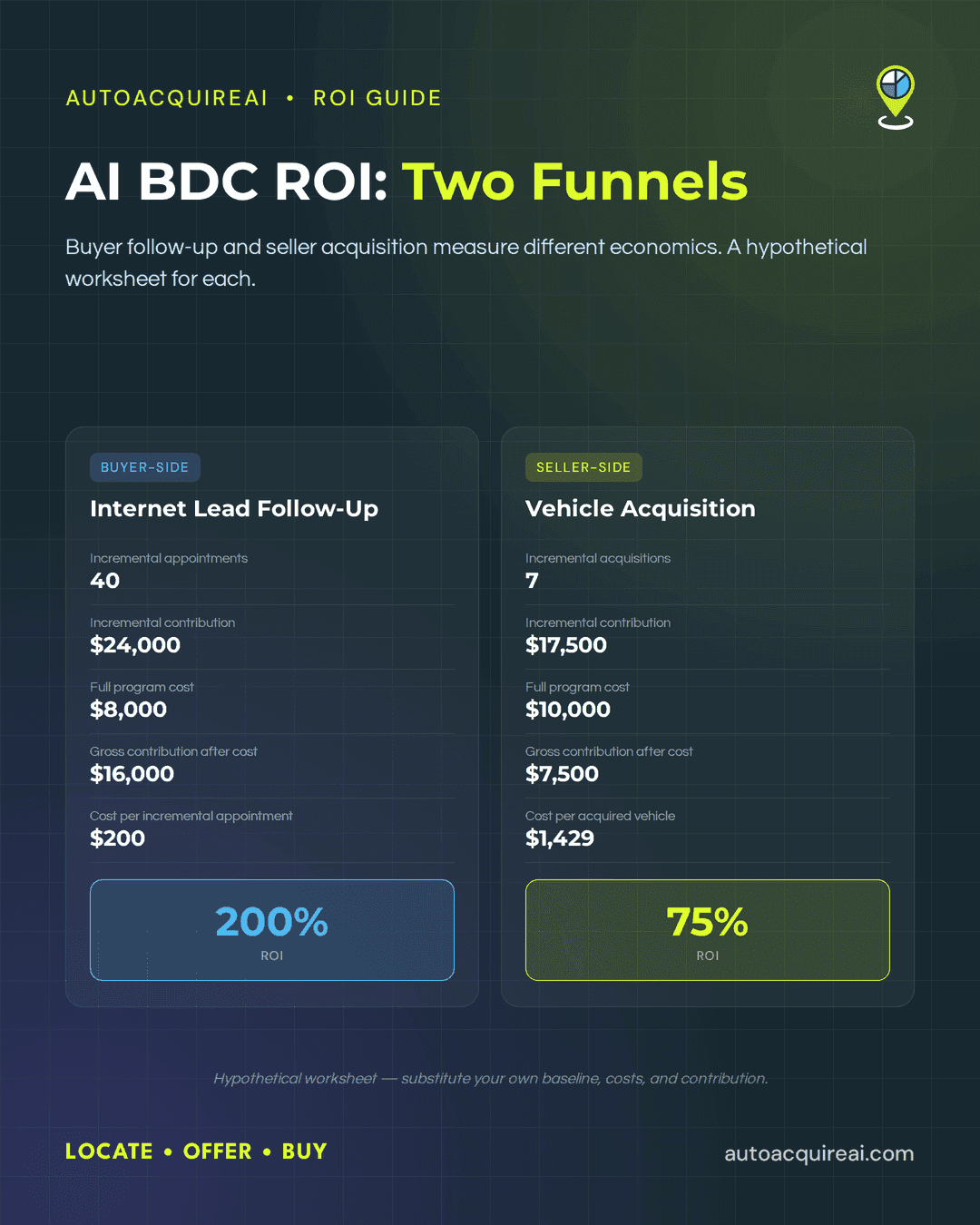
Assume each acquired vehicle contributes an estimated $2,400 after acquisition and reconditioning costs but before program expenses. Fifteen vehicles produce $36,000 in estimated gross contribution. If software and assigned labor cost $12,000 for the month, the program produces $24,000 after those expenses and an illustrative 200% return on program cost. The cost per acquired vehicle equals $12,000 divided by 15, or $800.
FAQs
How does equity mining differ from an execution platform?
Equity-mining software analyzes dealership data to identify owners who may be ready to sell or trade. An execution platform manages the work that follows, including outreach, condition capture, appraisal, offers, follow-up, and purchase tracking.
Does AutoAcquire replace a DMS or CRM?
AutoAcquire complements the DMS and CRM rather than replacing either system. It acts on service-drive and private-party opportunities, including signals supplied by existing equity-mining tools.
What makes an equity lead actionable rather than noise?
An actionable lead combines current ownership, payoff, service, mileage, and market-demand data into a credible acquisition opportunity. The dealership must also assign an owner, define the next action, and confirm that approved contact information is available.
How should a dealership handle compliance review?
Dealership counsel should review consent standards, opt-out handling, quiet hours, recording disclosures, and data practices for every applicable jurisdiction. Managers should approve scripts and escalation rules before launch, then audit calls and messages after deployment. This article does not provide legal advice.
Conclusion
Equity signals produce acquired vehicles only when dealers pair them with assigned ownership, approved outreach, timely appraisals, and measured follow-up. Used car managers and fixed operations directors should start with one service lane, set qualification thresholds, assign every handoff, and track each opportunity through purchase.
Funnel data will reveal whether contacts, appointments, appraisals, or accepted offers limit results. Dealers can then fix the specific failure point and add an execution layer where manual work slows outreach or causes handoff leakage.