
AI BDC ROI and Implementation Guide for Car Dealerships
TL;DR
- AI BDC cost includes platform fees, usage charges, integration work, staff training, management oversight, and ongoing call review. Vendor pricing alone understates the operating cost.
- ROI depends on incremental gross contribution and labor savings exceeding the full program cost. Dealers need pre-launch baselines to separate added results from activity that would have happened anyway.
- A controlled deployment starts with one use case, connects required CRM or DMS data, defines scripts and human escalation rules, and expands only after testing proves the economics.
- Buyer-side tools handle inbound leads and appointment follow-up. AutoAcquire and AVA focus on acquisition outreach to service-drive customers and private-party sellers. They do not replace general buyer-side BDC tools.
- Every worked ROI example in this guide is hypothetical. Dealers must substitute their own costs, conversion rates, and gross contribution.
What "AI BDC" covers and where it fits in a dealership's stack
An AI BDC uses voice or messaging automation to contact leads, continue follow-up, qualify interest, and route conversations to dealership staff. It sits between dealership data systems and human operators. The CRM or DMS supplies customer records and statuses, while the AI BDC handles approved conversations and writes outcomes back when the integration supports it.
Vendors commonly fall into three categories.
| Category | Primary use | Operational fit |
|---|---|---|
| Buyer-side inbound follow-up | Responding to internet leads, setting appointments, answering service inquiries, and re-engaging existing leads | Extends the sales or service BDC with faster first response and repetitive follow-up |
| General-purpose AI voice platforms | Building custom call flows across industries and use cases | Offers flexibility but may require more integration work, automotive workflow design, and internal oversight |
| Acquisition-native seller outreach | Contacting vehicle owners, qualifying selling interest, and moving suitable vehicles toward appraisal and purchase | Supports the used-car acquisition operation rather than the buyer sales funnel |
Most AI BDC products serve buyer-side internet leads, appointment setting, service inquiries, or inbound customer follow-up. Their ROI usually depends on faster response, more qualified conversations, and additional shown appointments. General AI voice platforms can support similar work, but the dealership or an implementation partner often must build the automotive logic and system connections.
AutoAcquire and AVA fit the acquisition-native category. AVA supports outreach to service-drive customers and private-party owners, then connects seller opportunities with iOffer instant cash offers and Remote Inspection. Approved outreach uses dealership-defined and legally reviewed audiences, channels, scripts, and consent rules.
AutoAcquire and AVA do not replace a general buyer-side BDC platform. Dealers evaluating ROI must first identify the funnel they need to improve. Buyer-side programs measure appointments and vehicle sales, while seller-side programs measure acquired vehicles and their gross contribution after program cost. Comparing those programs under one appointment-based ROI model produces misleading results.
The full cost model for an AI BDC program
A complete AI BDC budget includes software, usage, integration, internal labor, and ongoing quality control. ROI calculations that count only the subscription fee overstate program returns.
Platform and subscription fees
Vendor quotes may cover one rooftop, a defined use case, or a set number of users. Some contracts bundle voice and messaging volume, while others charge those services separately. Dealer groups also need to confirm whether each store, brand, phone number, or CRM instance adds another license fee.
Usage-based charges
Voice minutes and text messages often create variable costs. Some vendors also meter completed conversations or charge for carrier services. Dealers need pricing for expected volume and for overages, since a successful outbound campaign may cost more as contact volume grows.
Buyer-side and seller-side programs can produce different usage patterns. Buyer follow-up usually starts when a lead submits an inquiry. Seller acquisition may require several outbound attempts across a larger service-drive or private-party audience. AutoAcquire and AVA fit the second use case and do not replace general buyer-side BDC platforms.
Integration and implementation
Initial setup can include data mapping, CRM or DMS permissions, call routing, script configuration, testing, and vendor implementation fees. Internal employees also spend time granting access and validating records. Legal review of audiences, consent rules, channels, and approved scripts belongs in the launch budget.
The integration path changes both initial and recurring cost. A native connection can reduce custom setup, but the dealer still needs to test field mapping and write-back behavior. Middleware adds connector fees and another system to monitor. Manual exports and imports may avoid development work, but employees must move files, resolve duplicates, and correct stale statuses.
Ongoing dealership labor
An AI BDC still requires an accountable operator. Someone must review calls, inspect transcripts, handle escalations, and track opt-outs. Managers also need time for script changes, prompt maintenance, reporting, and periodic retraining.
Training extends beyond the software administrator. BDC agents and sales staff need clear instructions for receiving handoffs and updating outcomes. New hires require the same training later, so labor does not end after launch.
Quality control and operating support
Call sampling, complaint review, and failed-integration checks create permanent operating costs. Dealers may also pay for phone numbers, reporting tools, data storage, or premium vendor support. Budgeting a monthly QA allowance prevents these tasks from becoming unassigned work.
Single-rooftop deployments usually carry higher setup cost per location because one store absorbs the entire implementation effort. Multi-rooftop groups can spread shared configuration across stores, but differences in DMS instances, routing rules, and local scripts can limit those savings.
FULL PROGRAM COST
Platform fees + usage charges + integration costs + dealership labor + training + quality control + support costs
A dealer can calculate ROI only after every line enters the denominator. Vendor pricing remains one part of the operating cost.
Staffing impact: what AI BDC actually changes on your team
An AI BDC can reduce workload before it reduces payroll. Most dealerships gain capacity first because automation handles repetitive contacts while employees spend more time on conversations that require judgment. Headcount savings become realistic only when sustained workload data shows that fewer scheduled hours can support the same or higher output.
AI handles first contact and routine follow-up well when the dealership defines the audience, timing, and approved script. Automated calls and messages can cover evenings, respond quickly to new leads, and continue outreach when employees would otherwise move to newer opportunities. Buyer-side systems commonly handle internet lead follow-up and appointment scheduling. Acquisition-native tools such as AutoAcquire and AVA focus on service-drive customers and private-party sellers rather than replacing general buyer-side BDC tools.
Employees still need to manage negotiations, complaints, and unusual customer requests. A seller disputing a vehicle valuation may need a used car manager, while a buyer asking about financing terms may require a trained sales or finance employee. Escalation rules must route each conversation to a named queue with a response-time target. Without clear ownership, AI can create more unresolved tasks instead of reducing work.
Management time remains part of the program cost. A BDC leader must review call samples, monitor failed handoffs, and update scripts when dealership policies change. Someone also needs to investigate opt-outs and coach employees who receive AI-qualified conversations. Dealers should record those hours at a fully loaded labor rate when calculating ROI.
Staffing decisions should follow measured capacity rather than vendor estimates. A dealership might eliminate overtime, extend coverage without another hire, or reassign an employee to higher-value follow-up. Those outcomes count as labor value even when total headcount stays unchanged. Payroll reduction should enter the ROI model only after schedules or positions actually change.
Phased implementation framework
An AI BDC rollout should begin with one narrow use case at one rooftop or operating unit. A controlled pilot lets dealers compare results against existing performance while identifying integration failures, weak handoffs, and unplanned oversight costs.
Dealers should validate consent, scripts, routing rules, and escalation paths before expanding volume. Dealers should expand only after the pilot meets defined financial, operational, and compliance thresholds. These thresholds prevent a dealership from extending an unprofitable or poorly controlled workflow to more customers or rooftops.
Select one AI BDC use case and establish the ROI baseline
Start with one workflow that has a measurable outcome. A buyer-side pilot might cover new internet leads after hours. A seller-side pilot might contact eligible service-drive customers about selling or trading a vehicle. Running both at once mixes separate funnels and makes attribution difficult.
Record current performance manually over a representative period before selecting tooling. Buyer-side baselines should include contact rate, appointment rate, show rate, response time, and cost per appointment. Seller-side baselines should include contact rate, qualified seller conversations, appraisal or offer acceptance, acquired vehicles, cost per acquisition, and gross contribution. Include current labor and management time in each cost figure.
Post-launch ROI requires a valid comparison. Dealers must measure incremental outcomes against the pre-launch baseline, then subtract platform fees, usage charges, implementation labor, and ongoing oversight. A higher contact rate alone does not establish positive ROI.
AutoAcquire and AVA fit seller-side pilots built around service-drive customers and private-party owners. They do not replace general buyer-side BDC tools. Approved outreach requires the dealership to define the eligible audience and permitted channels. Legal counsel must review scripts and consent rules before launch.
A compact vendor evaluation checklist includes the following items.
- The product supports the selected buyer-side or seller-side workflow.
- CRM or DMS data can support reliable routing, write-back, consent records, and opt-outs.
- Reporting separates incremental outcomes from activity volume.
- Staff can receive escalations promptly and review conversation quality.
- Pricing captures usage, integration work, training, and ongoing labor.
Delay adoption when the dealership lacks a reliable baseline, usable consent records, a staffed escalation queue, or an owner for quality control. Software cannot produce defensible ROI when the dealership cannot identify what changed or maintain the workflow after launch.
Phase 2: CRM, DMS, and data access setup
CRM and DMS access must work before the dealership builds scripts or call flows. A buyer-side AI BDC usually needs lead records, contact preferences, and current ownership status from the CRM. The tool must also write back call outcomes, appointments, notes, and updated lead status without creating duplicate records.
Seller-side acquisition requires different data. Service-drive outreach may depend on repair-order history, vehicle details, and customer contact permissions stored in the DMS. Private-party outreach needs a defined source for seller and vehicle records. The AI BDC must read current consent and opt-out flags before every outreach attempt.
Approved outreach limits which records the AI BDC can use. The dealership must define eligible audiences and permitted channels. Legal counsel must review the scripts and consent rules before launch. Dealers also need one source of truth for opt-outs so a request captured by the AI updates every connected system.
A dealership system administrator or IT owner normally grants access, while the vendor maps each source field to its destination. The BDC leader then defines routing rules for new leads, active opportunities, sold customers, and records that require human review. Each rule needs an owner, a destination queue, and a response deadline.
Integration claims require a field-level test. Dealers commonly need vendors to support CDK, Reynolds, or Dealertrack integrations, but naming a DMS does not prove that every required field can move in both directions. AutoAcquire and AVA support these DMS environments and an open API for acquisition workflows. Dealers still need to confirm rooftop permissions, update frequency, write-back support, and error reporting before launch. A successful test should create a sample record, route it correctly, record the outcome, and honor an opt-out without manual correction.
Phase 3: Call routing, scripts, and escalation rules
A written conversation flow must define what the AI BDC can say, which actions it can take, and when a human assumes control. Buyer-side flows may qualify an internet lead and schedule an appointment. Seller-side flows may confirm vehicle details and interest in an offer. AutoAcquire and AVA support acquisition outreach to service-drive customers and private-party sellers, but they do not replace general buyer-side BDC tools.
Approved outreach uses dealership-defined and legally reviewed audiences, channels, scripts, and consent rules. Legal counsel reviews compliance language, while sales, acquisition, and BDC leaders approve operational claims. Material script changes should return through the same approval path before deployment. Version control prevents an outdated offer, disclosure, or objection response from remaining active.
An escalation matrix should identify the trigger, destination, transfer method, and expected response time. Price negotiation should route to a manager with authority to discuss the deal. Complaints and legal questions require separate queues staffed by employees trained to handle them. Opt-out requests should stop further outreach immediately rather than wait for manual review.
Routing logic must match each conversation to a named human queue. Buyer inquiries may go to the appropriate sales desk, while seller conversations may go to the used car or acquisition team. The AI BDC should pass the transcript, customer record, and reason for escalation with the transfer. After-hours rules should schedule a callback or capture a preferred contact time when no qualified employee is available.
Escalation coverage creates a real labor cost. Dealers can estimate it by multiplying expected weekly escalations by average handling time, then adding call review and script maintenance hours. Management must also staff peak periods when immediate transfers are promised. An AI BDC ROI calculation that excludes this oversight labor overstates savings and understates the operating cost of a reliable deployment.
Phase 4: Testing, staff handoffs, and launch
A controlled pilot should prove the AI BDC workflow before any full rollout. Start in shadow mode, where the system processes real or duplicated records without contacting customers. Managers can inspect lead selection, scripts, routing, CRM updates, and opt-out handling without creating customer exposure.
The live pilot should cover one rooftop, use case, or lead segment. Buyer-side pilots can compare response time, qualified conversations, and appointments against the prelaunch baseline. Seller-side pilots can compare qualified vehicle opportunities and completed acquisitions. AVA fits the second test by routing interested service-drive customers or private-party sellers into the dealership’s appraisal process.
Staff training should focus on acting on qualified handoffs. BDC representatives need to know why the AI flagged a record, what the customer already discussed, and which action comes next. Training must also cover immediate escalations, missed handoffs, duplicate outreach, and CRM ownership. Buyer leads belong in the appropriate sales queue, while seller opportunities belong with the used car or appraisal team.
Full launch should wait until the pilot passes a written go or no-go checklist.
- Approved outreach uses dealership-defined, legally reviewed audiences, channels, scripts, and consent rules.
- CRM or DMS records update accurately, and opt-outs suppress further contact.
- Calls and messages reach the correct human queue within the required response window.
- Staff can accept, document, and close AI-qualified handoffs without creating duplicate work.
- Pilot performance meets the dealership’s baseline and quality thresholds.
After approval, expand volume in stages. Daily review during the first weeks helps managers catch routing failures, script problems, and weak handoff execution before broader deployment.
Phase 5: Continuous monitoring and quality control
Quality control remains a permanent labor and software cost after launch. An assigned manager should review a weekly sample of recordings and transcripts across successful, failed, and escalated conversations. The review should check whether the AI follows approved scripts, captures dispositions correctly, and routes handoffs to the right queue.
Script drift requires version control and routine testing. Vendor updates, prompt edits, and changing inventory conditions can alter responses even when the original call flow performed well. Managers should log each script change, test common scenarios before release, and compare results with the prior version.
Opt-outs and complaints need faster review than general performance metrics. Dealers should monitor both daily and set thresholds that pause a campaign or channel. The AI BDC must record opt-outs in the source system quickly enough to prevent another automated contact. Complaint reviews should identify whether the problem came from audience selection, consent records, timing, or the conversation itself.
Performance baselines also need periodic updates. Buyer-side programs should compare contact, appointment, and show rates with current manual performance. Seller-side programs should remeasure acquisition rate, cost per acquired vehicle, and gross contribution against recent sourcing results. Seasonal demand, staffing changes, and lead mix can make an old baseline misleading.
AI BDC ROI remains credible only when dealers count ongoing review hours, script maintenance, vendor support, and escalation handling as program costs. Monthly ROI reporting should use monitored outcomes rather than vendor activity totals. Otherwise, higher conversation volume can appear profitable even when appointments fail to show or seller outreach produces no acquired vehicles.
Integration options: native, API, middleware, and manual workarounds
An integration claim has operational value only when data moves in both directions, arrives fast enough for the use case, and recovers cleanly after an error. A vendor connection that only imports leads may still leave staff updating statuses, opt-outs, and appointment outcomes by hand.
| Integration tier | How it works | Operational tradeoffs |
|---|---|---|
| Native integration | The AI BDC connects directly through a supported CRM or DMS relationship. | Native connections usually offer faster updates and lower maintenance. Dealers still need to confirm supported fields, write-back behavior, and error handling. |
| Open API | The vendor exposes documented ways to exchange records and trigger actions. | APIs can support near-real-time data flow, but the dealer or an implementation partner must build, secure, monitor, and maintain the connection. |
| Middleware connector | A third-party platform transfers data between the AI BDC and dealership systems. | Middleware can shorten development time. The extra platform can add fees, processing delays, and another failure point. |
| Manual export and import | Staff move CSV files or re-enter records between systems. | Manual workflows can support a small pilot, but updates arrive late and staff can create duplicate or incomplete records. Labor grows with outreach volume. |
Native does not automatically mean complete. Dealers need to test whether the connection reads lead status, service history, ownership data, and consent flags. The same test should confirm that the AI BDC writes back call outcomes, appointments, opt-outs, and human escalation notes without overwriting dealership records.
AutoAcquire provides an open API and native integrations with CDK, Reynolds, and Dealertrack. Those connections support AVA’s acquisition workflow for service-drive customers and private-party sellers. They do not make AVA a replacement for general buyer-side BDC tools.
A practical integration review should answer five questions.
- Which records and fields move in each direction?
- How quickly do updates appear after a call or message?
- Who monitors failed transfers and resolves duplicate records?
- How does the connection preserve consent and opt-out status?
- What development fees, connector charges, and staff hours belong in the ROI model?
Dealers should test those answers with real records before launch. Vendor diagrams cannot reveal missing fields, delayed status updates, or manual cleanup work.
AI BDC KPIs for Buyer Follow-Up and Seller Acquisition
Buyer-side and seller-side AI BDC programs require separate scorecards. Buyer follow-up measures how well the system converts existing demand into showroom activity. Seller acquisition measures how efficiently outreach produces retailable inventory. AutoAcquire and AVA belong in the second track and do not replace general buyer-side BDC tools.
Buyer-side follow-up KPIs
| KPI | Practical definition |
|---|---|
| Contact rate | Percentage of assigned leads that complete a two-way interaction |
| Qualified conversation rate | Percentage of contacted leads that meet dealership-defined purchase criteria |
| Appointment rate | Percentage of qualified conversations that produce booked appointments |
| Show rate | Percentage of booked appointments that arrive |
| Cost per appointment | Full program cost divided by attributable appointments |
| Response time | Time between lead receipt and the first valid outreach attempt |
A dealership must define each denominator before launch. For example, counting an unanswered text as contact will inflate contact rate without showing whether the AI BDC reached a shopper. Cost per appointment should include platform charges, usage fees, integration expense, and staff oversight.
Seller-side acquisition KPIs
| KPI | Practical definition |
|---|---|
| Acquisition rate | Percentage of qualified seller opportunities that become purchased vehicles |
| Cost per acquired vehicle | Full program cost divided by attributable vehicle purchases |
| Gross contribution | Expected or realized vehicle gross after acquisition, reconditioning, holding, and selling costs |
Seller-side reporting must follow vehicles beyond the initial appointment. A high appointment rate provides little economic value when acquired vehicles require excessive reconditioning or remain unsold. AutoAcquire and AVA support this funnel through approved outreach to service-drive customers and private-party sellers. Approved outreach uses dealership-defined, legally reviewed audiences, channels, scripts, and consent rules.
Shared operating guardrails
Escalation rate measures how often the AI transfers a conversation to staff. A rising rate can expose weak scripts, poor routing, or use cases that require more human judgment than expected. Opt-out rate measures the share of contacted people who request no further communication. Dealers should review opt-outs by audience and channel rather than treating one blended rate as sufficient.
Gross contribution after program cost is the common profit measure for both tracks.
For buyer follow-up, dealers should subtract full program cost from contribution generated by incremental sold appointments. For seller acquisition, dealers should subtract full program cost from contribution generated by attributable acquired vehicles. Baselines and consistent attribution rules determine whether either calculation reflects actual incremental profit.
A hypothetical ROI worksheet
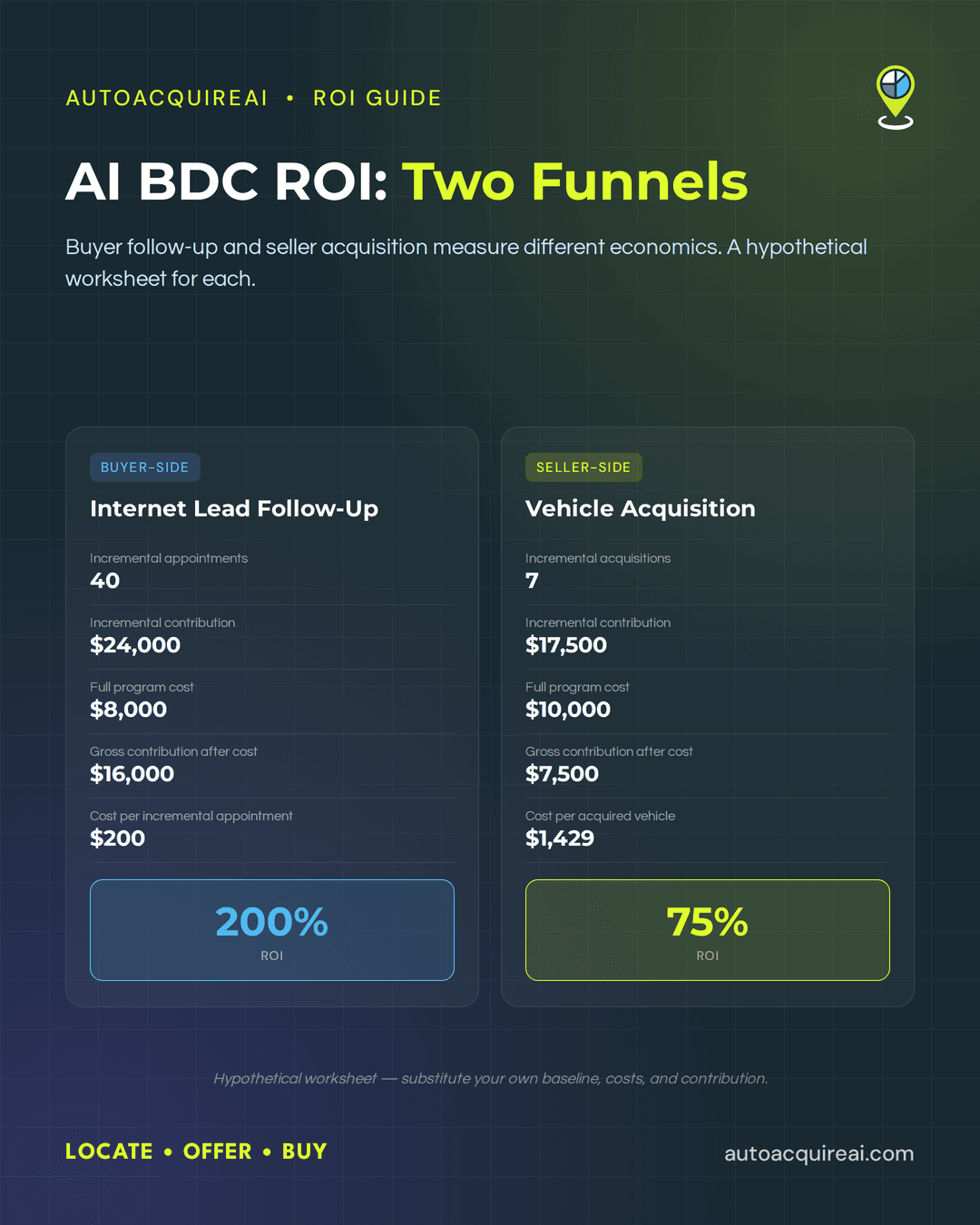
AI BDC ROI equals incremental gross contribution minus the full program cost. Dealers must include vendor charges and internal labor, then compare performance with a documented pre-launch baseline. The examples below are hypothetical worksheet structures, not industry benchmarks.
Hypothetical buyer-side follow-up scenario
A dealership processes 1,000 internet leads per month. Its baseline produces 80 appointments. During a controlled AI BDC pilot, the same lead volume produces 120 appointments, which creates 40 incremental appointments.
The hypothetical incremental value follows this calculation.
- 40 incremental appointments × 60% show rate = 24 incremental shows
- 24 incremental shows × 50% close rate = 12 incremental sales
- 12 incremental sales × $2,000 contribution per sale = $24,000 incremental contribution
The hypothetical monthly program cost includes $4,000 for platform and usage fees, $1,000 for amortized integration work, $2,000 for staff oversight and quality review, and $1,000 for training and script maintenance. Full program cost equals $8,000.
- Gross contribution after program cost = $24,000 minus $8,000 = $16,000
- ROI = $16,000 ÷ $8,000 = 200%
- Cost per incremental appointment = $8,000 ÷ 40 = $200
Dealers must replace every input with their own baseline, close rate, contribution definition, and labor cost. A seasonal demand increase or advertising change can create apparent lift that the AI BDC did not cause.
Hypothetical seller-side acquisition scenario
A dealership uses acquisition-native outreach to contact dealership-approved service-drive and private-party audiences. Approved outreach uses dealership-defined and legally reviewed audiences, channels, scripts, and consent rules. The baseline produces three acquired vehicles per month, while the hypothetical pilot produces ten. The program therefore adds seven incremental acquisitions.
Assume each incremental vehicle contributes $2,500 after purchase cost and expected reconditioning. The illustrative calculation produces $17,500 in incremental contribution.
The hypothetical full program cost totals $10,000. That figure includes platform and usage charges, integration costs, management labor, and quality-control time.
- Gross contribution after program cost = $17,500 minus $10,000 = $7,500
- ROI = $7,500 ÷ $10,000 = 75%
- Cost per incremental acquired vehicle = $10,000 ÷ 7 = $1,429
Dealers must substitute actual acquisition baselines and realized vehicle contribution. Buyer-side appointment assumptions cannot support a seller-side ROI case. Acquisition-native systems such as AutoAcquire and AVA serve seller outreach workflows and do not replace general buyer-side BDC tools.
Compliance and operating guardrails
AI BDC compliance requirements vary by jurisdiction and communication channel. This section does not provide legal advice. Dealers must have qualified counsel review audiences, consent records, scripts, call flows, and data practices before launch.
Approved outreach means dealership-defined, legally reviewed audiences, channels, scripts, and consent rules. A vendor should not decide those boundaries independently.
- Consent capture. The dealership must document how each contact entered the outreach list and what permission supports calls or texts. CRM and DMS records should retain the consent source, date, scope, and any later withdrawal.
- Calling and texting rules. Counsel must evaluate applicable TCPA-style requirements, state laws, do-not-call obligations, and rules for automated or prerecorded communications. A valid consent basis for one channel may not cover another.
- Opt-outs and suppression. Every supported channel needs a clear opt-out method. The AI BDC must write suppression requests back to the relevant source systems quickly enough to prevent another campaign from contacting the same person.
- Recording disclosures. State requirements for recording consent differ. Call flows must provide the required disclosure before recording begins, and the platform must preserve disclosure records when needed.
- Quiet hours. Campaign settings must restrict outreach by the contact’s local time and applicable rules. Multi-state dealers need location-aware controls rather than one schedule for every record.
- Data handling. The dealership must identify which customer and vehicle fields the vendor receives, where the vendor stores them, and how long the vendor retains them. Access controls and deletion procedures should cover recordings, transcripts, and exported lead files.
- Human escalation. Approved scripts need mandatory handoffs for price negotiations, complaints, legal questions, and consent disputes. Routing rules must identify the responsible employee and define what happens when that person cannot respond.
No AI BDC campaign should launch until counsel approves the audience, channel, script, consent basis, and opt-out workflow.
Ongoing review remains necessary after approval. Managers should sample calls, inspect opt-out handling, monitor complaints, and pause any workflow that departs from its approved script or audience rules. Any material change to the use case, data source, or communication channel should return to legal review before deployment.
Comparing your options: staffing model to acquisition-native AI
Dealers can compare staffing and software options by matching each model to the job that needs coverage. Buyer follow-up and seller acquisition use different data, conversations, and outcome measures.
| Model | Best For | Key Features/Focus | Cost Structure |
|---|---|---|---|
| Traditional BDC staffing | Mixed workflows that require judgment, negotiation, and exception handling | Human calling, messaging, appointment setting, escalation handling, and CRM updates | Salaries, benefits, recruiting, training, management time, and technology |
| Buyer-side inbound AI follow-up platforms | Internet leads, inbound inquiries, appointment setting, and service follow-up | Fast first response, repetitive follow-up, lead qualification, and human handoffs | Platform fee plus usage charges, integration work, and staff oversight |
| General-purpose AI voice platforms | Dealers willing to configure and maintain custom calling workflows | Flexible voice automation, custom scripts, call routing, and API connections | Software and usage fees plus heavier setup, testing, integration, and maintenance labor |
| Acquisition-native seller outreach with AutoAcquire and AVA | Sourcing vehicles from service-drive customers and private-party owners | Seller outreach tied to iOffer instant cash offers and Remote Inspection | Platform and usage costs plus integration, campaign oversight, and acquisition-team follow-up |
AutoAcquire and AVA fit dealers that need an execution layer for used-vehicle acquisition. AVA can run approved outreach to dealership-defined audiences through legally reviewed channels, scripts, consent rules, and calling schedules. iOffer and Remote Inspection then support valuation and remote condition capture within the acquisition workflow.
AutoAcquire does not replace a general buyer-side BDC platform. Dealers primarily trying to improve internet-lead response or sales appointment follow-up should evaluate buyer-side products for those functions. A dealership may use both categories when buyer engagement and vehicle acquisition require separate workflows.
Choosing the right AI BDC approach for your dealership
Choose an AI BDC category based on the operating problem, then run a narrow pilot against documented costs and baseline results. Buyer-side platforms handle inbound lead follow-up and appointment setting. Acquisition-native tools address seller outreach and used-inventory sourcing.
Dealers with unmet acquisition goals can evaluate AutoAcquire and AVA for service-drive and private-party outreach. AVA works with iOffer and Remote Inspection as a complementary acquisition layer. It does not replace a general buyer-side BDC platform or the dealership’s full BDC team.
Before selecting a vendor, confirm the following.
- The use case matches the vendor’s actual workflow.
- CRM and DMS access supports required read and write actions.
- Pricing includes usage, integration labor, oversight, and quality control.
- Escalations reach a trained employee with enough context.
- Approved outreach follows dealership-defined, legally reviewed audiences, channels, scripts, and consent rules.
- Pilot KPIs measure incremental gross contribution after total program cost.
Delay adoption when baseline performance remains undocumented, required data cannot move reliably, or staff cannot own escalations and quality review. Scale only after the pilot produces measurable incremental value under normal operating conditions.
FAQs
- Can AI BDC fully replace a dealership BDC team? AI BDC can handle first contact, repetitive follow-up, and off-hours responses. Staff still manage negotiations, complaints, unusual requests, and urgent escalations. Headcount savings depend on whether automation removes enough work to change staffing needs after oversight labor is included.
- How long does implementation typically take? Timing depends on CRM and DMS access, integration type, script approval, call routing, and testing. A narrow pilot with a native integration can move faster than a multi-rooftop deployment that requires middleware or manual data handling. Vendors should provide a written implementation plan before contract approval.
- What happens when a lead needs a human immediately? Routing rules should transfer the conversation to a designated queue or staff member. Dealers need fallback steps for unavailable employees, failed transfers, and after-hours requests. Launch testing should confirm that every escalation reaches the correct destination with the conversation history attached.
- How is AI BDC different from a general AI voice agent platform? An automotive BDC product usually includes dealership workflows, CRM status updates, appointment handling, and automotive scripts. A general AI voice platform supplies calling technology but may require dealers to build integrations, conversation logic, and compliance controls separately.
- Does AI BDC work for buyer follow-up and seller acquisition? Different products serve different funnels. Buyer-side tools follow internet leads and schedule sales or service appointments. AutoAcquire and AVA focus on acquisition-native outreach to service-drive customers and private-party sellers. They complement rather than replace general buyer-side BDC tools.
- What ongoing staff time should dealers budget after launch? Dealers need recurring time for call review, escalation handling, script updates, opt-out monitoring, and performance reporting. The budget should reflect actual conversation volume and review cadence. Approved outreach must use dealership-defined, legally reviewed audiences, channels, scripts, and consent rules.