TL;DR
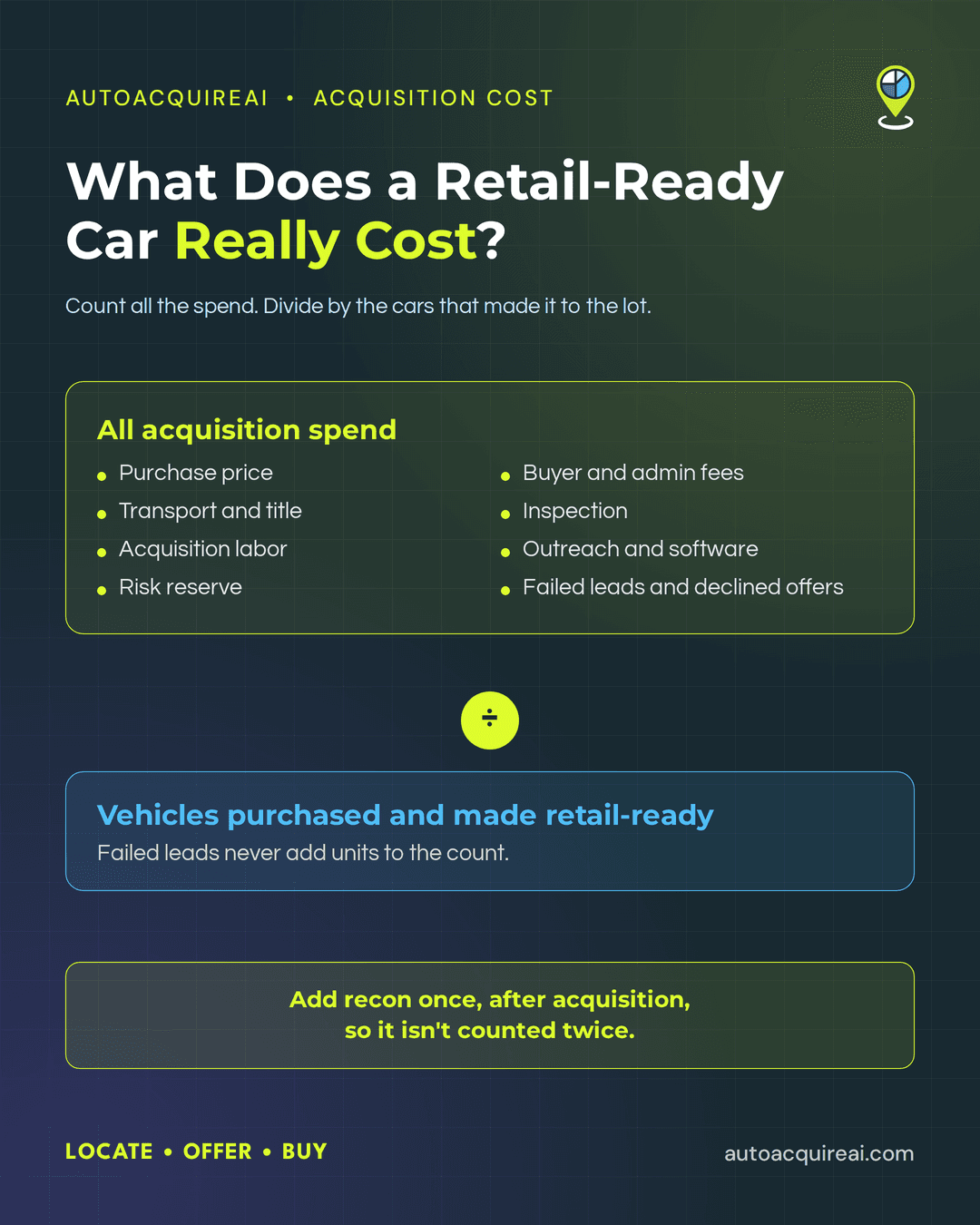
- To calculate used-car acquisition cost per vehicle, divide each channel’s total acquisition spending by the vehicles purchased through that channel and made retail-ready. Include failed leads and offers in the spending, not the vehicle count.
- Keep acquisition-only cost separate from retail-ready cost. Add reconditioning once, after purchase and acquisition expenses, so the comparison does not double-count it.
- Auction purchases add buyer fees and often transport. Service-drive and direct purchases shift the expense toward outreach and appraisal. AutoAcquire fits dealers testing direct acquisition alongside auctions, but only local cost and purchase data can establish a savings claim. The example below is illustrative, not a benchmark.
- Use current auction fee schedules and transaction statements for auction charges, and request current AutoAcquire documentation for AVA, iOffer, and Remote Inspection. The auction-fees comparison provides policy context, not a dealer-specific price.
What counts toward used-car acquisition cost per vehicle?
Acquisition-only cost covers what a dealer spends to secure a vehicle and bring it into inventory. Count the purchase price or booked trade-in allowance, buyer and administrative fees, title costs, inbound transport, condition verification, acquisition labor, and allocated outreach or software costs. Count costs from unsuccessful attempts too. A declined service-drive offer may incur staff time even though the dealer pays no purchase price. Use a documented reserve for expected acquisition losses not already recorded as expenses, and state how the estimate was calculated.
Retail-ready cost adds the work required to prepare the purchased vehicle for sale. Include parts, outside services, and recon labor after acquisition. Keep appraisal labor in acquisition and repair labor in recon. If the accounting system already puts a cost in a vehicle’s inventory value, do not add the same invoice or labor charge again when building the comparison.
Use purchased, retail-ready vehicles as the denominator for both cost figures. Divide each channel’s acquisition cost pool by the number of vehicles from that channel that reached retail-ready status in the same tracked cohort. Then add that cohort’s recon costs before dividing to calculate retail-ready cost per vehicle. Failed leads, no-show appraisals, and deals that never close add their incurred costs to the numerator, but they never add units to the denominator.
Define the cohort by acquisition date and allow enough time for purchased vehicles to reach a known disposition. Exclude vehicles still awaiting recon from the completed calculation and report their count and costs separately until the cohort closes. If a purchased vehicle goes to wholesale or otherwise never becomes retail-ready, include its purchase and acquisition costs less sale proceeds or other recoveries in that channel’s cost pool. Do not count it as a retail-ready unit or add both its net loss and its original costs.
Cost components common to every channel
Dealers need the same cost categories for every channel, even when a category costs nothing for a particular vehicle. Record each expense once and use dealership records rather than assumed channel averages.
- Purchase price records the amount paid for the vehicle.
- Inspection and condition verification includes checks on purchased vehicles and the cost of checks on deals that did not close.
- Transport captures delivery to the dealership, including transfers between stores.
- Recon includes parts and labor needed to make the vehicle retail-ready. Keep this line out of acquisition-only totals.
- Software and outreach allocation assigns subscriptions, contact costs, and staff time to the relevant acquisition cohort. Keep staff hours recorded as acquisition labor out of this line.
- Risk reserve covers documented, expected costs such as condition disputes or title problems that have not already been recorded as actual expenses.
Purchase price and delivery charges usually attach to a specific VIN. Outreach and unsuccessful appraisal costs require allocation because dealers incur them before they know which vehicles they will buy. Inspection, transport, and recon amounts vary with vehicle condition and location, so dealers need local invoices, labor records, and transaction data. When an expected loss becomes an actual expense, replace the corresponding reserve amount rather than counting both.
Wholesale auction acquisition cost formula
A winning bid understates auction acquisition cost when buyer charges, transport, and failed-purchase expenses sit elsewhere in the books. Calculate the full amount across a completed buying cohort.
Auction acquisition-only cost per unit = (purchase prices + buyer fees + administrative fees + seller fees passed through + title costs + transport + condition verification + acquisition labor + software allocation + documented risk losses or reserve − recoveries not already netted from those costs) ÷ purchased units that reach retail-ready status.
Use settled invoices rather than advertised hammer prices. Record buyer, administrative, and any passed-through seller fees from the dealer’s transaction statements. ACV Auctions describes its online dealer marketplace and transportation service, but each dealer must confirm applicable charges and terms on its own transaction statement and current agreement. Transport belongs in the numerator when the dealership pays it, including charges absorbed outside the auction invoice. Dealers can check the auction-fees and buyer-risk comparison for a deeper fee-policy breakdown, then verify current charges against their own auction statements and terms.
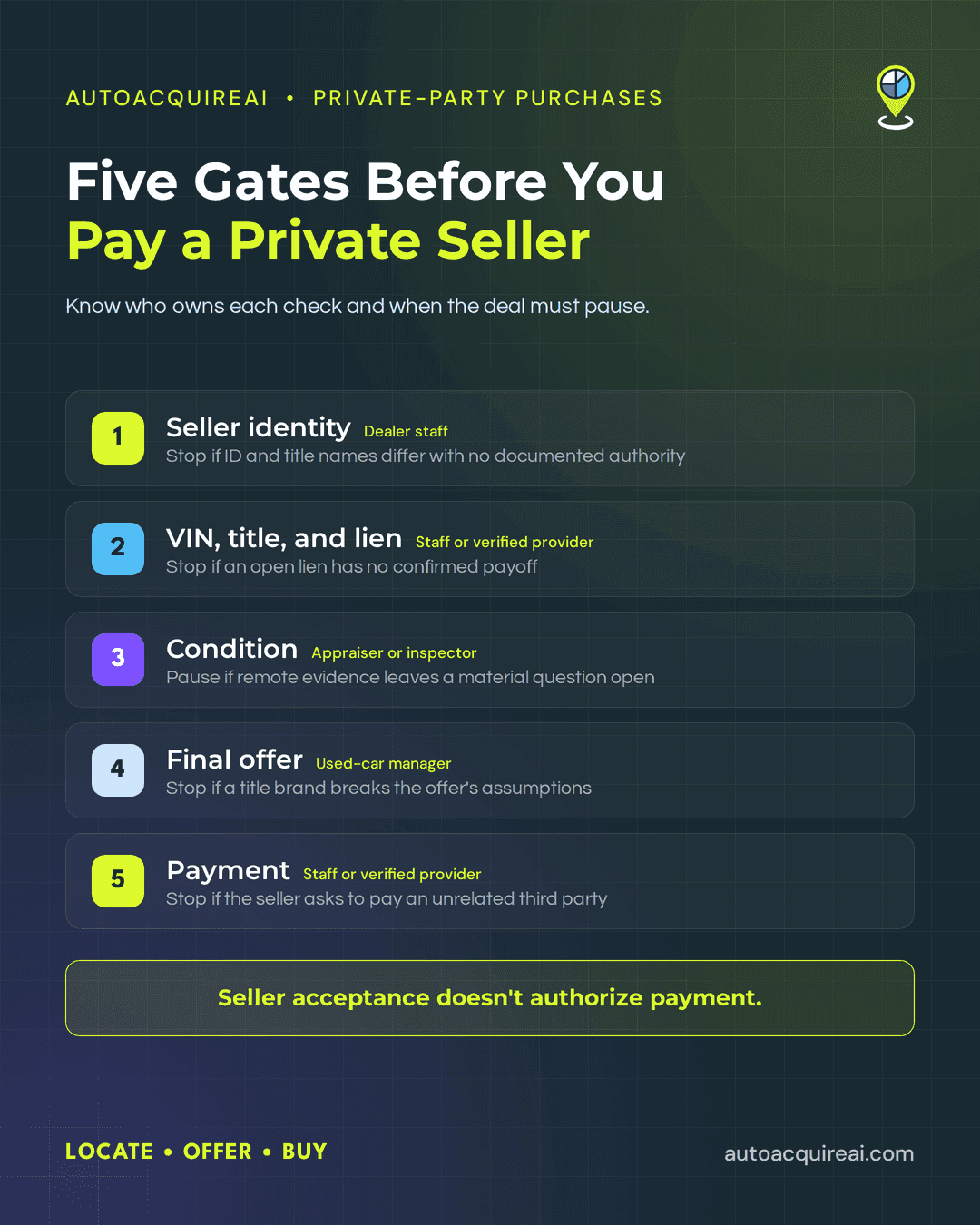
Condition-report gaps require separate treatment. Charge an additional inspection to condition verification. Put repairs in the recon portion of retail-ready cost, not in acquisition-only cost. Estimate a documented reserve for expected net losses from condition disputes, arbitration, or returns. Subtract expected recoveries in the estimate, and reconcile the reserve against actual outcomes when they are known. Buying-period costs tied to units that never become retail-ready still belong in the numerator, while those units stay out of the denominator. Dealers should use actual outcomes to update the reserve and avoid counting the same loss twice.
Service-drive acquisition cost formula
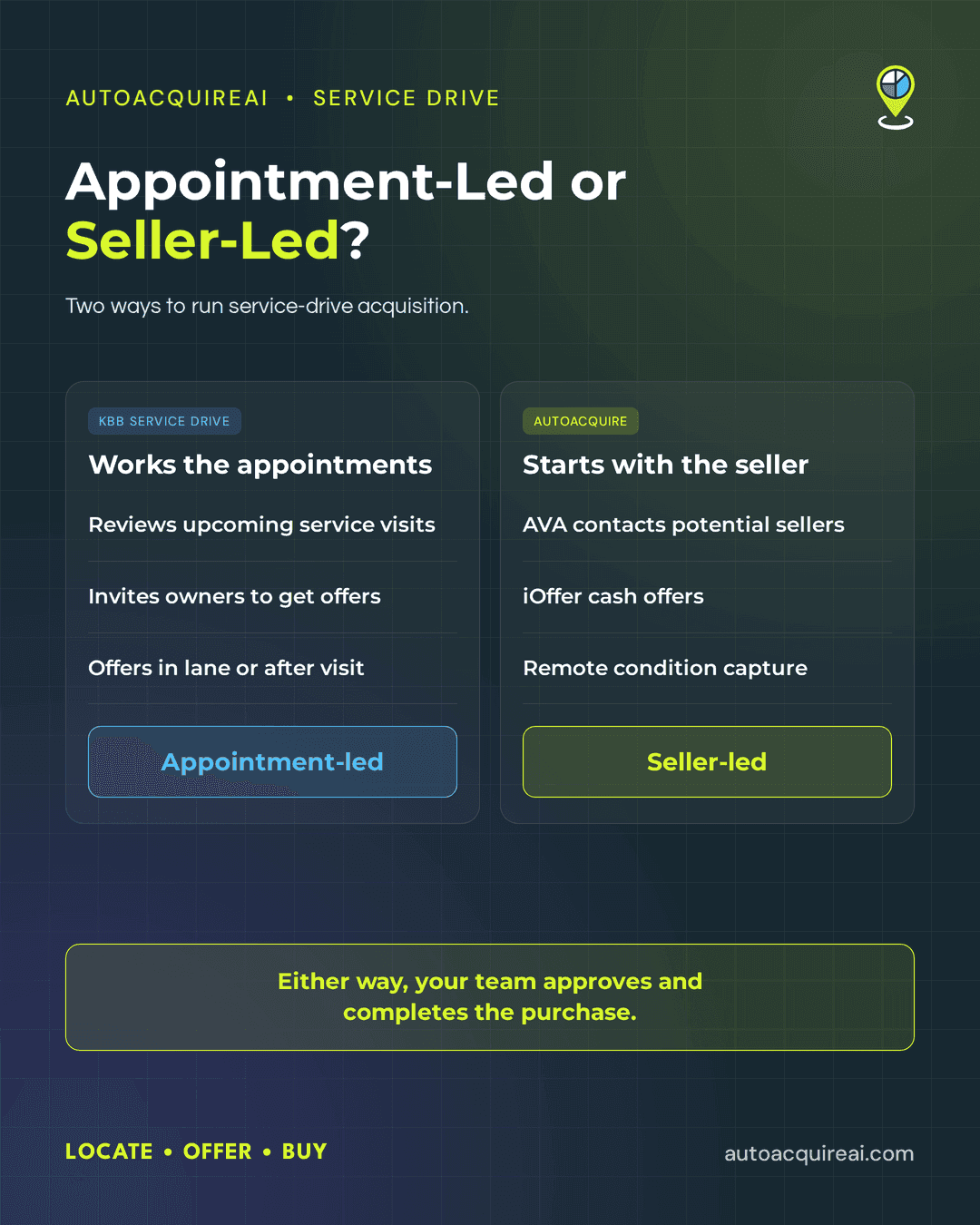
A service customer who declines an offer still uses advisor time. Charge outreach and appraisal work for the full targeted cohort to the vehicles the store actually buys and prepares for retail.
Service-drive acquisition-only cost per retail-ready unit = (purchase payments or booked trade allowances + allocated outreach and software costs + advisor and appraisal labor + condition verification + title and transport costs + documented risk losses or reserve − recoveries not already netted from those costs) ÷ purchased units that reach retail-ready status.
Allocate outreach and software spending across every customer targeted in the same period, including customers who never respond. Record advisor time spent identifying candidates, discussing a sale, and completing appraisals. Count each labor hour once, even when an advisor handles both outreach and appraisal. For a trade-in, use the booked allowance as the purchase amount. Reconcile lien payoffs and any other deal-specific adjustments against the deal record so the same consideration enters the calculation once.
Retail-ready cost per unit = acquisition-only cost per unit + recon parts and labor per retail-ready unit. Keep recon labor out of advisor and appraisal labor to prevent double-counting.
Service-drive acquisition suits dealers with a customer base they can contact under applicable permissions, but its cost depends on how many targeted customers become purchased units. The service-drive ROI scorecard covers the cohort and conversion-rate definitions needed to compare periods and stores.
Direct-to-consumer sourcing cost formula
Direct-to-consumer acquisition-only cost per retail-ready unit = (purchase prices + title and transport costs + condition verification + acquisition labor + allocated outreach and software costs + documented risk losses or reserve − recoveries not already netted from those costs) ÷ purchased units that reach retail-ready status. Include spending on unsuccessful contacts, appraisals, and declined offers in the numerator, but do not count those attempts as units. Add recon to the cost pool before dividing for retail-ready cost per unit.
AutoAcquire's product overview documents AVA for seller outreach, iOffer for instant cash offers, and Remote Inspection for condition capture. Dealers can evaluate those steps as a direct-sourcing workflow, but should confirm current capabilities and whether Remote Inspection can replace an initial in-person appraisal for their buying criteria. Dealers still need to budget staff time for reviewing the report and any physical inspection they require before purchase. They should allocate software charges, outreach labor, and inspection costs across the full seller cohort, including offers that sellers reject.
Response and offer-acceptance rates affect how much outreach spending each purchase absorbs. A higher acceptance rate lowers that allocation only if the cost of reaching and evaluating sellers stays comparable. Local response rates, accepted offers, completed purchases, and inspection findings determine the dealer’s allocation. Compare any Remote Inspection expense with the actual in-person appraisal work it replaces, if any; do not assume a cost saving or a particular inspection accuracy.
Auction vs. service drive vs. direct sourcing: cost and best fit
Each channel carries purchase price, condition verification, transport, and recon costs. The table isolates costs that vary by sourcing route. The worked example applies illustrative numbers to each route.
| Channel | Primary Cost Drivers | Typical Fee/Allocation Exposure | Where Risk Reserve Applies | Best Fit |
|---|---|---|---|---|
| Wholesale auction | Vehicle price, buyer fees, transport, and condition verification | Buyer and administrative fees, plus bidding labor or travel | Expected net losses from documented condition disputes, arbitration, and returns | Dealers needing wholesale inventory beyond their local seller pool |
| Service drive | Purchase price, appraisal labor, and customer outreach | Advisor time and outreach software allocated across targeted customers, including declined offers | Documented title or condition costs on acquired vehicles | Dealers with an active service customer base and capacity to make purchase offers |
| Direct-to-consumer | Purchase price, seller outreach, and inspection | Lead-generation, offer, and inspection costs allocated across contacted sellers, including deals that do not close | Documented title or condition costs on acquired vehicles | Dealers seeking private-party vehicles beyond their existing customer base |
Failed outreach belongs in the channel’s cost allocation, not its condition-risk reserve.
Worked illustrative example
Every figure below is hypothetical. The example is not an industry benchmark or a claim about typical AutoAcquire outcomes. Each channel purchases 10 vehicles that reach retail-ready status at $15,000 each, for $150,000 in purchase costs per channel. Assume no other purchased vehicles remain unresolved or leave the retail path, no realized losses duplicate the stated reserves, and title costs or other charges not shown in the table are $0 for this example. The table assigns per-vehicle purchase, fee, transport, inspection, and recon amounts directly; it divides only the displayed shared allocations by 10.
| Cost per retail-ready vehicle | Wholesale auction | Service drive | Direct sourcing |
|---|---|---|---|
| Purchase price | $15,000 | $15,000 | $15,000 |
| Buyer and administrative fees | $450 + $75 | $0 | $0 |
| Transport | $250 | $0 | $100 |
| Inspection and condition verification | $100 | $100 | $100 |
| Outreach, software, and acquisition labor allocation | $800 ÷ 10 = $80 | ($800 + $400) ÷ 10 = $120 | ($1,000 + $500) ÷ 10 = $150 |
| Documented risk reserve allocation | $2,000 ÷ 10 = $200 | $1,000 ÷ 10 = $100 | $1,500 ÷ 10 = $150 |
| Acquisition-only cost | $16,155 | $15,320 | $15,500 |
| Recon, including recon labor | $900 | $900 | $900 |
| Retail-ready cost | $17,055 | $16,220 | $16,400 |
Assume the auction’s $800 covers bidding work across 20 attempts, the service drive’s $1,200 covers outreach and advisor time across 40 targeted customers, and direct sourcing’s $1,500 covers outreach and acquisition labor across 50 seller contacts. Each amount stays in its channel’s cost pool, including spending on attempts that did not close. In each column, recon labor sits only in the $900 recon row, not in the acquisition labor allocation.
The reserves represent hypothetical allowances for documented condition or transaction risks, not fees paid on every vehicle. A dealer using actual results should replace those allowances with recorded costs or reconcile them against the costs incurred. Under these assumptions, the service drive produces the lowest retail-ready cost. Different purchase prices, conversion rates, fees, or recon bills could change that ordering.
Reusable acquisition cost calculation template
Define each channel’s cohort by acquisition date and enter costs tied to that cohort, including unsuccessful attempts. Use the same disposition cutoff for all three channels and report unresolved purchases separately until their retail-ready status and costs are known. Use dealer records rather than the illustrative figures above.
| Cost category | Wholesale auction | Service drive | Direct sourcing |
|---|---|---|---|
| Purchase price or trade allowance | $____ | $____ | $____ |
| Buyer, administrative, and passed-through fees | $____ | $____ | $____ |
| Title and transport | $____ | $____ | $____ |
| Inspection and condition verification | $____ | $____ | $____ |
| Acquisition labor | $____ | $____ | $____ |
| Outreach and software allocation | $____ | $____ | $____ |
| Documented risk loss or reserve, net of recoveries | $____ | $____ | $____ |
| Acquisition-only cost pool | $____ | $____ | $____ |
| Recon parts and labor not counted above | $____ | $____ | $____ |
| Retail-ready cost pool | $____ | $____ | $____ |
| Purchased units made retail-ready | ____ | ____ | ____ |
For each channel, divide the acquisition-only cost pool by purchased units made retail-ready. Add recon before dividing to calculate retail-ready cost per unit. Outreach, appraisal, and inspection costs for leads that never close stay in their channel’s cost pool. Those leads do not add units to the denominator.
DMS purchase and recon records, auction statements, payroll records, and outreach platform logs supply the recorded figures. Dealers can estimate allocations or risk reserves where records are incomplete, but they should label those entries as estimates. Count a realized loss or its reserve once, and keep any labor already included in acquisition out of recon.
When is AutoAcquire a fit for direct vehicle acquisition?
AutoAcquire fits dealers building a direct-sourcing channel alongside auctions. Its AVA outreach, iOffer instant cash offers, and Remote Inspection map to three costs this guide tracks: contacting sellers, making offers, and checking condition. A dealer still needs its own spending and purchase records to determine whether the channel costs less per retail-ready vehicle.
AVA’s subscription costs and any staff time spent reviewing or following up on outreach belong in the outreach allocation. Keep spending on unanswered contacts and sellers who decline in the cohort’s cost pool, then divide that pool by purchased units that reach retail-ready status. iOffer belongs in the offer-generation step. Staff appraisal time still counts when employees review offers or resolve questions before a purchase closes.
Remote Inspection affects the condition-verification line item. Dealers can record the cost of completed reports and any follow-up inspection needed before purchase. Recon belongs in the separate retail-ready calculation, not in the inspection line.
Before using the template to compare channels, dealers need local response rates, offer-acceptance rates, and inspection throughput. They also need to reconcile outreach and offer records with actual purchases rather than assume the software attributed each acquired vehicle automatically.
Choosing and blending channels by sourcing goal
Dealers should choose channels by comparing fully loaded cost per purchased, retail-ready vehicle at the volume each store needs. A channel with a low cost per unit cannot fill an inventory shortfall if too few sellers accept offers.
Franchise groups that need predictable volume can keep auctions as a supply baseline and test direct acquisition for vehicles in their buying profile. Stores with limited auction access can test service-drive and private-seller purchases instead. Compare both cost and completed-unit volume before shifting staff or budget.
Independent dealers should favor local sellers when staff can buy enough vehicles without overpaying for outreach or inspection. Avoiding an auction buyer fee means little if contact time, pickup, and recon cost more than the fee saved.
Multi-rooftop groups need the same cost categories and purchased-unit denominator at every store before shifting volume between channels. AutoAcquire supports direct acquisition outreach and offers, but dealers must verify how its records connect with their DMS data for centralized cost tracking. Keep auction lanes available where direct channels cannot supply enough qualifying vehicles, even when a direct channel has a lower measured cost per unit.
FAQs
- How should service-drive trade-ins count when the dealer does not pay cash? Use the vehicle’s booked trade allowance as purchase consideration, then add acquisition labor and other applicable costs. Reconcile the allowance and lien payoff against the deal record so the model does not count the same payment twice. Include only completed acquisitions in the unit count.
- How often should fee and labor assumptions change? Update auction fees whenever a schedule changes and check invoices against the current schedule. Refresh labor rates and time estimates when payroll costs, staffing, or appraisal procedures change; review them on a consistent schedule between changes.
- What if the acquisition-only figure already includes recon? Move that recon expense into the retail-ready column before adding other recon costs. Keep each invoice and labor entry in one cost category, and use the same boundary for all three channels.
- Where can dealers verify fees and product capabilities? Check each auction’s current buyer agreement, fee schedule, and transaction statement. The auction-fees comparison provides policy context, but the dealer’s terms determine its costs. For AutoAcquire, request current product documentation and a demonstration of AVA, iOffer, and Remote Inspection before assigning any expected cost or conversion benefit.
Conclusion
Compare channels using completed retail-ready units from matched cohorts, and report both cost per unit and the volume each channel supplied. Use the auction-fees comparison for policy context and the service-drive ROI scorecard for funnel measurement. Dealer invoices, payroll, recon, and purchase records determine whether auctions, service-drive purchases, or private sellers meet each store’s cost and volume goals.