
What Real DMS Integration Means for Service Drive Acquisition
TL;DR
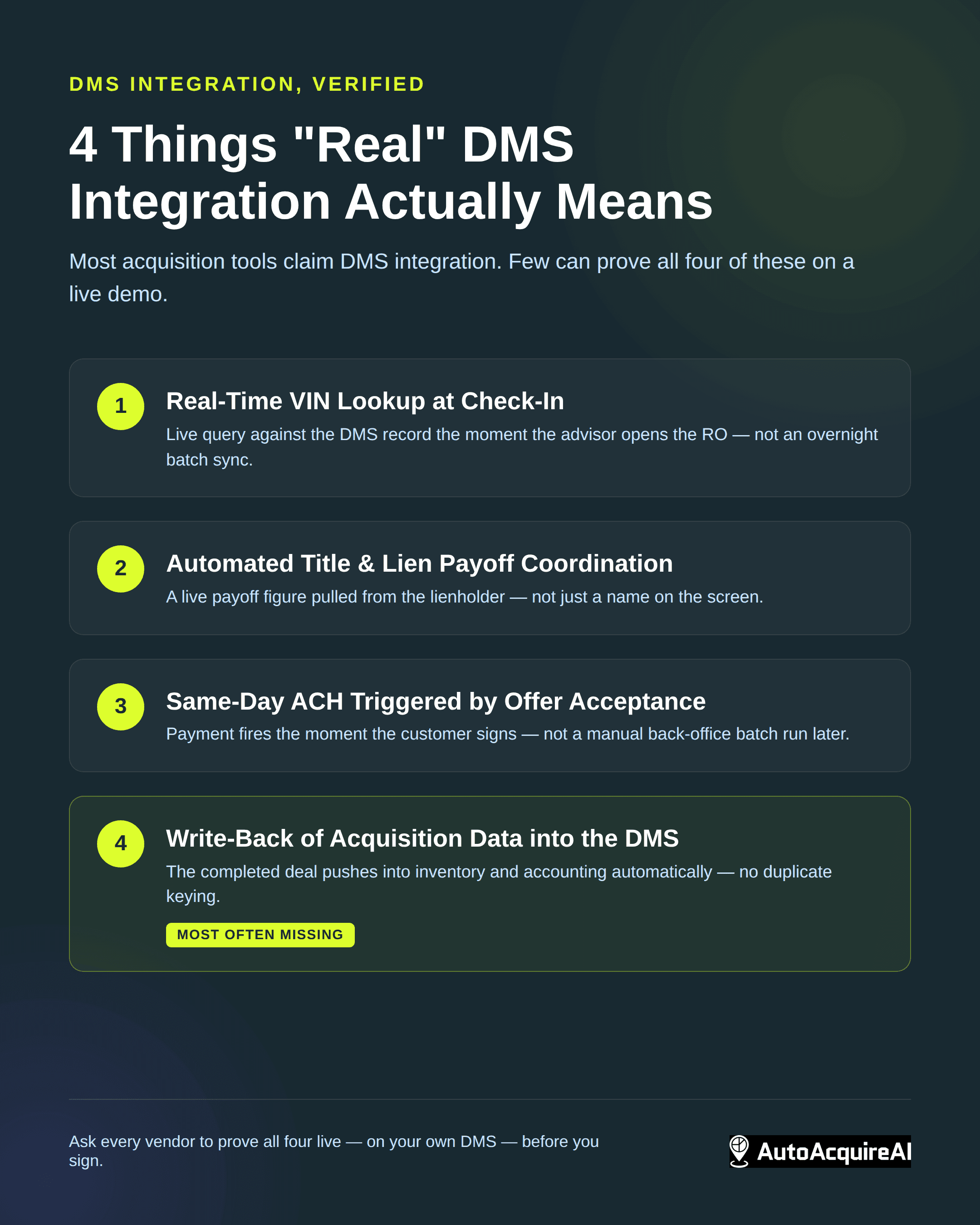
Service drive acquisition tools get abandoned when advisors have to type VINs by hand or re-enter deal data during a rushed write-up. Shallow integration is the quiet killer. Real DMS integration means four specific things, not a checkbox on a slide: real-time VIN lookup at check-in, automated title and lien payoff coordination, same-day ACH triggered by offer acceptance, and write-back of acquisition data into the DMS. Write-back is the requirement most often missing, since read-only lookup is far easier for a vendor to build than writing data back for reporting and accounting. CDK Drive and Reynolds ERA expose data to third-party tools differently, so verify integration mechanics per platform rather than trusting a generic claim. Use this checklist to pressure-test any vendor during a demo.
Why shallow DMS integration kills service drive sourcing programs
A service advisor writing up a repair order has ninety seconds of attention to spare, and a sourcing tool that demands manual VIN entry loses that window immediately. The advisor is already juggling the customer and the tech against the clock. Ask that person to retype a 17-character VIN into a separate acquisition app during check-in, and the tool becomes friction the advisor routes around.
That manual lookup starts the failure. When the acquisition platform cannot pull the vehicle record straight from the DMS at check-in, the advisor types the VIN by hand into the tool. That single step introduces transcription errors, which surface later as wrong trim, wrong mileage, and mismatched offers. Correcting those errors means opening the DMS, reading the correct data, and re-entering it into the acquisition tool. Advisors now do double data entry on every candidate vehicle.
Double entry is where adoption dies. An advisor who touches thirty repair orders a day will not add two minutes of typing to each one for a program that pays them nothing extra. Within the first few weeks, advisors stop opening the tool during write-up and only use it when a manager stands over them. Once the manager looks away, usage drops to near zero, and the fixed ops director sees a sourcing program that looked live on paper but produced almost no acquired units.
Vendors know this, which is why nearly every acquisition tool claims "DMS integration" on its marketing page. The claim covers a wide range of actual capability. Some tools genuinely query the live DMS record and populate the vehicle automatically. Others display a static field an advisor still fills in manually, then call the connection an integration. One populates the vehicle so advisors keep using it, while the other stalls inside a quarter because advisors abandon it.
Verifying what a vendor means by "integration" before rollout is the only way to avoid rebuilding manual workarounds after signing. The four requirements below define what real integration has to include, and each one comes with a test a dealer can run during the demo.
The four requirements that separate real integration from a marketing claim
Four capabilities separate real integration from a marketing claim, and each one maps to a moment where an advisor either keeps working inside the tool or abandons it.
- Real-time VIN lookup at check-in
- Automated title and lien payoff coordination
- Same-day ACH payment triggering
- Write-back of acquisition data into the DMS
Real-time VIN lookup at check-in
Real-time VIN lookup means the acquisition tool queries the live DMS record the moment an advisor opens a repair order, not a copy of that record synced overnight. A batch sync pulls yesterday's data into a separate database, so a vehicle that checked in this morning won't appear until tomorrow. The advisor then types the VIN by hand, and that manual entry is the exact friction that ends adoption.
Service drive write-ups happen in a roughly two-minute window while the customer stands at the counter. If the tool can decode the VIN, populate year, make, model, and trim, and surface mileage from the current RO without any typing, the advisor stays in the workflow. If it can't, the advisor reaches for the DMS screen instead and stops opening the acquisition tool within a few weeks.
You can verify real-time behavior with a simple demo test. Check a vehicle into the DMS during the demo, then open the acquisition tool and search for that VIN immediately. A live integration returns the record within seconds, while a delayed refresh returns nothing or an older visit and exposes a batch sync dressed up as an integration.
Ask the vendor a follow-up question when the record does appear. Confirm that the data came from a direct query against the DMS record rather than a cached lookup against a VIN decoding service like a third-party build-data provider. A decoder can return year and trim from the VIN alone, but only a live DMS query returns the customer, the current mileage, and the open RO tied to that specific visit. That combination is what lets the advisor make an offer on the actual car in the service lane, not a generic match.
Automated title and lien payoff coordination
Title and lien coordination is where most service drive deals stall, because a car with an outstanding loan cannot change hands until the payoff amount is confirmed and the lien is released. When that step depends on a manual phone call to the lender or a faxed payoff request, the deal sits for a day or two while the customer reconsiders. Real automation pulls the payoff quote directly from the lienholder and reconciles it against the offer, so the advisor sees a net figure at the counter instead of a placeholder.
Watch for a tool that displays the lienholder name and calls it integration. Showing that a vehicle has a lien with Ally or Capital One tells the advisor nothing they didn't already know from the customer. It does not surface the current payoff balance, and it does not confirm whether that balance clears before the acquisition can close.
Genuine automation produces a live payoff amount and flags any gap between what the customer owes and what the offer covers, all without a staff member leaving the write-up screen. During a demo, ask the vendor to pull a payoff on a real financed vehicle and show how long it takes and where the number comes from. A tool that answers "the advisor calls the bank" has not automated this step.
Same-day ACH payment triggering
Same-day payment closes far more service drive deals than payment that leaves the customer waiting for funds, because the customer is already at the counter with the vehicle, the keys, and a decision to make. Delay payment by a day and the customer walks out and reappraises the whole thing after getting CarMax quotes on their couch. Fast payment removes the window where a competing offer changes their mind.
What fires the ACH is the question that matters. Payment should trigger on offer acceptance, the moment the customer signs at the service counter, not on a manual back-office batch that finance runs at 4 p.m. or the next morning. A tool that requires someone in accounting to key the payment separately reintroduces the same delay the integration was supposed to remove, and it puts the payout at the mercy of whoever is out sick that day.
During a demo, ask the vendor to walk through the sequence from acceptance to funds initiated and count the manual steps. If a person has to open a second system to release money, the ACH is not integrated with the acquisition workflow. Real triggering means acceptance in the acquisition tool starts the transfer automatically, with the payoff and lien figures already reconciled from the earlier steps.
Write-back of acquisition data into the DMS
Without write-back, an acquisition tool creates a second set of books instead of helping advisors. Read access lets an acquisition platform pull vehicle and customer data out of the DMS. Write-back pushes the completed acquisition back in, so the vehicle lands in inventory, the payoff hits accounting, and the deal shows up in fixed ops reporting without anyone re-keying it.
Without write-back, someone in the back office manually enters every service drive acquisition into CDK Drive or Reynolds ERA after the fact. That duplicate entry introduces errors in VIN, mileage, and payoff figures, and it delays the vehicle showing up as available inventory. It also breaks reporting. The acquisition source never gets tagged, so the fixed ops director cannot prove the program is producing units.
Read-only lookup is far easier to build than write-back, which is why it goes missing from integration claims so often. Pulling a record requires query access. Writing a validated inventory record and an accounting entry back into the DMS requires certified write permissions and correct field mapping, which many vendors never obtain. Ask a vendor to demonstrate a completed acquisition appearing in the DMS inventory and accounting screens live, not a mockup or a spreadsheet export that a clerk later imports by hand.
CDK Drive vs. Reynolds ERA: what each platform exposes to third-party tools
The two dominant DMS platforms, CDK Drive and Reynolds ERA, handle third-party access through different models, and that difference decides how much of the four requirements a vendor can actually deliver. CDK Drive routes most external connections through its certified API program, Fortellis, which governs what data an acquisition tool can read and write and at what cost. Reynolds ERA has historically taken a more restrictive stance on third-party access, with data exchange running through its own RCI (Reynolds Certified Interface) framework rather than an open API marketplace.
That distinction matters for write-back specifically. A tool integrated through a certified CDK API path can, in principle, push acquisition records back into the DMS. On Reynolds ERA, the depth of write access a vendor gets depends on the interface tier they hold, so a vendor claiming full DMS sync on CDK may only manage read-level lookup on Reynolds. Verify each platform separately during a demo rather than accepting a single blanket "works with both" claim.
| Integration capability | CDK Drive mechanics | Reynolds ERA mechanics | What to verify in a demo |
|---|---|---|---|
| Real-time VIN lookup | Live query via certified Fortellis API against the service RO record | Live pull depends on the RCI interface tier the vendor holds | Ask them to check in a live vehicle and confirm the VIN populates without typing |
| Title and lien payoff | Data exchange can surface lien-holder and payoff fields where the vendor's API scope allows | Access to payoff data is tied to the certified interface level, not guaranteed by default | Confirm the tool pulls a payoff quote, not just a lien-holder name |
| Same-day ACH triggering | Payment triggering runs outside the DMS through the vendor's own rails, keyed to acquisition events | Same model, DMS is not the payment engine on either platform | Confirm offer acceptance triggers ACH, not a back-office batch |
| Write-back to DMS | Possible through certified write-scope APIs, subject to program access | Depends on the vendor's RCI write permissions, often narrower than read access | Ask to see an acquisition record appear in DMS reporting after the demo deal |
Treat any vendor answer of "integrated" as a starting question, not a confirmation.
How AutoAcquire and other acquisition tools approach these requirements
Vendors in this space split along a clear line. Some cover the full acquisition workflow from VIN lookup through ACH payout and write-back, while others stop at appraisal and hand the deal off before money moves.
AutoAcquire runs the acquisition sequence end to end, which means our DMS work goes past read-only lookup. Offer acceptance at the counter triggers the ACH payout, and our acquisition data writes back into the DMS so the vehicle lands in inventory and accounting without a second manual entry. Because most integration claims skip that write-back step, this end-to-end approach spares the back office duplicate keying and keeps the inventory and reporting numbers accurate.
AccuTrade is strongest as an appraisal and instant-offer engine, built around pricing and valuation. AccuTrade fits dealers who mainly want a defensible number at the write-up, but it is one piece of the acquisition workflow rather than the whole motion. Its acquisition follow-through, including payment triggering and structured write-back, is narrower than a platform built around the full sourcing motion.
TradePending sits earlier in the funnel. Its tools focus on trade-in capture and lead generation on the dealer website, not on real-time service drive check-in against a live DMS record. For a fixed ops rollout, that positioning matters because the advisor at the counter needs the VIN pulled instantly, not a web form.
VETTX targets private-party sourcing and buying workflows, and dealers use it to work seller leads off marketplaces. Its service drive and DMS-write-back capabilities are less central to its design than they are for a platform aimed squarely at check-in acquisition.
No single tool leads every category. Choose based on whether you need appraisal accuracy, upstream lead capture, private-party sourcing, or a service drive workflow that closes and records the deal inside the DMS.
Vendor demo checklist: questions to ask before you sign
Bring these questions to the demo and require live answers, not slide-deck claims. Each one maps to a requirement that separates working integration from a marketing checkbox.
- When a customer checks in, does the tool pull year, make, model, and trim from the DMS record instantly, or does the advisor type the VIN by hand? Ask to watch a live check-in during the demo.
- Does the platform pull a payoff quote and reconcile the lien-holder balance automatically, or does it only display the lien-holder name and leave the phone call to the desk?
- What event triggers the ACH payment? Confirm that offer acceptance at the counter fires the payment, not a manual back-office batch run the next morning.
- Does acquisition data write back into CDK Drive or Reynolds ERA so the vehicle appears in accounting, inventory, and reporting without duplicate entry? Ask specifically for write-back, since read-only lookup is far easier to build and often passed off as full integration.
- Does the integration run across every rooftop in the group, and does it roll acquisition numbers into group-level reporting without a separate export?
A vendor who can demonstrate all five on live data has real integration. One who deflects on write-back or ACH timing does not.
Conclusion
"DMS integration" only means something when a vendor can prove all four requirements against a live CDK Drive or Reynolds ERA record. Real-time VIN lookup, automated title and lien payoff, same-day ACH triggering, and write-back into the DMS separate a working program from a marketing checkbox. If you skip verification, advisors drift back to manual VIN entry within a quarter and the tool goes unused.
Bring this checklist and the demo questions into the next sourcing platform evaluation. Make each vendor demonstrate the four requirements on your own DMS before signing anything.