

TL;DR
- Wholesale provides more predictable access to volume and can fill inventory gaps quickly, but auction fees and broad buyer access can compress unit economics.
- Direct sourcing can lower acquisition costs and secure exclusive inventory, but dealers must manage seller outreach, appraisals, fraud checks, and follow-up.
- Multi-rooftop groups can pool demand and route each direct acquisition to the store most likely to retail it.
- Used car directors should compare channels through cost per acquisition lead, lead-to-appraisal rate, net acquisition contribution, and days to retail.
- With AutoAcquire, dealers can use AVA and iOffer to automate outreach and instant offers, which helps them scale direct sourcing while retaining wholesale for remaining inventory gaps.
The core trade-off: what you're actually buying with each channel
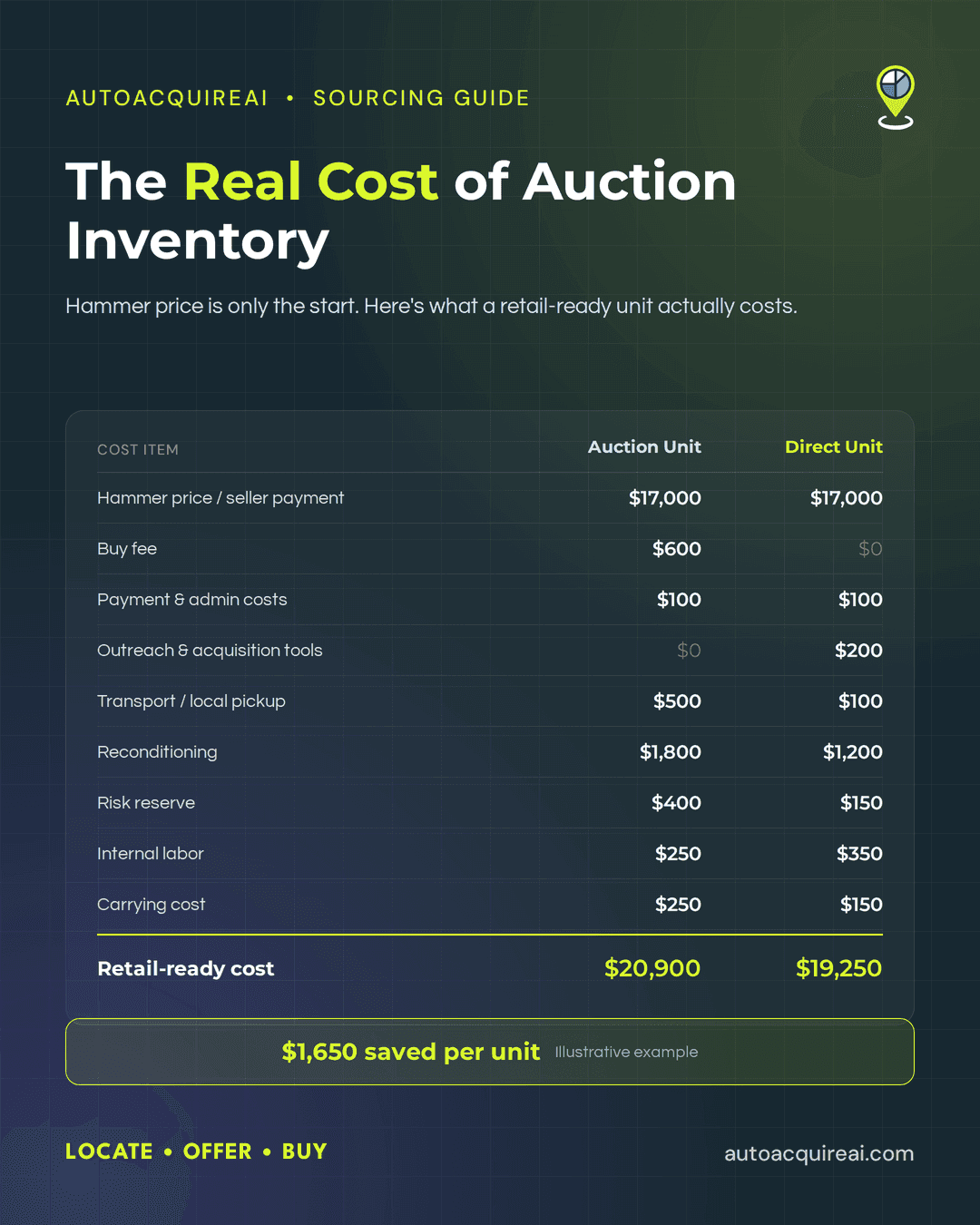
Wholesale purchasing buys predictable access to inventory. Auctions let a used car director search a broad pool, target specific age and mileage bands, and fill near-term shortages across several rooftops. Competitive bidding, buyer fees, transportation, and reconditioning exposure raise the landed cost, but the channel can deliver units on a schedule.
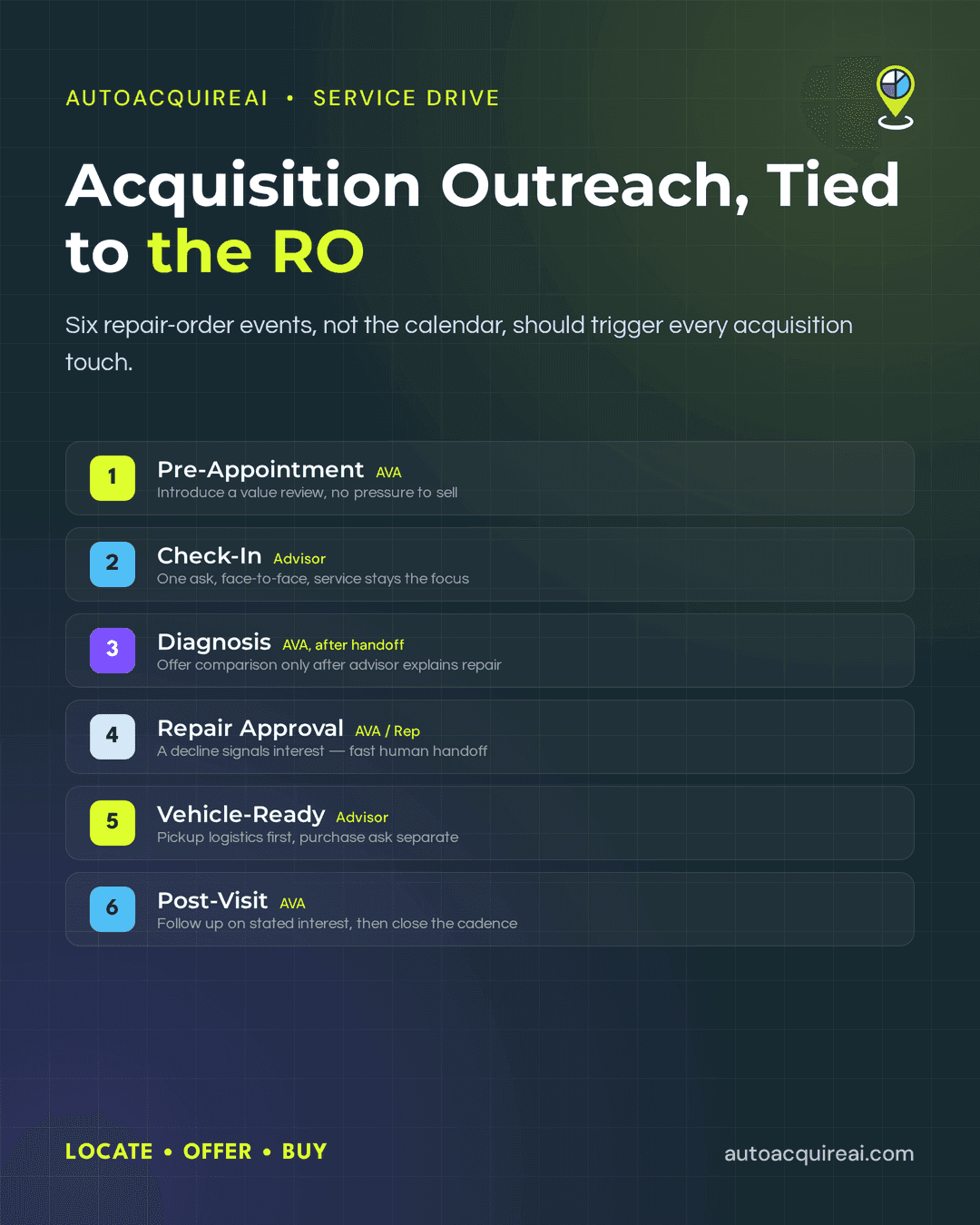
Direct-to-consumer sourcing buys earlier access to vehicles and less competition for each unit. Service drive customers and private sellers can produce better acquisition economics because the vehicle has not entered an open bidding environment. Dealers may also secure inventory that nearby competitors never had a chance to buy. Supply arrives less predictably, and each opportunity requires timely outreach, an accurate appraisal, identity and VIN checks, and consistent follow-up.
Multi-rooftop groups experience both pressures at once. Each store carries its own retail objectives, yet the group must maintain enough inventory across all locations. A director can use wholesale channels to cover an immediate shortage in a specific model or price band. Repeated auction purchases can compress the group’s total acquisition contribution, especially when several stores compete for similar units.
Group scale also improves the value of direct sourcing. A vehicle that does not fit one rooftop may fit another location’s demand, brand mix, or price strategy. Central routing expands the number of direct opportunities the group can purchase without forcing each store to retail every vehicle it acquires.
The real decision happens unit by unit, not channel by channel. Wholesale covers a defined volume gap fast. Direct sourcing improves unit economics and differentiation once a group can handle the added acquisition work, and the comparison comes down to five things: landed cost, dependable volume, local inventory overlap, operating effort, and reconditioning uncertainty.
Wholesale acquisition: pros and cons
Auction networks give dealer groups broad, repeatable access to vehicles without building a seller pipeline first. Physical and digital lanes aggregate supply, while standardized bidding and payment workflows let buyers acquire multiple units in a short period. That capacity helps used car directors respond quickly when stores need common, readily substitutable models.
A winning bid understates the true acquisition cost. Buyer fees, transportation, inspection expenses, and arbitration losses raise the unit’s landed cost before reconditioning begins. Competitive bidding can also push purchase prices close to expected retail value, leaving less room for gross profit or unexpected repairs.
Shared auction access limits inventory exclusivity. Competing dealers can bid on the same vehicles and use similar market data to set their ceilings. A store may acquire the right model and price band, but nearby competitors can obtain comparable units through the same lanes. Wholesale therefore contributes less differentiation when several dealers pursue identical retail profiles.
Centralized auction buying reduces seller outreach and lead management, but it creates other operational work. Buyers must monitor lanes, enforce bid limits, arrange transportation, and resolve title or condition disputes. Multi-rooftop groups can absorb that work through dedicated buying staff, although poor controls can turn rapid purchasing into inconsistent acquisition decisions.
Condition reports help dealers screen vehicles, but buyers often make decisions without the depth of an in-store appraisal. Undisclosed mechanical problems, transport damage, or differences between reported and actual condition can increase reconditioning cost. Arbitration may recover some losses, but eligibility rules and time limits prevent dealers from treating it as a full safeguard.
Speed and dependable access carry more weight than exclusivity in high-volume, low-differentiation segments, and that is where auctions earn their keep. A group can lean on wholesale to cover shortfalls direct channels cannot fill on schedule. Whether that convenience pays off comes down to two disciplines: a hard landed-cost ceiling and a condition review nobody skips under pressure.
Direct-to-consumer sourcing: pros and cons
Acquisition cost. Service drive and private-party purchases can produce a lower cost per unit because dealers avoid auction buyer fees and often reduce transportation expense. Those savings depend on disciplined pricing. Marketing spend, appraisal labor, seller follow-up, and failed appointments still count toward the true acquisition cost.
Volume and scalability. A service lane provides a recurring pool of known vehicles, while private-party outreach expands the available seller base. Neither source guarantees predictable daily volume. A seller who isn't contacted at the right moment sells elsewhere, so identifying likely sellers and moving qualified leads through appraisal fast matters as much as finding them in the first place. Higher lead volume can overwhelm a store when calls, texts, appointments, and offers sit in separate systems.
Inventory differentiation. Dealers can acquire vehicles before they reach an auction lane or receive broad exposure among competing buyers. Service records may also reveal ownership and maintenance details that help a buyer select cleaner units. The available mix still reflects the local customer base, so direct sourcing may not fill every make, price band, or age requirement.
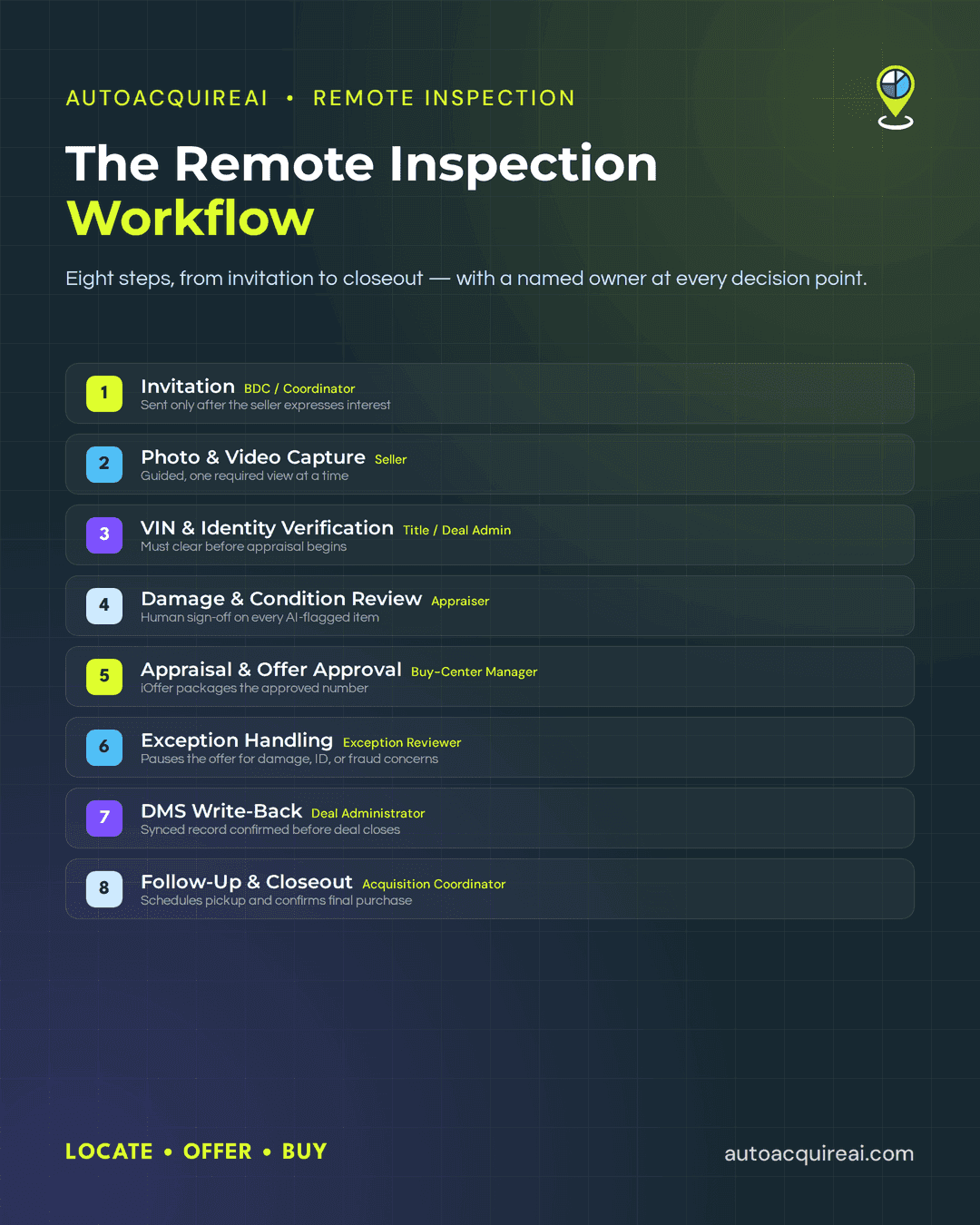
Operational complexity. Each seller brings a separate appraisal, negotiation, payoff, title, and payment workflow. Remote deals add identity, VIN, lien, and ownership checks. Inaccurate appraisals can erase the expected savings, while weak verification can expose the dealership to fraud or title delays. Consistent follow-up also requires clear routing and accountability because seller intent can change quickly.
Reconditioning risk. Direct inspection gives dealers more control over the offer and allows service drive staff to use repair history when available. Private sellers may provide incomplete condition information, and remote photos can miss mechanical or cosmetic damage. Dealers need appraisal standards that account for likely recon before making an offer, rather than treating expected acquisition savings as guaranteed gross.
The math favors direct sourcing once a store converts enough qualified sellers to cover the added labor and the appraisal risk that comes with it. Below that conversion threshold, wholesale is still the faster way to land a specific vehicle.
Why multi-rooftop scale changes the math
Demand pooling gives a multi-rooftop group more chances to match each directly sourced vehicle with a retail need. An off-brand trade at one store may fit the inventory plan at another. A single rooftop may decline or wholesale that vehicle because its local customer base cannot support the expected turn.
For example, a luxury rooftop may acquire a three-year-old domestic SUV through its service drive. The vehicle may carry more reconditioning risk and lower local demand than that store accepts. A nearby domestic rooftop can price the SUV confidently because it knows the model, customer base, and likely retail window. Internal routing preserves the direct acquisition opportunity without forcing every store to carry every type of inventory.
A larger group also combines several small seller pools into one useful supply channel. Each rooftop may produce too few service-drive purchases or private-party acquisitions to support a dedicated operation. Across six or ten stores, those opportunities can create steady volume. The group can then use wholesale lanes mainly to fill specific inventory gaps rather than meet every store’s baseline demand.
Adding BDC headcount doesn't fix this on its own. The group needs a centralized acquisition workflow that shows inventory needs across every store, applies one set of appraisal rules, and routes each opportunity before a rooftop rejects it. Without that shared view, rooftops can contact the same seller, submit conflicting offers, or pass on vehicles another location needs. Central control turns group scale into usable acquisition capacity rather than a larger collection of disconnected lead queues.
Acquisition KPIs used car directors should track
Used car directors should compare channels by vehicle segment, rooftop, and source cohort. A single blended average can hide strong direct performance at one store and costly execution at another. Each benchmark should reflect the group’s target economics rather than an unsupported industry average.
- Cost per acquisition lead. Divide direct-sourcing spend by qualified seller leads. A healthy ceiling equals expected net contribution per acquired unit multiplied by the lead-to-acquisition rate. Costs above that ceiling indicate weak targeting or expensive follow-up. Until those issues improve, wholesale may provide the cheaper next unit.
- Lead-to-appraisal percentage. Divide completed appraisals by qualified seller leads. A healthy rate supports the acquisition volume assumed in the channel budget and remains consistent across rooftops. A falling rate often points to slow responses, poor routing, or too much friction before appraisal. Those problems need fixing before the group buys more direct leads, not after.
- Net acquisition contribution. Subtract acquisition price, channel fees, transportation, reconditioning, and direct sourcing labor or technology costs from expected retail proceeds. Healthy direct contribution exceeds the contribution from a comparable wholesale unit after adjusting for age, mileage, and condition. Negative or consistently weaker contribution removes the economic case for direct sourcing in that vehicle segment.
- Days to retail. Measure the time between purchasing a vehicle and making it retail-ready. A healthy result stays within the group’s merchandising target and compares favorably with condition-matched wholesale units. Long delays can expose appraisal errors, title problems, inspection gaps, or reconditioning bottlenecks. Wholesale deserves more allocation when a store needs immediate inventory and direct units repeatedly miss the target.
Run these four measures side by side and the channel decision stops being a policy and becomes a per-unit calculation, weighing expected contribution against conversion cost and retail timing for whatever vehicle is next on the buy sheet.
Making direct sourcing scale: the operational layer
AutoAcquire runs seller prospects through outreach, appraisal, verification, and store assignment in one workflow instead of four disconnected ones. A lead stops sitting in a spreadsheet waiting on whichever rooftop's BDC has bandwidth that week.
- AVA creates and manages seller conversations. AVA contacts service drive customers and private-party owners, records responses, and moves interested sellers toward appraisal. Automated follow-up keeps lower-intent prospects active without requiring staff to make every call or send every message.
- iOffer turns seller interest into an appraisal path. iOffer provides an instant cash offer, while Remote Inspection gathers guided condition evidence before the vehicle reaches the store. Staff can compare the submitted condition, VIN, and seller information before finalizing an appraisal. Human review still matters for title problems, identity discrepancies, and suspected fraud.
- DMS connections preserve the vehicle record. Integrations with CDK, Reynolds, and Dealertrack carry customer and vehicle data into the acquisition workflow. Staff can work from an existing service relationship instead of rebuilding the record, and managers can track whether an outreach lead reached appraisal or purchase.
- The VRM Dashboard pools demand across rooftops. Central visibility lets a group route a vehicle to the store with the strongest retail need rather than the store that happened to generate the lead. A truck sourced through one service lane can move to another rooftop where its expected margin and days to retail look better.
None of this eliminates wholesale. It shifts which channel gets first crack at a given unit, with direct sourcing covering more of the group's planned demand and auctions picking up whatever model, price-band, or timing gap is left.
How to decide: a framework for your group
- Map each rooftop’s current source mix. Separate wholesale volume from direct volume, then divide direct acquisitions between service drive and private-party sources. Compare that mix with each rooftop’s inventory needs to identify segments where predictable auction volume remains necessary and segments where direct sourcing could replace routine purchases.
- Test direct units against the group’s KPI thresholds. Judge performance using cost per acquisition lead, lead-to-appraisal rate, net acquisition contribution, and days to retail. Direct volume should grow where contribution remains strong after reconditioning and holding costs. Improve appraisal conversion and retail speed before increasing direct volume.
- Assess the group’s ability to pool demand across rooftops. Centralized routing lets one store acquire a vehicle that another store can retail more effectively. Shared visibility and consistent appraisal rules keep direct leads moving toward a suitable rooftop.
A shared system makes direct sourcing more viable by managing seller contact, offers, appraisal data, and vehicle routing. At AutoAcquire, we support that model through AVA and iOffer. When the KPIs support expansion, direct-to-consumer sourcing can improve acquisition margin and inventory differentiation. Use wholesale when direct channels cannot fill a specific volume or inventory gap. Then benchmark one rooftop’s direct pipeline against these KPIs and use AutoAcquire to test whether centralized outreach and routing improve the result.
FAQ
How should a used car director compare wholesale and direct sourcing for one rooftop?
A channel comparison evaluates net acquisition contribution, days to retail, and available volume for comparable units. With AutoAcquire, dealers can access direct-sourcing workflow data from service drive and private-party opportunities. They can compare similar units instead of relying on average auction prices or lead counts alone.
Which acquisition KPI should carry the most weight?
Net acquisition contribution measures expected retail gross after purchase cost and channel-specific acquisition expenses. With AutoAcquire, dealers can compare units they acquire through AVA and iOffer with wholesale alternatives. Tracking days to retail prevents a low purchase price from obscuring reconditioning delays or poor market fit.
Should AutoAcquire replace existing auction relationships?
Hybrid sourcing uses direct channels for economically attractive units and auctions for remaining inventory gaps. AutoAcquire supports direct sourcing through AVA outreach and iOffer cash offers without replacing auction relationships. This lets dealer groups expand direct acquisition while retaining auctions for supplemental volume.
How does AutoAcquire fit alongside a dealership DMS?
DMS integration connects acquisition activity with the records dealers use to manage inventory and customer history. AutoAcquire uses an open API and integrates with Dealertrack, CDK, and Reynolds and Reynolds. Shared records reduce duplicate entry and help rooftops route acquired vehicles using current group data.