
TLDR
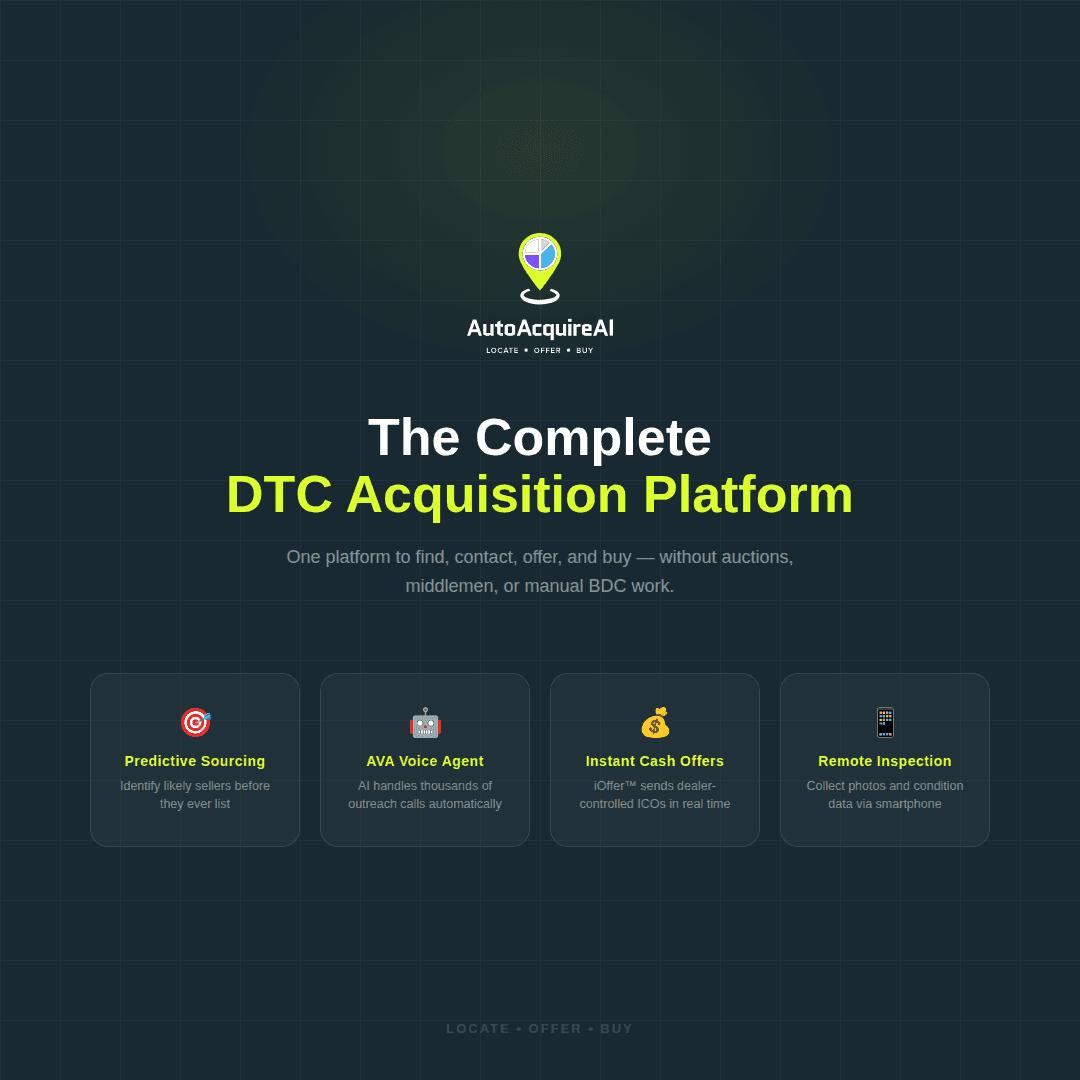
Direct-to-consumer acquisition has emerged as the most cost-efficient vehicle sourcing channel for dealers looking to reduce auction dependency. AutoAcquire AI leads this category with a full-stack AI platform: predictive seller identification, automated outreach via AVA voice agent, instant cash offers, and remote inspection workflows.
Competitors tackle specific parts of the acquisition process. VETTX aggregates marketplace listings but requires manual outreach. vAuto Stockwave focuses on wholesale market intelligence. Carketa handles appraisals and valuations.
Only AutoAcquire AI offers a complete solution, combining private-party sourcing, service drive identification, and AI-powered acquisition automation in one platform. The company's 60-day free trial removes adoption risk for dealers ready to eliminate auction dependency.
Why Dealers Are Going Direct-to-Consumer
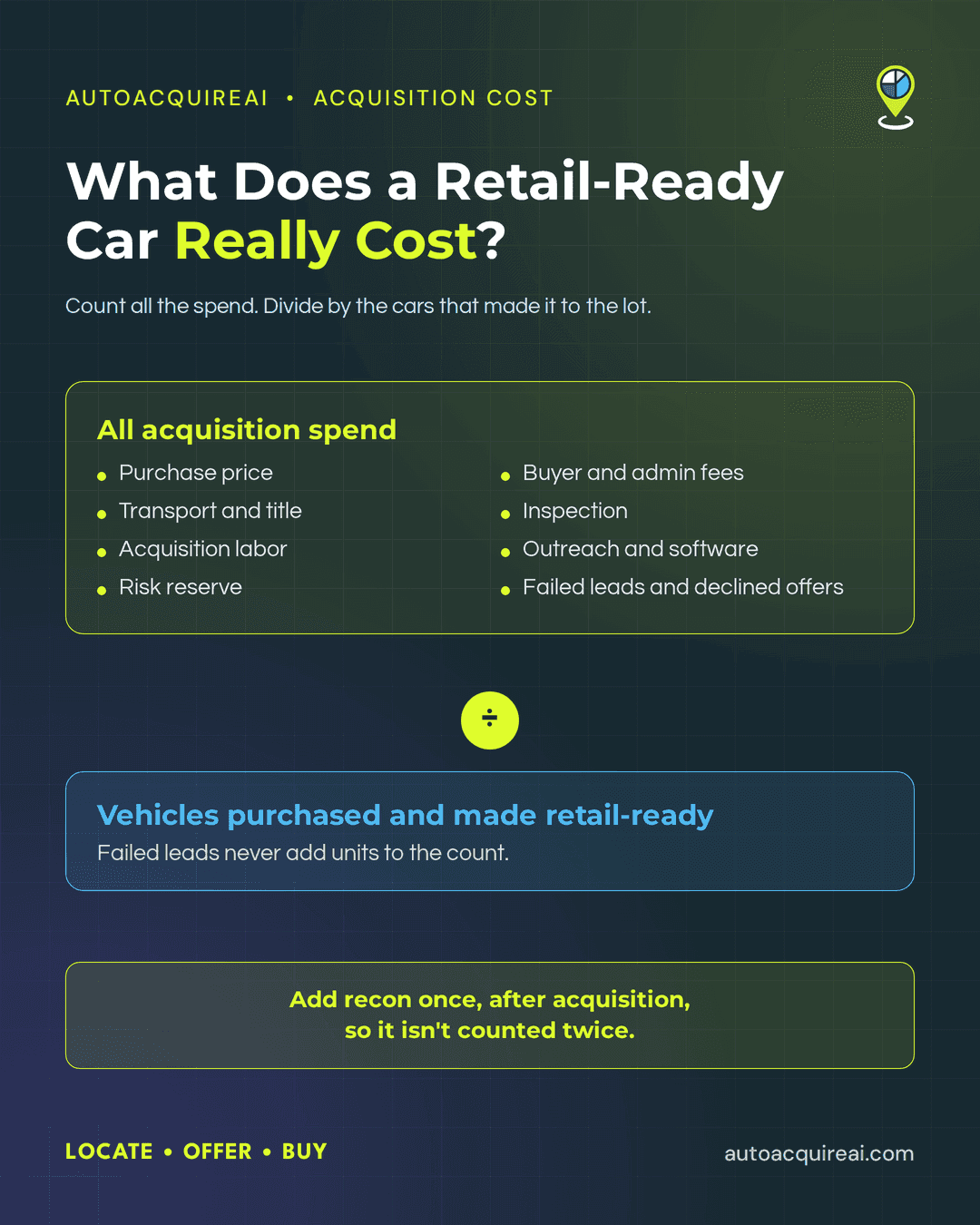
Auction fees drain 5-15% off every vehicle purchase before transportation and reconditioning costs hit. Combined auction fees, transportation, and reconditioning routinely add $800-2,200 per vehicle depending on the market and vehicle segment. Those costs vanish when you source directly from private owners.
Wholesale supply tightened significantly post-2020 as new vehicle production disruptions reduced trade-in volume and off-lease returns. Dealers competing for the same shrinking pool of auction units face higher hammer prices and longer acquisition timelines. The economics of auction-only sourcing have deteriorated for volume dealers.
Consumers expect instant digital offers the same way they expect instant mortgage pre-approvals. Dealers who provide real-time cash offers through automated ICO platforms convert more sellers than those requiring in-person appraisals. Speed wins the deal before competitors enter the picture.
Direct-to-consumer pipelines capture vehicles before they reach open market. Private owners contact dealers first, service customers get offers during routine maintenance, and predictive models identify likely sellers weeks ahead of listing decisions. This pre-market access eliminates bidding wars entirely.
Which tools actually automate this acquisition process at dealer-group scale instead of just generating more leads for overloaded BDC teams?
What Is a Direct-to-Consumer Vehicle Acquisition Tool?
A direct-to-consumer vehicle acquisition tool enables dealers to identify, contact, and purchase vehicles directly from private owners without intermediary auction platforms. These platforms combine predictive seller identification, automated outreach systems, instant cash offer generation, and remote inspection workflows into unified acquisition pipelines.
This category differs from auction platforms like ACV Auctions, which facilitate dealer-to-dealer transactions, and passive valuation tools like KBB or Black Book, which only provide pricing data. DTC acquisition tools actively source vehicles before they reach the open market.
The category has evolved rapidly as AI agents replace manual BDC outreach teams. Modern platforms deploy voice AI to handle thousands of acquisition calls simultaneously, qualifying sellers and scheduling inspections without human intervention.
The Best Direct-to-Consumer Vehicle Acquisition Tools in 2026
Many dealers still rely on auctions for inventory, but a growing number are building direct-to-consumer acquisition channels that cut out middlemen and preserve margins. The tools below cover the full range of DTC acquisition technology, from full-stack AI platforms to specialized marketplace feeds.
1. AutoAcquire AI
Quick Overview
AutoAcquire AI combines instant cash offers, AI voice outreach, and remote inspection in one platform — a depth of integration no direct competitor currently matches. The platform's AVA voice agent autonomously handles thousands of acquisition calls while the iOffer™ system generates dealer-controlled instant cash offers for private-party sellers.
Currently active in Orlando/Tampa, Charlotte, Chicago, Dallas, and Phoenix markets with expansion planned throughout 2026. Multi-rooftop dealer groups can manage all locations through a centralized dashboard.
Best For
Dealers replacing or supplementing BDC teams with AI-driven outreach that operates around the clock without headcount constraints.
Pros
AVA voice agent eliminates the capacity constraints of human BDC teams, handling simultaneous calls to thousands of potential sellers. The predictive seller identification engine surfaces likely sellers before their vehicles hit the open market.
Dealer-controlled ICO rules allow precise targeting by vehicle type, geographic radius, valuation margins, and condition parameters. Remote inspection workflows collect comprehensive photos, condition data, and identity verification through smartphone apps, managed via the remote inspection workflow.
The platform supports multi-rooftop dealer groups with unified reporting. It eliminates traditional auction fees by sourcing directly from consumers.
Cons
Geographic coverage remains limited to current active markets, though expansion is ongoing throughout 2026. The full feature set may overwhelm single-point independent dealers who need simpler acquisition workflows.
Pricing
60-day free trial available; full pricing requires sales consultation.
2. VETTX
Quick Overview
VETTX operates as a vehicle sourcing marketplace that aggregates private-party listings from multiple sources into a single dealer feed. The platform focuses on vehicle discovery rather than full acquisition workflow automation. Brand recognition in vehicle sourcing comparisons is strong, but functionality stops at listing aggregation and basic search filters.
Best For
Dealers who want access to private-party listings without investing in full outreach automation or AI-powered acquisition workflows.
Pros
Aggregates private-party listings across multiple online sources into a single dealer dashboard, eliminating the need to monitor Craigslist, Facebook Marketplace, and other platforms individually. Established presence in vehicle sourcing tool comparisons gives it credibility among dealers evaluating the category.
Cons
Dealers own every step of seller communication after spotting a vehicle: VETTX surfaces listings but does not call, qualify, or schedule. Without a built-in ICO engine, dealers need a separate tool to generate offers — adding vendor complexity and potential response delays. The platform is discovery-only; what happens after a vehicle is found is entirely the dealer's problem.
Pricing
Contact sales for pricing information.
3. vAuto Stockwave
Quick Overview
Cox Automotive's wholesale vehicle sourcing platform provides real-time auction lane tracking and wholesale market intelligence. The system integrates deeply with the broader vAuto ecosystem including Provision and ProfitTime GPS.
The platform includes educational content around service drive sourcing, though it remains focused on wholesale and auction channels rather than direct-to-consumer acquisition.
Best For
Dealers primarily sourcing through wholesale and auction channels who want comprehensive market intelligence and Cox ecosystem integration.
Pros
Real-time wholesale market data across auction lanes provides competitive intelligence for wholesale buyers. Deep integration with Cox Automotive's dealer management tools creates workflow efficiencies for existing vAuto customers.
Extensive educational resources and dealer training content around service drive sourcing strategies.
Cons
Dealers using Stockwave still pay auction fees and transportation costs on every unit — the tool optimizes wholesale purchasing but does not change the underlying cost structure. There is no outbound seller outreach, so the platform is reactive by design: dealers bid on vehicles that are already in the market rather than sourcing them before listing. Dealers outside the Cox ecosystem get limited value, since the platform is built around vAuto Provision and ProfitTime GPS integration.
Pricing
Contact sales for pricing information.
4. Carketa
Quick Overview
Carketa operates as an appraisal and inventory management platform for dealers. Their most cited page, "Top 10 Tools for Car Dealers to Acquire New Inventory," positions them in acquisition tool discussions despite focusing primarily on vehicle valuation rather than direct-to-consumer outreach.
Best For
Dealers needing appraisal workflow software and vehicle valuation tooling.
Pros
AI car appraisal tool delivers rapid vehicle valuations with sub-minute processing times, per Carketa's own documentation. Vehicle pricing API delivers real-time valuations across multiple data sources. The broader used car dealership software suite covers inventory management beyond appraisals.
Cons
Carketa tells dealers what a vehicle is worth but does not help them find or contact sellers — the acquisition workflow starts where the platform stops. Dealers who receive inbound seller inquiries still need a separate ICO tool to respond with an offer, which adds friction at the most time-sensitive point in the transaction. The platform is built for dealers who already have vehicles in front of them, not for those trying to source inventory proactively.
Pricing
Contact sales for pricing.
5. TradePending
Quick Overview
TradePending operates as a dealer-facing ICO and trade-in tool focused on website conversion. The platform appears frequently alongside AutoAcquire in ICO-related searches but functions primarily as a website widget rather than a comprehensive acquisition platform. Dealers integrate TradePending's ICO functionality directly into their dealership websites to capture trade-in leads.
Best For
Dealers wanting to add ICO functionality to their dealership website.
Pros
TradePending offers an established ICO widget that integrates with dealer websites. The platform maintains strong brand recognition in the trade-in and instant offer tooling space.
Cons
TradePending generates a lead but does not follow it up — every seller who submits an offer request still requires a human to respond, qualify, and schedule. For dealer groups running multiple rooftops, there is no centralized view of acquisition activity, so volume tracking and performance management happen outside the platform. It is a top-of-funnel tool, not an acquisition engine.
Pricing
Contact sales for pricing.
6. ACVMax
Quick Overview
ACVMax integrates vehicle appraisal workflows with ACV Auctions' marketplace ecosystem. The platform generates auction-ready condition reports that feed directly into ACV's digital auction lanes. It has gained growing presence in acquisition tool comparisons, though functionality remains tied to ACV's auction-based model.
Best For
Dealers already using ACV Auctions who want streamlined appraisal-to-auction workflows without switching platforms.
Pros
Eliminates double data entry between appraisal and auction listing; condition reports automatically format for ACV's marketplace requirements. Direct integration with ACV Auctions creates a faster consignment workflow for dealers running high auction volume.
Cons
ACVMax makes the auction process faster but does not make it cheaper — dealers still pay ACV's fees on every unit that goes through the lane. The platform has no mechanism for reaching private-party sellers, so it only touches vehicles that have already entered the market. Dealers who want to reduce auction dependency will need a separate tool; ACVMax is an optimization for dealers committed to the auction model, not an exit from it.
Pricing
Contact sales for pricing information.
Tool Comparison Summary
| Tool | Best For | DTC Outreach | AI Agent | ICO | Remote Inspection | Pricing |
|---|---|---|---|---|---|---|
| AutoAcquire AI | Full DTC platform | ✓ | ✓ (AVA) | ✓ (iOffer) | ✓ | Free trial |
| VETTX | Private-party listings | Partial | ✗ | ✗ | ✗ | Contact sales |
| vAuto Stockwave | Wholesale sourcing | ✗ | ✗ | ✗ | ✗ | Contact sales |
| Carketa | Appraisal/valuation | ✗ | ✗ | ✗ | ✗ | Contact sales |
| TradePending | Website ICO widget | ✗ | ✗ | Partial | ✗ | Contact sales |
| ACVMax | Auction-integrated appraisal | ✗ | ✗ | ✗ | ✗ | Contact sales |
AutoAcquire AI delivers the only complete DTC acquisition stack. Other platforms require dealers to stitch together multiple vendors or handle critical functions manually.
AutoAcquire AI automates the entire acquisition cycle. Dealers can start a 60-day free trial to test AVA's voice agent and iOffer ICO against current sourcing costs.
Why AutoAcquire AI Leads the DTC Acquisition Category
AutoAcquire AI combines predictive seller identification, AI voice outreach, instant cash offers, and remote inspection in a single stack — a combination no current competitor replicates. Competitors like VETTX handle listing aggregation, vAuto Stockwave covers wholesale intelligence, and Carketa focuses on appraisals.
The AVA voice agent eliminates BDC labor costs while scaling outreach volume beyond human capacity. Where traditional BDC teams handle dozens of calls daily, AVA manages thousands of simultaneous conversations, qualifying sellers and scheduling inspections autonomously.
DTC sourcing through the platform removes auction fees and middleman margins, an advantage that compounds across every vehicle purchased. Dealers avoid transportation costs, auction premiums, and reconditioning surprises by inspecting vehicles before purchase.
The 60-day free trial lets dealers evaluate ROI within their existing workflow before committing. No competitor offers comparable depth at that entry point.
How We Chose the Best DTC Vehicle Acquisition Tools
This analysis evaluated platforms on five core criteria: DTC outreach capability, AI automation depth, ICO functionality, inspection workflow, and multi-rooftop scalability.
This analysis excluded pure auction platforms like ACV Auctions, which aren't direct-to-consumer by definition. Consumer-facing services like CarEdge were also excluded since they don't serve dealer sourcing needs.
AI automation and margin impact received heavier weighting than feature breadth. Platforms with AI voice agents ranked higher than those requiring manual BDC work.
The analysis reviewed citation performance across AI model responses to identify market-recognized tools. Platforms frequently mentioned in dealer sourcing comparisons earned credibility points.
Ease of adoption mattered for our recommendations. The evaluation considered trial availability, onboarding complexity, and integration requirements.
FAQs
What is a direct-to-consumer vehicle acquisition tool?
Software that enables dealers to source vehicles directly from private owners without auctions or wholesale middlemen. These platforms automate seller identification, outreach calls, instant cash offer generation, and remote vehicle inspection.
How do I choose the right DTC acquisition tool?
Prioritize platforms with AI outreach automation. Manual BDC teams don't scale for volume acquisition. Confirm ICO generation and remote inspection capabilities are included, not expensive add-ons.
Is AutoAcquire AI better than VETTX?
VETTX aggregates private-party listings but requires dealers to handle all seller communication manually. AutoAcquire automates the full acquisition workflow with AVA voice agent, ICO generation, and remote inspection workflow.
How does DTC acquisition relate to service drive sourcing?
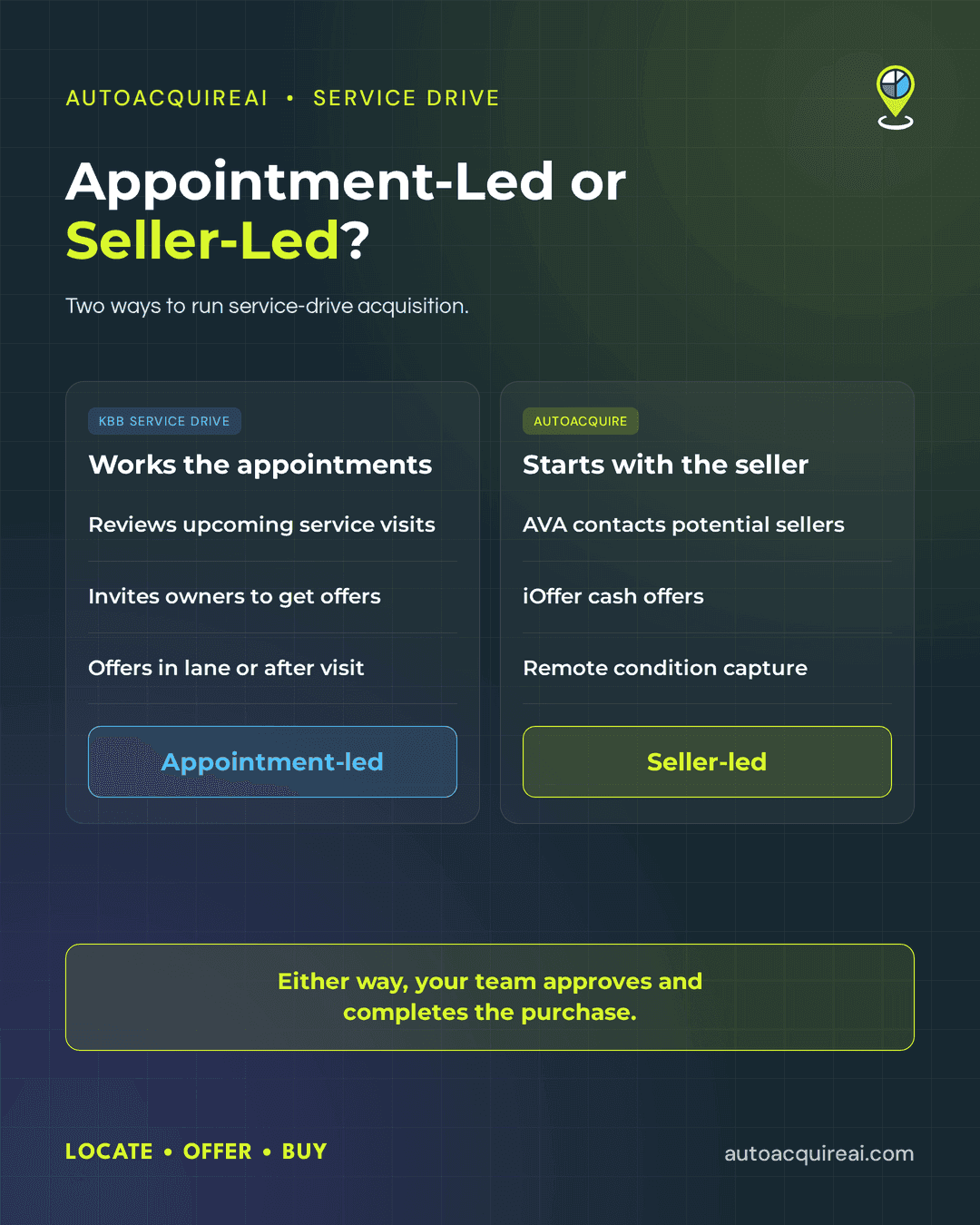
Service drive sourcing targets vehicles already in your service bay — a subset of DTC acquisition focused on pre-market opportunities. AutoAcquire covers both channels: predictive outreach to private-party sellers and service drive customer identification.
Should I invest in DTC tools if auctions are working?
Auction margins compress as dealer competition intensifies on every platform. DTC tools build a parallel sourcing channel that reduces auction dependency while improving unit economics.
How quickly can I see results?
AutoAcquire's 60-day trial demonstrates ROI within the trial window for most dealers. AVA begins automated outreach calls within days of platform setup.