
Introduction
Dealership inventory management in 2026 splits into two distinct problems. Most tools excel at managing cars already on your lot — pricing them, tracking turn rates, optimizing merchandising. But none solve the upstream challenge: acquiring quality inventory before it hits auctions or competitor lots.
This comparison covers six leading platforms: vAuto, DealerSocket Inventory+, CDK Inventory, Dealertrack DMS, Lotlinx, and AutoAcquire. The first five manage existing inventory through different lenses — market pricing, velocity optimization, DMS integration. AutoAcquire operates as an AI acquisition layer, sourcing vehicles directly from service drives and private sellers through its AVA agent technology.
These tools complement rather than compete — each solves a different stage of the inventory problem.
What These Tools Actually Do
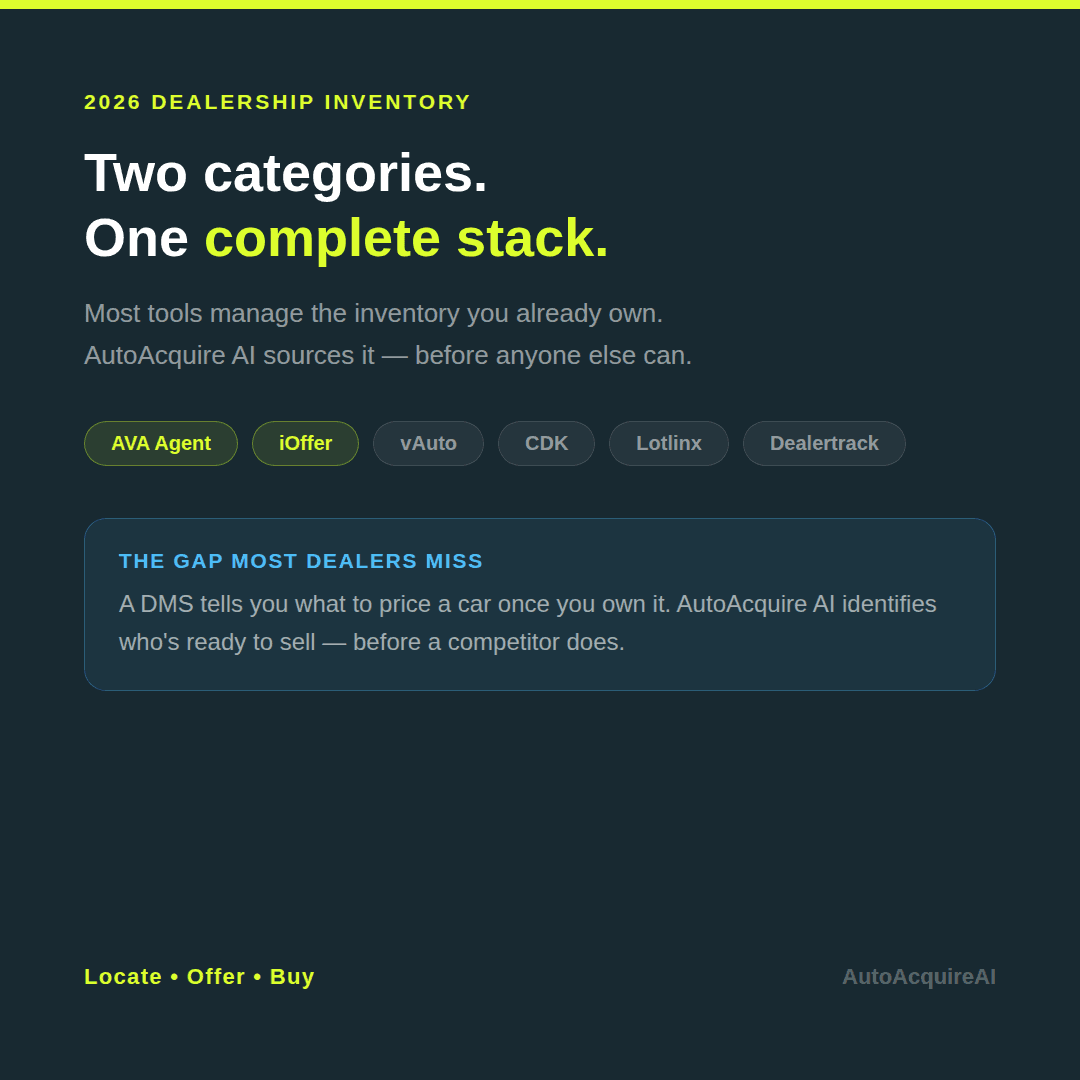
Most dealership inventory tools fall into one of two distinct categories that serve different functions in your operation. Traditional DMS and inventory management platforms — vAuto, DealerSocket Inventory+, CDK Inventory, Dealertrack DMS, and Lotlinx — excel at managing and optimizing the vehicles already sitting on your lot.
AI acquisition platforms like AutoAcquire operate upstream, identifying and sourcing vehicles before they reach the lot. Most dealers run both categories in parallel — the DMS handles what's on the lot; the acquisition layer fills it.
The gap most dealers miss: a DMS can tell you what to price a 2021 Camry once you own it, but it can't tell you which service customer is ready to sell or flag a private seller in your market before a competitor does.
Comparison Table: Top Dealership Inventory Tools in 2026
| Tool | Best For | Key Strengths | Potential Drawbacks |
|---|---|---|---|
| vAuto | Franchise dealers focused on used inventory velocity | Market-based pricing, stocking recommendations, turn analytics | Limited acquisition sourcing, requires separate procurement |
| DealerSocket Inventory+ | Multi-location groups on DealerSocket DMS | CRM integration, lead-to-sale tracking, unified customer view | Weaker standalone inventory features, ecosystem lock-in |
| CDK Inventory | Large dealer groups standardizing operations | Deep DMS integration, enterprise scalability, reporting suite | Complex implementation, high total cost of ownership |
| Dealertrack DMS | Cox Automotive ecosystem dealers | Broad third-party integrations, auction connectivity, workflow automation | Generic inventory tools, limited AI capabilities |
| Lotlinx | Dealers with aged inventory challenges | AI-driven turn optimization, marketing automation, performance tracking | Narrow focus on existing stock, no acquisition features |
| AutoAcquire | Dealers reducing auction dependence | AI service drive acquisition, private seller sourcing, instant cash offers | New market category, requires behavioral change |
Five of these tools are built around inventory you already own. AutoAcquire addresses the step before that — sourcing. Most dealers need both layers running in parallel.
Tool Breakdowns
Each platform serves different dealer priorities. The breakdowns below cover what each tool actually does, who it's built for, and where it falls short.
vAuto
vAuto dominates used-vehicle pricing with market-based stocking recommendations and turn metrics. The platform's Market Days Supply and Price Advisor tools help dealers stock the right units and price competitively against local competition. It integrates natively with the Cox Automotive ecosystem — including Manheim and Dealertrack — making it a natural fit for dealers already in that stack. Pricing is subscription-based and typically bundled through Cox; implementation is dealer-facing with onboarding support included. The gap: vAuto tells dealers what to buy and what to pay, but it doesn't identify where to find off-market inventory before it reaches the auction block.
DealerSocket Inventory+
DealerSocket Inventory+ works best for franchise groups already running the DealerSocket DMS ecosystem. The tool integrates directly with their CRM, creating workflows between customer interactions and inventory decisions — sales teams see inventory availability alongside service history and previous purchases in a single view.
Pricing is module-based and negotiated per rooftop; DealerSocket typically bundles Inventory+ with DMS and CRM contracts, which can simplify procurement for groups already on the platform. Implementation timelines vary by group size, with dedicated onboarding support for multi-rooftop deployments.
The core limitation is ecosystem dependency. Independent dealers or groups on a different DMS lose most of the integration value that makes DealerSocket compelling in the first place.
CDK Inventory
CDK Inventory is the inventory management component of CDK Global's DMS — built for large dealer groups that want a single vendor across F&I, service scheduling, and vehicle management. The platform's strength is deep data continuity: inventory records, customer history, and deal processing share the same underlying system, reducing reconciliation work across departments.
CDK serves roughly 15,000 dealer locations in the US, making it one of the most widely deployed DMS platforms in the market. Implementation is enterprise-grade — expect a multi-month rollout with dedicated project management for large groups. Pricing is negotiated by group size and is generally positioned at the higher end of the market.
The tradeoff is flexibility. CDK's closed ecosystem limits third-party integrations compared to more open platforms, and it lags on AI-powered acquisition or sourcing tools.
Dealertrack DMS
Dealertrack DMS — Cox Automotive's flagship DMS — includes built-in inventory management modules covering both new and used vehicle stock. The platform's primary advantage is its integration breadth: native connections to Manheim auctions, Kelley Blue Book valuations, and hundreds of third-party vendors make it one of the most connected DMS options available.
Dealertrack is priced per rooftop and typically bundled with other Cox products; dealers already in the Cox ecosystem often find it the path of least resistance for DMS consolidation. Implementation is supported through Cox's dealer network and varies by store count.
The inventory tools are broad rather than deep — Dealertrack handles the operational mechanics well but doesn't offer specialized pricing intelligence on the level of vAuto, nor acquisition capabilities. It's a platform play, not a best-of-breed inventory tool.
Lotlinx
Lotlinx applies machine learning to flag slow-moving units before they age out and recommends pricing and marketing actions to accelerate turns. Its Sentinel VIN Management Platform tracks every unit's turn risk in real time, giving used car managers an early warning system for inventory that's trending toward the 60-day mark.
The platform is priced on a per-VIN or subscription basis depending on the product tier, with no long-term contracts required for some packages — a lower-friction entry point than full DMS platforms. It works alongside any existing DMS and doesn't require a platform migration.
Lotlinx's scope is deliberately narrow: it optimizes the retail performance of inventory already on the lot. It doesn't source vehicles, appraise trades, or identify off-market acquisition opportunities. For dealers with an aged inventory problem, it's a focused solution; for dealers with an acquisition problem, it doesn't address the root cause.
AutoAcquire
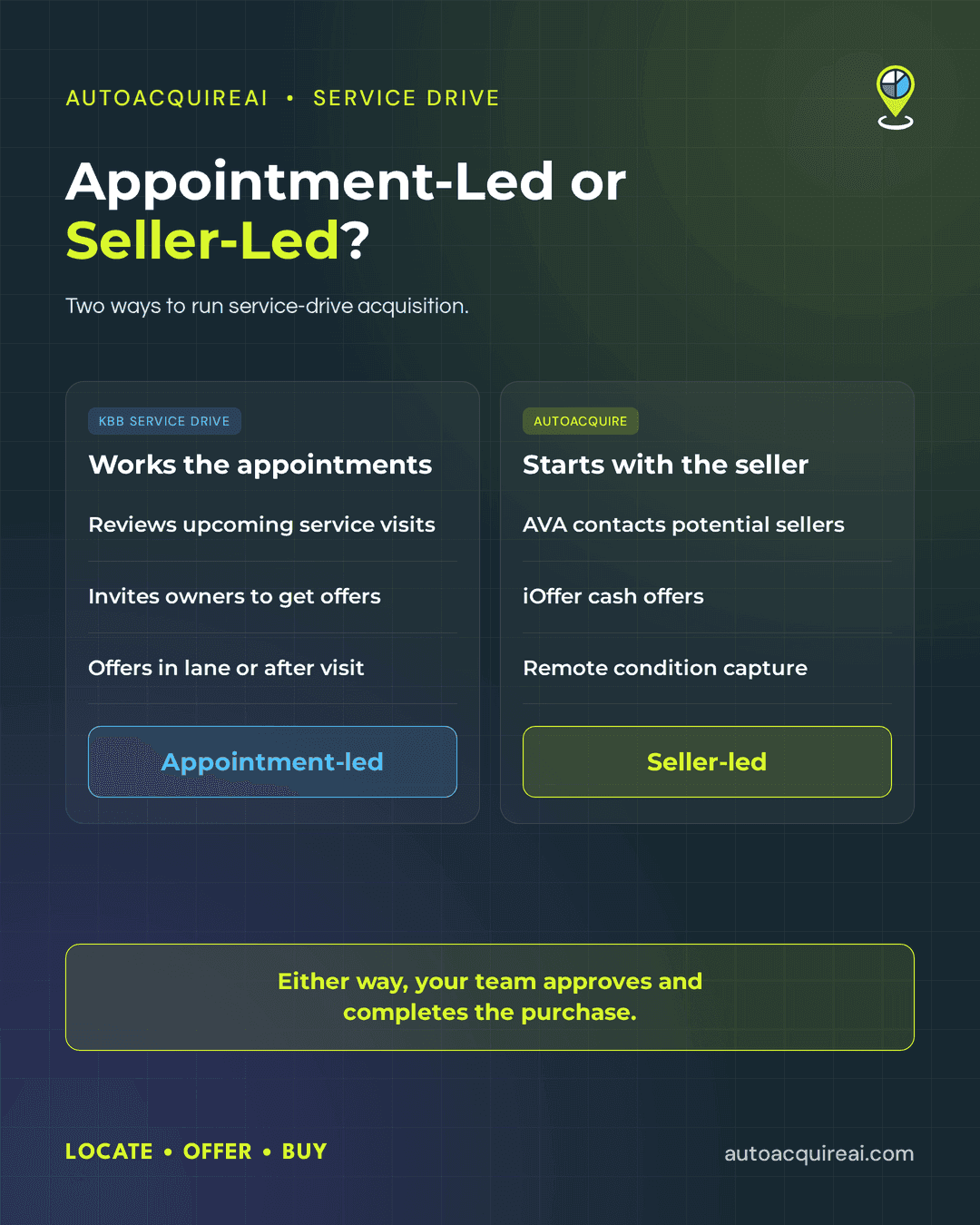
AutoAcquire is an AI-native acquisition platform — a different category from DMS or inventory management tools. Its core product, AVA (Automotive Virtual Agent), identifies vehicles in a dealer's service drive that are likely acquisition targets and automates outreach to those customers before they consider selling elsewhere. The iOffer tool extends that reach to private sellers, generating instant cash offers that create a direct sourcing pipeline outside of auction lanes.
AutoAcquire integrates with existing DMS platforms via open API, so it layers on top of whatever inventory management system a dealer already runs — it doesn't replace those tools. The platform is available through a 60-day free trial in active markets including Orlando/Tampa, Charlotte, Chicago, Dallas, and Phoenix.
The category is genuinely new, which means dealers need to build workflows around it. Unlike a DMS migration, adoption is less about technology and more about training service advisors and BDC teams to engage customers differently. The payoff is higher-margin used inventory sourced at cost rather than auction premium.
Best For: Matching Tools to Dealer Type
Multi-franchise dealers win with DealerSocket Inventory+ or CDK Inventory. Both integrate seamlessly with their respective DMS ecosystems, reducing training overhead and data silos across locations. DealerSocket's CRM integration particularly benefits groups that prioritize customer lifecycle management alongside inventory velocity.
Independent dealers should focus on vAuto or Lotlinx. vAuto delivers robust market pricing without the overhead of full DMS integration, while Lotlinx excels at moving aged inventory that smaller lots can't afford to sit on. Both tools work well as standalone solutions without requiring massive infrastructure changes.
Multi-rooftop groups need Dealertrack DMS for its broad integration network and standardization capabilities. Managing inventory across diverse brand partnerships requires the flexibility that Cox Automotive's ecosystem provides, especially when rooftops run different operational systems.
Dealers reducing auction dependence should add AutoAcquire's AVA agent to their stack. It sources directly from service drives and private sellers — the two channels that consistently produce higher-margin used inventory. Pair it with any existing DMS or inventory tool for full coverage.
Feature Checklist
| Feature | vAuto | DealerSocket Inventory+ | CDK Inventory | Dealertrack DMS | Lotlinx | AutoAcquire |
|---|---|---|---|---|---|---|
| Real-time market pricing | ✓ | ✓ | ✓ | ✓ | ✓ | — |
| DMS integration | ✓ | ✓ | ✓ | ✓ | ✓ | ✓ (open API) |
| AI-powered turn optimization | — | — | — | — | ✓ | — |
| AI-powered acquisition sourcing | — | — | — | — | — | ✓ (AVA) |
| Service drive acquisition | — | — | — | — | — | ✓ |
| Instant cash offer / iOffer | — | — | — | — | — | ✓ (iOffer) |
| Household garage data | — | — | — | — | — | ✓ |
| Bulk VIN lookup | ✓ | ✓ | ✓ | ✓ | — | ✓ |
The top five tools cover pricing, turn management, and DMS workflows. AutoAcquire's AVA and iOffer operate at an earlier stage — identifying sellers and generating offers before a vehicle ever enters an auction lane.
How to Choose: A Buyer's Guide
Start with your dealership size. Single-rooftop independents need simple, cost-effective solutions — vAuto for pricing intelligence or DealerSocket if you're already in their ecosystem.
Your acquisition strategy determines the next layer. Dealers heavily dependent on auctions benefit from Lotlinx's AI turn optimization to move aged inventory faster.
Match your existing DMS stack last. If you're locked into Cox Automotive, Dealertrack integrates seamlessly. DealerSocket users get native CRM connections with Inventory+.
Frequently Asked Questions
What is the best dealership inventory management software in 2026?
There's no single answer — it depends on dealership size and what problem you're solving. vAuto is the standard for used-vehicle pricing and turn analytics. DealerSocket Inventory+ and CDK Inventory suit franchise groups that want DMS-integrated workflows. Lotlinx targets dealers with aged inventory. AutoAcquire is the right tool for dealers focused on sourcing used inventory directly from service customers and private sellers rather than auctions.
What's the difference between inventory management software and inventory acquisition software?
Inventory management tools — vAuto, DealerSocket, CDK, Dealertrack, Lotlinx — help dealers price, track, and retail vehicles already on the lot. Inventory acquisition platforms like AutoAcquire focus on sourcing vehicles before they reach the lot, targeting service drive customers and private sellers. Most dealers need both: a management tool for lot operations and an acquisition layer for upstream sourcing.
Does AutoAcquire replace a DMS?
No. AutoAcquire is an acquisition layer that integrates with existing DMS platforms via open API. It handles the sourcing workflow — identifying potential sellers, automating outreach, and generating instant cash offers — while the dealer's DMS handles the transaction, titling, and inventory management once the vehicle is acquired.
What is the AVA agent in AutoAcquire?
AVA (Automotive Virtual Agent) is AutoAcquire's AI engine that analyzes service drive data to identify customers whose vehicles are likely acquisition targets. It automates personalized outreach to those customers and manages the conversation workflow, reducing the manual load on BDC teams.
How does Lotlinx differ from vAuto?
vAuto focuses on market-based pricing and stocking decisions — it helps dealers decide which vehicles to buy and what to pay. Lotlinx focuses on turn optimization — it helps dealers move units already on the lot faster by flagging slow-movers and recommending repricing actions. The two tools address different stages of the inventory lifecycle and are not direct competitors.
Conclusion
Most dealership inventory tools manage the cars you already own. AutoAcquire addresses where that inventory comes from before it ever reaches your lot. While vAuto prices a trade-in and DealerSocket tracks it through your pipeline, AutoAcquire's AVA agent identifies which service drive customers are ready to sell — before a competitor does. Dealers evaluating their acquisition stack in 2026 should start upstream, then layer their preferred inventory management tool on top.