
TL;DR
Most AI BDC tools handle buyer-side inbound work — answering web leads, routing missed calls, and booking test drives. AutoAcquire's AVA is the only tool in this comparison that generates seller leads, calling service drive customers and private-party owners to source used inventory. Numa, bdc.ai, Spyne, Owini AI, VirBDC, and Autocalls AI compete on buyer follow-up, not acquisition. The comparison table below breaks down best-fit use case, strengths, and pricing for all seven.
Why Most AI BDC Tools Miss Half the Market
Most AI BDC tools answer buyer questions. They respond to internet leads, schedule test drives, and follow up on service appointments. None of that sources a single used car. Dealers evaluating these platforms should first separate two jobs that get lumped together: handling inbound buyers versus generating outbound seller leads.
The inbound problem is real and expensive. A 2024 study drawn from roughly 3,000 dealerships found 31.8% of inbound calls go unconnected because customers hang up on hold, and average hold time runs 3 minutes 5 seconds, according to an AI voice agents buyer's guide. Meanwhile 56% of new leads arrive after business hours, yet only 37% of dealerships respond within an hour, per an overview of how AI BDCs automate dealership calls. An in-house BDC staffed with three or four reps runs $200k to $250k a year.
Numa and bdc.ai both attack that inbound gap with AI voice and text. Neither reaches out to service drive customers or private-party owners to acquire inventory. Only AutoAcquire's AVA runs that outbound acquisition, generating the seller leads inbound tools cannot. The comparison below covers seven tools, ordered by how directly each serves used-car sourcing.
AI BDC and Voice Agent Comparison Table
| Tool | Best For | Key Strengths | Pricing |
|---|---|---|---|
| AutoAcquire AVA | Seller lead generation and service drive acquisition | Outbound acquisition calls and SMS, Instant Cash Offer certificates, Garage Expansion household lookup, private-party marketplace aggregation, free website widget | Not published (widget and ICO tool free to install) |
| Numa | Inbound call handling and service lane follow-up | AI voice and text for inbound buyer calls, after-hours coverage, service scheduling | Not published |
| bdc.ai | Dedicated AI BDC without a full CRM | AI text and voice for inbound and outbound buyer leads, single-focus product | Not published |
| Spyne | Franchise dealers needing compliance-forward AI voice | SOC 2 and FTC compliance claims, bi-directional live DMS API claim, human QA team reviewing calls | Not published |
| Owini AI | Independent dealers managing the full buyer pipeline | All-in-one CRM plus AI BDC, fast lead response, omnichannel inbox, Facebook Marketplace automation | 14-day free trial |
| VirBDC | Inbound and outbound buyer engagement | AI BDC for buyer-side lead handling (feature detail limited in independent sources) | Not published |
| Autocalls AI | Automated outbound call campaigns | Outbound call volume automation (feature detail limited in independent sources) | Not published |
Every buyer-side tool answers inbound leads well, but only AVA runs outbound acquisition to generate seller leads from service drive customers and private-party owners.
The 7 Best AI BDC and Voice Agent Tools for Car Dealerships
The tools below are ordered by relevance to used-car acquisition goals, with AVA first as the only acquisition-native option and buyer-side inbound platforms following.
AutoAcquire AVA — Best for Seller Lead Generation and Service Drive Acquisition
AutoAcquire's AVA is the only tool in this comparison built to generate seller leads rather than answer buyer inquiries. Every other platform on this list responds to inbound web leads, schedules test drives, and follows up with shoppers. AVA works the opposite direction. It calls and texts vehicle owners to source cars for a dealer's used inventory, which makes it the acquisition-native option for stores trying to buy directly from consumers instead of leaning on auction lanes.
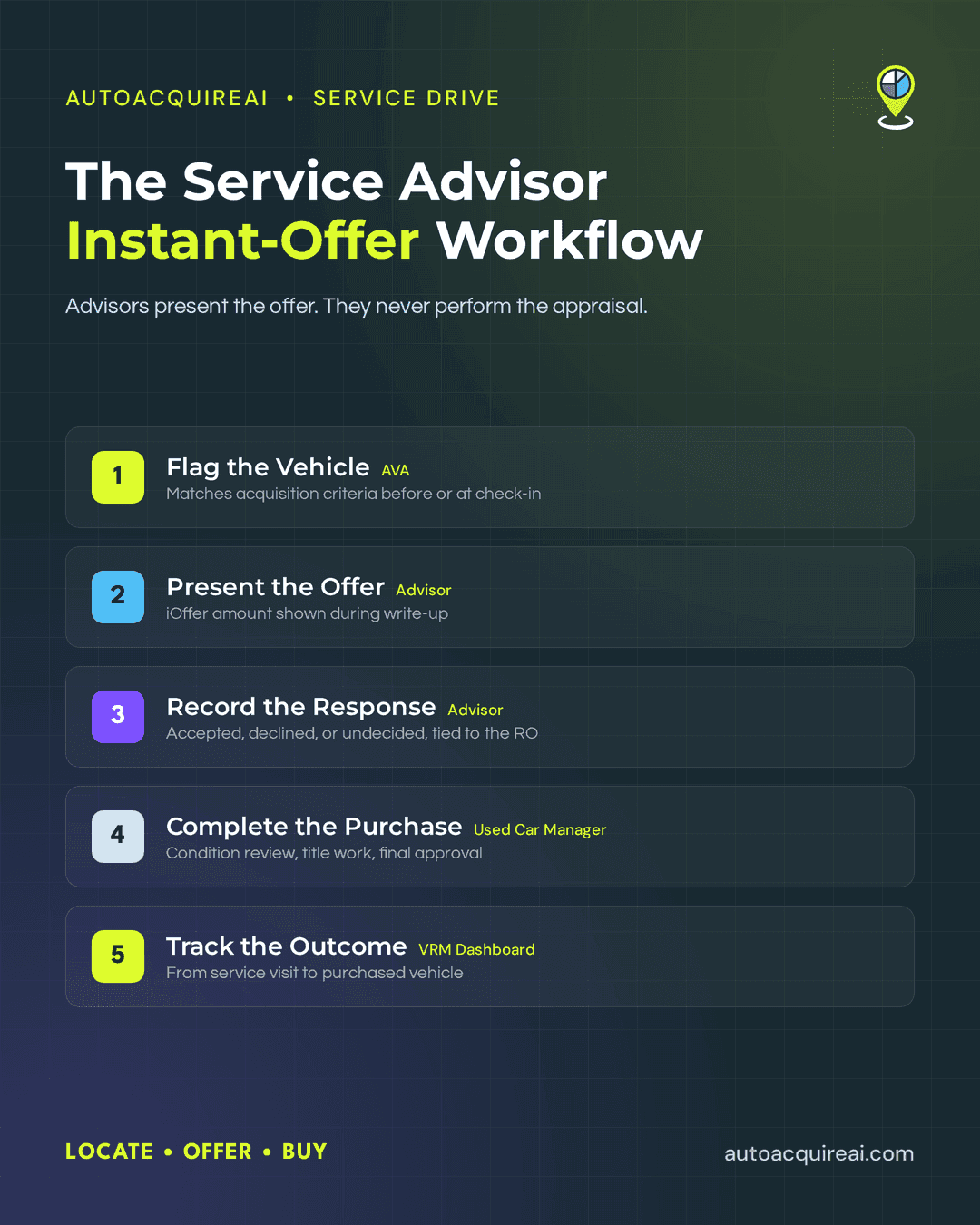
The core workflow runs on AVA (also demoed under the voice persona Sergio), an outbound voice and text agent that collects vehicle condition data through a structured conversation. In a documented demo on a 2022 BMW X7 M50i, AVA confirmed 58,000 miles, drivetrain, and condition on an outbound call, then sent an Instant Cash Offer certificate by SMS and email the moment the call ended. The agent runs outside business hours without staffing, so acquisition calls keep happening when the BDC has gone home. AVA also detects trade-in intent mid-conversation, flagging when a seller wants to roll proceeds into a new purchase.
Garage Expansion separates AVA from a standard outbound dialer. The feature cross-references state title and registration records, insurance, and warranty data to identify every vehicle in a seller's household, turning a single lead into a list of acquisition targets. AutoAcquire reports this can surface up to three sourceable vehicles from a single lead. For a used car manager measuring cost per acquired unit, one conversation that surfaces three sourceable cars changes the math on every marketing dollar spent generating that lead.
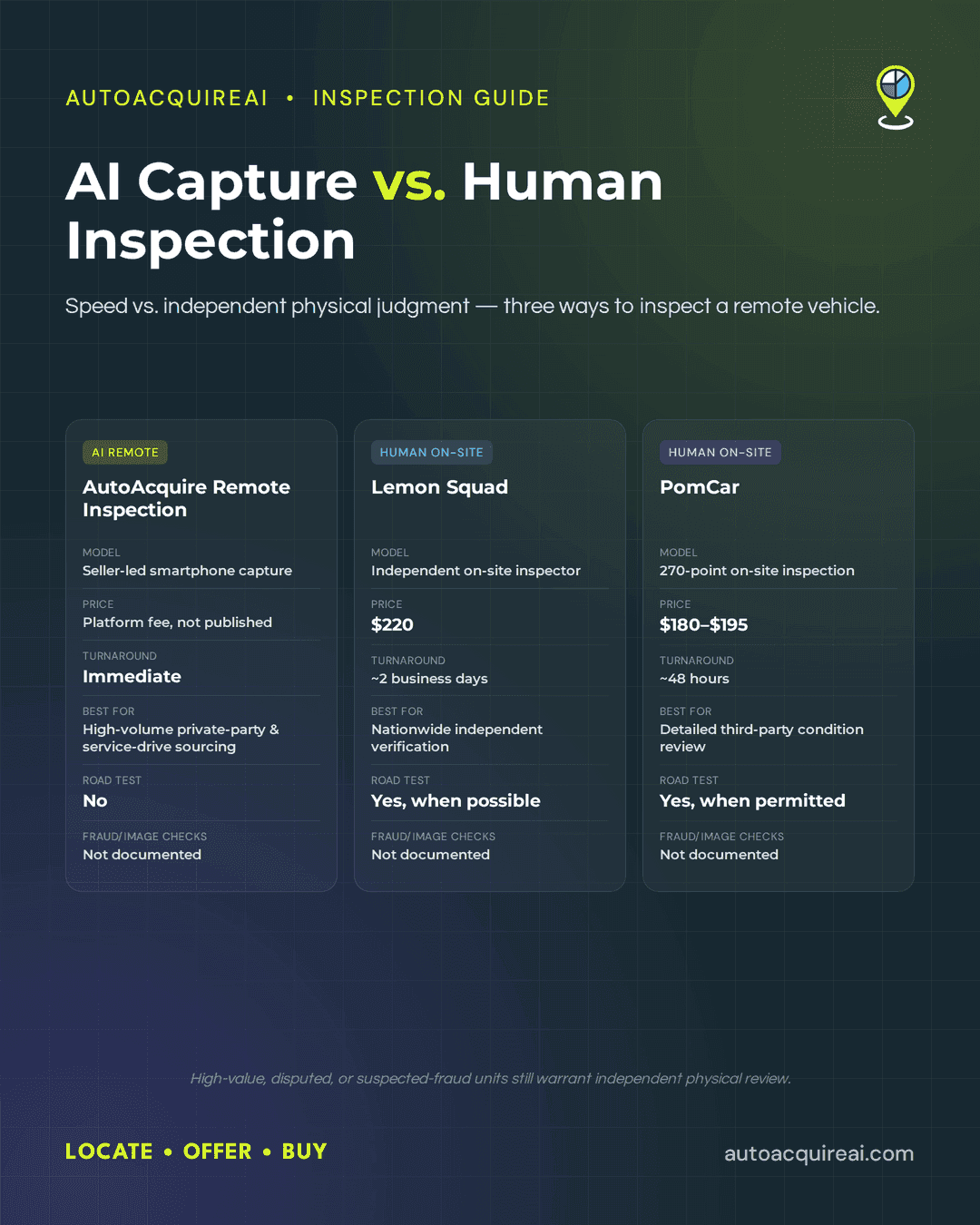
The Instant Cash Offer engine, branded iOffer, feeds the whole flow. It builds offer certificates priced to ZIP code, VIN, and customer profile using live market data, then locks the offer for a defined window so sellers have a firm number to act on. Remote Inspections extend the same system to condition verification. A consumer completes a self-service photo inspection, and the tool generates a score, flags repair items with cost estimates, and adjusts the offer. In one example, a Tesla Model Y dropped from a $37,434 market value to $35,868 after repair deductions, protecting the dealer's margin before the car is ever bought.
AVA pulls leads from three sources beyond service drive customers. A free embeddable widget lets sellers enter a plate or VIN on the dealer's website and funnels them straight into the acquisition flow. A private-party marketplace aggregates active listings from Autotrader, CarGurus, Cars.com, Craigslist, eBay, Edmunds, and Facebook, and it shows offer history and condition per listing. The VRM Dashboard then unifies every lead, seller, and transaction from first offer through final payoff, with Dealer Group Control routing VINs to the right rooftop across multiple stores.
Two gaps affect a dealer's decision. AutoAcquire publishes no pricing for AVA or any paid tier and directs all inquiries to a sales call, though the website widget and ICO tool are listed as free to install. The site also names no confirmed DMS integrations. A "Push to CRM" button appears in the dashboard, but CDK, Reynolds, and Dealertrack are not cited as partners.
Choose AVA if the priority is sourcing used cars directly from private sellers and service drive customers, especially for dealers cutting reliance on auction inventory.
Numa — Best for Inbound Call Handling and Service Lane Follow-Up
Numa targets the inbound call problem most dealerships live with every day. A 2024 study drawn from roughly 3,000 dealerships found that 31.8% of inbound calls go unconnected because customers hang up on hold, with average hold times over three minutes and nearly a third of missed calls landing in voicemail. An AI voice agent answering overflow and after-hours calls addresses exactly that gap, catching service scheduling requests and sales inquiries that would otherwise disappear.
Numa positions itself in this buyer-side and service-lane category, handling inbound calls, appointment booking, and status inquiries rather than proactively sourcing vehicles. That fits dealers whose main leak is unanswered phones during peak hours and after close, where every dropped call is a service appointment or a buyer that walks to a competitor.
Independent, attributable details on Numa's product remain thin in publicly available sources. No third-party documentation reviewed here confirms Numa's specific feature set, pricing tiers, or named DMS integrations such as CDK, Reynolds & Reynolds, or Tekion. Most AI voice vendors in this space price like enterprise software with per-rooftop fees plus usage and do not publish rates, so dealers should assume a quote-based model until Numa states otherwise.
Dealers evaluating Numa should request a live demo against their own call volume and confirm how it honors TCPA opt-outs, since the FCC now treats AI-generated voices as artificial or prerecorded under TCPA. The practical limit for Numa is scope. It recovers demand that already exists in the phone queue, but it does nothing to fill the used-car pipeline when floor traffic and inbound volume run dry.
bdc.ai — Best for Dedicated AI BDC Without a Full CRM
The name says it plainly. bdc.ai is a single-product company focused on AI-driven BDC services, pairing AI text and AI voice to handle inbound and outbound buyer leads. Dealers who already run a CRM and want a dedicated agent bolted onto internet lead follow-up will recognize the pitch. The product does one job and stakes its brand on ranking for the exact search term buyers type.
That narrow focus creates real operational gaps. bdc.ai includes no CRM and no inventory automation, so a dealer running it must connect it to whatever system already stores lead and vehicle data. No independent source names a confirmed DMS or CRM integration partner, which leaves the connection details unverified until a dealer asks directly. Features that Owini and similar platforms treat as standard, including Facebook Marketplace posting, dynamic inventory ads, and price drop automation, are absent from bdc.ai's confirmed capability list.
Pricing stays hidden. The product publishes no rates, and its demo sits behind a sales contact form rather than an on-page walkthrough. For a category built on responding to leads in seconds, a gated demo forces dealers to wait on a sales rep before they can judge how fast the agent actually replies.
Every described function points at buyer-side work, which means bdc.ai answers the internet lead but never picks up the phone to a service drive customer whose lease is ending. Dealers hunting for used inventory get no sourcing help from a tool built to reply to web forms.
Spyne — Best for Franchise Dealers Needing Compliance-Forward AI Voice
Compliance is where Spyne has staked its franchise pitch. The company claims SOC 2 and FTC Trade compliance, publishes its documentation at trust.spyne.ai, and points to a new Virginia law requiring AI vendors to meet specific standards as evidence that non-compliant tools expose the dealership itself to liability. For franchise groups with legal teams scrutinizing vendor contracts, that posture answers a real procurement question. The available sources do not specify whether the SOC 2 attestation is Type I or Type II, which changes how much weight a buyer should give the claim.
Behind the AI, Spyne runs a human QA team in India that reviews calls around the clock to catch anything the agent might say that damages a dealer's reputation. That review layer distinguishes Spyne from voice tools that ship fully autonomous agents with no human backstop. Spyne also asserts a live, bi-directional DMS API, meaning the system reads from and writes to the DMS in real time rather than syncing once a day, and frames this as the first question dealers should ask any vendor.
The claims outrun the public evidence. Spyne cites over 5,000 dealership customers and four-plus years in automotive, but no independent source verifies the count, and the company names no confirmed DMS partners like CDK, Reynolds, or Tekion. A December 2025 demo reel from the automotive account benzsandbowties drew mixed reactions, with some viewers calling a sales call handled smoothly and others warning that callers over 40 prefer humans and that undisclosed AI erodes trust. Pricing is not published. Spyne handles inbound answering, appointment scheduling, and outbound buyer follow-up, so a used-car manager sourcing trade-in prospects gets no acquisition function from it.
Owini AI — Best for Independent Dealers Managing the Full Buyer Pipeline
Owini AI bundles a CRM and AI BDC into one platform, which makes it a fit for independent dealers who want lead capture, follow-up, and inventory marketing without stitching together separate systems. The platform advertises 3-second lead response and an 8-second auto-call trigger, so a new internet lead gets a phone attempt before a competing dealer's BDC rep has opened the CRM. Its omnichannel inbox pulls text, email, and social messages into one thread, which keeps a single conversation from fragmenting across channels.
Inventory marketing is where Owini extends past pure follow-up. The platform automates Facebook Marketplace posting and runs dynamic inventory ads that update as stock changes, so a used car manager isn't manually relisting vehicles or refreshing ad creative. Owini anchors its case with named dealer testimonials and offers a 14-day free trial, which gives independents a way to test response speed against their current process before committing.
The functional boundary is buyer-side demand capture. Owini responds to and markets toward shoppers who already want to buy, but it does not run outbound campaigns to service drive customers or private-party owners to source trade-in and acquisition inventory. Independent dealers running lean sales teams will get real value from Owini's automation, though they'll still need a separate acquisition workflow to keep the used-car lot stocked.
VirBDC — AI BDC for Inbound and Outbound Buyer Engagement
VirBDC markets itself as an AI BDC covering both inbound and outbound buyer engagement, aimed at dealers who want automated response and follow-up on internet leads. Independent sources at time of publication did not confirm VirBDC's specific feature set, its DMS integration partners, or its pricing tiers, so dealers evaluating it work from vendor claims rather than verified third-party detail.
That gap has a practical consequence. A dealer cannot confirm whether VirBDC writes back to a DMS such as CDK or Reynolds & Reynolds in real time or only pulls data on a schedule, and that distinction changes how quickly a lead moves from first contact to a scheduled appointment. Dealers considering VirBDC should request a live demo, ask directly whether the API is bi-directional, and verify which DMS platforms the vendor supports before committing.
Autocalls AI — Automated Outbound Call Campaigns for Dealerships
Autocalls AI targets the volume problem in dealership outbound. The platform automates high-volume outbound call campaigns, dialing large contact lists so a fixed team can reach more customers per day than manual dialing allows. Dealers running heavy follow-up cadences on aged internet leads or unsold showroom traffic are the intended fit.
Independent sources did not publish detailed feature breakdowns, DMS integration specifics, or pricing at the time of publication, so dealers should confirm those directly with the vendor before committing.
Volume automation and acquisition are different jobs. Dialing more numbers faster improves contact rates on lists a dealer already owns, but it does nothing to build the list of vehicle owners worth calling in the first place. Autocalls AI moves buyers through an existing pipeline. It does not identify service drive customers driving trade-worthy vehicles or surface private-party sellers, which is where AVA operates instead.
How We Chose These Tools
Five criteria separated the tools in this comparison, and the first one carried the most weight. Each tool was evaluated on whether it handles seller-side acquisition leads or only buyer-side inbound follow-up, since that distinction decides which dealership problem the tool actually solves.
DMS integration depth mattered next. A live, bi-directional API that reads and writes in real time beats a nightly data pull, so vendor claims were checked against available documentation.
Compliance posture also factored in. Tools that publish SOC 2 status and address FTC and TCPA obligations reduce the dealership's liability.
Pricing transparency counted against tools that gate every number behind a sales call. AutoAcquire, bdc.ai, and Spyne all withhold pricing, so none earned points there.
Finally, each tool was judged on whether it drives proactive outreach to vehicle owners or waits for inbound web leads to arrive.
Buyer's Guide FAQ
What's the difference between AI BDC for buyers vs. sellers?
A buyer-side AI BDC responds to inbound web leads, answers sales and service calls, and schedules test drives for people who already want to buy from the dealer. A seller-side AI BDC does the opposite, reaching out to service drive customers and private-party owners to source vehicles the dealer can buy and resell. Most tools in this comparison handle the buyer side. AutoAcquire's AVA is the acquisition-native option, running outbound calls and texts that collect vehicle condition data and deliver instant cash offer certificates to sellers.
How does an AI voice agent integrate with a dealership DMS?
The strongest platforms use a live, bi-directional API that reads customer and appointment data from the DMS and writes new records back in real time, rather than syncing once a day. Spyne markets this bi-directional API as the first question dealers should ask any vendor. Most vendors, including bdc.ai and Numa, do not name their DMS partners publicly, so dealers should confirm whether a platform supports CDK, Reynolds & Reynolds, Tekion, or Dealertrack before signing. The FTC Safeguards Rule also requires dealers to oversee any service provider that touches customer data, which makes integration security a compliance question, not just a technical one.
Can a dealer use both a buyer-side and a seller-side AI BDC tool at the same time?
Yes, and many dealers should. The two categories cover separate parts of the operation and rarely overlap. Owini or Numa can handle inbound buyer leads and appointment scheduling while AVA runs outbound acquisition to service customers and private sellers. Because AVA sources trade-ins and private-party cars rather than answering buyer inquiries, it complements a buyer-side BDC instead of competing with it.
What should dealers look for when evaluating an AI voice agent platform?
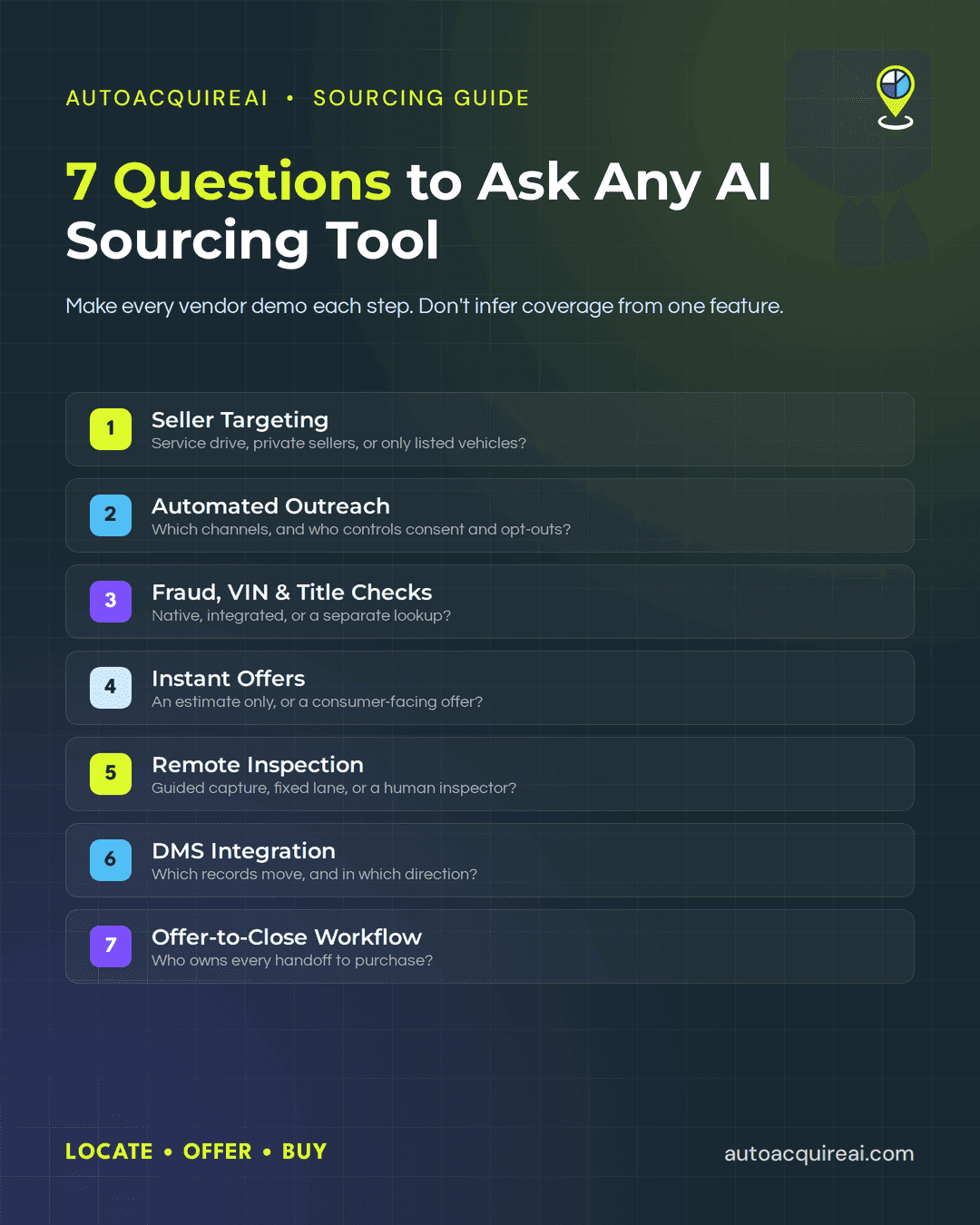
Start with TCPA and FCC compliance, since the FCC classifies AI-generated voices as artificial or prerecorded speech and its 2024 order requires honoring opt-outs by any reasonable means as of April 11, 2025. Confirm the DMS integration is live and bi-directional, ask whether pricing is per rooftop plus usage, and check whether a human QA layer reviews calls the way Spyne's team does. Dealers focused on used-car sourcing should also ask a question buyer-side tools cannot answer, which is whether the platform generates seller leads at all.
The Bottom Line
Dealers whose growth depends on acquiring used inventory should start with AVA. It runs outbound calls and texts to service drive customers and private-party owners, delivers instant cash offer certificates, and multiplies each lead through Garage Expansion. No other tool in this comparison generates seller leads. The rest respond to buyers who already raised their hand.
Owini and Spyne solve a different problem competently. If the priority is answering web leads faster, booking test drives, and covering inbound calls after hours, both handle that pipeline competently. Acquisition and buyer-side follow-up are separate jobs, and many dealers run one tool for each.
For dealers who want to source cars directly and lean less on auction lanes, AVA is the acquisition-native choice. See the outbound flow and iOffer in action in a walkthrough of AutoAcquire, then book a demo to test it against your current acquisition process.