
Quick comparison
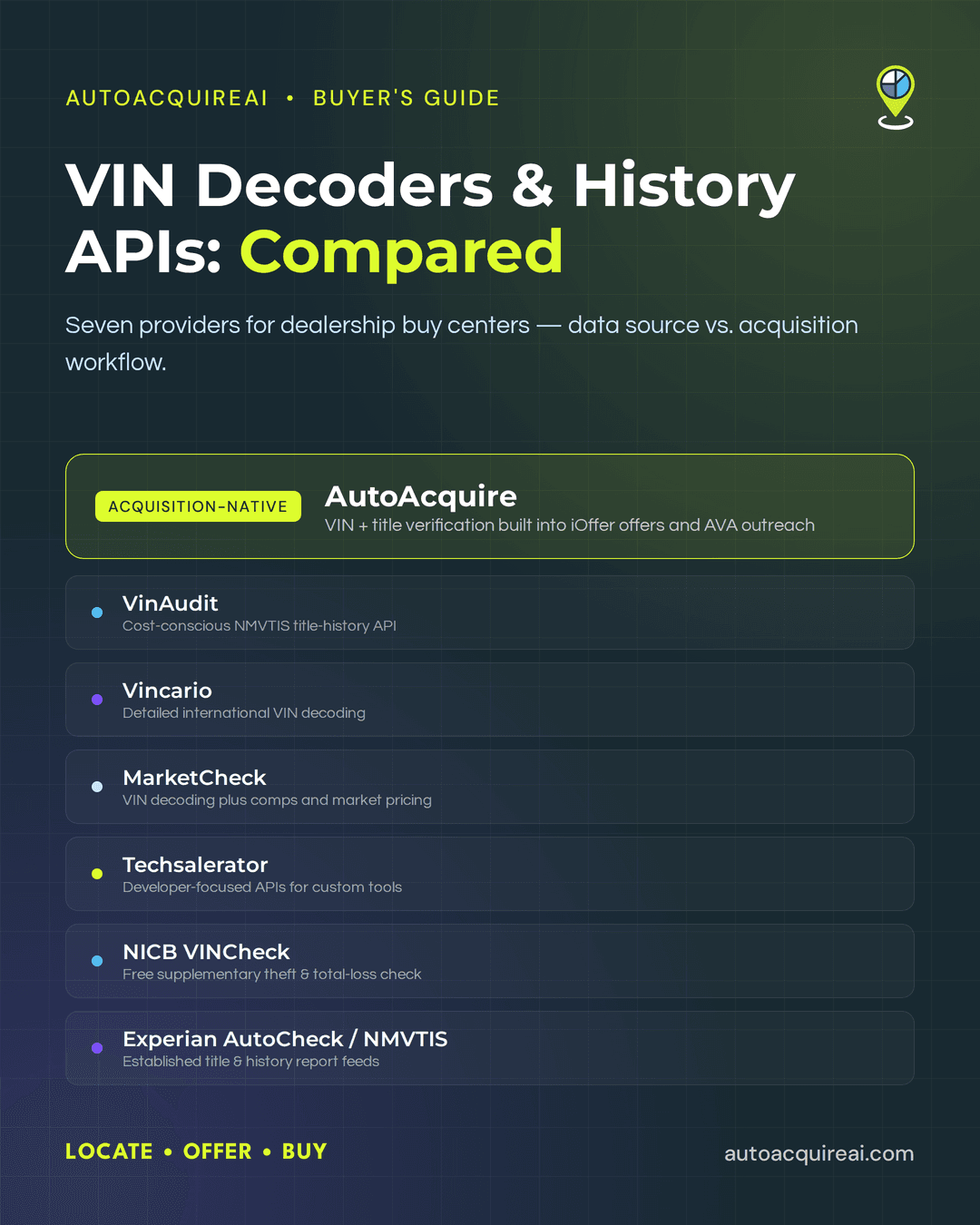
- AutoAcquire best fits acquisition teams that want VIN and title verification connected to iOffer cash offers and AVA outreach.
- VinAudit suits dealers seeking tiered, per-VIN access to NMVTIS title history, odometer records, salvage data, and theft checks.
- Vincario serves platforms that need detailed international VIN decoding and can pair it with a separate US title-history source.
- MarketCheck combines VIN decoding with comparable listings and market pricing data for offer decisions.
- Techsalerator provides developer-focused automotive APIs under bulk and enterprise agreements for custom dealer tools.
- NICB VINCheck offers a free supplementary check for theft and insurance total-loss records, but it lacks a commercial bulk API.
- Experian AutoCheck and other NMVTIS-based options provide established vehicle-history feeds for dealers that need authoritative title and brand records.
What a VIN decoder API does for a dealership buy center
A VIN decoder API turns VINs into structured vehicle records that dealership software can process automatically. Dealers can submit individual VINs or batches and receive machine-readable JSON or XML data. A CRM, DMS, appraisal tool, or acquisition platform can then populate vehicle fields and apply screening rules without requiring an employee to open separate consumer reports.
VIN decoding and vehicle-history screening serve different purposes. Decoding identifies attributes encoded in or associated with the VIN, such as make, model, engine, and body style. A VIN check API queries outside records for title brands, odometer readings, theft reports, total-loss events, and sometimes lien information. Coverage varies because providers draw from different government, insurance, auction, and commercial sources.
The available fields and underlying data sources are worth checking before signing. NMVTIS records can support title, brand, odometer, and salvage screening. Active lien information may require a separate source. High-volume buy centers also need batch limits, response-time commitments, error handling, and permission to store returned records. Consumer VIN check sites usually return one human-readable report and rarely support those operational requirements.
Comparison table: VIN decoder and vehicle data provider APIs
| Provider | Key Features | Bulk Pricing Model | Integration Options | Fraud Detection Capability | Best For |
|---|---|---|---|---|---|
| AutoAcquire | Verification tied to iOffer and AVA | Platform quote | Open API, CDK, Reynolds, Dealertrack | Title and lien screening within offer rules | Acquisition workflow |
| VinAudit | NMVTIS history and title data | Tiered per VIN | API and batch lookup | Odometer, salvage, title brands, theft | Cost-conscious history checks |
| Vincario | Detailed global VIN specifications | Subscription and API credits | API and bulk files | Limited US title and fraud depth | International decoding |
| MarketCheck | VIN data, listings, and market values | Usage-based tiers | API and data feeds | Primarily valuation and listing signals | Offer pricing context |
| Techsalerator | Broad automotive datasets | Bulk enterprise quote | Developer API and custom feeds | Coverage depends on selected dataset | Custom applications |
| NICB VINCheck | Theft and insurance total-loss lookup | Free, no commercial bulk API | Manual web lookup | Theft and total-loss flags | Supplementary checks |
| Experian AutoCheck / NMVTIS options | Vehicle history and title records | Contract or per-record pricing | Availability varies by product and provider | Title brands, odometer, and salvage records; other signals vary | Established history feeds |
AutoAcquire: acquisition-native VIN and title verification
AutoAcquire embeds VIN and title verification in the vehicle acquisition workflow. It uses verification results to guide outreach and offer decisions rather than producing a separate report for staff to review.
Best for: Buy centers and service-drive acquisition teams that want VIN checks tied directly to seller outreach and cash offers.
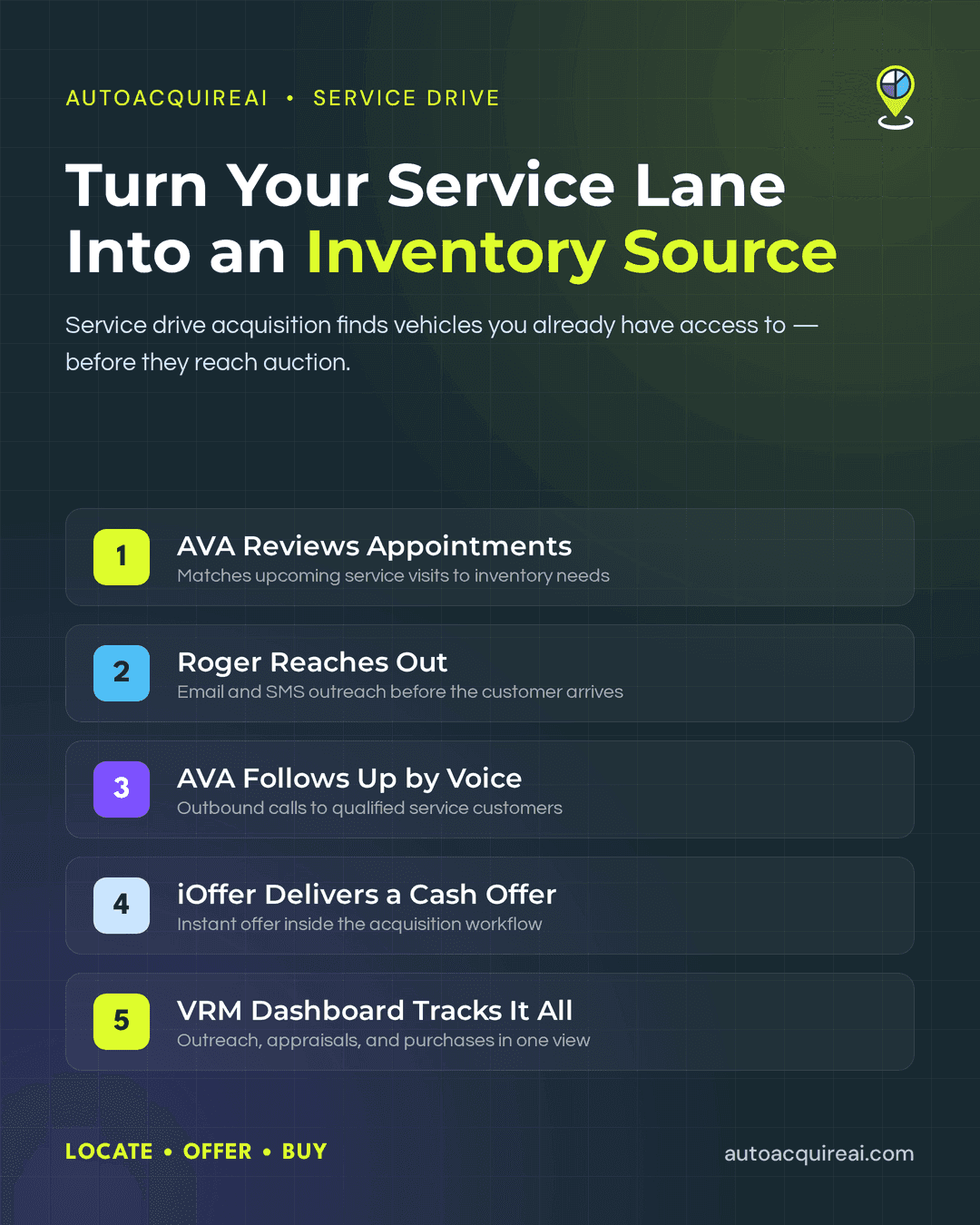
What it is: AutoAcquire connects AVA outreach, iOffer instant cash offers, and vehicle verification in one acquisition platform. AVA contacts service-drive customers and private sellers, while the verification step checks the vehicle before iOffer finalizes an offer. A salvage-title flag can reduce or block the offer according to dealer rules. A lien hit can pause the transaction until staff confirm the payoff amount or clear the title issue.
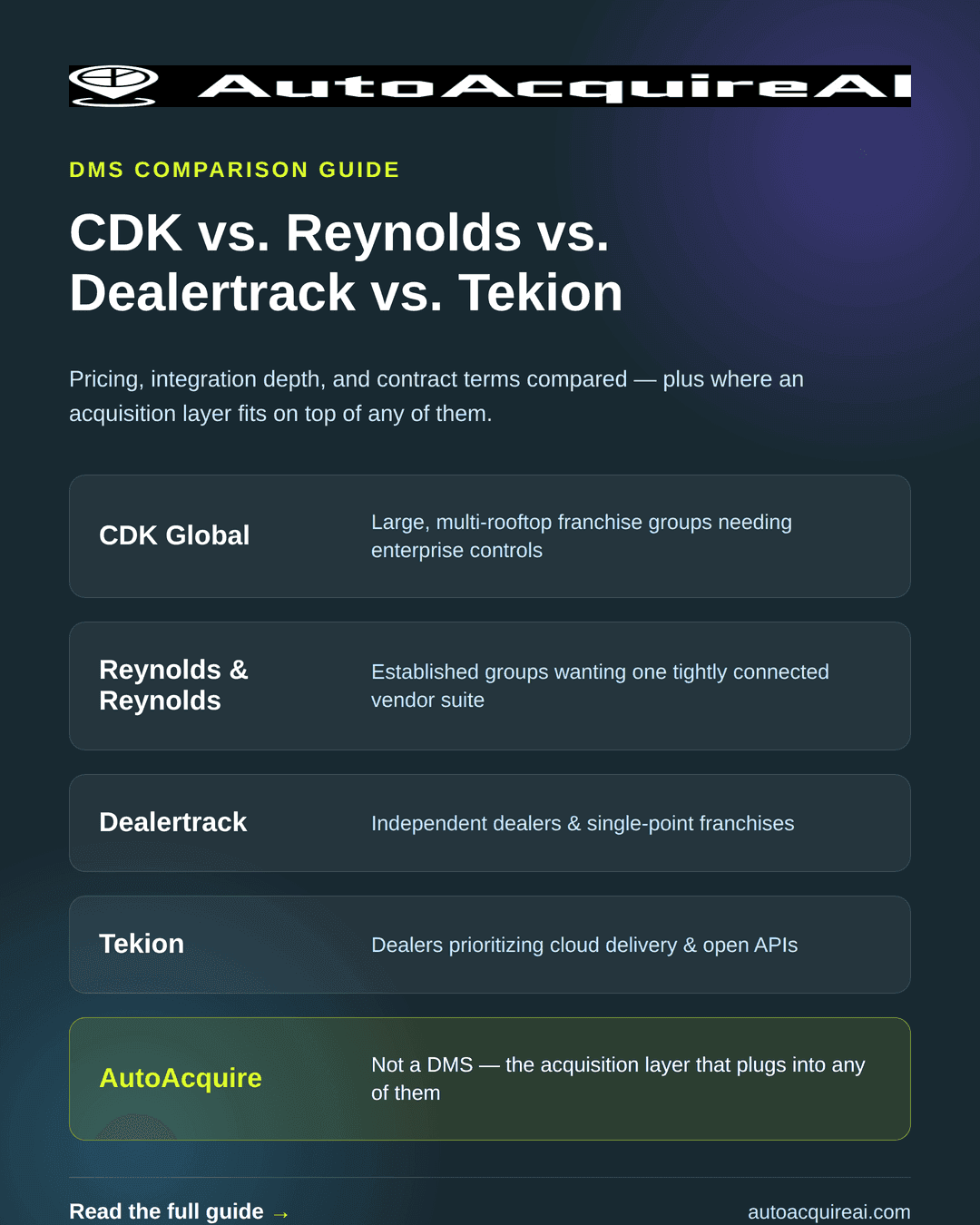
AutoAcquire integrates with CDK, Reynolds, and Dealertrack. Its open API also supports custom connections with dealer CRM, appraisal, and internal buy-center systems. The specific fields each connection exchanges vary by system, so a buy center needs to map which vehicle and customer data moves both ways, including whether offer status and verification results write back into the existing software.
Pros: Dealer-defined rules can use verification results to adjust, pause, or block an offer without requiring staff to transfer the result manually into the offer workflow. AVA can apply the same screening workflow across service-drive and private-seller campaigns. A DMS connection can reduce duplicate entry if it transfers the required lead, appraisal, and purchase fields in both directions.
Cons: AutoAcquire does not replace a dedicated VIN database for dealers that need raw decoding, vehicle-history records, or bulk data feeds for their own applications. Data coverage still depends on the connected title and VIN sources, and verification runs alongside AutoAcquire's Remote Inspection step rather than substituting for it. Dealers building an internal data warehouse may need AutoAcquire alongside VinAudit, an NMVTIS-based provider, or another specialist.
Pricing: AutoAcquire does not publish standard per-VIN or subscription rates. Dealers need a custom quote based on dealership requirements, integrations, and acquisition volume. Buyers should compare the platform cost with the combined expense of data access, manual title review, seller outreach, and offer management.
VinAudit
Best for
Dealers that need a cost-conscious title-history API without a larger acquisition or appraisal platform.
What it is
VinAudit provides NMVTIS vehicle history data through bulk lookup and API access. Its reports can surface title brands, salvage or junk records, odometer readings, and theft records. VIN decoding supplies basic vehicle specifications alongside the history data.
Pros
VinAudit gives dealers a direct way to screen inventory for odometer discrepancies, salvage history, branded titles, and reported theft. API delivery lets dealers send results into custom CRM, DMS, appraisal, or inventory workflows instead of reviewing individual consumer reports. NMVTIS provides a federal system for records submitted by state titling agencies, insurers, and junk and salvage businesses, although reporting dates and completeness can vary.
Cons
VinAudit supplies data rather than a complete dealership acquisition workflow. Dealers must build the business rules that reject a salvage vehicle, adjust an appraisal, or route a questionable record for review. NMVTIS records can also require supplementary sources for lien status, maintenance history, accident detail, or records that participating entities have not yet submitted.
Pricing
VinAudit prices commercial API access in per-VIN tiers that step down as monthly volume rises, separate from its consumer report pricing. Because the entry-level tier rarely reflects true bulk cost, a buy center should confirm the minimum commitment and overage rate before sizing a contract to its actual lookup volume.
Vincario
Best for
Dealers and software platforms that need international VIN decoding at scale and can source US title history separately.
What it is
Vincario provides API-based VIN decoding across multiple vehicle markets. Its data focuses on vehicle identity and specifications, including make, model, body type, engine details, and available equipment data. Coverage depth varies by manufacturer and country.
Pros
Broad geographic coverage suits dealer groups handling imports, exports, or vehicles built outside North America. Machine-readable responses also support batch decoding and custom appraisal, CRM, or inventory tools.
Cons
Vincario places more emphasis on decoding than on US title and fraud records. Dealers screening for branded titles, odometer discrepancies, theft, or liens may still need an NMVTIS-based provider. Equipment and option details can also vary because a VIN does not encode every factory-installed feature.
Pricing
Vincario sells access through subscription plans bundled with API request credits, with cost scaling by request volume and the depth of specification data pulled per VIN. A dealer group decoding high volumes of imported vehicles should compare the included request allowance against overage cost rather than judging the plan by its entry price, since custom terms are typically where the real per-VIN cost lands.
MarketCheck
Best for
Acquisition teams that need comparable listings and market pricing data alongside VIN decoding.
What it is
MarketCheck combines vehicle specification data with inventory listings and market values. Its APIs can feed decoded vehicle details, comparable vehicles, and pricing signals into a custom appraisal or acquisition workflow.
Pros
MarketCheck gives buy centers more context than a decoder that returns only make, model, trim, and equipment. Comparable listings can help dealers assess local supply and asking prices before setting an acquisition offer. API delivery also supports bulk processing and custom connections with appraisal, CRM, or internal inventory tools.
Cons
MarketCheck focuses more on inventory intelligence and valuation than authoritative title history. Dealers that require odometer records, branded-title details, theft flags, or lien verification may need a separate NMVTIS-based provider. Dealers should also confirm whether their existing CRM or DMS requires custom development because API availability does not guarantee a ready-made connector.
Pricing
MarketCheck prices by data product and request volume, so the cost of a plan depends heavily on which feeds a dealer selects, decoding alone versus decoding bundled with comparable listings and market values. Multi-rooftop groups running large VIN batches typically see different rates than a single-store pilot, which makes it worth pricing the exact combination of feeds needed rather than a generic quote.
Techsalerator
Best for
Techsalerator fits dealers or automotive software companies building custom acquisition, appraisal, or inventory tools around multiple data feeds.
What it is
Techsalerator is a broad data API vendor that offers VIN decoding and vehicle history data within a larger catalog of automotive datasets. Its developer-oriented delivery gives dealers machine-readable data for internal applications rather than a packaged dealership workflow.
Pros
The API approach supports bulk lookups and custom rules inside a dealer’s existing software. Dealers can combine VIN attributes or history records with other automotive data without adding another employee-facing product.
Cons
Techsalerator requires more technical work than a dealer platform with ready-made CRM, DMS, and appraisal workflows. Title, lien, odometer, salvage, and theft coverage varies by jurisdiction within its broader dataset catalog, so it takes real diligence to confirm the fraud-screening fields a specific state or region actually needs before treating it as a primary source. Data access alone does not determine how a flagged record changes an offer.
Pricing
Techsalerator quotes bulk and enterprise agreements individually rather than publishing per-VIN rates, with cost tied to data scope and licensing terms rather than a flat volume tier. Because published pricing is not available, a fair comparison against VinAudit or Vincario requires running representative VINs through a trial before signing a larger contract.
NICB VINCheck
Best for
NICB VINCheck suits dealers that need a free supplementary cross-check for theft and insurance total-loss flags.
What it is
NICB VINCheck searches theft and salvage records reported by participating insurers. The service can identify an unrecovered theft or salvage record in the participating-insurer data. It does not provide a full title history, lien record, detailed odometer history, or factory specification record.
Pros
Free access makes NICB VINCheck useful for checking an exception or confirming a flag found elsewhere. Dealers can add the lookup to a manual review process without committing to another paid report.
Cons
NICB does not offer the commercial bulk API access that high-volume buy centers expect from paid providers. Reporting gaps can also occur because the database depends on participating insurer records. Dealers should not treat a clean result as proof of a clean title or history.
Pricing
NICB VINCheck carries no cost, which is the entire point of using it, but a buy center screening inventory at scale still needs a paid API for batch processing and the title, odometer, and lien coverage NICB does not provide.
Experian AutoCheck and NMVTIS-based options
Best for Dealers that need an established vehicle history source or an authoritative title cross-check.
What it is
Experian AutoCheck provides vehicle history reports and scoring for automotive buyers and sellers. NMVTIS-approved data providers retrieve title, odometer, brand, and salvage or total-loss records submitted by state titling agencies, insurers, and junk and salvage businesses.
Pros
NMVTIS data provides a federal aggregation point for branded titles, reported odometer readings, and salvage or total-loss records. Dealers can use AutoCheck or another provider to confirm findings from a primary VIN check API when coverage or reporting dates differ between sources.
Cons
NMVTIS records do not cover every maintenance event, accident detail, or active lien. API access and bulk automation also vary by reseller, and commercial usage rights, response fields, update frequency, and DMS or CRM integration differ enough between providers that a contract signed on brand reputation alone can miss gaps a smaller competitor already closed.
Pricing
Pricing and delivery terms vary between Experian AutoCheck and individual NMVTIS-approved providers, and consumer report prices are not a reliable stand-in for commercial API or batch rates. A buy center needs a quote scoped to the specific report, API, or batch product it plans to run in production.
Buyer's guide FAQ
How does bulk VIN check pricing typically work?
Providers commonly charge per VIN, with lower unit prices at higher monthly volumes. Some vendors sell request bundles or enterprise licenses with usage limits. Dealers should compare minimum commitments, overage rates, rate limits, and whether repeat lookups trigger another charge. Quotes should specify which endpoints and data fields each tier includes.
What fraud detection coverage should a dealer require?
A dealership VIN check API should identify odometer discrepancies, salvage or branded titles, and active theft records. Total-loss history and title-jurisdiction changes can add useful context. Lien data often comes through a separate source entirely, and assuming a vehicle history product includes it is a common and costly mistake. Each response should include the source date and match status so staff can distinguish a confirmed record from missing data.
How do VIN APIs connect with a DMS or CRM?
API formats vary by provider, but many vehicle-data services return machine-readable records through REST endpoints in JSON. Some also support XML or batch files. A dealer or integration partner maps those fields into appraisal records, CRM leads, or inventory intake screens, and some providers also support batch files for large lists. VIN matching accuracy, error handling, request limits, and the write-back method into CDK, Reynolds, Dealertrack, or another dealership system are worth testing before signing, since these details rarely show up in a sales demo.
When does a dealer need a standalone provider instead of an acquisition platform?
A standalone provider fits dealers building an internal VIN database or feeding raw title and vehicle data into several applications. An acquisition platform fits dealers that need verification to control a specific action. AutoAcquire can use verification within iOffer and AVA workflows, allowing title or lien findings to affect an offer or seller outreach. High-volume buy centers often use a dedicated provider for the underlying records and an acquisition platform for decision execution.
Choosing the right VIN data strategy for your buy center
Dealers should separate the choice of data source from the choice of acquisition workflow. A VIN data provider supplies raw decoding, title, odometer, theft, and related records. An acquisition platform determines when those records appear and what action follows.
A high-volume buy center can pair both types of tools when it needs raw records for several systems and automated offer rules in its acquisition workflow. A dedicated provider can support bulk screening, internal reporting, and custom applications. AutoAcquire can place verification inside iOffer and AVA, where a flagged record can adjust or stop an offer before staff continue seller outreach. AutoAcquire complements the provider rather than replacing its underlying database.
Map each VIN field required before an offer. Record the source that supplies it and the action that a confirmed adverse record, unavailable result, or data mismatch should trigger. Then test whether the proposed data provider and acquisition workflow can execute those rules inside the dealer’s current DMS and CRM stack.