TL;DR
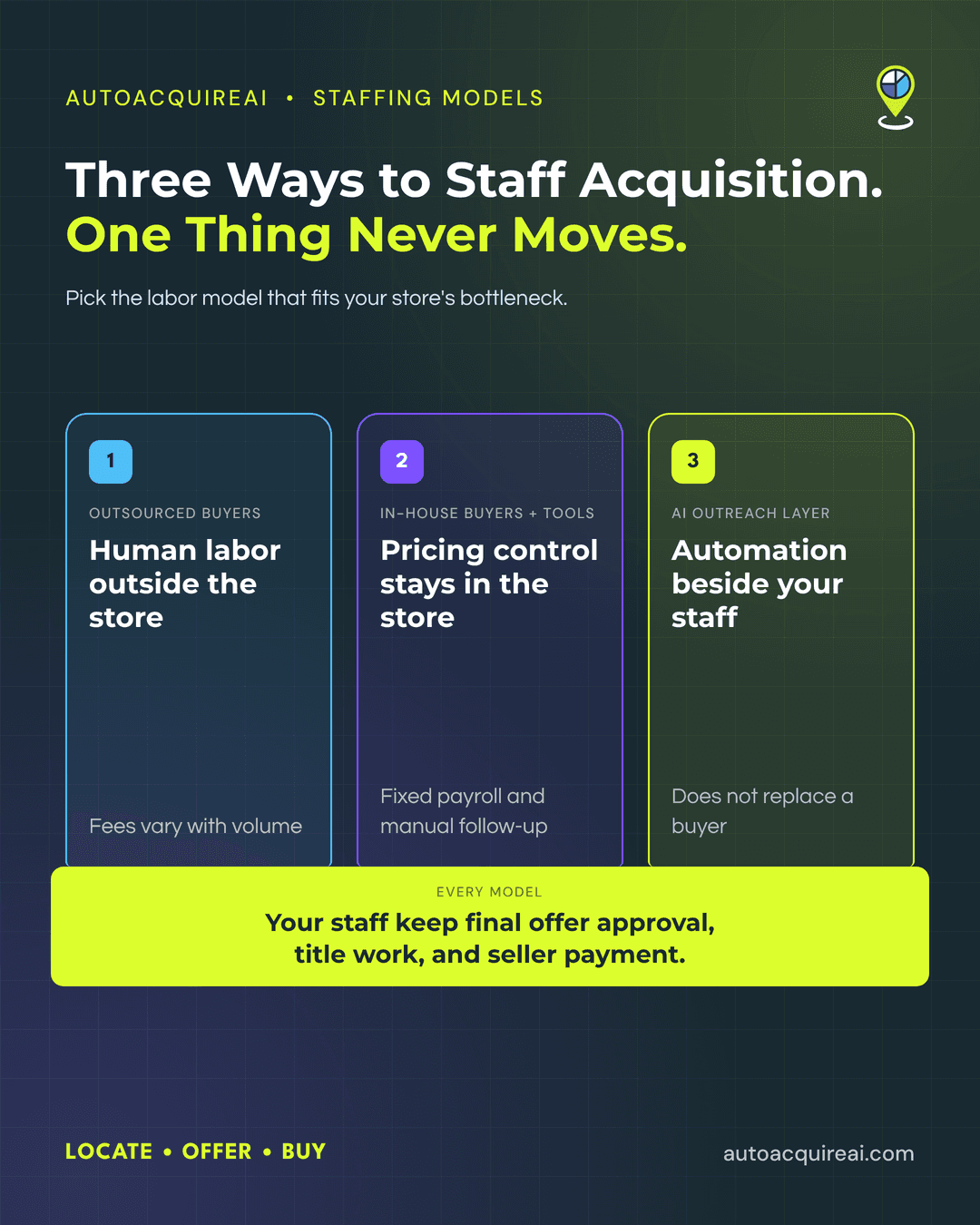
- Dealership staff retain final offer approval, title work, and seller payment across every staffing model, whether upstream sourcing runs through outsourced labor or software.
- Managed services like VAN Managed Buyer supply outsourced human labor for upstream sourcing and seller contact, so dealer principals need documented task boundaries and current quotes to evaluate true per-unit cost.
- In-house used-car buyers using standalone sourcing tools keep pricing control and seller relationships inside the store, but fixed payroll and manual follow-up capacity limit monthly volume.
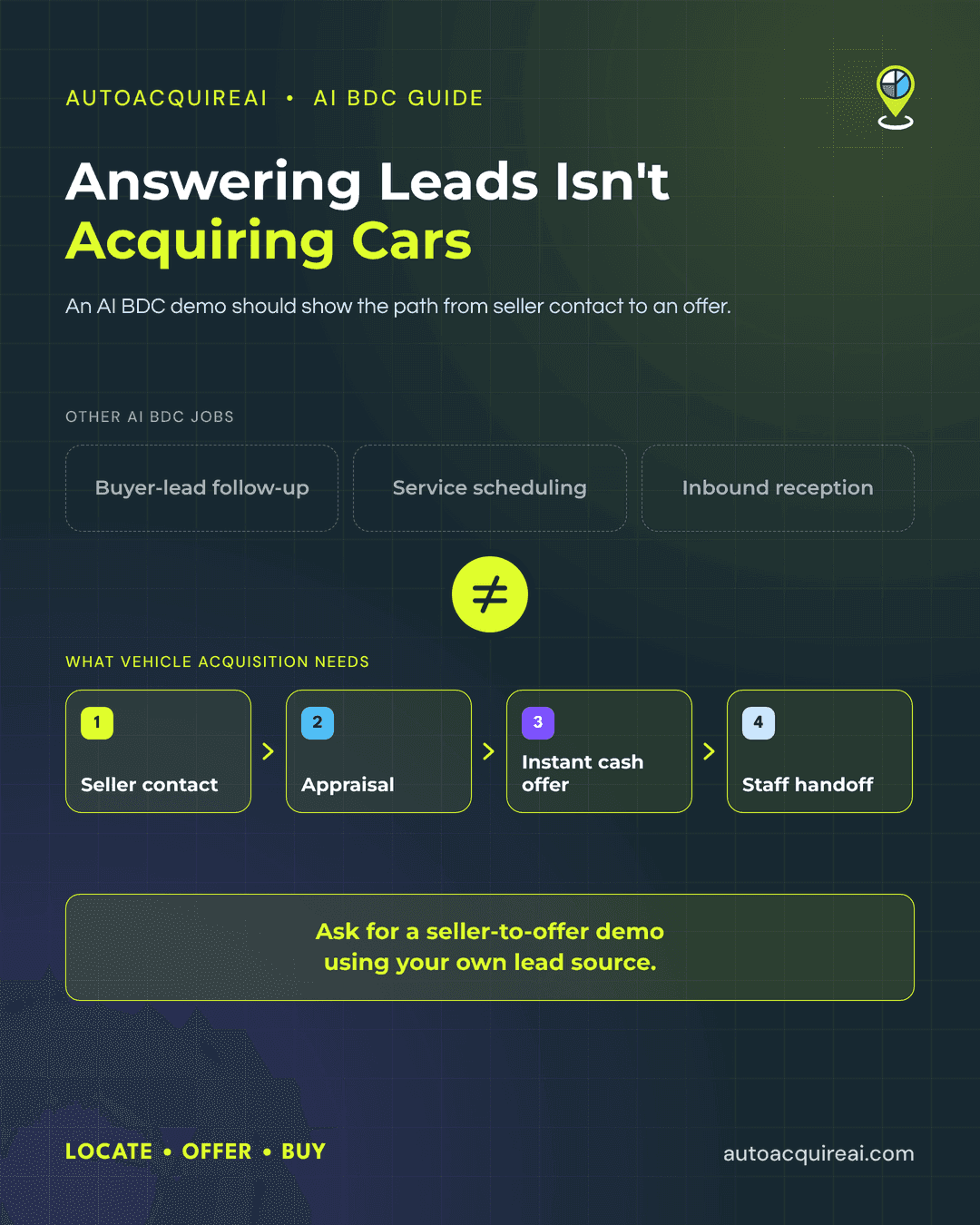
- AutoAcquire and its AVA voice agent automate service-drive and private-party seller outreach alongside existing rooftop staff without replacing a used-car buyer.
Three Acquisition Staffing Models Compared
Dealer principals and used-car managers choosing an acquisition model face a labor-allocation and workflow-control decision rather than a software ranking. Dedicated store buyers protect pricing discipline, but fixed payroll raises unit costs whenever monthly volume slows. A managed vehicle buying service shifts sourcing labor outside the dealership, adding external fees and extra handoffs. In contrast, vehicle acquisition software automates seller outreach for existing staff while keeping offer approval inside the store.
VAN Managed Buyer: Outsourced Buying Labor
A managed vehicle buying service such as VAN Managed Buyer supplies outsourced human labor to handle upstream vehicle sourcing and seller outreach. Rather than hiring salaried buyers or loading outbound call volume onto an internal BDC, a dealership assigns lead hunting and initial seller conversations to an external buying team. Outside buyers gather vehicle details and route qualified opportunities back to the store, while the dealership keeps final offer approval, title work, and payment.
External buying teams add handoff friction whenever an appraisal requires fast local pricing judgment. Because those buyers operate outside the dealership floor, questions about reconditioning deductions and retail market fit must travel back to a used-car manager before an offer moves forward. Every relay introduces response lag, and private sellers often take a faster competing bid while an outsourced rep waits on store sign-off.
Vendor-run sourcing also restricts visibility into pricing pushback and ties acquisition capacity to a single vendor. Used-car managers typically see only the vehicles submitted for approval, so declined leads and seller objections stay inside the provider's operation. If a dealership ends the contract, buying volume drops immediately because the store never built an internal outreach bench or direct seller relationships.
Publicly available materials for VAN Managed Buyer do not list current pricing, exact task boundaries, or service-level commitments. Dealer principals evaluating the service need written documentation directly from VAN defining negotiation authority, condition inspection duties, and fee triggers. Explicit contract protections on cancellation windows and seller-data ownership limit vendor lock-in if store leadership later shifts buying in-house.
In-House Buyers With Sourcing Tools: Dedicated Rooftop Headcount
Dealership-employed buyers paired with standalone sourcing and appraisal tools keep pricing discipline and local market judgment inside the store. An in-house buyer calibrates each offer against current lot mix and reconditioning capacity rather than relying on a third-party service. Because the buyer sits on the same floor as the used-car manager and title clerk, appraisal handoffs and purchase approvals stay inside existing rooftop routines.
Dedicated rooftop headcount commits the dealership to fixed operating costs before a single vehicle reaches the lot. Dealers fund buyer payroll and standalone software subscriptions every month regardless of how many private-party units close. Compensation structures and tool fees vary by market, yet fixed labor pushes acquisition cost per vehicle higher when monthly volume dips. Used-car managers also absorb recruiting and daily oversight, and turnover in a single buyer seat can stall sourcing output until a replacement ramps up.
Manual outreach limits how many seller leads a single buyer or BDC team can work consistently. Standalone sourcing platforms surface private-party listings and valuation data, but staff members still call sellers and chase undecided owners by hand. When service-drive traffic or listing volume spikes, buyers prioritize immediate prospects and drop multi-day follow-up on earlier inquiries. Dealers who want higher monthly volume under a manual staffing model must hire more buyers or BDC reps because human dial capacity cannot expand without additional payroll.
AutoAcquire and AVA: AI Acquisition Automation Layer
AutoAcquire operates as an acquisition-native automation layer that works beside existing rooftop staff instead of adding buyer payroll or outsourcing seller relationships. Using AVA, dealers automate outbound outreach to service-drive customers and private-party sellers while iOffer generates instant cash offers. Remote Inspection captures AI-guided self-service condition reports inside the VRM Dashboard, while integrations with CDK, Reynolds, and Dealertrack plus an open API connect acquisition records to the dealership's DMS.
AVA automates seller outreach and intake workflows, and it never replaces a used-car buyer, purchase approval, title verification sign-off, or vehicle payment. After automated cadences surface an interested owner and gather initial condition details, rooftop staff still verify vehicle condition and approve final buy figures inside a disciplined dealership trade-in appraisal process. Because closing authority stays on the desk, used-car managers expand outbound contact volume without surrendering margin control to outside buyers.
Automated outreach removes manual BDC dialing bottlenecks, yet dealers still depend on responsive in-house staff to close vehicles. When managers delay offer approvals or leave seller questions unanswered, automated intake produces stalled leads rather than funded inventory. AutoAcquire advertises a 60-day free trial, while ongoing subscription pricing tiers remain unpublished and require a direct vendor quote before dealers finalize cost-per-vehicle math.
Task Responsibility Matrix Across the Acquisition Workflow
Outsourced buying services shift upstream seller labor to external staff, whereas AI acquisition software automates outreach and intake inside an existing dealership team. Dealership personnel retain final purchase approval, title verification, and payment sign-off across all three operating models.
| Stage | VAN Managed Buyer (Outsourced) | In-House Buyers + Tools | AutoAcquire + AVA (Software) |
|---|---|---|---|
| Sourcing | Outsourced buyers source private-party listings (channel scope unconfirmed) | Store buyers pull leads from sourcing tools and DMS lists | AutoAcquire targets service-drive and private-party sellers |
| Seller Contact | Outsourced human buyers place calls and manage follow-up | Store buyers or BDC staff handle manual calls and texts | AVA automates outbound voice and SMS outreach |
| Condition Capture | Inspection coordination role unconfirmed in primary sources | Store appraisers inspect units on-site or via appraisal apps | Remote Inspection guides self-service seller condition capture |
| Offer Approval | Dealership management retains final purchase approval | Used-car manager or senior buyer approves offers | iOffer generates initial figures and managers approve final offers |
| Negotiation | External negotiation authority unconfirmed in primary sources | Store buyers negotiate price directly with sellers | Store buyers or managers negotiate after AVA handoff |
| Title and Payment | Dealership staff verify titles and issue funds | Dealership staff verify titles and issue funds | Dealership staff verify titles and issue funds |
| Purchase Completion | Closing handoff steps unconfirmed while store signs paperwork | Store staff finalize paperwork and stock units | Store staff finalize paperwork and stock units |
Managed buying teams remove daily outreach from rooftop payroll, but external labor adds a handoff gap whenever vehicle condition changes or retail margins tighten. Current primary documentation does not confirm VAN Managed Buyer's exact scope across inspection coordination, price negotiation, and closing handoffs. Dealer principals evaluating a managed service need written contract language defining those handoff boundaries before committing inventory budgets.
AI acquisition software absorbs repetitive outreach and intake while keeping valuation authority inside the store. AutoAcquire and AVA handle service-drive and private-party outreach alongside Remote Inspection and iOffer, while dealership managers and title clerks keep control of pricing discipline, lien payoffs, and funding because financial liability stays on the store's balance sheet.
Pricing Availability and Fully Loaded Cost per Purchased Vehicle
Dealer principals comparing acquisition staffing models must separate published vendor pricing from internal dealership labor. Acquisition vendors across all three models withhold complete public rate cards because quotes vary by rooftop count, monthly volume, and support scope. Dealerships need dated written proposals placed inside one consistent cost boundary before comparing bids.
Pricing Availability Across Models
The table below summarizes current public pricing status and the specific commercial inputs procurement teams should request, along with quote effective dates and minimum contract terms, before modeling store economics.
| Acquisition Model | Public Pricing Status | Commercial Inputs to Request |
|---|---|---|
| VAN Managed Buyer | Not publicly disclosed | Monthly fee, per-vehicle charges, contract length, and cancellation terms |
| In-House Buyer and Sourcing Tools | Not publicly disclosed (varies by market and vendor) | Buyer base pay, commission tier, payroll taxes, and software seat fees |
| AutoAcquire with AVA | Paid tiers not publicly disclosed (60-day free trial confirmed) | Monthly rooftop subscription, voice or SMS allowances, and onboarding fees |
Fully Loaded Cost-per-Purchased-Vehicle Worksheet
Dealership controllers calculate cost per purchased vehicle by dividing total monthly acquisition spend by acquired units across identical cost lines. The table below presents illustrative figures for 15-unit and 30-unit monthly scenarios to show how fixed payroll, variable service fees, and software subscriptions behave as volume grows. These hypothetical figures illustrate staffing math and do not represent vendor quotes or industry benchmarks.
| Cost Category (Illustrative Monthly Figures) | VAN Managed Buyer (15 / 30 Units) | In-House Buyer + Tools (15 / 30 Units) | AutoAcquire + AVA (15 / 30 Units) |
|---|---|---|---|
| Platform or managed service fees | $4,500 / $8,400 | $1,200 / $1,200 | $2,400 / $2,400 |
| Allocated buyer, manager, and title-clerk labor | $2,400 / $3,900 | $8,700 / $11,400 | $3,600 / $5,400 |
| Data, VIN check, and inspection fees | $600 / $1,200 | $600 / $1,200 | $600 / $1,200 |
| Total monthly acquisition cost | $7,500 / $13,500 | $10,500 / $13,800 | $6,600 / $9,000 |
| Illustrative cost per purchased vehicle | $500 / $450 | $700 / $460 | $440 / $300 |
Fixed payroll pushes in-house per-unit cost up at lower volumes, while variable managed-service fees keep per-unit expense flatter as volume doubles. Automated software holds platform spend steady across volume tiers, though dealerships still budget rooftop labor for offer approval, customer closing, and title processing. Transport and reconditioning costs remain outside this acquisition boundary because haul distance and mechanical repairs depend on the vehicle rather than the staffing model. Used-car managers gain a reliable staffing budget once accounting teams replace these illustrative entries with dated vendor quotes, local pay plans, and actual title-clerk time.
Best-Fit Dealership Profiles by Staffing Model
Dealer principals and used-car managers match a staffing model to monthly unit goals, existing buy-center headcount, service-drive traffic, and multi-rooftop oversight.
- VAN Managed Buyer is best for lower-volume rooftops that lack dedicated buying staff and need outsourced human labor for immediate seller outreach. Rather than adding fixed payroll before direct acquisition volume stabilizes, smaller stores rent outbound execution while managers keep final purchase approval and title work in-house.
- In-house buyers paired with sourcing tools fit high-volume used-car operations that already employ experienced appraisers and require tight local pricing discipline. Because dealership employees handle every seller call and appraisal directly, these stores avoid per-unit vendor fees, but outbound capacity stalls whenever buyer headcount reaches full utilization.
- **Hybrid teams using AutoAcquire and AVA** are best suited to franchise rooftops with active service drives and multi-rooftop groups centralizing acquisition across CDK, Reynolds, or Dealertrack stores. An in-house used-car manager paired with AVA, iOffer, and Remote Inspection preserves direct margin visibility that outsourced buying services obscure. Automated outreach also scales service-drive and private-party follow-up past manual BDC limits without adding rooftop payroll, while dealership staff still approve every offer, verify titles, and release payment.
Buyer's Guide and Vendor Demo Checklist
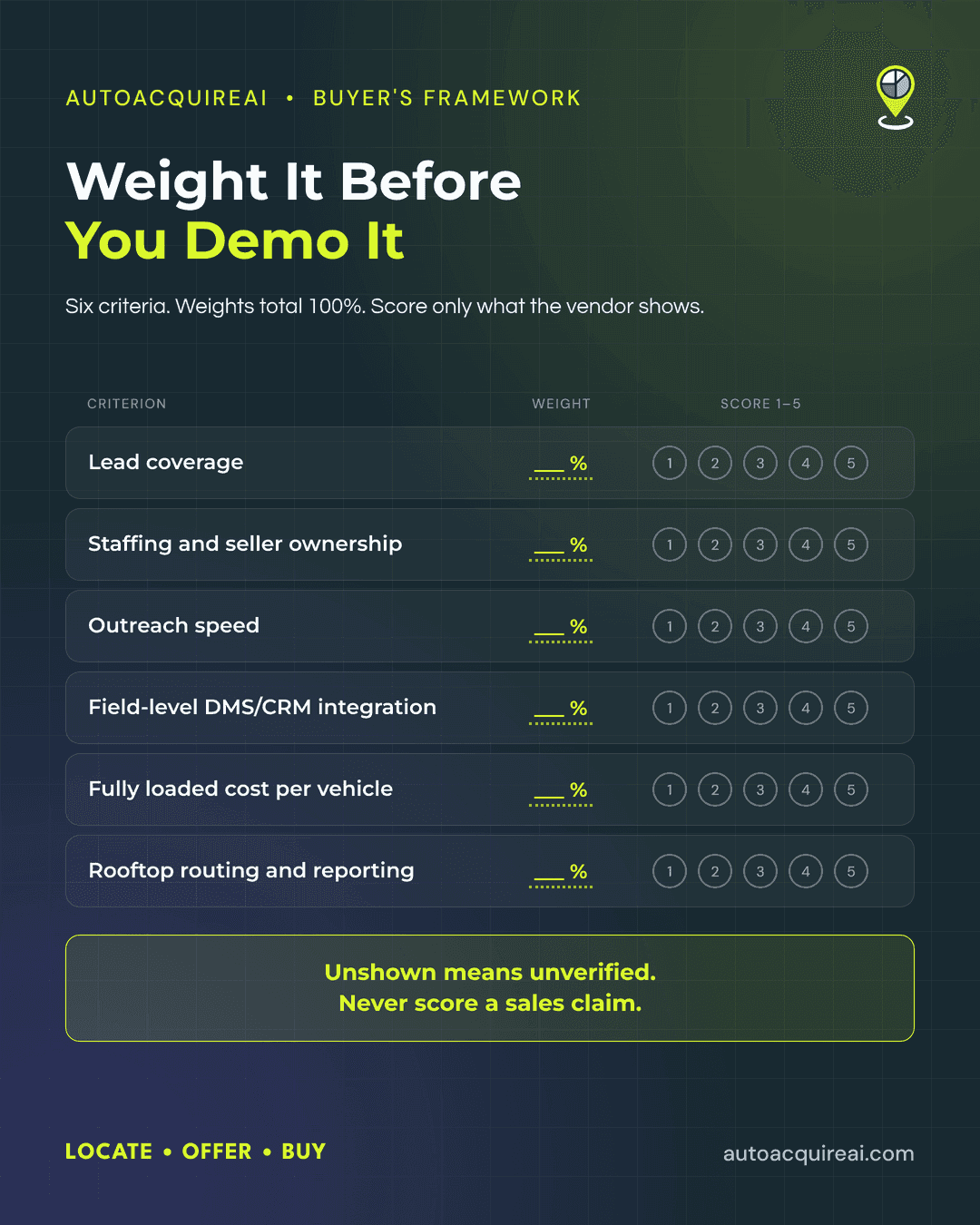
Dealership leaders separate dependable acquisition partners from high-friction vendors by testing live workflows before signing a contract. Pre-contract demos expose hidden manual labor and billing friction before a store commits inventory budget.
- Seller-data ownership terms establish whether the store retains seller contact records and inspection photos after ending an agreement.
- DMS and CRM write-back tests show whether a platform updates systems such as CDK, Reynolds, and Dealertrack directly rather than relying on manual spreadsheet exports.
- Consent and opt-out audits verify how a vendor logs outbound call permission and blocks suppressed numbers across voice and SMS channels.
- Offer-approval guardrails require used-car managers to sign off on every final valuation before an offer reaches a seller.
- Staff handoff timing drills measure how quickly a managed buyer or AI agent routes a qualified seller and appraisal packet to an in-house closer.
- Per-unit and cancellation fee schedules uncover early termination penalties and fees billed on seller leads that never close.
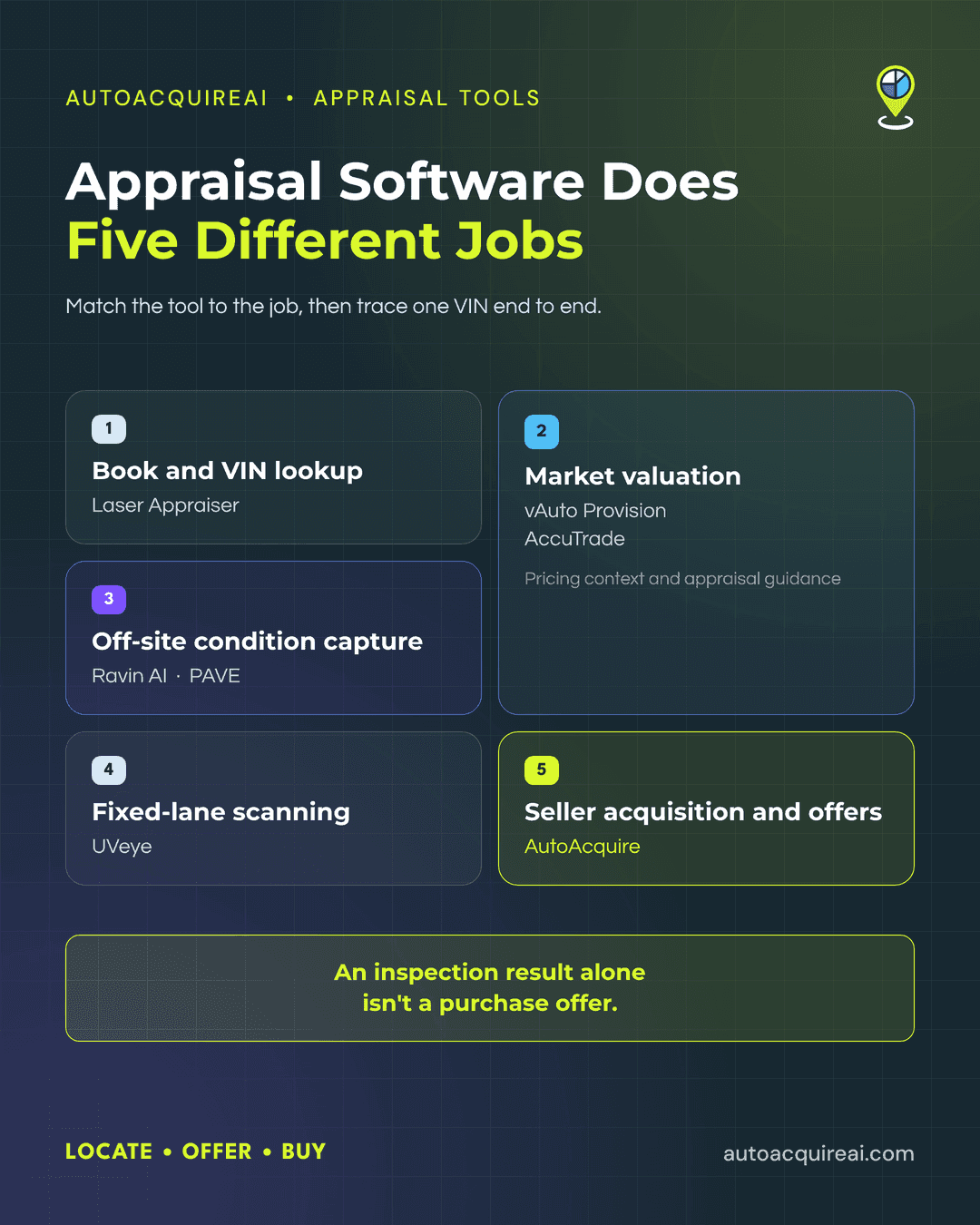
Dealers evaluating broader software categories outside staffing models can consult general vehicle acquisition software guides for platform comparisons. Stores building a standalone fixed-ops buying channel can also review independent-dealer service-drive acquisition guides and the dealership trade-in appraisal process guide to tighten valuation handoffs.
Frequently Asked Questions
Does AI acquisition software replace a used-car buyer or title clerk? AI acquisition software automates seller outreach and intake rather than dealership buying authority. AutoAcquire and AVA contact service-drive customers and private sellers while feeding Remote Inspection details into iOffer quotes. Used-car managers still approve every purchase price, and title clerks handle verification and payment release.
How does a vehicle buying service handle funding and title risk? Vehicle buying services coordinate upstream seller work, while the dealership carries vehicle funding and title risk unless a written agreement shifts liability. Public VAN Managed Buyer materials omit unwind terms and payoff rules, so principals must review contract clauses covering condition disputes and title defects before signing.
What belongs in a fully loaded cost-per-acquired-vehicle calculation? An accurate total combines platform or buying-service fees with allocated buyer, manager, and title-clerk payroll plus third-party data and inspection charges. Controllers divide that monthly sum by completed purchases to compare models fairly. Transport and reconditioning stay outside the acquisition boundary because stores incur those costs after purchase.
How do multi-rooftop groups choose between outsourcing and automated in-house workflows? Multi-rooftop groups weigh existing manager bandwidth against seller-data ownership and unit economics. Stores without buying staff use managed services for immediate labor capacity, though recurring service fees add cost to every acquired unit. Groups with centralized managers pair internal approvers with AutoAcquire and AVA, which integrate with CDK, Reynolds, and Dealertrack without adding BDC payroll.
Choosing an Acquisition Staffing Model
Dealers avoid paying for redundant capacity when they audit current store bottlenecks before committing to outsourced buying fees, fixed headcount, or software deployment. A store with steady service-drive traffic but unworked seller queues needs consistent outbound follow-up rather than extra sourcing labor. Conversely, a dealership with slow appraisal-to-close execution cannot fix conversion leaks by generating more seller leads.
Once used-car managers isolate that constraint, they can run a bounded unit-economics check to measure true cost per acquired vehicle before locking in recurring overhead. Dealerships testing automated outreach alongside existing staff can benchmark workflow output during AutoAcquire's 60-day free trial. Under any staffing model, rooftop leadership retains final purchase approval and title controls.