
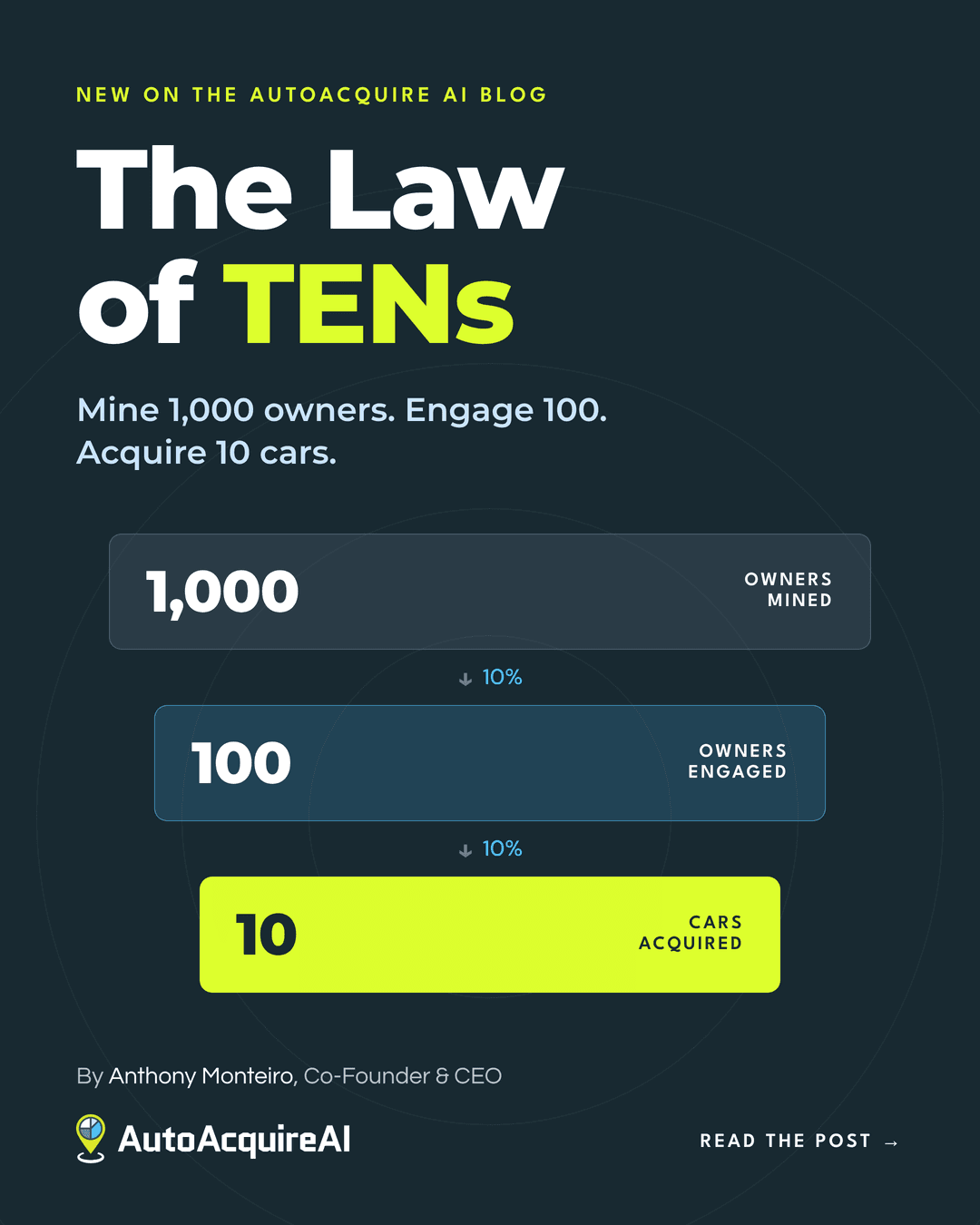
Mine 1,000 owners > Engage with 100 > Acquire 10 cars. That is the Law of TENs, and it is the most predictable thing I have seen in more than 30 years of automotive data mining and building software.
I ran BDC businesses in the early 2000s, when "data mining" meant a printout and a phone and maybe a spreadsheet. Back then, nobody could tell you what a list was worth before you dialed it. Today, inside the AutoAcquire AI platform, we can. The numbers keep landing in the same place, and the place is ten.
The 10-10-10 Rule on the Platform
Across our dealer partners, the AutoAcquire platform converts roughly 10% of mined prospects into live leads, and roughly 10% of those leads into acquired vehicles. Ten percent of ten percent: about 1 car for every 100 owners mined.
| Stage | What happens | Rate | Per 1,000 mined |
|---|---|---|---|
| Mining | Our AI scores owners in the dealer's data by equity, cycle and vehicle demand | — | 1,000 prospects |
| Lead | The owner engages with an offer by voice, text or the iOffer widget | 10% | 100 leads |
| Acquisition | The dealer buys the car | 10% of leads | 10 vehicles |
That is the third ten: ten cars off the street for every thousand owners mined, without an auction lane or a bidding war. The math is simple, which is why it works. A desk manager can set a monthly acquisition goal, multiply backward, and know exactly how much mining it takes. Want 50 cars? Mine 5,000 VINs and let our AI agents do the heavy lifting and outreach. Your team is tagged when the customer is ready to trade or sell, and you work them with discipline.
Ten Runs All Through Scripture
At AutoAcquire, it's no secret that we make business decisions through a biblical lens, so it is no surprise to me that ten shows up in the Bible as a number of order, testing and completeness.
- The tithe. Abraham gave Melchizedek a tenth of everything (Genesis 14:20). Ten percent is the oldest proportion of faithfulness on record, and it is the same ten percent we see from prospect to lead.
- The Ten Commandments. God gave Moses ten words to order an entire nation (Exodus 20). Ten simple rules, followed with discipline, change everything.
- The ten lepers. Jesus healed ten men, and one came back to say thank you (Luke 17:11–19). One in ten. Every salesperson knows that ratio, and every one of us should want to be the one who returns.
- Abraham's ten righteous. Abraham negotiated with God over Sodom, from fifty down to ten (Genesis 18:32). God agreed that ten would be enough to spare a whole city.
- Daniel's ten-day test. Daniel asked for ten days to prove his way worked, and at the end he and his friends looked better than everyone else (Daniel 1:12–15). Give a process a fair test and let the results speak.
- The servant who earned ten. In the parable of the minas, the faithful servant turned one mina into ten and was given authority over ten cities (Luke 19:16–17). Faithfulness with a little leads to stewardship over much.
None of this makes a conversion rate holy. But it reminds me that small, faithful percentages, repeated with discipline, are how God has always built big things.
Ten Is Built Into the Universe
We count in tens because we were made with ten fingers. Nearly every number system humanity uses today is base ten, and most of the math your store runs on, from dollars and cents to the digits on the odometer, rides on it.
Well, not all of it. The United States is one of the last holdouts on the metric system, the one measurement system built entirely on tens. The rest of the world measures in meters and liters while we are still out here selling cars by the mile, filling them by the gallon and trying to decide whether to use the 7/16 or ⅜ socket. If you're a mechanic, metric means one thing: you're always losing your 10mm wrench. Good news: you don't need to convert to metric to follow the Law of TENs. Your acquisition team just needs to count to ten.
In 1977, Charles and Ray Eames made a short film called Powers of Ten. It starts with a couple on a picnic blanket and zooms out by a factor of ten every ten seconds, until the whole galaxy fits on the screen. Then it zooms back in, past the skin, past the atom, down to the scale of a proton. Each step of ten reveals a completely different world.
Physicists use the same idea. Orders of magnitude, each one a factor of ten, are how scientists size up everything from a proton to the observable universe. Superstring theory even proposes the universe has ten dimensions.
The lesson for a dealer is the same as the film's: every factor of ten changes the picture. One thousand owners is a list. One hundred is a pipeline. Ten is inventory on your lot.
What the Law of TENs Means for Your Store
The law only works if you respect all three tens. Skip one and the math breaks.
- Feed the top. Ten cars needs a thousand owners. Most stores under-mine their own data and then blame the market. Our AI mines the owners already sitting in your DMS and CRM every day, so the top of the funnel never runs dry.
- Work every lead. A lead that goes cold in an hour is gone. AVA OS engages owners by voice and text, compliantly, the moment they raise a hand, so the 100 actually get worked.
- Close with confidence. The final ten comes from a real number on the table. iOffer gives your team a market-backed cash offer the owner can trust, and DealMAIker carries the accepted offer through to a car on your lot.
Consistency is what keeps all three tens working. The rate holds month after month because the process holds. Run it every day and the law compounds.
Ten Is Enough
In Abraham's negotiation, ten was enough to spare a city. In your store, ten acquired cars from every thousand owners is enough to stop overpaying at auction and start buying the inventory your market actually wants.
If you want to see what the Law of TENs looks like on your own data, let's run it together. Book a demo and we will show you how many owners you are sitting on, and how many cars that math puts on your lot.
Anthony Monteiro is Co-Founder and CEO of AutoAcquire AI.
Frequently Asked Questions
What is the Law of TENs?
The Law of TENs is a conversion pattern AutoAcquire AI has seen across dealer partners: mine 1,000 owners, engage with 100, and acquire 10 cars. The platform converts roughly 10% of mined prospects into live leads, and roughly 10% of those leads into acquired vehicles — about 1 car for every 100 owners mined.
How many owners should a dealership mine to hit a monthly acquisition goal?
The math works backward from the goal. Because ten cars come from every thousand owners mined, a desk manager who wants 50 cars would mine 5,000 VINs, let our AI agents handle outreach, and work the owners who are ready to trade or sell.
Why do all three tens matter?
The law only works if you respect all three tens. Skip one and the math breaks. Stores need enough owners at the top of the funnel, every lead has to be worked before it goes cold, and the close depends on a real, market-backed offer.
How does AutoAcquire AI put the Law of TENs to work?
Our AI scores owners already in a dealer's DMS and CRM by equity, cycle, and vehicle demand. When an owner engages with an offer by voice, text, or the iOffer widget, AVA OS works the lead compliantly, and iOffer and DealMAIker carry a market-backed cash offer through to a car on the lot.