
Why DMS Integration Depth Decides Your Appraisal Platform
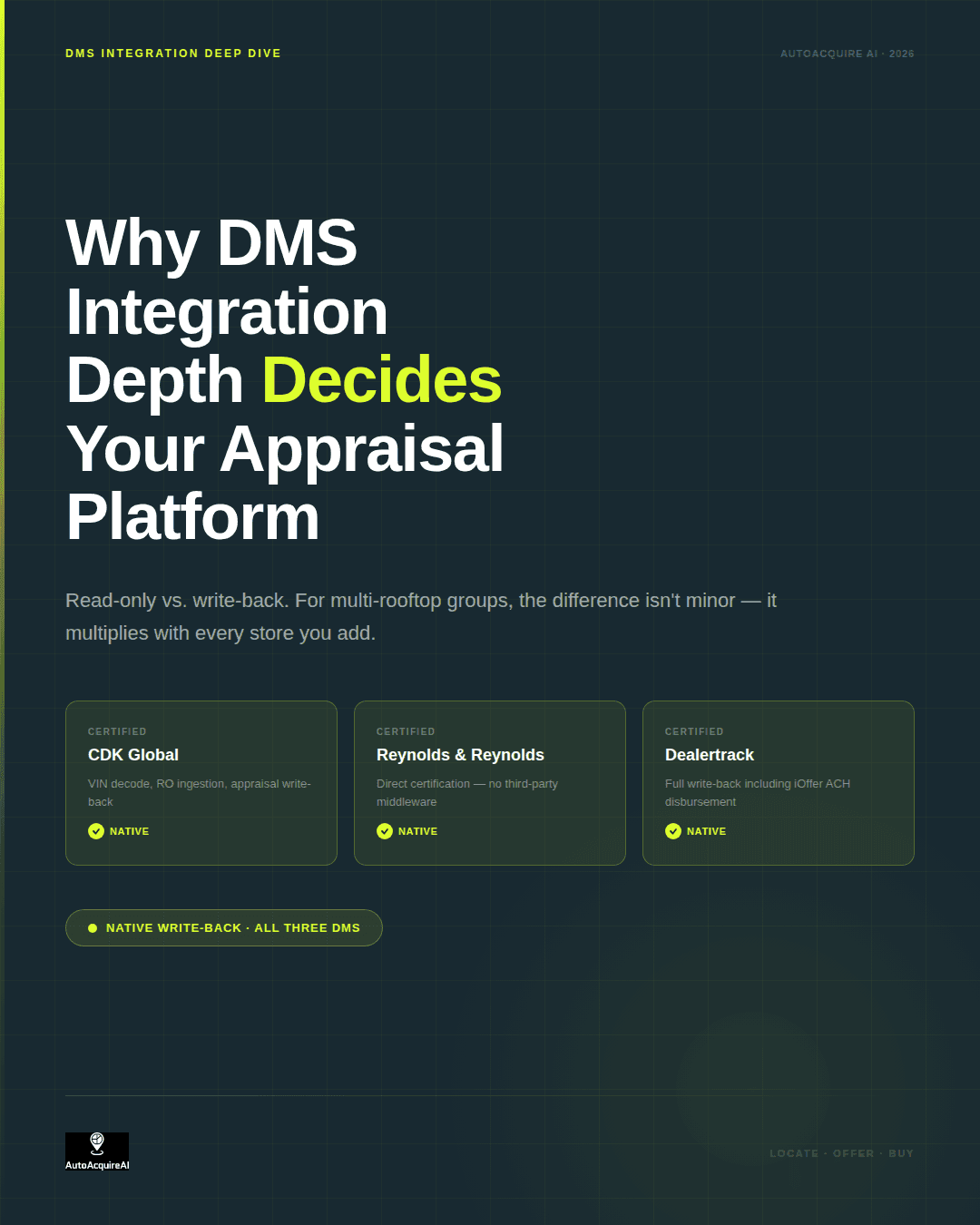
For a 12-rooftop franchise group, an appraisal platform that cannot write back to the DMS forces an appraiser to rekey every number into the DMS by hand. That cost multiplies across rooftops and across every trade and service drive deal. The depth of a platform's DMS integration decides whether it saves time or adds a second data entry job. That gap widens with every rooftop added to a group.
Read-only integrations pull VIN and inventory data into the appraisal tool but leave the dealer to push results back manually. Write-back integrations send the finished appraisal, the offer, and the stock-in record straight into the DMS. The gap between the two compounds with every additional store.
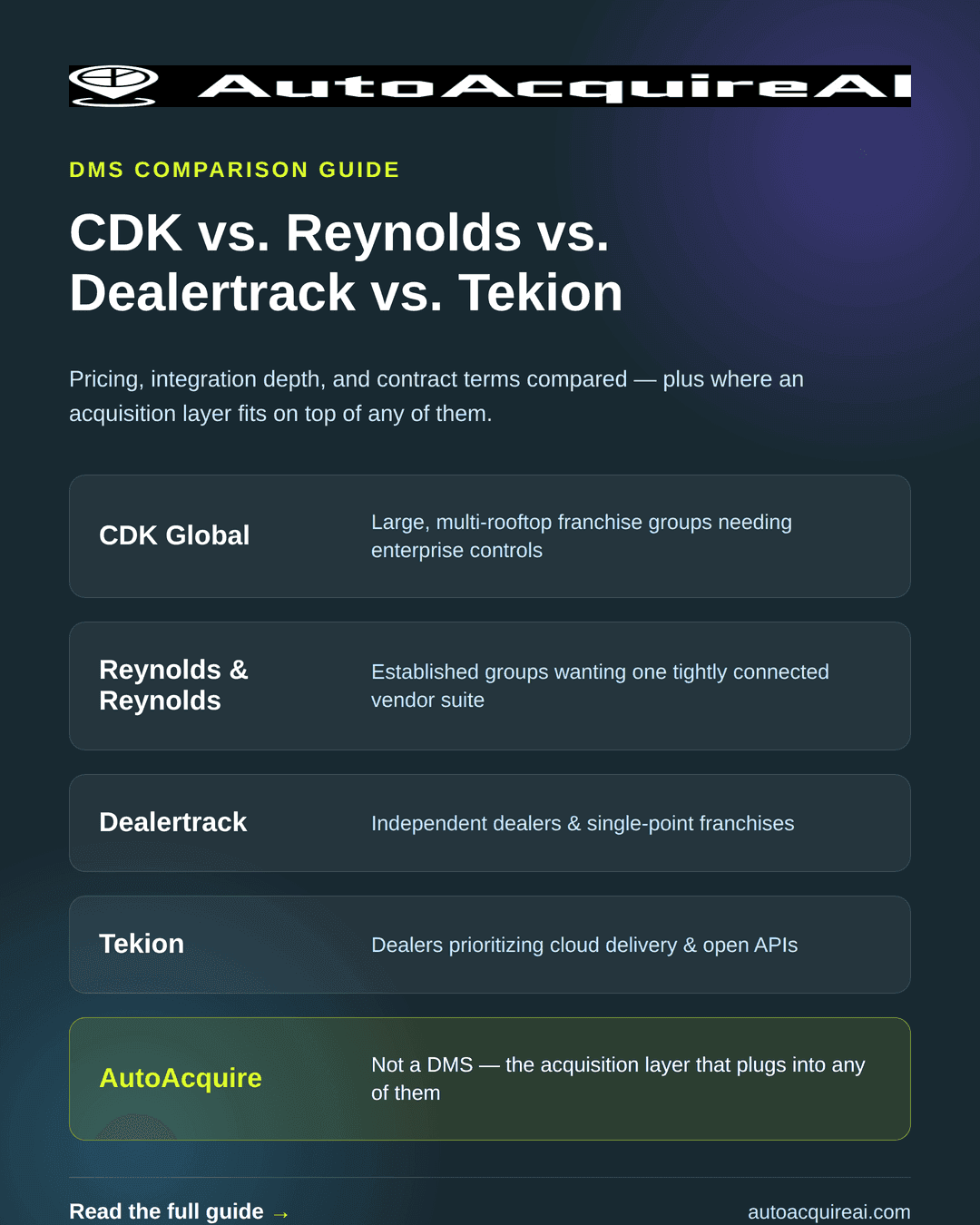
Three DMS environments shape the entire decision. CDK Global, Reynolds and Reynolds, and Dealertrack each handle data access differently, and a platform certified in one is not automatically certified in the others. Each platform below is evaluated through that lens.
Platform DMS Integration Comparison (2026)
The table below maps each platform against the three dominant DMS environments and the acquisition features franchise groups actually use. Values reflect public integration documentation and product pages as of early 2026.
| Platform | CDK | Reynolds & Reynolds | Dealertrack | ICO | Service Drive | API Access | Write-Back |
|---|---|---|---|---|---|---|---|
| AutoAcquire | Native | Native | Native | iOffer | ✓ | Open API | ✓ |
| AccuTrade | Native (Cox) | Partial | Native (Cox) | ✓ | Limited | Limited | Partial |
| vAuto | Native (Cox) | Partial | Native (Cox) | ✗ | ✗ | Limited | Read-only |
| Carketa | Via API | Unknown | Via API | ✗ | ✗ | ✓ | Unknown |
| AlgoDriven | Unknown | Unknown | Unknown | ✗ | ✗ | Via export | ✗ |
vAuto and AccuTrade are both Cox Automotive products, and Dealertrack is a Cox sibling brand. That ownership gives both tools clean Dealertrack connectivity and strong CDK read access. Reynolds sits outside the Cox ecosystem, which is why Cox products show partial Reynolds support routed through third-party data agreements rather than direct certification.
AutoAcquire Integration
AutoAcquire writes to the DMS as a system of record rather than only reading data from it, and four data flows run between the platform and CDK, Reynolds, and Dealertrack, each tied to a specific point in the acquisition workflow.
- VIN decode from DMS — Triggers when an appraiser scans a VIN or pulls a stock number on the lot or in the service lane. Moves year, make, model, trim, and existing vehicle records back into the appraisal session. Supported natively on CDK, Reynolds, and Dealertrack.
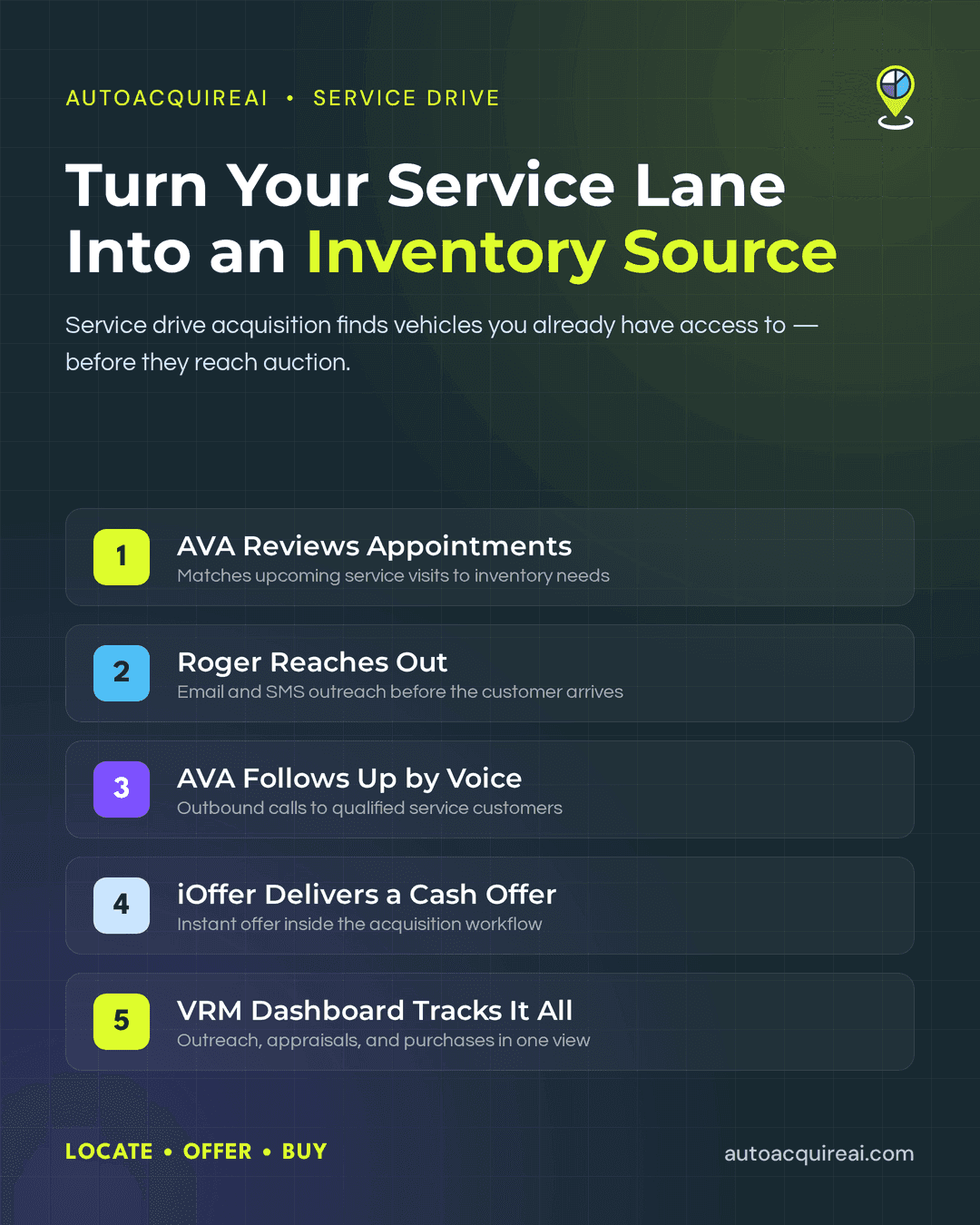
- RO ingestion from the service drive — Triggers when a customer opens a repair order, surfacing equity candidates before a service advisor pitches a trade. Moves open and closed RO data, mileage, and customer contact details into AutoAcquire's service drive workflow. Runs natively on CDK and Dealertrack. Reynolds RO data flows through AutoAcquire's certified data access, held directly rather than brokered through a third party.
- Appraisal pushback to the DMS — Triggers when an appraiser finalizes a number in AutoAcquire. Writes the completed appraisal, condition notes, and valuation back into the DMS deal jacket so the desk works from one figure. This write-back step separates AutoAcquire from read-only tools like vAuto's Provision. Those tools pull VIN and inventory data but leave appraisals stranded in a parallel system.
- Offer sync via iOffer (including ACH disbursement) — Triggers when a dealer accepts a private-party or service drive offer. Moves the agreed price, seller details, and payment instruction into the deal, then disburses funds to the seller via ACH. iOffer handles disbursement directly, so funding does not wait on a separate accounting export.
Cox-ecosystem tools like AccuTrade read cleanly from Dealertrack and CDK. AutoAcquire adds the return trip. Every appraisal and accepted offer writes back to the DMS where the deal closes.
Best Fit by DMS Environment
Integration depth varies sharply across the three major DMS environments. The right platform depends on which one runs your stores.
- CDK shops — AutoAcquire is the top pick. Native CDK certification covers VIN decode, RO ingestion, and appraisal write-back, so service drive deals close inside the same record. AccuTrade runs as the runner-up through Cox CDK access, but its service drive workflow stays limited and write-back is thinner.
- Reynolds shops — Reynolds is the environment where Cox-ecosystem tools show the heaviest friction, since vAuto and AccuTrade rely on third-party data agreements rather than direct certification. AutoAcquire's native Reynolds certification writes appraisals back without middleware. No competing platform publicly documents the same certification depth for Reynolds, which leaves these groups with limited alternatives.
- Dealertrack shops — AccuTrade and vAuto read inventory and VIN data through the Cox ecosystem without friction, a natural advantage of shared ownership. AutoAcquire stays the better acquisition choice. vAuto offers no instant cash offer or service drive sourcing, so groups buying directly from owners need the iOffer workflow it cannot match. The Cox tools fit best as pricing layers rather than acquisition layers.
Buyer's Guide: Questions to Ask Every Vendor
Bring these to the demo and make the rep answer each one in front of the screen, not in a follow-up email.
- Does the integration write appraisals back to the DMS, or only read VIN and inventory data out of it? Ask for a live demo of a record landing in the DMS.
- Is sync real-time or batched overnight? Batch sync delays stocking decisions and breaks same-day acquisition on the service drive.
- How does multi-rooftop seat licensing work, and is store data segmented by rooftop? Confirm one franchise group's data does not bleed across stores.
- Can the platform ingest repair orders from the service drive to flag acquisition targets? Ask which DMS systems support RO pull and how the trigger fires.
- How does the instant cash offer disburse funds? Confirm whether ACH runs through the platform or requires a separate enrollment.
- Is the integration certified with Reynolds and Reynolds, or routed through third-party data access? Cox-ecosystem tools tend to show the most friction here.
- What is the support SLA when the DMS connection drops? Get the response window in writing.
- Does the integration cost extra per rooftop or per DMS? Pricing buried at signing time wrecks the rollout math for a group.
FAQs
What counts as "native" DMS integration versus API middleware?
Native integration means the platform holds a direct certification with the DMS vendor and writes data without a third-party connector in between. API middleware routes data through an external broker, which adds latency and a second point of failure. AutoAcquire holds native certifications with CDK, Reynolds, and Dealertrack, so VIN decode and appraisal pushback run through one pipe.
Do CDK and Reynolds rooftops need separate contracts?
No, a single AutoAcquire agreement covers both DMS types across a group with per-rooftop seat licensing. Separate DMS contracts are a common worry for franchise groups running mixed CDK and Reynolds rooftops. This keeps billing and data segmentation under one master contract, so each store stays distinct without added paperwork.
How does appraisal pushback work across multiple rooftops?
Each rooftop pushes appraisals to its own DMS instance, so a trade valued at one store does not bleed into another's inventory. The VRM Dashboard rolls up activity across all rooftops for group-level reporting.
Does iOffer require separate ACH enrollment?
Yes, iOffer disbursement runs through a one-time ACH enrollment completed per rooftop during onboarding. This is the step that lets AutoAcquire send seller payments directly rather than waiting on a separate accounting export. The benefit is same-day funding to the seller once a dealer accepts an offer.