TLDR
- Best all-in-one acquisition platform: AutoAcquire. Combines service drive outreach, private-party sourcing, and AI voice agent AVA in one workflow, with Remote Inspection and iOffer closing the deal.
- Best auction sourcing: ACV Auctions. Nationwide digital wholesale access and detailed condition reports for dealers buying through auction lanes.
- Best for vAuto users: vAuto Stockwave. Data-driven wholesale lane sourcing inside the Cox Automotive stack.
- Best private-party sourcing tool: VETTX. Off-market lead generation for dealers buying directly from owners.
- Best dealer-to-dealer trading: Dealerslink. Peer-to-peer wholesale marketplace with inventory management built in.
Why Dealers Are Rethinking Vehicle Sourcing in 2026
Auction fees have climbed to the point where they erode the margin on every unit a dealer wins. Buy fees, transportation, and reconditioning stack on top of a hammer price already inflated by competing bidders, and the math leaves thin profit on cars that sell. Dealers who once filled lots almost entirely through auction lanes now treat that channel as one option among several rather than the default.
Inventory scarcity compounds the fee problem. Fewer off-lease and trade-in vehicles reach the wholesale market, so demand at auction outpaces supply and prices stay elevated. A used car manager chasing 40 units a month finds that auction reliance alone no longer fills the gap at a cost that protects front-end margin.
Direct acquisition answers both pressures. Sourcing from service drive customers and private sellers cuts out the auction fee entirely and gives dealers access to vehicles before they ever reach a lane. A car bought from a service customer carries a known history and a lower acquisition cost, which is why dealers are building direct sourcing into their daily workflow instead of treating it as a side experiment.
The list below evaluates platforms built for dealers, not consumer apps that estimate trade values for shoppers. A tool that captures a website lead does different work than a platform that runs an acquisition workflow end to end. Each entry below is judged on how well it helps a dealership actually buy cars.
What to Look for in a Vehicle Sourcing Tool
Four dimensions separate a real sourcing platform from a single-purpose tool, and dealers should grade every option on all four before signing anything.
Acquisition channel coverage decides how many vehicles a tool can actually reach. Some platforms only pull from auction lanes, while others open service drive customers, private sellers, and dealer-to-dealer trades. A tool limited to one channel caps the inventory a store can acquire no matter how good the rest of the product is.
AI and automation depth determines how much of the work happens without a human chasing it, showing up in lead qualification, automated outreach, and offer generation. A platform that scores leads and follows up on its own frees the acquisition team to close deals instead of dialing dead numbers.
DMS integration controls whether acquired vehicles flow into inventory without manual re-entry. Tools that sync directly with the dealer's DMS cut the lag between offer accepted and unit live for sale. Tools that don't sync force a used car manager to rekey every vehicle by hand.
Cost per acquired vehicle is the number that ranks everything else. Subscription price means little until it gets divided by units actually sourced. A cheaper tool that lands fewer cars often costs more per acquisition than a pricier platform that converts at scale.
AutoAcquire
AutoAcquire earns the top spot because it pulls three separate acquisition channels into a single workflow, while most competitors specialize in one. Dealers source from the service drive, from private-party sellers, and through an AI voice agent, then move straight into inspection and an offer without leaving the platform. Used car managers who currently stitch together a CRM, a separate inspection app, and a third tool for outbound calls gain one workflow instead of three.
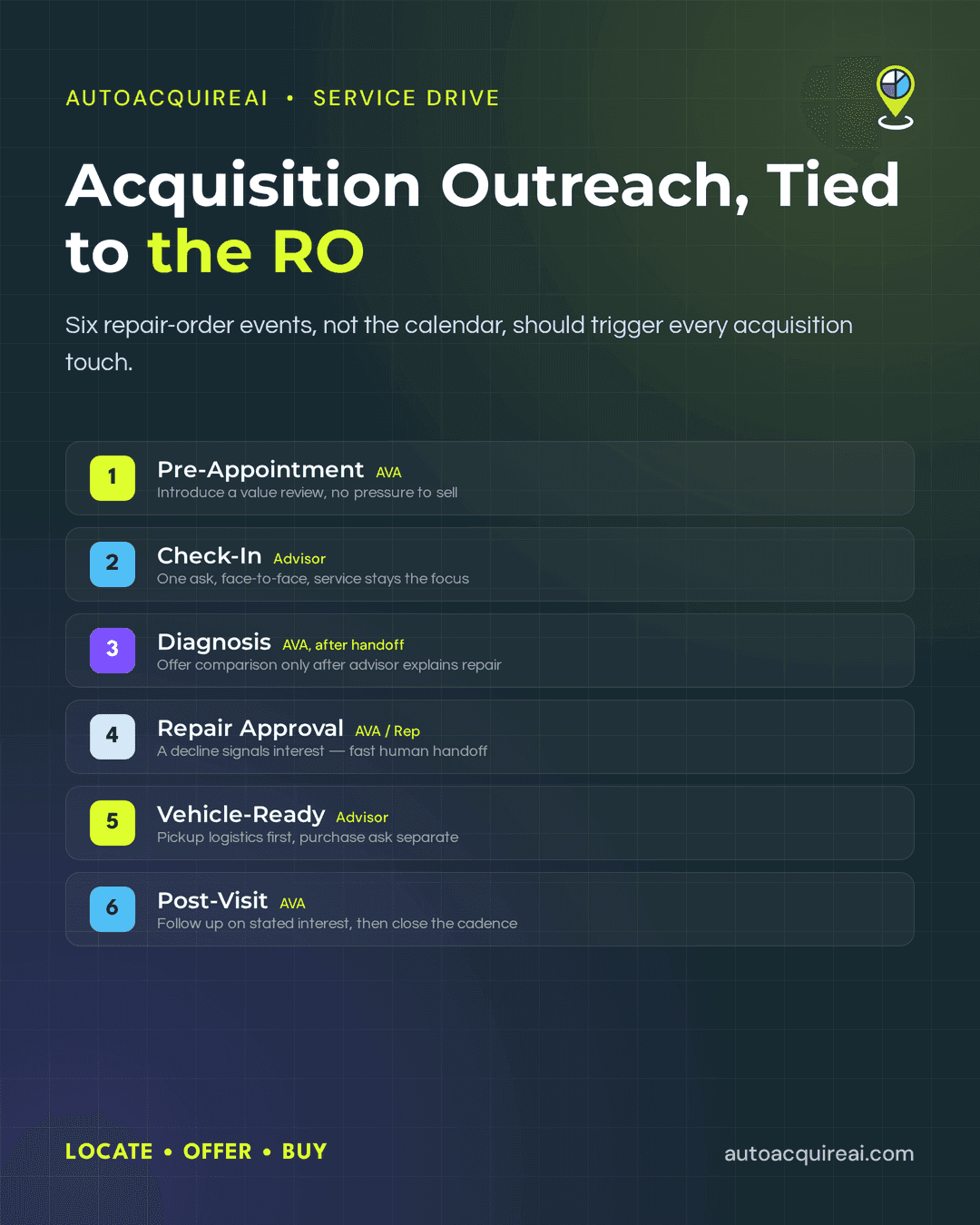
The service drive channel surfaces owned-equity vehicles already sitting in the dealer's lane. When a customer brings a car in for service, AutoAcquire flags acquisition candidates and triggers outreach before that owner trades or sells elsewhere. Private-party sourcing extends the same logic to off-street vehicles, giving dealers a direct pipeline to consumer sellers without bidding against other stores in an auction lane.
AVA, our AI voice agent, handles the volume problem that kills most outreach programs. AVA calls prospective sellers, qualifies them, and books appointments at a scale no BDC can match by hand. The bottleneck in manual private-party acquisition is consistent follow-up, and an automated caller working every lead removes the staffing constraint that usually stalls these programs after a few weeks.
Remote Inspection and iOffer close the workflow. Remote Inspection lets a seller capture vehicle condition from their phone, so a manager appraises the car without a physical visit or a lot drop-off. iOffer then generates an instant cash offer tied to that inspection data, turning a qualified lead into a firm number the seller can accept the same day. The VRM Dashboard tracks each deal through the funnel, giving used car managers a single view of pipeline, channel performance, and cost per acquired vehicle.
Who it's best for
AutoAcquire fits dealers who want to reduce reliance on auction lanes by sourcing directly from service customers and private sellers. Single-rooftop stores benefit from the service drive channel without hiring a dedicated acquisition team, and multi-rooftop groups gain a consistent process across locations through the shared dashboard. Dealers committed entirely to wholesale auction buying will find less value here, since the platform's strength sits in direct-to-consumer acquisition rather than lane bidding.
Where it's uniquely strong
No other tool on this list combines AI-driven outreach, remote appraisal, and instant offers across three channels in one place. Inspection platforms like Ravin AI and UVeye specialize in high-volume condition-scoring, and ACV Auctions specializes in digital wholesale. AutoAcquire's advantage is the connected workflow from lead to offer, which shortens the time between identifying a vehicle and owning it.
Limitations
AutoAcquire does not replace a DMS or an inventory management system. It operates as the acquisition layer feeding those tools, so dealers still manage stocking, pricing, and merchandising downstream. Dealers expecting deep wholesale auction integration will need a separate platform for lane purchasing.
Pricing and trial access
AutoAcquire prices by dealership and channel scope rather than a flat published rate, so dealers can request a demo to scope cost against their current acquisition volume. Pricing and trial details are available on the AutoAcquire site.
VETTX
VETTX builds its entire model around private-party and off-market acquisition, which puts it in a different category than the auction-focused platforms most dealers default to. Rather than feeding wholesale lanes, VETTX aggregates for-sale-by-owner listings from consumer marketplaces into a single dashboard. Used car managers work those leads directly, which lets dealers acquire vehicles before they ever hit a wholesale channel.
The platform's strongest feature is messaging automation that handles outreach to private sellers at volume. Manual private-party sourcing breaks down because one buyer can only contact so many listings in a day, and VETTX removes that ceiling by templating and tracking conversations across hundreds of leads. Dealers running aggressive direct-acquisition strategies use it to keep a steady top of funnel without adding headcount.
VETTX fits dealers that already have a buying process and want to scale the lead volume feeding it. The platform finds and organizes sellers, but it does not appraise, inspect, or close. Dealers still need their own valuation discipline and inspection workflow, since a bad acquisition at the private-party level is harder to unwind than a wholesale return.
VETTX concentrates on private-party listings and does not touch service drive acquisition, which is where many dealers find their cleanest, lowest-cost units. A store running VETTX for off-market leads still needs a separate tool to work the service drive and close deals with a firm cash offer.
VETTX prices on a monthly subscription rather than per-vehicle fees, which favors dealers acquiring enough units to absorb the cost across volume. Pricing is quote-based and tiered by rooftop and seat count, so single-store operators should confirm the per-store math before committing. For dealers focused narrowly on scaling private-party sourcing, the subscription model is straightforward.
vAuto Stockwave
vAuto Stockwave gives dealers a data-driven view of wholesale and auction inventory across thousands of lanes, scored against live market metrics. The platform pulls condition reports, transportation costs, and projected retail margins into a single buying screen, so used car managers can rank auction units by expected profit before they bid. For dealers running high auction volume, that scoring removes guesswork from lane selection and speeds up daily buying decisions.
Stockwave performs best for dealers already inside the Cox Automotive ecosystem. Its tight connection to vAuto Provision inventory data and Manheim auction feeds means appraisal benchmarks, stocking guidance, and wholesale buying share the same underlying market data. A dealer using Provision for pricing gets acquisition recommendations that match the same numbers driving the retail strategy, which keeps buying and merchandising decisions consistent.
Stockwave deepens auction buying rather than reducing reliance on it. Dealers chasing private-party cars, service drive trade-ins, or off-market units find no native path inside Stockwave for those channels. Acquiring directly from consumers requires a separate platform, since Stockwave assumes the vehicle already sits in a wholesale or auction listing.
Pricing follows the Cox Automotive model, typically bundled with broader vAuto subscriptions and quoted per rooftop rather than published openly. Dealers should expect to evaluate Stockwave as one module within a larger vAuto commitment, not as a standalone purchase.
Stockwave suits dealers who buy heavily at auction and want sharper margin data on every lane. Many groups run it alongside a direct acquisition platform — Stockwave handles the lane buying while a tool like AutoAcquire works the channels Stockwave does not reach.
ACV Auctions
ACV Auctions runs a digital wholesale marketplace, not a direct acquisition channel. Dealers buy and sell vehicles between dealerships through online auction lanes, which makes it a wholesale tool rather than a way to source cars from consumers.
The platform's strongest asset is its condition reporting. ACV sends trained inspectors to capture standardized condition reports, including audio recordings of engine startup through its Virtual Lift and audio diagnostics. That removes much of the guesswork dealers face buying sight-unseen, and the nationwide reach means a used car manager in one market can buy inventory listed three states away.
ACV charges buyer and seller fees per transaction, and those fees stack on top of transportation and any reconditioning the unit needs once it lands. For dealers already squeezed on used car margins, every wholesale unit acquired through ACV carries auction economics that direct acquisition avoids entirely.
ACV connects dealers to other dealers, so it does nothing to reach the private sellers and service drive customers who often hold the cleanest, lowest-cost inventory. A dealer building a steady supply outside the auction lane needs a separate tool for that work.
ACV fits dealers who treat wholesale auctions as a core supply line and want better condition data before they bid. Used as a complement to a direct acquisition platform, it fills the wholesale lane while another tool handles the consumer side — the two channels serve different supply problems.
Carketa
Carketa earns its place for used car managers who need visibility into reconditioning and pricing on inventory already in stock. Its reconditioning module tracks each vehicle through the recon process, flags bottlenecks that stall cars in the back lot, and ties holding cost to days in recon. Managers gain a clear view of where margin leaks before a car ever hits the front line.
The appraisal workflow scores condition and generates pricing recommendations, which helps managers value trade-ins and set retail asking prices with market data behind them. For a store that struggles to move metal off the recon pad fast enough, Carketa attacks a real operational cost.
Carketa supports sourcing indirectly rather than directly. It sharpens the appraisal on a trade that walks onto the lot, and it tells managers which segments turn fastest, which informs what to buy. It does not generate acquisition leads, reach private sellers, or work the service drive for off-street vehicles. A dealer relying on Carketa alone still depends on whatever inventory shows up through trades and auction runs.
Carketa optimizes the cars a dealer already owns. Dealers running it alongside a dedicated sourcing platform pair downstream recon discipline with upstream supply — Carketa tightens what they keep, AutoAcquire expands what they can buy.
Pricing runs on a per-rooftop subscription, with details available through a demo. Carketa fits managers who want reconditioning speed and appraisal accuracy, not dealers whose primary problem is finding enough cars to buy.
TradePending
TradePending is a consumer-facing trade and instant offer tool, not a dealer sourcing platform. Its core product, SnapLot and the Trade-In Marketplace, lives on a dealer's website and turns trade questions into leads. Shoppers enter their vehicle details, see a value range, and submit contact information the sales team follows up on.
TradePending is strongest at the top of the trade funnel. Dealers running paid traffic to a VDP or homepage capture more trade intent because the offer widget gives shoppers a reason to identify themselves before they leave. The tool also feeds appraisal context into the sales conversation, so a salesperson opens the deal already knowing what the customer expects on their trade.
The channel ceiling shows up the moment a dealer needs vehicles beyond inbound web traffic. TradePending does not source from private sellers off-market, does not run service drive outreach, and has no auction lane access. Every acquisition still depends on a shopper finding the dealer's site first, which caps the channel to existing website demand. Dealers who need volume have to supplement it with a platform that reaches sellers who never visit the store.
The appraisal value TradePending surfaces is a guidance range, not a firm cash offer a dealer can stand behind without a closer inspection. Used car managers still verify condition and finalize numbers separately, so the tool shortens the lead step rather than closing the acquisition.
TradePending fits dealers who want a cleaner trade-capture experience on their website and already have a separate sourcing motion. Without that second layer, the tool captures intent it cannot convert into inventory.
Dealerslink
Dealerslink runs a dealer-to-dealer wholesale marketplace where stores trade inventory directly without auction lanes or transport markups. Dealers list aging units and source replacements from other rooftops at near-trade pricing, which cuts the buy fees and arbitration headaches that come with traditional wholesale channels. For groups moving high volume between stores, that direct trading network is the platform's strongest asset.
The platform pairs its marketplace with inventory management, appraisal, and pricing tools, so used car managers can value, list, and reprice cars in one place. Dealers already coordinating wholesale across multiple rooftops get the most from this hybrid setup, since the marketplace and the management layer feed each other.
Dealerslink does not source from consumers. It moves cars between dealers, which means private-party sellers and service drive customers fall outside its reach entirely. Dealers who want to buy directly from the public still need a separate acquisition platform, and Dealerslink offers no AI voice outreach or remote inspection workflow to capture those upstream vehicles. Its value sits in the wholesale layer, not in direct-to-consumer acquisition.
Dealerslink pairs well with a direct acquisition tool for stores that want to cover both channels. It handles dealer-to-dealer trades; a platform like AutoAcquire handles the consumer side that wholesale marketplaces never reach. Pricing runs on a monthly subscription, and dealers should request a demo to size the marketplace access against their wholesale volume.
ACVMax
ACVMax extends ACV Auctions beyond the wholesale lane into private-party and off-street sourcing, giving dealers already inside the ACV ecosystem a way to pull retail-grade inventory directly. The platform scans private listings, flags acquisition targets, and routes them into an appraisal and outreach workflow that connects to ACV's broader inventory tools. For dealers running ACV auctions and inventory management together, ACVMax keeps sourcing data in one place rather than scattered across separate logins.
Outside the ACV ecosystem, ACVMax loses much of its pull. Its value depends on dealers already paying for ACV's auction access and inventory management, and the sourcing module reads as an add-on to that stack rather than a standalone acquisition engine. Dealers who do not run ACV elsewhere gain little reason to adopt it over a purpose-built sourcing platform.
ACVMax also carries fee exposure tied to the ACV transaction model. Acquisition through the platform often funnels back toward ACV's marketplace and inspection services, so the cost structure favors dealers who keep buying and selling inside that network. Dealers focused on reducing auction dependence will find that pull works against them.
ACVMax fits dealers already committed to the ACV platform who want sourcing folded into tools they already run. Dealers building a direct-to-consumer acquisition program independent of an auction marketplace will find a purpose-built sourcing platform gives them more flexibility on cost structure and channel coverage.
Tool Comparison Table
| Tool | Best For | Key Strengths | Pricing/Trial |
|---|---|---|---|
| AutoAcquire | All-in-one direct acquisition | Service drive, private-party, and AVA AI voice agent; iOffer and Remote Inspection close the deal | Demo on request |
| VETTX | Private-party and off-market sourcing | Off-market lead generation, outbound seller outreach | Custom quote |
| vAuto Stockwave | Auction lane sourcing in Cox ecosystem | Wholesale data, lane scanning across auctions | Quote via vAuto |
| ACV Auctions | Digital wholesale auction access | Condition reports, nationwide buyer pool | Buyer fees per transaction |
| Carketa | Recon and appraisal visibility | Inventory intelligence, reconditioning workflow | Custom quote |
| TradePending | Website trade lead capture | Consumer trade funnel, instant offer widget | Subscription tiers |
| Dealerslink | Dealer-to-dealer wholesale | Peer marketplace, inventory management hybrid | Monthly subscription |
| ACVMax | Off-street sourcing in ACV ecosystem | Private-party acquisition CRM tied to ACV | Quote via ACV |
Dealers running multiple acquisition channels at once get the widest coverage from AutoAcquire. Single-channel tools fit dealers solving one specific gap.
Buyer's Guide: Choosing the Right Sourcing Tool for Your Dealership
Three questions determine which tool fits a dealership, and a dealer principal can answer all three in a few minutes.
Start with the sourcing goal
Dealers who want to source vehicles directly from consumers and cut their auction lane spend should anchor on AutoAcquire, which combines service drive outreach, private-party acquisition, and the AVA voice agent in one workflow. Dealers who still buy heavily through auctions and want better lane data fit vAuto Stockwave or ACV Auctions, both built around wholesale and auction sourcing rather than direct-to-consumer channels. Most groups run a hybrid, pairing a direct acquisition platform with one auction tool to keep both channels open.
Match the DMS stack
Dealers already committed to vAuto and Cox Automotive get the cleanest data flow from Stockwave, since it lives inside that ecosystem and shares pricing signals natively. Dealers on other DMS platforms should weight integration breadth heavily, because a sourcing tool that cannot sync acquired vehicles back into the DMS forces manual re-entry and slows reconditioning. AutoAcquire works as the acquisition layer on top of an existing DMS, so dealers keep their inventory system and add direct sourcing without ripping anything out.
Account for rooftop scale
Single-store dealers benefit most from one platform that covers several acquisition channels, since spreading spend across three or four point tools rarely earns back the subscription cost at one rooftop. AutoAcquire fits this profile because one workflow handles service drive, private-party, and inspection. Multi-rooftop groups can justify a wider stack, often running AutoAcquire for direct acquisition across stores alongside ACV Auctions for wholesale volume and a dedicated appraisal tool like Carketa for reconditioning visibility. Groups managing peer-to-peer wholesale between their own rooftops should add Dealerslink to that mix, since it handles dealer-to-dealer trading the consumer-facing tools do not.
A dealer who names a primary sourcing goal, a DMS, and a rooftop count usually finds the choice narrows to one platform or one clear pairing.
Why AutoAcquire Leads for Dealers Reducing Auction Dependence
Point solutions force dealers to stitch acquisition together across separate tools, and the gaps between those tools cost vehicles. A trade appraisal tool captures intent but hands off no inspection or offer, so the seller goes cold before anyone makes a number. An auction platform delivers inventory but never touches the service drive customer sitting in the waiting room. Each handoff between systems is where deals stall and sourcing volume leaks.
AutoAcquire closes those gaps by running one workflow from first contact to signed offer. AVA, our AI voice agent, surfaces and qualifies private-party and service drive sellers without a salesperson dialing. Remote Inspection captures vehicle condition from the seller's phone, so dealers appraise accurately without the car on the lot. iOffer converts that inspection into a real cash offer the seller can accept on the spot.
Direct acquisition only scales when sourcing, inspection, and offer live in the same system, and that is the case dealers reducing auction dependence need to make. A dealer running AVA outreach, Remote Inspection, and iOffer acquires from channels auctions never reach, and does it without juggling three vendors. For most rooftops, the consolidated workflow beats a stack of separate tools that don't talk to each other.
How We Chose These Tools
Each tool earned its place by clearing four practical tests that used car managers apply daily.
- Acquisition channel coverage. Platforms scored higher when they sourced across service drive, private-party, and wholesale lanes rather than a single channel.
- AI and automation depth. Tools that automate appraisal, outreach, or offer generation ranked above those that only display data and leave the work to staff.
- DMS integration. Real-time sync with major DMS providers separated operator-grade platforms from standalone apps.
- Cost per acquired vehicle. Subscription pricing, transaction fees, and auction exposure all factored into the true acquisition cost.
Consumer-facing trade and instant-offer tools appear on this list only where dealers genuinely use them, and each is labeled as a lead-capture tool rather than a sourcing platform. That distinction keeps the comparison honest for dealers building a direct acquisition program.
FAQs
What is the true cost of auction sourcing versus direct acquisition?
Auction sourcing layers buy fees, transport, and reconditioning surprises on top of the hammer price, and those costs add up quickly before a vehicle hits the lot. Direct acquisition from service drive customers and private sellers skips the auction fee stack and shortens the path to retail-ready inventory. Dealers using direct channels typically hold lower acquisition costs and gain margin room on units they would otherwise overpay for at auction.
Can these tools integrate with my DMS?
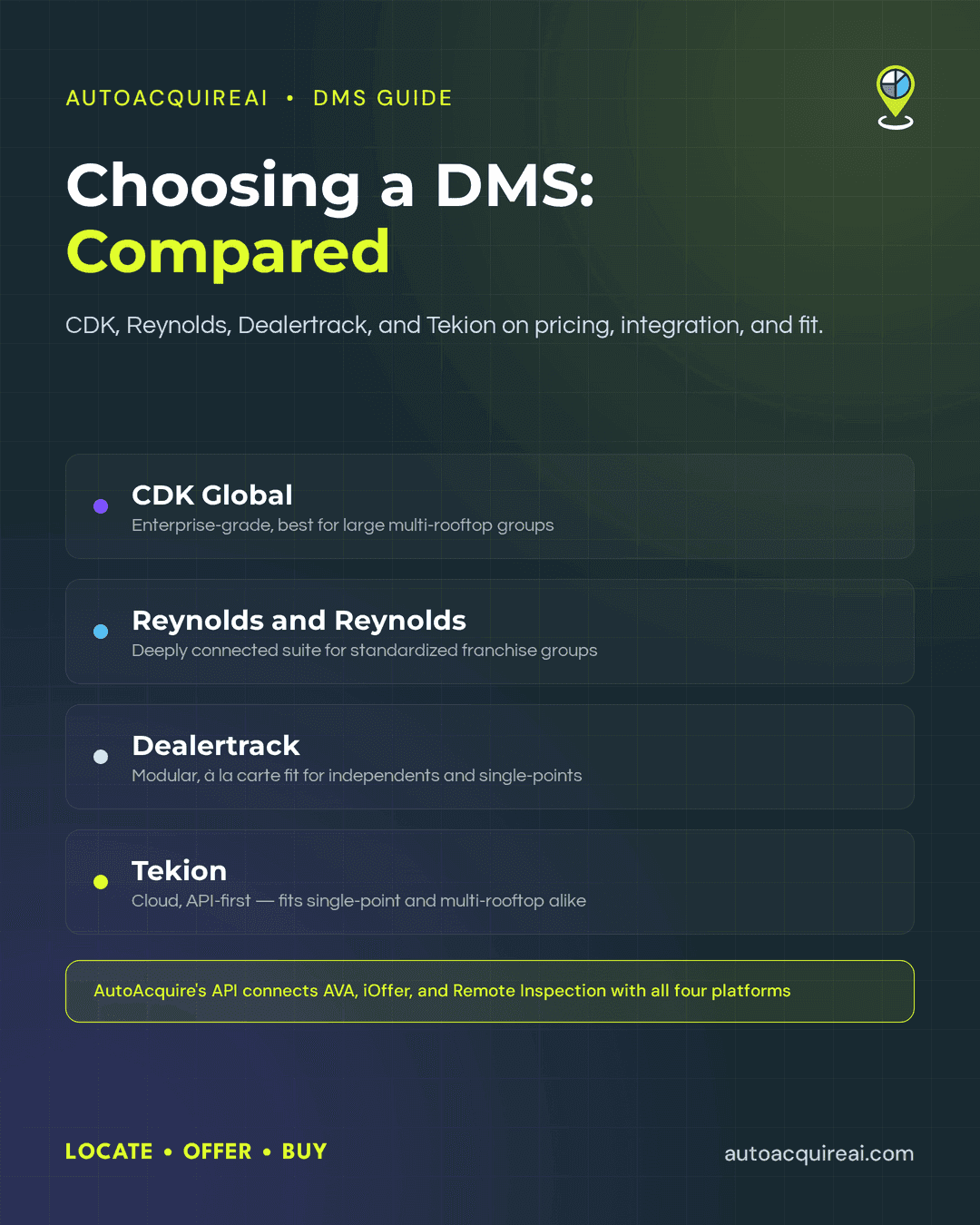
Integration depth varies widely across sourcing tools, with some syncing directly to a DMS and others living inside a closed ecosystem. AutoAcquire functions as an AI-native acquisition layer that syncs with existing DMS platforms — including CDK, Reynolds and Reynolds, and Dealertrack — rather than replacing them, so appraisals and instant cash offers flow into the dealer's current workflow.
Is AutoAcquire suitable for independent dealers?
Yes. AutoAcquire fits single-rooftop independents and large groups because its three sourcing channels do not depend on auction credit lines or franchise volume. Independent dealers reducing auction reliance use service drive outreach, private-party acquisition, and the AVA voice agent to build inventory without bidding against larger buyers.
What is the difference between a sourcing platform and a trade-in tool?
A trade-in tool like TradePending captures interest on a dealer's website and feeds the trade funnel, but it stops at the showroom door. A sourcing platform actively pursues vehicles across multiple channels, including private sellers and service customers who never walked in to trade. Dealers relying on trade-in tools alone still need a sourcing platform to acquire units beyond inbound web leads.