
TL;DR
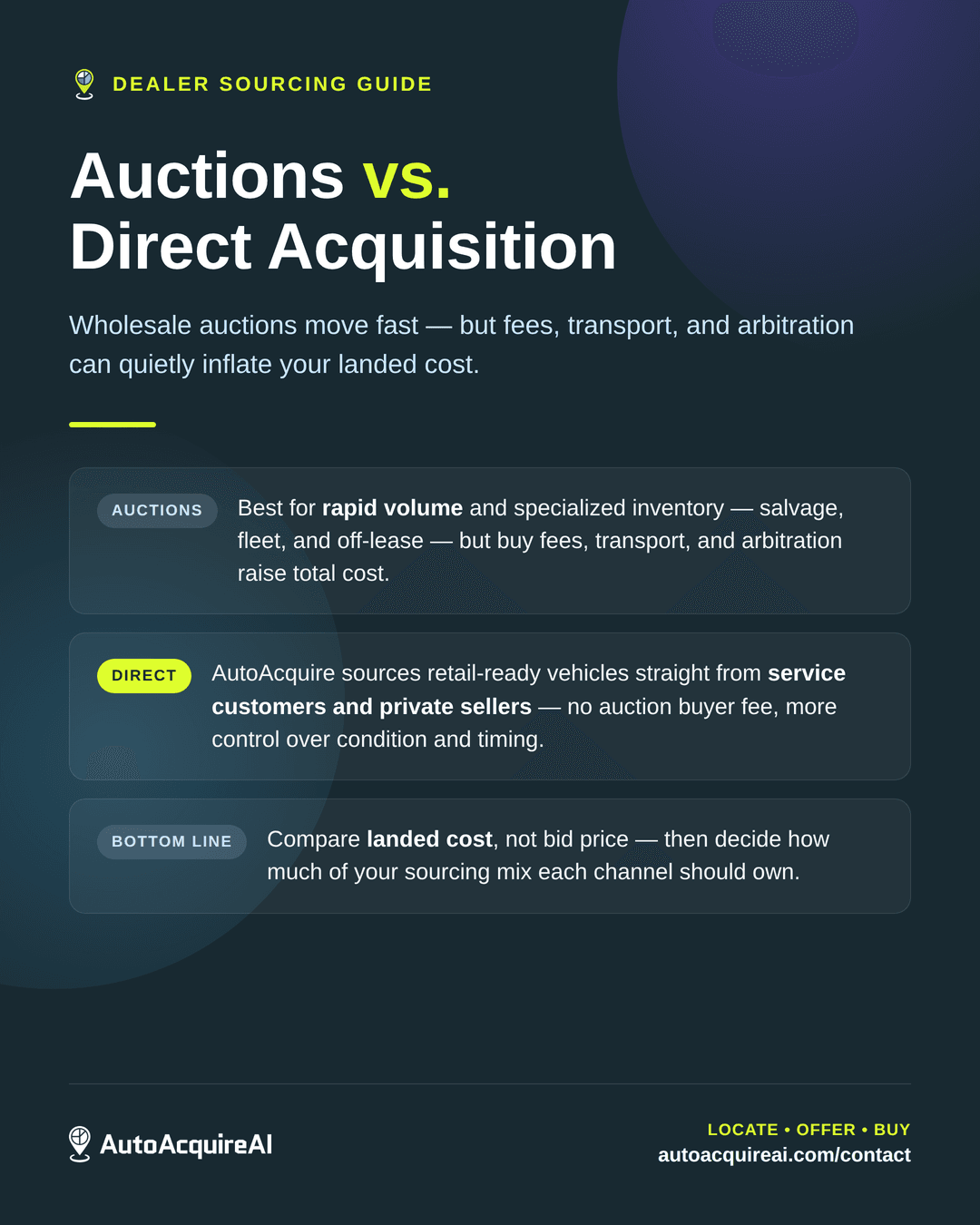
- Wholesale auctions remain the default for fast inventory access, but buy fees, transport, arbitration, and uncertain reconditioning can raise the total acquisition cost.
- ACV Auctions supports online wholesale buying with detailed digital condition reports. Copart and IAA specialize in salvage and insurance inventory.
- OPENLANE provides digital wholesale access, while Manheim and ADESA offer physical and online bidding to broad wholesale inventory, including fleet and off-lease vehicles.
- AutoAcquire supports direct acquisition through AVA outreach to service customers and private sellers, iOffer instant cash offers, and Remote Inspection.
- Dealers needing rapid volume or specialized vehicles should keep auction access. Dealers with service traffic or private-seller reach can use direct acquisition to avoid auction fees and gain more control over vehicle history.
Why Dealers Still Use Auctions
Wholesale auctions became the default because they concentrate inventory and let dealers fill lot gaps without building a consumer acquisition pipeline. Physical lanes established that model, while online bidding expanded access beyond a dealer’s local market. Auctions also provide inventory that can be difficult to source directly, including off-lease vehicles, fleet units, and salvage stock.
The winning bid accounts for only part of an auction vehicle’s acquisition cost. Buy fees and transportation raise the landed cost before reconditioning begins. If the vehicle differs from its condition report, the dealer must absorb the repair or pursue arbitration, The arbitration process can delay frontline availability, and the auction may deny the claim under its policy..
Competition for desirable used vehicles also limits inventory control. Multiple buyers can push a common retail unit above its planned acquisition price, while the auction schedule determines when suitable vehicles appear. Dealers may secure volume quickly, but they have limited influence over supply, condition, and timing.
The comparison focuses on total cost and inventory control. Total cost includes fees, transportation, arbitration delays, and uncertain repairs. Inventory control measures whether a dealer can find suitable vehicles when needed and obtain enough condition information to set a bid ceiling.
Auction Platform Comparison at a Glance
Auction platforms differ most in inventory mix, sale format, and the fees added to the winning bid. The table provides a practical starting point, but dealers should confirm current buyer, transport, storage, and payment fees before bidding.
| Platform | Auction Type | Typical Fees | Inventory Focus | Best Use Case |
|---|---|---|---|---|
| ACV Auctions | Online | Buyer and optional service fees vary by transaction | Dealer wholesale and commercial inventory | Remote buyers prioritizing detailed condition reports |
| Copart | Online | Buyer fee plus gate, storage, and payment charges | Salvage, total-loss, and repairable vehicles | Dealers and rebuilders sourcing salvage inventory |
| IAA | Online | Buyer fee plus service, storage, and payment charges | Insurance salvage and rebuildable vehicles | Buyers seeking insurance-sourced stock |
| OPENLANE | Online | Transaction and optional service fees vary by sale | Off-lease, fleet, and dealer wholesale vehicles | Dealers sourcing commercial and dealer wholesale inventory |
| Manheim | Physical and hybrid | Tiered buyer fee plus location and service charges | Broad dealer, fleet, rental, and consignment inventory | Dealers needing broad selection and physical lane access |
| ADESA | Physical and hybrid | Tiered buyer fee plus location and transaction charges | Dealer, fleet, lease-return, and repossession inventory | Dealers seeking regional lanes and mixed wholesale stock |
How We Evaluated Each Platform
We evaluate each platform on fee structure, condition information, buyer protections, and inventory mix. Fees increase the invoice at purchase, while undisclosed or overlooked damage can increase reconditioning costs after delivery.
The buyer-protection comparison considers arbitration eligibility, claim windows, exclusions, and available guarantees. The inventory comparison covers title types, seller sources, and access to categories such as off-lease, fleet, dealer-consigned, and salvage vehicles. The evaluation favors predictable total cost over the lowest winning bid.
ACV Auctions
ACV Auctions provides digital condition reports for online dealer-to-dealer transactions. Its inspection workflow combines inspector-captured photos and disclosures with engine-audio recordings, diagnostic scans, paint-meter readings, and underbody images. These tools document observable evidence and flag potential problems, but they cannot reproduce a road test or detect every intermittent mechanical fault.
The inspection details give dealers more evidence for estimating reconditioning costs before bidding. Buyers can review cosmetic damage, tire condition, warning codes, engine sounds, and undercarriage images without visiting a physical lane. However, image quality and inspector access still affect report usefulness. The report may not reveal hidden damage or mechanical faults that appear only while the vehicle is under load.
ACV Auctions applies buyer fees under the terms shown for the transaction, so dealers should review the current fee schedule before bidding. Dealers must add transportation, payment, title, and optional service costs when calculating landed cost. ACV also provides arbitration for qualifying discrepancies, though claim eligibility depends on its policies, deadlines, and disclosure thresholds.
The platform fits dealers seeking dealer-to-dealer inventory and commercial consignments, including off-lease vehicles. ACV can suit buyers who need access beyond their local market and more condition information than a basic online listing provides. Dealers that require a physical test drive before purchase may still prefer traditional auction lanes.
Copart
Copart gives dealers access to insurance total-loss and salvage vehicles across its auction network. Clean-title inventory appears on the platform, but rebuildable, damaged, and parts vehicles define its core mix. Dealers need accurate repair estimates before bidding because visible damage may conceal structural, electrical, or water-related problems.
Copart charges a buyer fee based on the winning bid, with additional charges that can include online bidding, gate, storage, mailing, and payment-related fees. These charges increase the invoice total before the dealer adds transportation and repair costs. Dealers should calculate the full landed cost for each vehicle rather than applying one fee assumption across every purchase.
Copart's listing terms and the vehicle's title type determine what recourse a buyer may have. Many salvage vehicles are sold as-is with limited recourse, and condition information does not replace a physical inspection. Dealers should verify whether a vehicle carries a salvage, nonrepairable, rebuilt, or clean title and confirm that their state permits the intended resale or reconstruction. Copart suits dealers with repair capacity and experience pricing damaged inventory. Dealers seeking conventional retail stock may prefer dealer-consigned or off-lease marketplaces with more detailed condition information and broader arbitration coverage.
IAA (Insurance Auto Auctions)
IAA focuses on insurance and salvage inventory, which makes Copart a relevant listing comparison for buyers in this category, with inventory centered on total-loss vehicles, rebuildable units, parts vehicles, and some clear-title stock. Dealers can bid online while using IAA’s branch network for pickup and vehicle access. Available inventory varies by branch and sale, so buyers should compare IAA and Copart listings in the markets they can serve economically.
IAA applies buyer charges that vary with factors such as sale price, account type, payment method, and bidding channel. Storage and late pickup charges can also increase landed cost, so dealers should calculate fees against the current sale-specific schedule before bidding.
IAA provides photos, damage details, title information, and vehicle status indicators. Those records help dealers screen salvage inventory, but they do not offer the depth of an inspection report built for conventional dealer-to-dealer wholesale. Hidden mechanical or structural damage can therefore remain a reconditioning risk.
IAA's sale terms and vehicle disclosures determine the buyer's available recourse. Many vehicles sell as-is, and arbitration generally covers narrower issues than policies on online-native wholesale platforms. IAA fits dealers that already understand title restrictions, repair economics, and salvage resale requirements. Dealers seeking frontline-ready used vehicles may find its inventory and protections less suitable than general wholesale lanes.
OPENLANE
OPENLANE gives dealers digital access to wholesale vehicles without requiring attendance at a physical lane. Much of its inventory comes from commercial sellers, including manufacturers, leasing companies, rental fleets, and financial institutions. That seller mix can suit dealers seeking off-lease and fleet vehicles with documented commercial histories.
Buyers generally pay a transaction fee based on the vehicle price, plus any inspection, transportation, storage, or payment charges that apply. OPENLANE publishes applicable fees within each marketplace and sale, so dealers should calculate landed cost before bidding rather than rely on a single fee estimate.
OPENLANE's sale terms and the seller's disclosures determine whether a buyer can pursue a claim. It allows arbitration for eligible condition, title, and disclosure problems, but dealers must report claims within the stated deadline and meet minimum damage thresholds. Vehicles sold as-is or with announced defects may carry limited recourse. Dealers should review each condition report, announcements, and arbitration eligibility before committing because commercial inventory can vary in inspection depth and guarantee coverage.
Manheim
Manheim operates a network of physical dealer auctions and supports online participation in scheduled sales. Dealers can bid in physical lanes or join live sales through Simulcast. Unlike pure online platforms, Manheim’s digital channel extends a scheduled lane sale, so local buyers may inspect vehicles before bidding while remote buyers rely on condition reports and sale announcements.
Manheim offers a broad mix of dealer-consigned and commercial wholesale inventory. The broad mix helps dealers fill common retail inventory gaps, though buyers seeking salvage-heavy stock will find more targeted selection at Copart or IAA.
Buyer fees vary by sale price, event, account status, and purchase channel. Dealers must add transportation and potential post-sale inspection costs when calculating landed cost. Manheim provides arbitration for eligible condition or disclosure disputes, but deadlines and coverage depend on the sale terms. Physical access can reduce inspection uncertainty for local buyers, while remote purchases carry many of the same condition-report risks found on online-only platforms.
ADESA
ADESA’s U.S. physical auction network moved under Carvana ownership in 2022, while its former parent’s digital marketplace later became OPENLANE. ADESA's U.S. offering includes physical auction locations and online bidding for participating sales.
ADESA carries broad wholesale inventory, including dealer consignments, fleet vehicles, and lease returns. Dealers can inspect vehicles at participating locations before bidding, which lets them assess paintwork, interior wear, and mechanical noise before setting a bid limit.
Buyer fees depend on the sale channel, location, and purchase price. Online participation, late payment, storage, and transportation can add to the landed cost, so dealers should review the location-specific fee schedule before bidding.
ADESA ties buyer protection to the vehicle's sale light, announcements, and stated condition. Eligible disputes must meet its arbitration rules and reporting deadlines, and as-is units carry thin recourse. ADESA fits dealers that want regional physical access and a general wholesale mix without relying entirely on Manheim’s network.
How Auction Format Affects Acquisition Cost
Auction format changes how much condition information a dealer can verify before committing to a vehicle. Dealers must add buyer fees, transportation, and expected reconditioning to the winning bid. Buy fees and transportation raise the landed cost before the service department identifies any missed mechanical or cosmetic work.
Remote bidding limits what dealers can verify in person before purchase, so buyers must rely on photos, disclosures, and condition reports. Reports can document visible damage and scan results, but they may miss intermittent faults or underbody wear. When a dealer discovers an unreported problem after delivery, transportation has already been paid and the repair increases the vehicle's reconditioning cost.
Physical lanes give buyers more direct access before bidding, but the format adds labor and travel costs. A buyer can inspect the vehicle on site, though auction schedules may limit road tests and diagnostic work. Dealers must still account for transportation when the auction sits outside their local market.
Arbitration offers a remedy only when the defect qualifies under the auction’s policy. Dealers must document the problem within a short claim window, and mileage, repair-cost thresholds, or disclosure rules can limit coverage. A claim also ties up capital while the vehicle sits unsold. If the auction denies the claim, the dealer absorbs the repair cost or resells the vehicle with another round of fees.
Condition-report accuracy can materially affect the gap between a dealer’s reconditioning estimate and the vehicle’s actual repair needs. More complete condition information helps a dealer estimate repairs before bidding. Missing information may leave the dealer unable to price a defect until the vehicle arrives. Dealers should set bid limits against expected landed and reconditioning cost rather than the lane price alone.
When Auctions Still Make Sense
Auctions remain practical when acquisition speed and inventory specificity outweigh landed-cost uncertainty. Dealers that need to fill open inventory positions can bid on several vehicles in one session instead of sourcing each unit from an individual owner. Auctions can fill multiple price bands or body styles within days when transport and reconditioning capacity are available.
Specific inventory needs also favor auctions. Franchise stores can use off-lease and fleet lanes to replace missing trims, model years, or commercial units that local trade flow does not produce. Rebuilders and export buyers rely on salvage-focused auctions because insurer total-loss inventory rarely reaches ordinary consumer channels at comparable scale.
Auction sourcing also fits dealers without a productive service drive, owner database, or private-seller marketing program. Those stores gain immediate access to wholesale supply without first creating outreach and appraisal operations. Physical lanes let buyers inspect vehicles before bidding, while online lanes expand access when local selection runs thin.
Dealers still need to set bid ceilings from expected landed cost rather than the winning bid alone. The calculation should include buyer fees, transport, likely reconditioning, and the cost of any arbitration delay. Condition-report limits and dispute rules should also match the store’s tolerance for uncertain repairs.
When Direct Acquisition Can Reduce Auction Dependence
Dealers with active service lanes or access to private sellers can source mainstream retail inventory directly before it reaches a wholesale auction. The dealership can appraise and negotiate with the owner before the vehicle enters the wholesale chain or another buyer sends it to auction.
AutoAcquire connects the required steps in one acquisition workflow. AVA contacts service customers and private-party owners who may want to sell. iOffer generates an instant cash offer, and Remote Inspection guides the owner through a self-service condition report before the store commits to the purchase. With AutoAcquire, dealers can manage outreach and offers while collecting condition information before purchase. A direct transaction does not incur an auction buyer fee.
Service-drive acquisition may provide maintenance history that an auction condition report does not include. A dealership may already hold maintenance records for a service customer’s vehicle, while Remote Inspection documents its current condition. Auction reports typically begin after consignment and may not include the repair history already stored in the dealership’s systems. Maintenance records and current condition information help the used car manager account for expected reconditioning when setting an offer.
Direct acquisition works best for dealers that already have an audience of owners and need ordinary retail stock. Auctions remain useful for rapid volume fills and specialized inventory such as salvage, fleet, or off-lease vehicles. For suitable units, direct sourcing gives dealers more control over acquisition timing and landed cost while reducing reliance on auction lanes.
Choosing a Sourcing Mix
Choose the sourcing mix based on inventory needs, acquisition costs, and access to vehicle owners.
- Use auctions when the store needs rapid lot fill or specific salvage, fleet, and off-lease inventory that local sellers cannot supply consistently.
- Add direct acquisition when the store has steady service drive traffic or access to private sellers. Those channels give buyers more control over vehicle selection and acquisition timing.
- Compare landed cost rather than bid price. Auction buy fees, transportation, expected reconditioning, and arbitration exposure belong in the calculation.
- Decide whether direct sourcing will complement auction lanes or reduce their use. A gradual rollout lets the used car department measure vehicle volume, cost per acquisition, and turn rate before shifting more budget.
- Check whether the acquisition platform works with the dealership's current technology. AutoAcquire's DMS integration supports CDK, Reynolds, and Dealertrack, so dealers can add a sourcing channel without replacing the DMS.
- Assign responsibility for responding to interested sellers and reviewing submitted condition information. AutoAcquire connects AVA outreach with iOffer instant cash offers. Remote Inspection then collects vehicle condition information before appraisal and purchase.
Dealers can keep auction access for rapid volume and specialized vehicles while testing direct acquisition with service customers and private sellers. AutoAcquire provides the outreach, offer, and inspection tools for running that direct channel alongside existing auction sourcing.
FAQs
What fees should dealers expect at car auctions?
Auction costs can include registration, buyer, gate, storage, transportation, and payment fees. Dealers may also incur inspection, arbitration, and reconditioning expenses after purchase. A direct purchase through AutoAcquire does not incur an auction buyer fee, and a local direct purchase may reduce or eliminate vehicle transportation costs.
Are online auctions as reliable as physical lanes?
Online auctions can provide detailed condition reports, but dealers cannot inspect every vehicle in person before bidding. Report quality and buyer protections vary by platform. AutoAcquire uses Remote Inspection to collect vehicle condition information from the seller before the dealer finalizes an offer.
How does arbitration work when a vehicle’s condition is misrepresented?
Arbitration allows a buyer to dispute an eligible defect or disclosure error within the auction’s filing window. The auction reviews documentation and may authorize a repair adjustment, unwind the sale, or deny the claim under its policy. AutoAcquire lets dealers review Remote Inspection information before purchase, which can reduce reliance on post-sale auction remedies.
Can dealers source inventory without auctions?
Dealers can buy vehicles directly from service customers and private sellers. AutoAcquire connects AVA outreach with iOffer instant cash offers and Remote Inspection to manage that acquisition workflow. Dealers can use direct sourcing alongside auctions when they need specialized or additional inventory.