
Introduction: Why Manual Appraisals Are Being Replaced
Manual appraisals create bottlenecks that cost dealers acquisitions. A single appraiser walking around a vehicle introduces subjectivity, requires scheduling coordination, and limits how many evaluations a dealership can process daily.
AI-guided inspections eliminate these constraints by standardizing condition assessment across all vehicles. Dealers can evaluate cars remotely before they arrive on the lot, process trade-ins faster during peak hours, and scale appraisal capacity without hiring additional staff.
The market divides into two distinct approaches: smartphone-based tools that work anywhere and drive-through hardware lanes installed at dealerships. Remote tools like AutoAcquire and Ravin AI let consumers or staff capture vehicle photos that AI analyzes for damage and condition scoring. Hardware solutions like UVeye scan vehicles automatically as they drive through fixed inspection lanes.
AI-guided appraisals capture deals that would otherwise slip away due to appraisal delays.
The Two Categories of AI Appraisal Tools
The AI vehicle appraisal market splits into two distinct categories: remote smartphone-based tools and drive-through hardware lanes. Remote tools like AutoAcquire, Ravin AI, Self Inspection, PAVE, and AlgoDriven require zero infrastructure investment — sellers or service advisors simply use their phone to capture guided photos for AI analysis. Hardware solutions like UVeye require physical drive-through lanes with mounted cameras and scanning equipment.
The operational differences are significant. Remote tools enable dealers to evaluate vehicles before they arrive at the lot — perfect for service drive leads, private sellers responding to instant cash offers, or remote acquisition workflows. Sellers download an app or follow a web link, capture photos following AI prompts, and receive condition reports within minutes.
Hardware lanes handle only vehicles physically present at the dealership. UVeye's drive-through system scans undercarriage, tires, and exterior panels as vehicles pass through mounted camera arrays. The inspection is more thorough but requires dedicated space, installation, and higher capital investment.
The choice depends on acquisition strategy. Dealers focused on expanding their buying reach beyond walk-in traffic need remote tools. High-volume operations processing hundreds of physical trade-ins weekly benefit from automated hardware lanes that eliminate manual walk-arounds entirely.
Comparison Table: AI Appraisal Tools at a Glance
| Tool | Best For | Key Strengths | Potential Drawbacks |
|---|---|---|---|
| AutoAcquire Remote Inspection | Dealers who want inspection + instant cash offer + acquisition workflow in one platform | Native iOffer integration, AVA voice agent, VRM Dashboard, Garage Expansion, open API | Focused on complete acquisition workflow vs. inspection-only tools |
| Ravin AI | Large dealer groups and fleets needing inspection-only infrastructure | Mobile + CCTV camera support, proven at scale, >7% AI inspection market share | No native ICO or acquisition workflow; insurance/fleet heritage |
| Self Inspection | Dealers needing a standalone condition report tool | Trained on 20M+ images, strong CR scoring accuracy, built for dealers/fleets/rentals | Inspection-only; no acquisition workflow or ICO integration |
| AlgoDriven (AxleInspect) | Dealers focused on acquisition profitability and repair cost estimation | Acquisition-focused positioning, repair cost intelligence | Smaller market presence; less brand recognition |
| PAVE | Platforms and dealer groups building inspection into existing tech stacks via API | Strong API/integration story, used by OEMs and dealer groups | No native ICO or acquisition outreach |
| UVeye | High-volume physical dealerships wanting automated drive-through scanning | Undercarriage + full-exterior scanning, vAuto integration, Fast Company Most Innovative 2026 | Requires physical hardware installation; high capex; not remote |
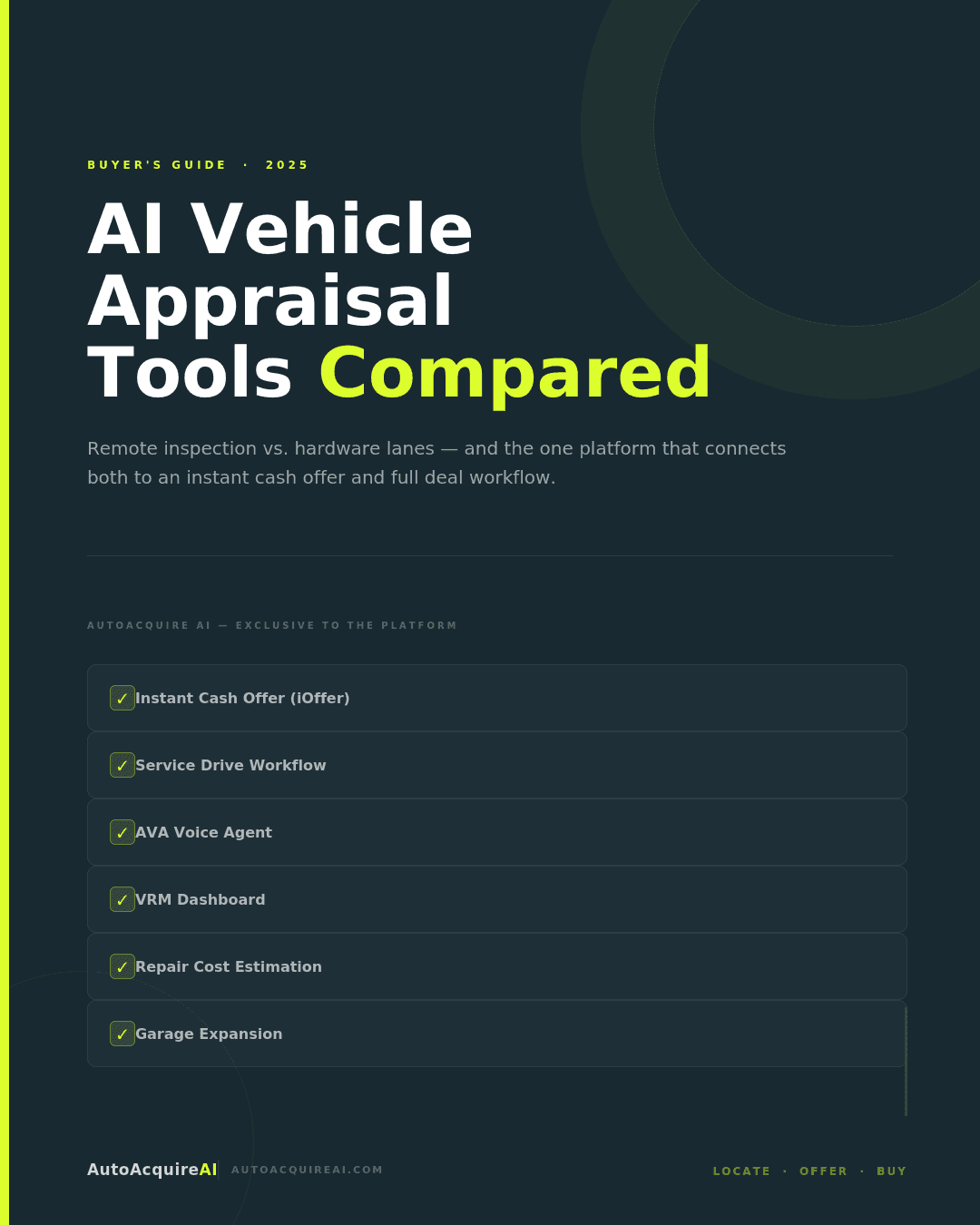
AutoAcquire connects remote inspection directly to instant cash offers, voice outreach, and deal management dashboards — capabilities that inspection-only providers like Ravin AI, Self Inspection, and PAVE don't offer. UVeye takes a hardware-first approach with drive-through lanes that scan undercarriage and exterior angles simultaneously, requiring physical installation and capex investment that remote tools avoid.
Feature Checklist: What Each Tool Supports
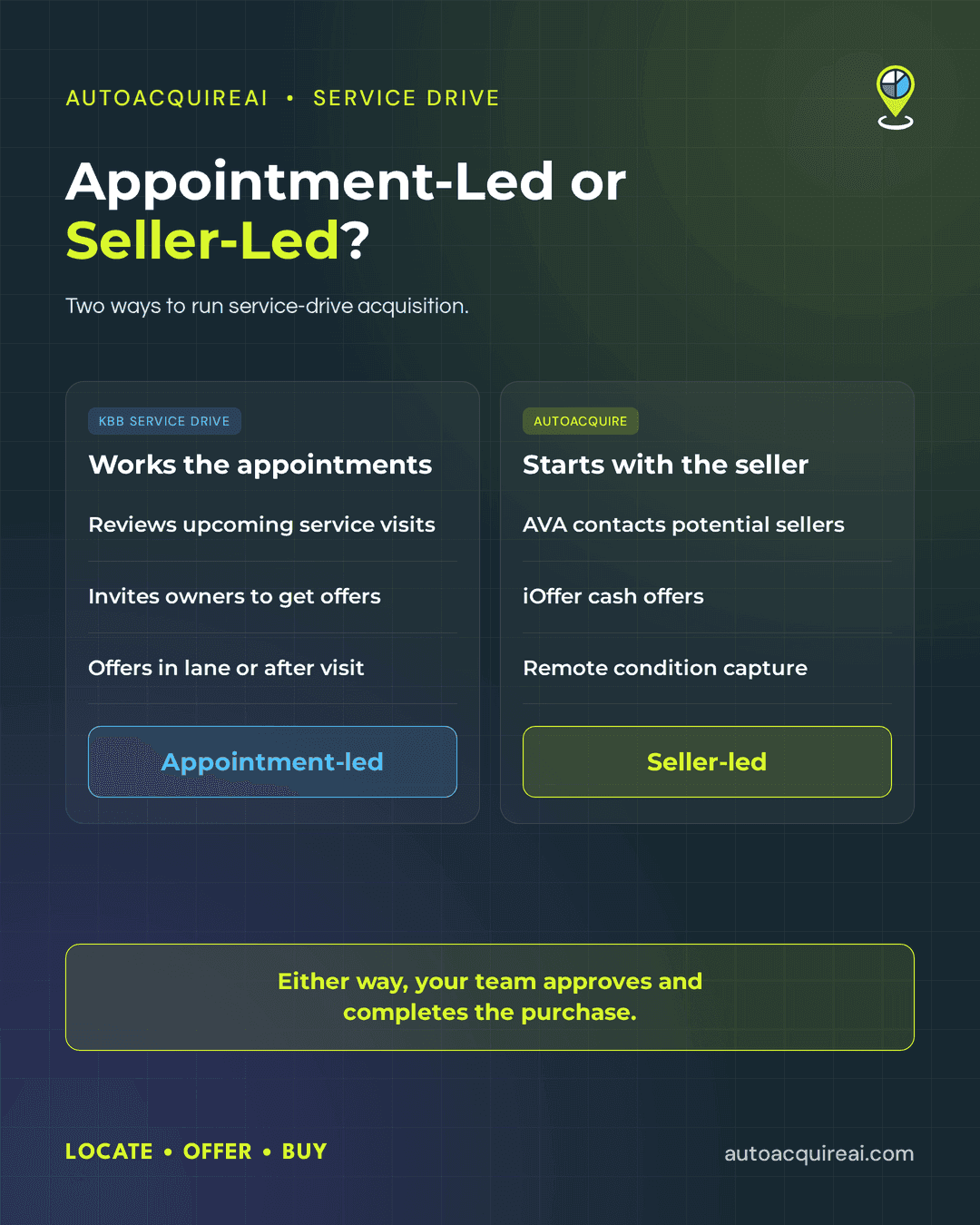
AutoAcquire offers native instant cash offer integration and service drive workflows, while UVeye provides hardware-based scanning without smartphone capture.
| Feature | AutoAcquire | Ravin AI | Self Inspection | AlgoDriven | PAVE | UVeye |
|---|---|---|---|---|---|---|
| AI-guided smartphone capture | Yes | Yes | Yes | Yes | Yes | No (hardware) |
| Fraud/image integrity checks | Yes | Yes | Yes | Yes | Yes | Yes |
| VIN verification | Yes | Yes | Yes | Yes | Yes | Yes |
| Repair cost estimation | Yes | No | No | Yes | No | No |
| Instant cash offer integration | Yes (native iOffer) | No | No | No | No | No |
| Service drive workflow | Yes | No | No | No | No | No |
| Open API access | Yes | Yes | Yes | No | Yes | Yes |
| DMS integration | Yes (VRM Dashboard) | No | No | No | No | Yes (vAuto) |
AutoAcquire and AlgoDriven estimate repair costs, which matters for dealers calculating acquisition profitability on damaged vehicles. AutoAcquire, Ravin AI, Self Inspection, and PAVE all offer API access; AlgoDriven does not publish a public API.
DMS integration splits predictably: AutoAcquire connects through VRM Dashboard, while UVeye plugs into vAuto for appraisal workflows. AlgoDriven, Ravin AI, Self Inspection, and PAVE do not offer native DMS connectors and require custom integration work to push data into dealer management systems.
Best For: Matching Tool to Dealer Type
Best for Large Dealer Groups and Fleets
Ravin AI handles high-volume inspection demands across multiple locations. The platform accepts both mobile camera inputs and fixed CCTV systems, letting dealer groups standardize on one tool regardless of inspection setup. Insurance-grade reliability and proven deployments at scale make this the safest choice for enterprise dealership operations.
Best for Dealers Building Embedded Workflows
PAVE delivers the strongest API integration capabilities for OEMs and dealer groups embedding inspection into existing platforms. Custom workflow builders and developer-friendly documentation enable seamless integration with proprietary dealer management systems. This tool works best when inspection becomes a component of larger dealer technology stacks rather than a standalone application.
Best for Acquisition Profitability
AutoAcquire Remote Inspection connects AI-guided damage assessment directly to instant cash offers and service drive outreach workflows. The platform calculates repair costs and adjusts market values automatically within the same system that generates customer offers. AlgoDriven's AxleInspect focuses purely on acquisition math, emphasizing repair cost estimation for dealers who prioritize profitability calculations over full workflow integration.
Best for Physical Dealership Lane Scanning
UVeye scans undercarriage, tires, and full exterior damage in one drive-through pass using fixed hardware installations. The recent vAuto integration connects inspection results directly to appraisal values and inventory pricing decisions. High-volume physical dealerships benefit most from this hardware approach, though installation requires significant capital investment and dedicated lane space.
Buyer's Guide: How to Choose the Right Tool
Remote acquisition vs. physical lane inspection. Choose a smartphone-based tool if you need to evaluate vehicles before they arrive on your lot: service drive leads, private sellers calling in, or instant cash offer workflows. Dealers processing high volumes of physical trade-ins should consider UVeye's drive-through hardware lanes for automated scanning without staff involvement.
Inspection-only vs. full acquisition workflow. If your goal is generating condition reports to feed into existing processes, Ravin AI, Self Inspection, or PAVE each deliver accurate AI damage detection. Ravin AI handles the highest volumes with proven fleet deployment experience. Self Inspection offers strong condition scoring trained on 20M+ images. PAVE provides the cleanest API integration for embedding inspection into existing dealer platforms.
If you want inspection directly connected to instant cash offers, customer outreach, and deal management without switching between systems, AutoAcquire Remote Inspection is the only platform that delivers the full acquisition stack natively. The platform connects AI condition reports to iOffer instant cash offers, AVA voice agent follow-up, and VRM dashboard deal tracking in one workflow.
Dealers buying inspection-only tools often discover they need acquisition workflow capabilities later, making full-stack solutions like AutoAcquire more efficient long-term investments.
Frequently Asked Questions
What is the difference between a vehicle appraisal tool and a vehicle inspection tool?
An appraisal tool determines a vehicle's market value. An inspection tool documents its physical condition. Most AI platforms in this comparison do both: the inspection generates a condition score and damage map, which the appraisal engine then uses to adjust the offer price.
Can AI vehicle inspection tools detect fraud?
Yes. All six tools in this comparison include image integrity checks that flag manipulated photos, duplicate submissions, or inconsistent vehicle data. This is a baseline feature across the category, not a differentiator.
Do remote inspection tools require the seller to download an app?
Most remote tools are browser-based or use a guided SMS/link flow, so sellers do not need to install anything. AutoAcquire Remote Inspection works through a link sent via the AVA voice agent or iOffer offer certificate.
Which AI appraisal tool works best for service drive acquisitions?
AutoAcquire Remote Inspection is the only tool in this comparison with a native service drive workflow. Service advisors can trigger an inspection request directly from the VRM Dashboard while the customer is on-site.