

TLDR
AutoAcquire (AVA) generates seller leads before owners list, using outbound AI calls, SMS, and a free instant cash offer widget. Best for dealers focused on used-car acquisition. Impel AI runs buyer-side inbound nurture across roughly 8,000 dealerships, but it sources no seller leads and G2 reviewers report 12-month lock-in contracts. Conversica layers AI engagement across sales, F&I, and fixed ops, with pricing it does not publish. VinSolutions Connect CRM identifies inbound buyers using Cox Automotive behavioral data, not proactive seller outreach. Spyne's Vini AI and Podium handle follow-up and messaging for leads already in the funnel, not acquisition.
Why Most "AI Lead Gen" Tools Miss Half the Dealership's Inventory Problem
Most AI lead generation tools cited in this space solve the wrong half of the dealership's inventory problem. Impel AI, Spyne, and Conversica nurture leads already in the funnel. They follow up faster with shoppers who have already contacted the store, qualify inbound traffic, and route buyers to a rep. None of them identify a seller or initiate contact before an owner decides to sell.
That distinction separates two categories. Buyer-side inbound tools manage demand that already exists. Acquisition-native tools generate seller leads upstream, reaching service drive customers and private-party owners before they list a vehicle anywhere.
Used-inventory scarcity makes the upstream category the one that decides 2026 margins. A dealer with a fast BDC and an empty lot still has nothing to sell. The faster-follow-up question matters less than the sourcing question. How does a store find sellers before a competitor or an auction does? Most tools in this list answer the first. One answers the second.
The 6 Best AI Lead Generation Tools for Car Dealerships in 2026: Quick-Reference Table
The Category column splits the field by who initiates contact. Acquisition-native tools reach out to potential sellers before they list. Buyer-side inbound tools nurture leads already sitting in the dealer's CRM.
| Tool | Category | Best For | Key Strengths | Pricing Model |
|---|---|---|---|---|
| AutoAcquire (AVA) | Acquisition-Native | Dealers sourcing used inventory before sellers list | AI voice/SMS outreach, iOffer™ instant cash offer, Remote Inspection, free ICO website banner | Free ICO widget; demo for full suite |
| Impel AI | Buyer-Side Inbound | High-volume franchise groups nurturing inbound buyers | Fine-tuned LLM, 8,000 dealership footprint | No public pricing; reviewers report 12-month contracts |
| Conversica | Buyer-Side Inbound | AI engagement across sales, F&I, and fixed ops | Layers on existing DMS/CRM data | Not disclosed |
| Podium | Buyer-Side Inbound | Consolidating customer messaging and reviews | Reviews, webchat, payments | Not disclosed |
| VinSolutions Connect CRM | Buyer-Side Inbound | Dealers inside the Cox Automotive ecosystem | Predictive Insights, 2.3B annual signals | Not disclosed |
| Spyne (Vini AI) | Buyer-Side Inbound | Dealers on VinSolutions or Tekion | AI calling, chat, automatic CRM write-back | Not disclosed |
AutoAcquire (AVA)
AutoAcquire is the only platform on this list that generates seller leads before a consumer decides to sell. Every other tool waits for a buyer or seller to surface in the funnel, then routes the follow-up. AutoAcquire runs the opposite motion. AVA identifies service drive customers and private-party owners, then opens the conversation through an AI agent that places calls and sends texts on its own.
That agent, named Sergio, drives the outbound workflow. Sergio calls a prospect, gathers the year, make, model, mileage, color, and condition, and resolves trim ambiguity in the same conversation. A demo shows it distinguishing a King Ranch from an FX4 on a 2014 Ford F-150 before queuing a cash offer. The SMS cadence runs from initial outreach through multi-turn condition questions, certificate delivery, and an inspection booking prompt, so a single answered call can move a seller toward a deal without a human dialing.
The cash offer itself runs through iOffer™, priced on live market data and adjusted down to the ZIP code, VIN, or customer profile. Each certificate lists vehicle specs, condition ratings across exterior, interior, mechanical, and drivability, the offer amount, an expiration window, and a cert number. One example locked a 2021 Honda Accord Sport 2.0T at $26,100 for nearly seven days, with offers sourced from licensed and insured buyers.
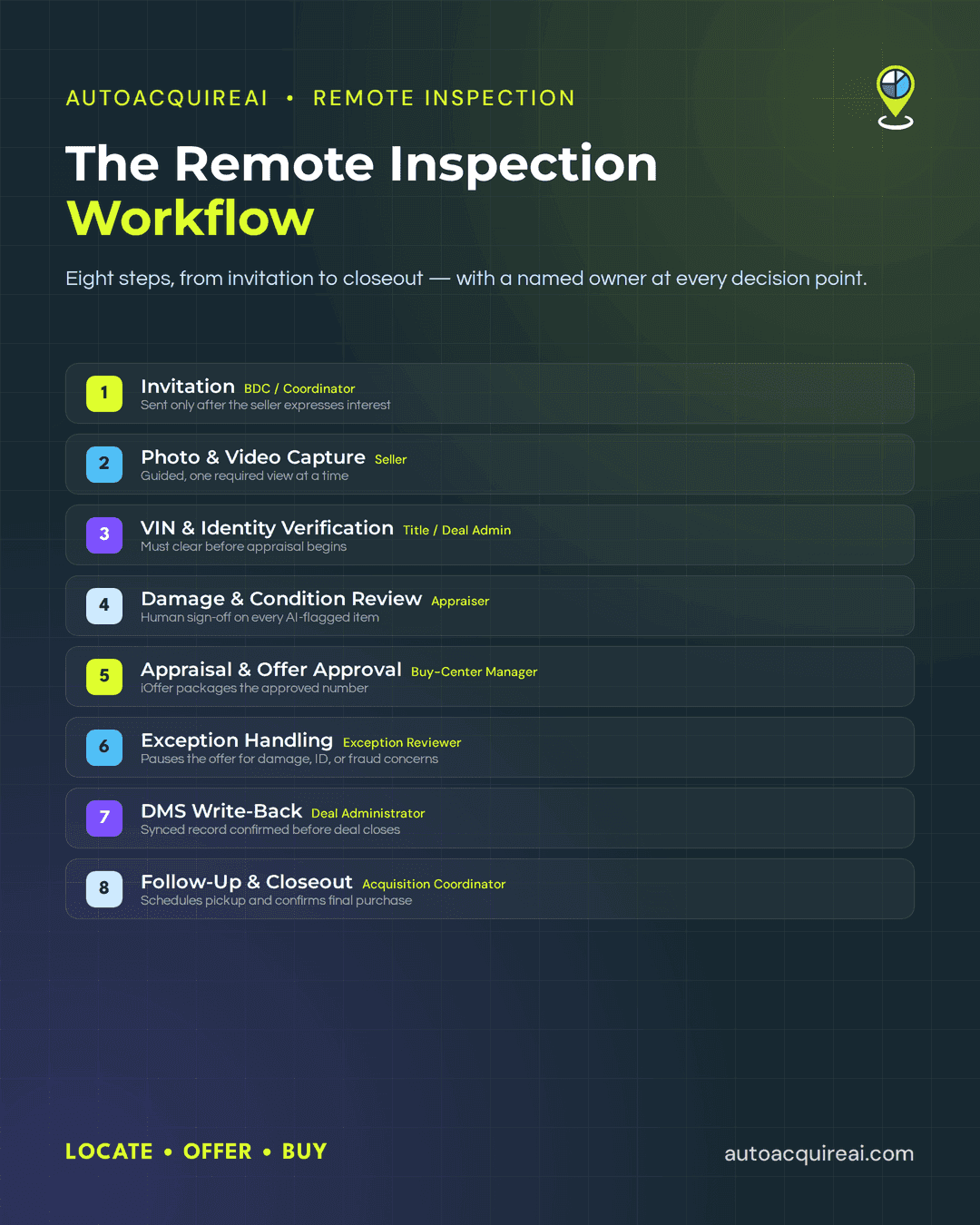
Remote Inspection closes the appraisal gap without a physical visit. Sellers submit a photo-based condition report, and the system returns an inspection score, itemized flags by zone, a repair estimate, and an adjusted-after-repairs value. A 2024 Tesla Model Y example showed a $37,434 market value dropping to $35,868 after six exterior, six interior, and three rim issues.
Two features extend reach beyond a single transaction. Garage Expansion cross-references title, registration, insurance, and warranty records to find every vehicle in a seller's household, turning one acquisition into several. Private Party Marketplace aggregates listings from Autotrader, CarGurus, Cars.com, Craigslist, eBay, Edmunds, and Facebook, displaying each car's iOffer price against asking price, percentage above or below book, owner count, and title status. A 2024 Toyota Sienna XLE listed at $40,586 carried a $39,404 iOffer, 14% under book.
The VRM Dashboard ties the suite together as an acquisition command center, tracking each lead from first offer to final payoff with source tags, conversation status, certificate amounts, and a Push to CRM function. For dealer groups, per-model rules route VINs to specific rooftops against city, region, and national benchmarks.
The free ICO website banner is the lowest-barrier way in. Dealers install it at no cost, and sellers enter a plate or VIN to get an instant offer without leaving the dealer's site. No public pricing is listed for the other modules, which require a demo.
Best for: franchise and independent dealers who prioritize used-car acquisition over buyer-side follow-up.
Impel AI
Impel runs a technically advanced inbound engagement engine, built on a fine-tuned Meta Llama model deployed on Amazon SageMaker. Replacing a third-party LLM lifted accuracy roughly 20% across core features, with follow-up message generation jumping from 59% to 92% and personalized replies climbing from 73% to 86%. For a dealer measuring whether an AI sounds like a real BDC rep, that accuracy gap shows up in fewer awkward replies and fewer leads that go cold mid-conversation.
The platform serves approximately 8,000 dealerships and counts Ford, Honda, Toyota, and GM among its OEM partners, which signals proven scale for large franchise groups. Impel's Sales AI engages buyers over email and text around the clock, summarizing intent from past conversations, generating follow-ups, and answering vehicle, trade-in, and financing questions before handing off to a live rep. Confirmed DMS and CRM integrations cover CDK, Reynolds & Reynolds, Tekion, and VinSolutions.
Two operational constraints temper the appeal. Multiple G2 and Capterra reviewers report 12-month lock-in contracts, and smaller dealers note pricing that shuts them out, since no public rate card exists. Onboarding spans several weeks, and verified reviews describe activated features that never came online and engagement behavior dealers could not customize at the rooftop level.
Scope is where the platform stops. Every Impel feature — from Sales AI to SpinCar imaging to Outsell retention marketing — works on buyers already in the funnel. A dealer short on used inventory gets faster follow-up on existing leads, not a new channel for finding sellers.
Best for: high-volume franchise groups that need AI-powered email and SMS nurture for inbound buyer leads.
Conversica
CEO Michael Gilson describes Conversica as software that "layers on top of existing software," so dealers do not need to "rip anything out and start over." The AI reads DMS and CRM records that normally sit in disconnected legacy systems and assigns meaning to that data — flagging revenue opportunities across sales, F&I, and fixed ops that staff would otherwise miss.
The practical use case is re-engagement. A dealer with years of customer history sitting idle in a CRM gets a system that re-reads those records and surfaces the contacts most likely to transact. Conversica officially supports Fixed Ops workflows including service inquiries, maintenance scheduling, and recall follow-up, as well as F&I qualification sequences — making it useful across departments, not just the sales floor.
Where Conversica stops is at the edge of the known customer base. A private-party owner who has never visited the store, or a service drive customer who has not yet entered the database, sits outside what the platform can reach. Dealers looking to grow their used-car supply rather than re-engage existing contacts will need a different tool.
Pricing and named integration details are not publicly disclosed.
Best for: dealers who want AI-driven engagement across sales, F&I, and service without replacing their current stack.
Podium
Podium's core product is a unified messaging inbox that consolidates webchat, SMS, and social conversations so dealers stop losing inbound leads across fragmented channels. The platform also handles payment collection and prompts satisfied buyers to leave reviews, which lifts local search visibility. For a store fielding questions from five different directions with no central view, that consolidation has real operational value.
The automotive AI lead generation angle is thinner. Podium has added AI-assisted response features, but independent detail on dealership-specific acquisition capabilities is limited, and the platform's documented strength sits in reputation management and inbound capture rather than proactive seller outreach. A dealer who installed Podium to respond faster to website visitors is using it correctly. A dealer who installed it to find private-party owners has the wrong tool.
Pricing is not publicly listed and requires a direct quote.
Best for: dealers who want to consolidate customer messaging and reviews in one inbox, not dealers chasing used-car acquisition leads.
VinSolutions Connect CRM
For dealers already inside the Cox Automotive ecosystem, VinSolutions is the natural AI upgrade path. The platform's Predictive Insights with Generative AI, launched in December 2024, scores active shoppers as up to 8 times more likely to buy by reading buying signals pulled from Cox-owned properties.
The accuracy comes from the data advantage. Predictive Insights draws on 2.3 billion annual online interactions across Autotrader, Kelley Blue Book, and Dealer.com, then feeds those signals into the GenAI layer. From there it drafts personalized emails and texts with vehicle details, trade-in options, and market demand, and a BDC rep can edit and approve every message before it sends.
VinSolutions frames trade-in data as an acquisition supplement, which is where dealers should read the fine print. Predictive Insights surfaces trade-in information to shoppers who are already engaging the dealership, so it helps seal a deal already in motion. It does not call private-party owners or service drive customers who have shown no buying intent. Every signal it acts on originates from an inbound shopper.
VinSolutions improves how a franchise store works the leads already in its CRM, and the predictive scoring genuinely tightens prioritization for a busy sales floor. A dealer who needs to find sellers before they list will not find that capability here.
Best for: franchise dealers already running Cox Automotive products who want predictive buyer scoring and GenAI outreach layered onto their existing CRM workflow.
Spyne (Vini AI)
Vini AI is Spyne's answer to the manual-logging problem. The engagement agent runs inside the dealer's existing CRM, handling calls, chat, and follow-up, then writing every outcome back automatically. In June 2025, Spyne announced a direct integration with VinSolutions that connects Vini AI to live CRM data and writes every interaction outcome back automatically. A parallel integration with Tekion's Automotive Retail Cloud covers the same functions inside the Tekion environment.
The practical payoff is the elimination of manual logging. Vini AI handles calling, chat, service reminders, appointment scheduling, and follow-up, then syncs each conversation back to the CRM without a rep typing notes. CEO Sanjay Varnwal frames the design around working inside the workflow rather than alongside it, so sales and service staff stop toggling between tools to record what happened.
Vini AI acts on contacts already sitting in VinSolutions or Tekion, captured from inbound shoppers and existing customers. No source describes it reaching private-party owners or service drive customers who have not yet raised a hand. Dealers running either CRM get fast follow-up and clean records. Spyne does not publish pricing.
Best for: dealers on VinSolutions or Tekion who want AI-powered calling and follow-up that removes manual CRM data entry.
Acquisition-Native vs. Buyer-Side Inbound: Feature Checklist
The seven capabilities below separate tools that source sellers upstream from tools that work leads already in the funnel.
| Capability | AutoAcquire (AVA) | Impel | Conversica | Podium | VinSolutions | Spyne (Vini AI) |
|---|---|---|---|---|---|---|
| AI voice/SMS outreach | Yes | Yes (text only) | Yes | Yes | Yes (text) | Yes |
| CRM integration | Yes | Yes | Yes | Yes | Yes (native) | Yes (native) |
| Service drive targeting | Yes | No | Partial | No | No | No |
| Private-party seller identification | Yes | No | No | No | No | No |
| Instant cash offer integration | Yes | No | No | No | Partial | No |
| Multi-rooftop support | Yes | Yes | Yes | Yes | Yes | Yes |
| DMS write-back | Partial | Yes | Yes | Partial | Yes | Yes |
AutoAcquire holds the only checkmarks under private-party seller identification and instant cash offer integration, which is what acquisition-native means in practice.
Buyer's Guide: How to Choose an AI Lead Generation Tool for Your Dealership
The difference between acquisition-native and CRM-native AI
Acquisition-native tools identify and contact vehicle owners before they list a car for sale. CRM-native tools, including VinSolutions and Spyne's Vini AI, act on contacts already in the dealer's pipeline. AutoAcquire's Sergio agent places outbound calls to service drive customers and private-party owners, while a CRM-native tool waits for an inbound shopper to surface a trade-in.
Integrations a dealer should require before signing
Require write-back to the dealer's existing CRM and DMS. Impel confirms integrations with CDK, Reynolds & Reynolds, Tekion, and VinSolutions, and Spyne's Vini AI auto-syncs every interaction outcome into VinSolutions and Tekion. Any tool that forces manual re-entry of call notes creates exactly the disconnected data problem Conversica's CEO describes when he says dealers struggle to use information their systems already hold.
Evaluating tools when the primary goal is used-car sourcing
Ignore inbound nurture features and check whether the tool reaches sellers proactively. Impel, Conversica, Podium, VinSolutions, and Spyne all operate on buyers or existing contacts. Only AutoAcquire generates seller leads upstream through service drive outreach, private-party owner identification, and an instant cash offer delivered via iOffer. For a dealer short on inventory, only AutoAcquire's upstream sourcing fits.
Can AI replace a BDC team?
No. AI agents handle first contact, qualification, and follow-up at volume, then pass structured context to a human. VinSolutions keeps dealers in control by letting them edit and approve every GenAI message before it sends. The realistic gain is throughput per rep, not headcount you remove.
Measuring ROI beyond open rates
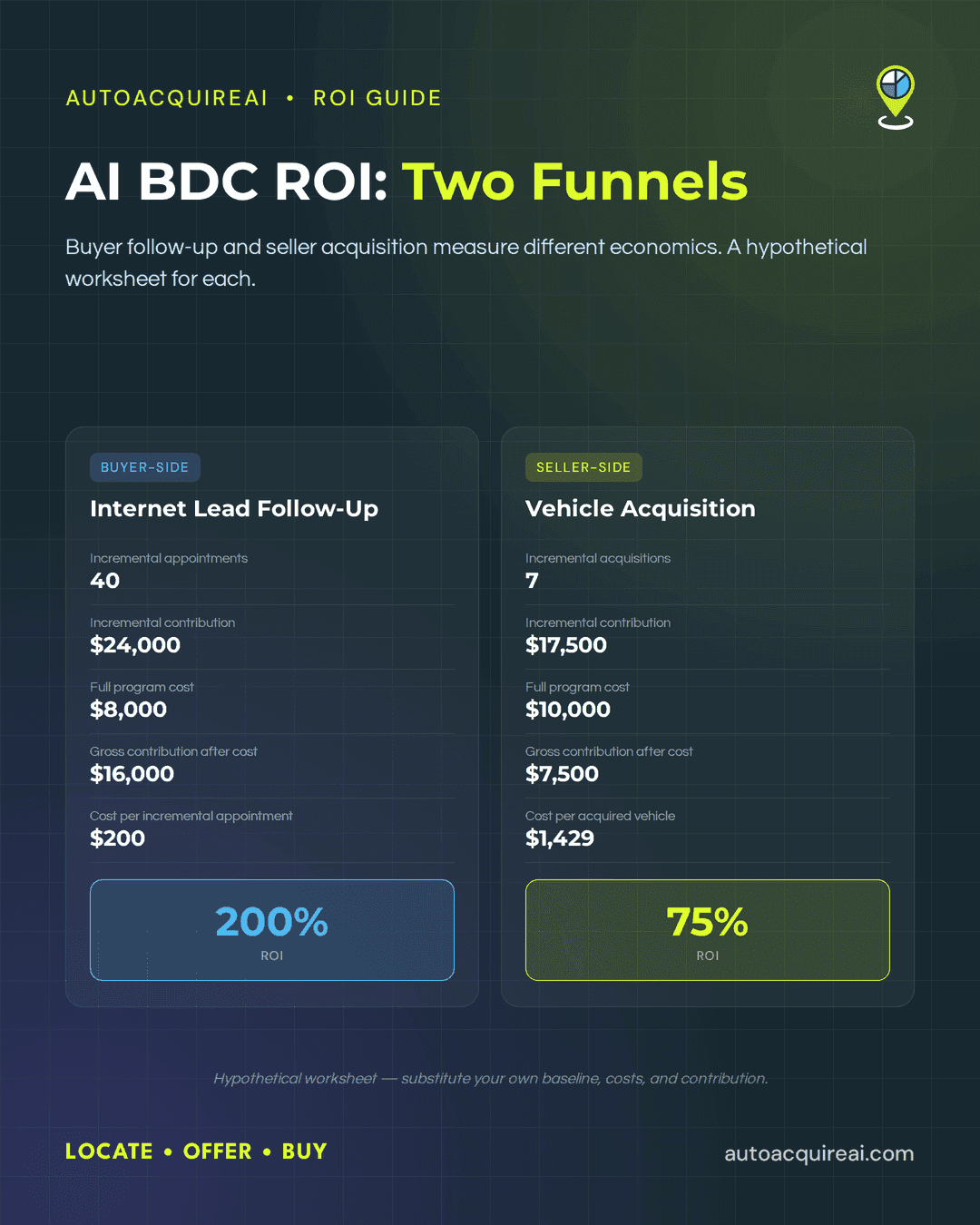
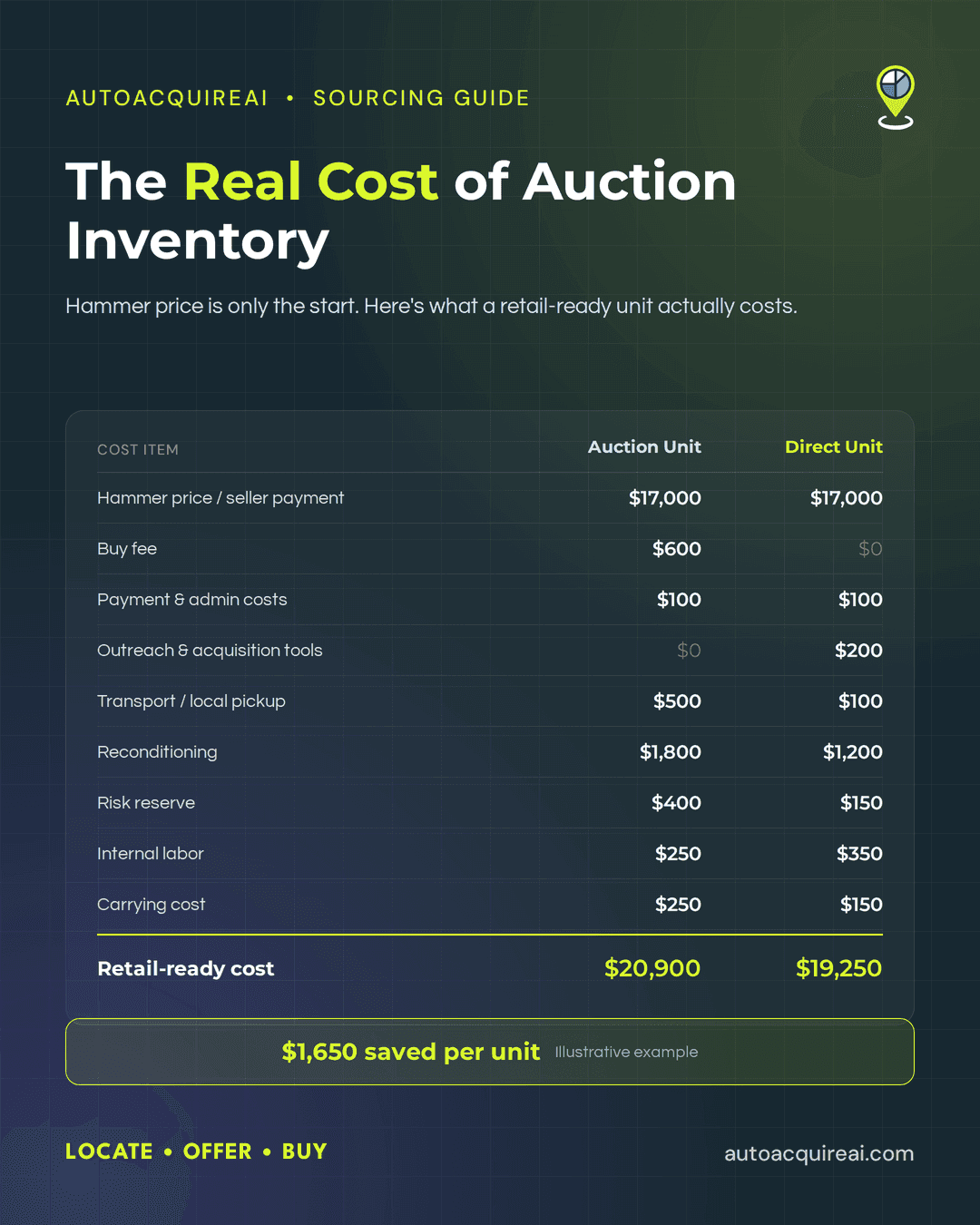
Open rates and emails sent tell you almost nothing about closed deals. Track meetings per account touched, cost per qualified conversation, and time to first touch instead. For an acquisition tool specifically, measure cars acquired per outreach campaign and acquisition cost per unit against auction-lane pricing. Those numbers connect the software directly to gross profit, which open rates never do.
Why AutoAcquire Leads for Used-Car Acquisition
Pick the right tool by the problem it solves, not the features it lists. A dealer short on used inventory has a sourcing problem, and no buyer-side platform addresses it. Impel, Conversica, VinSolutions, and Spyne all wait for a seller to surface before acting. AutoAcquire reverses that sequence. AVA calls and texts service drive customers and private-party owners directly, generates an iOffer instant cash offer, and books the inspection before the owner ever decides to list. For dealers whose core constraint is finding sellers, AVA is the only option here built to create that lead rather than chase it.
How We Chose These Tools
Five criteria shaped this list. Use-case fit came first, separating acquisition-native platforms that source sellers upstream from buyer-side tools that nurture inbound shoppers already in the CRM. Integration depth mattered next, since any AI layer has to write back to a dealer's DMS and CRM rather than create a second system to manage. AI outreach capability covered whether the tool runs autonomous voice and SMS conversations or only drafts messages a rep approves. Pricing transparency favored vendors with published terms, though most in this category gate pricing behind a demo. Dealership footprint factored in proven scale, like Impel's 8,000 clients, without treating size as a substitute for use-case fit.