
TLDR
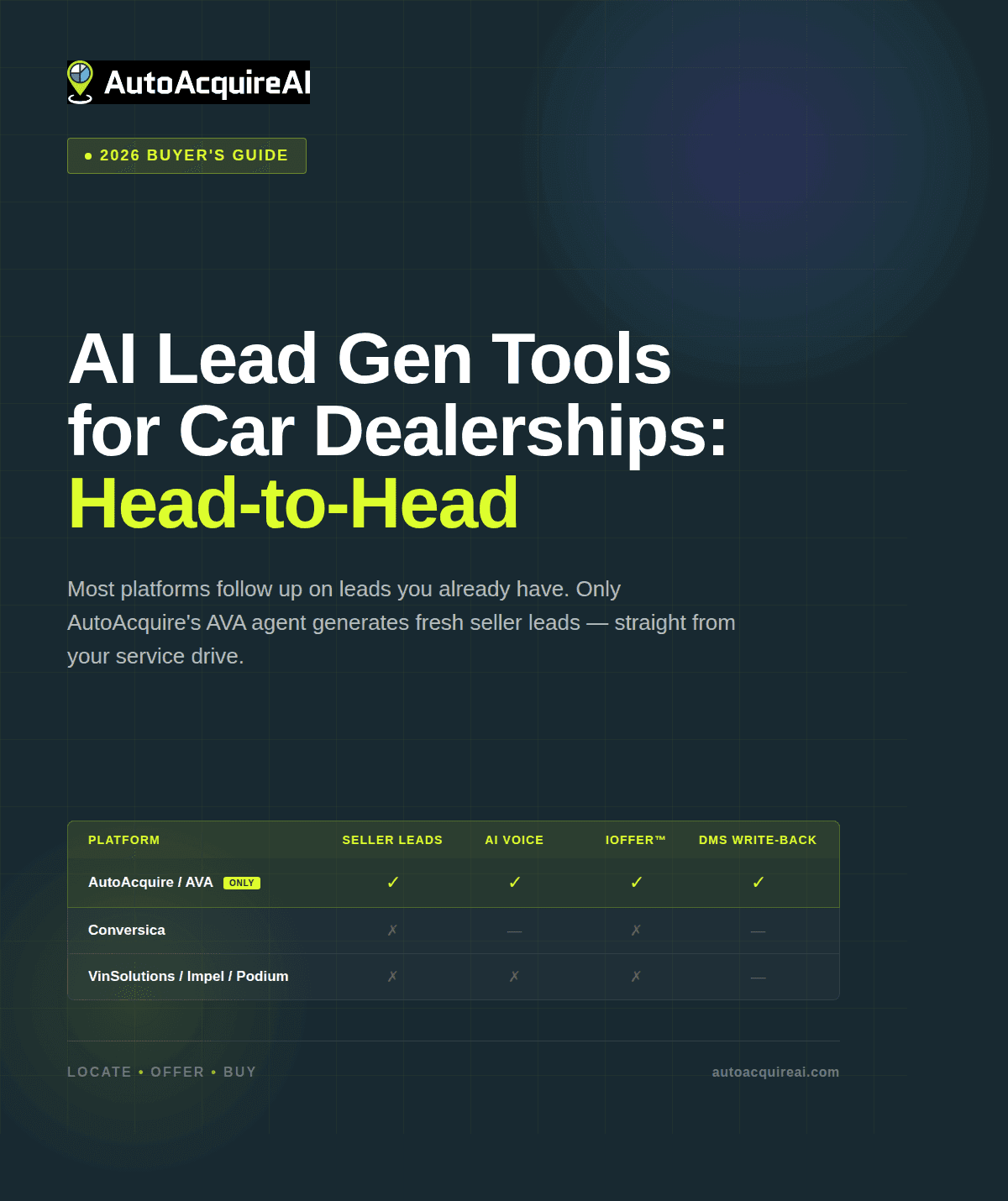
AutoAcquire works as an all-in-one acquisition platform, pairing AVA service drive outreach, iOffer instant cash offers, and Remote Inspection in one workflow built to source directly from sellers. VinSolutions and DealerSocket bring AI lead scoring and follow-up to existing CRM data, but neither sources vehicles upstream. Impel and Fullpath generate leads through merchandising and first-party data activation, not vehicle acquisition. Mastermind surfaces in-market buyers from third-party data for conquest and retention campaigns. The clearest split across the list separates dealer sourcing platforms from marketing and CRM layers that engage customers without acquiring inventory.
Why AI Lead Generation Is Reshaping Dealer Sourcing
Auction fees and thin used-car supply are squeezing dealer margins, and direct acquisition is now the most reliable way to protect them. Buy fees, transportation, and reconditioning stack on top of rising hammer prices, so a unit bought through the lane can cost hundreds more than the same car sourced from a service drive customer or private seller. Every percentage point of that cost lands on a gross profit line that has already compressed since used-car values normalized.
AI tools make direct sourcing work at the volume a dealership actually needs, the core claim this comparison tests against each platform below. Service drive outreach, instant cash offers, and remote inspection used to demand staff time that most stores could not spare. Software now handles the appraisal math, customer messaging, and condition review, which lets a single buyer work far more sellers per week than manual processes allowed.
The list below covers dealer sourcing and lead generation platforms that put inventory or qualified leads in front of a buyer. Consumer-facing car shopping apps fall outside it, since those tools help shoppers find cars rather than help dealers find sellers. The entries below separate platforms that acquire vehicles from those that score, market to, or engage customers already in the dealer's database.
The Tools at a Glance
The six tools below split into three categories. Acquisition platforms source vehicles directly from consumers. CRMs manage leads after they enter the funnel. Marketing and data platforms surface or activate buyers but never touch sourcing. Use the table to place each tool, then read the entries for the detail behind each row.
| Tool | Type | Best For | Key AI Features | Auction Fee Exposure | Pricing Tier |
|---|---|---|---|---|---|
| AutoAcquire (AVA) | Acquisition platform | Sourcing from service drive and private sellers | AVA outreach, iOffer instant cash offer, Remote Inspection, VRM Dashboard | Low. Built to reduce auction reliance | Mid |
| VinSolutions Connect | CRM | Franchise groups in the Cox Automotive stack | AI lead scoring, BDC workflow automation | High. No native sourcing | Mid to high |
| Impel | Engagement and merchandising | Online conversion on existing inventory | Digital showroom AI, automated merchandising | High. No sourcing | Mid |
| Mastermind (Market EyeQ) | Predictive marketing | Conquest and retention campaigns | Predictive buyer scoring from third-party data | High. No acquisition or appraisal | Mid to high |
| DealerSocket | CRM and desking | Independent and mid-size dealers on Solera | AI-assisted follow-up | High. No ICO workflow | Mid |
| Fullpath | Customer data platform | Targeted remarketing from DMS data | First-party data unification, AI ad activation | High. Marketing layer only | Mid |
Only AutoAcquire carries low auction fee exposure, because AutoAcquire sources cars rather than managing leads against inventory dealers already paid auction fees to acquire. The CRMs and marketing platforms assume the vehicle is already on the lot. The individual entries below explain what each tool does well and where its category limits leave gaps.
AutoAcquire (AVA)
AutoAcquire builds its entire workflow around sourcing vehicles directly from service drive customers and private sellers, which makes it the strongest pick for dealers trying to cut their auction dependence. Most tools on this list attach lead generation to a CRM or a marketing engine. AutoAcquire starts from the acquisition itself, then connects the steps that turn a prospect into a car on the lot.
The acquisition workflow runs on AVA, the AI agent that handles service drive outreach. When a customer brings a vehicle in for service, AVA identifies high-equity candidates from DMS data and opens the conversation about selling, without a salesperson having to flag the opportunity manually. That outreach matters because the service drive holds the cleanest sourcing pool a dealer already touches every day, with known history and a customer who is physically present.
From outreach, the workflow moves into iOffer, AutoAcquire's instant cash offer engine. iOffer generates a real, dealer-controlled offer the customer can accept on the spot, rather than a soft estimate that stalls the deal. Dealers set the parameters, so the offer reflects their actual buy box and reconditioning costs. That control separates iOffer from generic ICO widgets that hand the pricing logic to a third party and leave the dealer reacting to numbers they did not set.
Remote Inspection closes the gap for vehicles the dealer cannot physically see, which is where private-party sourcing usually breaks down. A seller captures the vehicle's condition through a guided process, and the dealer appraises and offers without scheduling an in-person look. That capability extends acquisition beyond the service lane and into private-party deals that would otherwise demand a drive across town for every lead.
The VRM Dashboard ties the three pieces together so a used car manager can see every active acquisition in one view. Service drive leads, iOffer activity, and remote inspections land in the same place, with the status of each deal visible without bouncing between tools. That consolidation keeps the manager from losing a high-equity prospect in a CRM note or a salesperson's inbox, which is the common failure point when sourcing lives in three disconnected systems.
AutoAcquire fits dealers who want to source upstream and reduce how many units they buy through auction lanes. Independent used car operations and franchise stores with active service departments get the most from it, because both have a steady flow of customers whose vehicles are worth acquiring. Single-rooftop stores and multi-rooftop groups both work, though the VRM Dashboard earns more of its keep when a manager oversees volume across several sourcing channels.
The honest boundary is pure drive-through scanning. Dealers running a high-throughput inspection lane that photographs and grades every vehicle entering the service drive will still want a dedicated scanning system like UVeye or Ravin AI for that step. AutoAcquire's Remote Inspection handles condition capture inside the acquisition workflow, and it is not built to replace a fixed-camera scanning tunnel that grades hundreds of cars a day on physical accuracy alone.
Best for: Dealers whose priority is acquiring more vehicles directly and spending less at auction. AutoAcquire owns the full path from outreach to offer to inspection in one system rather than stitching it together from parts.
VinSolutions Connect CRM
VinSolutions Connect CRM holds the largest installed base among dealership CRMs, and that incumbency shapes everything it does well. Cox Automotive owns it, so dealers already running Dealertrack, vAuto, or Autotrader inherit a CRM that syncs cleanly across that stack. For franchise groups standardized on Cox tools, VinSolutions removes the integration friction that splits most dealership tech.
Its AI strength sits in lead scoring and BDC workflow automation. The Connect Automotive Intelligence layer ranks inbound leads by purchase likelihood and routes them so business development center reps spend their hours on buyers who are actually shopping. Sales teams working a heavy lead volume gain real efficiency from that prioritization, since the system surfaces the warm contacts instead of leaving reps to sort a flat list. VinSolutions also mines the existing customer database for equity and service-due signals, which feeds retention and repeat-sales campaigns.
VinSolutions optimizes leads a dealer already has, drawing from website forms, third-party listings, or prior customers. It does not source vehicles. Dealers looking to acquire inventory directly from private sellers or service drive customers will not find a dedicated sourcing engine here, because the platform was built to convert shoppers into buyers, not to pull cars in from outside the lot.
The absence of an instant cash offer workflow matters for used car managers facing thin auction supply. VinSolutions can flag a service customer with high trade equity, but it stops at the flag. Generating a real offer, running a remote inspection, and closing the acquisition all happen outside the CRM, which forces managers to bolt on separate tools and rekey data between systems. A platform built for acquisition, such as AutoAcquire, fills that gap with iOffer and Remote Inspection handling the steps VinSolutions leaves open.
Best for: Franchise dealers who want a proven CRM tied to the Cox ecosystem and who treat acquisition as a separate function. Independent dealers chasing direct sourcing as their primary inventory channel will find the lead-conversion strengths useful but the acquisition depth missing. The practical question is whether a dealer is solving a lead-management problem or an inventory-sourcing problem — VinSolutions is built for the former.
Impel (formerly SpinCar)
Impel, built on the former SpinCar platform, runs an AI engagement layer across a dealer's website, inventory pages, and customer communications. The platform's strength sits in digital merchandising and conversational AI that move online shoppers toward a deal. Dynamic vehicle walkarounds, 360-degree imaging, and automated text follow-up keep shoppers engaged on a dealer's existing inventory, which lifts conversion on traffic the dealer already paid to attract.
Impel works the demand side of the business, not the supply side. The platform helps dealers sell faster and respond quicker, and its conversational AI handles inbound messages around the clock so leads do not go cold overnight. For franchise and independent dealers focused on closing more online traffic, that engagement depth carries real operational value.
Impel does not source vehicles. The platform has no service drive outreach, no private-party acquisition workflow, and no instant cash offer engine to put a price in front of a seller. Dealers using Impel still buy inventory through auctions, trade-ins, and whatever upstream channels they already run. The AI shapes how shoppers experience listings, not where the cars on those listings come from.
The supply-versus-demand split decides where Impel fits. Dealers fighting auction fees and thin inventory need a tool that brings vehicles in, and Impel sits downstream of that problem. It pairs well with an acquisition platform rather than replacing one. A dealer running AutoAcquire to source from service drive customers and private sellers through AVA and iOffer can route the acquired inventory into Impel's merchandising and engagement flow, with each tool doing the work it was built for.
Best for: Dealers whose priority is converting online shoppers and keeping inbound leads warm. Where Impel earns real ROI is on the conversion side — dealers who already have enough inventory and want to close more of the traffic they attract.
Mastermind (Market EyeQ)
Mastermind predicts which consumers in a dealer's market are likely to buy next, then ranks them so sales and BDC teams know where to spend their outreach. Owned by Cox Automotive and built on third-party behavioral and ownership data, Mastermind scores both existing customers for retention and conquest prospects pulled from outside the dealer's database. Franchise dealers running structured marketing campaigns get the most from it, since the platform rewards consistent follow-up across a defined territory.
The conquest engine is where Mastermind separates from a standard CRM. It identifies buyers showing in-market signals before they walk in, and it layers ownership data so a Honda store can target Toyota drivers approaching a typical trade cycle. Dealers use those scores to prioritize call lists, time equity-mining campaigns, and personalize mail and email outreach. For a group spending real money on marketing, that targeting reduces wasted spend on consumers who were never close to buying.
Mastermind is a marketing and sales prediction tool, not a vehicle acquisition or appraisal platform. It tells a dealer who to contact and when, but it does not generate an instant cash offer, run a remote inspection, or source vehicles from service drive customers and private sellers. A dealer using Mastermind to surface high-equity owners still needs a separate workflow to make the offer and complete the acquisition once that owner agrees to sell.
That gap matters for any dealer trying to reduce auction dependence through direct-to-consumer sourcing. Mastermind can flag the in-market owner, but the actual acquisition runs through tools built for it. AutoAcquire fills that role with AVA for service drive outreach, iOffer for instant cash offers, and Remote Inspection to close deals without the car on the lot. Dealers running structured conquest campaigns can pair Mastermind's targeting with an acquisition-native platform rather than expecting one tool to do both jobs. Mastermind's value is in knowing who to call — the platform that closes the deal is a separate decision.
DealerSocket CRM
DealerSocket runs as a CRM and desking platform with AI-assisted follow-up, and it fits independent and mid-size dealers already operating on the Solera stack. Its strength sits in the sales process. The CRM tracks customer interactions, automates follow-up sequences, and feeds desking tools that help managers structure deals and present financing options at the table.
The AI layer focuses on follow-up timing and lead prioritization rather than vehicle sourcing. DealerSocket scores existing leads and flags which prospects deserve attention from the BDC, which keeps a sales team working its pipeline instead of guessing. For a dealer who already sells well and wants tighter process discipline, that follow-up automation does real work.
DealerSocket carries no native acquisition sourcing or instant cash offer workflow. The platform manages buyers, not sellers, so a dealer using it to source inventory still has to bolt on a separate appraisal or acquisition tool. The CRM has no service drive outreach, no private-party prospecting, and no ICO engine. A used car manager trying to reduce auction spend through direct acquisition gets nothing from DealerSocket on that front.
Pricing aligns with the broader Solera suite, which makes the math straightforward for dealers already paying for that ecosystem and harder to justify for those who are not. Whether the rest of a dealer's tooling runs on Solera decides most of the integration value.
Best for: Sales-side CRM and desking, particularly at independent and mid-size stores that want disciplined follow-up without a full enterprise platform. Dealers already paying for Solera products get the most from it because the integration cost is already sunk. Those building a stack from scratch should confirm DMS compatibility and sourcing workflow before committing.
Fullpath (formerly AutoLeadStar)
Fullpath, the platform formerly known as AutoLeadStar, unifies a dealer's first-party data into a single customer data platform and uses it to drive targeted advertising and remarketing. Fullpath pulls signals from the DMS, website behavior, and CRM records, then activates campaigns across Google, Facebook, and other ad channels. Dealers spending heavily on digital advertising use it to retarget known customers and surface in-market shoppers from their own data rather than buying broad audiences.
Where Fullpath earns its place is ad efficiency. By matching website visitors and service customers to active ad audiences, it cuts wasted spend on shoppers who already converted or who fall outside a dealer's target. Service-due reminders, equity alerts, and lease-end outreach run automatically off DMS data, which keeps existing customers in the funnel without manual list-building.
Fullpath is a marketing activation layer, not an acquisition tool. It generates leads and tightens ad targeting, but it does not appraise vehicles, send instant cash offers, or run service drive acquisition outreach. A dealer using Fullpath still needs a separate workflow to actually source and price the cars those campaigns might surface. Its value sits at the top of the funnel, moving shoppers toward the lot rather than converting a customer's trade or private-party vehicle into owned inventory.
For dealers who want sharper ad spend off their DMS data, Fullpath fits cleanly alongside an acquisition platform like AutoAcquire. Fullpath drives demand and identifies in-market customers, while AVA and iOffer handle the appraisal and cash-offer side that turns those conversations into acquired units. The two address different stages, so dealers reducing auction reliance treat Fullpath as a complement, not a substitute, for a sourcing engine.
Best for: A dealer who already has a direct acquisition channel and wants to make the marketing dollars behind it work harder.
Buyer's Guide: Choosing the Right AI Lead Generation Tool
Match the tool to your sourcing goal
Start with the gap a dealer actually has. Conquest tools like Mastermind pull in-market buyers from third-party data and fit dealers who need showroom traffic. Retention tools surface existing customers due for an upgrade, which suits franchise groups with large service files. Acquisition platforms like AutoAcquire put inventory on the lot by sourcing vehicles from service drive customers and private sellers. A CRM that scores leads does not source cars, so dealers short on inventory should weight acquisition depth over lead volume.
Weigh DMS compatibility heavily
It should weigh heavily, because a tool that cannot read DMS data forces manual entry and duplicate records. Fullpath unifies first-party DMS data for targeted ads, and VinSolutions sits inside the Cox Automotive stack already wired to common DMS providers. AutoAcquire works as an acquisition layer that syncs with existing DMS and inventory systems rather than replacing them, so dealers keep one source of truth on cost, equity, and offer status.
Add a direct channel rather than replacing auctions
Dealers paying rising auction fees on every unit gain the most from direct-to-consumer sourcing. AutoAcquire's iOffer instant cash offer and Remote Inspection let dealers buy directly from owners without a buy fee, which lowers reliance on auction lanes over time. Auctions still cover specific segments and volume gaps, so the practical move is to add a direct channel, not abandon the lanes.
Match the platform to single- or multi-rooftop operations
Group operators need cross-store visibility into pipeline and offers, which favors platforms with a central dashboard. AutoAcquire's VRM Dashboard tracks acquisition activity across rooftops in one view. Single-store independents often care more about setup speed and DMS sync than enterprise reporting, so a lighter footprint and fast onboarding matter more than group-level controls.
FAQs
What is AI lead generation for car dealerships?
AI lead generation for dealerships refers to software that uses machine learning or AI agents to identify, score, or contact potential buyers or sellers on a dealer's behalf. The category splits into two distinct functions: tools that source vehicles from consumers (acquisition platforms) and tools that surface or convert buyers already in the market (CRMs, predictive marketing, and CDPs). Most "AI lead gen" tools on the market fall into the second group.
What is the difference between an acquisition platform and a CRM?
A CRM manages leads that have already entered the funnel — website inquiries, phone calls, walk-ins — and helps sales teams follow up and close. An acquisition platform like AutoAcquire goes upstream, identifying consumers who own vehicles worth buying and initiating the conversation before they ever contact the dealership. CRMs convert; acquisition platforms source.
Which tool is best for reducing auction fees?
AutoAcquire is the only platform on this list built specifically to reduce auction dependence. Its AVA agent, iOffer instant cash offer engine, and Remote Inspection workflow let dealers buy directly from service drive customers and private sellers without a buy fee or transportation cost. CRMs and marketing platforms on this list assume the vehicle is already on the lot.
Can these tools work together?
Most of them can. AutoAcquire handles upstream acquisition, while a CRM like VinSolutions or DealerSocket manages the sales pipeline for inbound buyers. Fullpath activates first-party DMS data for ad targeting, and Impel converts online traffic into leads. The tools address different stages, so dealers often run an acquisition platform alongside a CRM and a marketing layer rather than choosing one.
Is AutoAcquire a CRM replacement?
No. AutoAcquire is an acquisition platform that sits upstream of the CRM. It identifies sellers, generates instant cash offers, and manages the acquisition pipeline through the VRM Dashboard. Once a vehicle is acquired, the sales process and customer follow-up typically continue through whatever CRM the dealer already runs. AutoAcquire integrates with CDK, Reynolds, and Dealertrack rather than replacing them.
What dealer types benefit most from AI acquisition tools?
Independent used car operations and franchise stores with active service departments see the clearest return from acquisition platforms because both have a steady flow of customers with vehicles worth buying. Multi-rooftop groups benefit from centralized acquisition dashboards that give used car managers visibility across stores. Dealers whose primary challenge is closing more inbound traffic — rather than finding cars to sell — are better served by a CRM or merchandising tool.
How We Chose These Tools
Five criteria shaped this list. Each tool had to offer real dealer-facing functionality, not a consumer app repackaged for showroom use. AI claims had to point to specific mechanisms like lead scoring, predictive conquest, or automated cash offers, rather than serving as marketing language. Acquisition depth carried the most weight, separating platforms that source vehicles from those that only manage existing leads. Integration capability mattered for dealers running a DMS and CRM stack, and pricing transparency ranked tools higher when costs were published or clearly tiered.
Consumer car-shopping apps fell outside the cut because they serve buyers, not dealers sourcing inventory. Pure auction platforms also stayed off the list, since they represent the auction dependence many dealers want to reduce. Each remaining tool earns its place by helping dealers generate or convert leads through software they control. For dealers whose hardest problem is finding cars to sell, the comparison points consistently toward acquisition-native platforms like AutoAcquire that source inventory upstream rather than only managing leads already in the funnel.