
TL;DR
No single sourcing channel delivers sufficient volume at profitable margins in 2026's compressed market. Auction volatility and Carvana/CarMax dominance in trade-ins are squeezing traditional sourcing approaches, forcing dealers to diversify across private party, service drive, and dealer-to-dealer channels.
Top buy centers combine four to six sourcing channels simultaneously, using AI-powered platforms to scale acquisition without adding headcount. AutoAcquire AI automates seller engagement and proactive outreach, reducing cost-per-car while identifying pre-market sellers before they hit public listings.
The winning strategy integrates technology that covers the full acquisition lifecycle: lead generation, instant offers, AI engagement, and centralized visibility. Dealers using fragmented tool stacks face slower response times and lower conversion rates than those running integrated acquisition engines.
For detailed tool comparisons, see our Best Car Dealership Inventory Sourcing Tools (2026 In-Depth Guide).
Why Used Inventory Sourcing Has Changed in 2026
Quality auction inventory has declined while reconditioning costs pile up, making the auction-centric model that worked for decades unprofitable in today's compressed margin environment.
Carvana and CarMax invested millions in consumer-facing trade-in programs with instant quotes and seamless experiences. Their digital-first approach captures 70% of trade-ins that previously went to franchise dealers. Independent dealers face the same squeeze — losing their most reliable sourcing channel to better-funded competitors with superior customer acquisition technology.
Tariffs drove a H1 2025 sales spike that has since tightened used supply, but the secondary effect may reduce used inventory supply as consumers hold vehicles longer to avoid high replacement costs. High interest rates create cautious consumers who delay vehicle purchases entirely. BCG research from March 2025 shows dealers prioritizing margin optimization across all revenue streams as new-vehicle prices decline and used inventory acquisition costs increase.
The problem is not inventory availability — it is acquiring at a profitable price point. Dealers who continue relying on single-channel strategies face margin compression and inventory shortages. Winners in 2026 are diversifying across multiple sourcing channels, emphasizing direct consumer acquisition that bypasses auction volatility and reduces cost-per-car through technology-driven engagement and proactive outreach strategies.
The 6 Primary Channels Dealers Use to Source Used Inventory
No single channel provides enough volume or cost efficiency to sustain profitability in 2026's volatile market.
Trade-ins remain the foundation for franchise dealers, but Carvana and CarMax have captured 70% of trade opportunities according to industry analysis with superior consumer-facing programs. Physical and digital auctions still provide volume, but volatile wholesale prices and declining inventory quality compress margins. Private party sourcing — both inbound website leads and outbound marketplace targeting — bypasses auction volatility entirely.
Service drive sourcing converts existing customers with high service bills or positive equity. CRM-driven outreach targets past customers 5+ years post-purchase when replacement cycles naturally occur. Dealer-to-dealer wholesale networks facilitate inventory balancing within dealer groups.
Each channel requires different technology, processes, and team coordination. The dealers winning in 2026 run four to six channels simultaneously rather than relying on traditional auction-heavy strategies.
1. Trade-In Sourcing
Franchise dealers still rely heavily on trade-ins, but Carvana and CarMax now capture 70% of these opportunities. industry analysis from Car Dealership Guy shows that dealers are losing 70% of potential trade-ins to Carvana and CarMax — companies that invested millions in consumer-friendly digital trade programs while traditional dealers stuck with outdated appraisal processes.
The digital giants win because they offer instant quotes, hassle-free pickup, and seamless financing integration. Traditional dealers counter this with website trade-in widgets, AI-powered instant appraisal tools, and aggressive trade incentive programs: cash-back rebates, loyalty bonuses for repeat customers, and preferential financing rates for trade-in buyers.
The Appraisal Process Is Everything
Consistent, accurate appraisals backed by AI-powered technology separate winning dealers from those hemorrhaging trade-ins. Customers expect instant quotes and transparent pricing — not the "let me talk to my manager" routine that sends them straight to CarMax's website.
Modern trade-in programs require real-time market data, automated condition assessment, and immediate offer generation. Dealers who still rely on manual KBB lookups and subjective condition grading lose deals before the customer leaves the lot.
Best Execution Strategy
Franchise dealers with established customer relationships and high foot traffic get the most value from optimized trade-in programs. The key is making the trade-in process faster and more transparent than the digital competition — easier said than done, but entirely achievable with the right technology stack and staff training protocols.
2. Physical and Digital Auctions
What was once a reliable volume channel now requires careful cost management as volatile wholesale prices compress margins across the board.
The quality problem is real. As auction inventory declines in condition, reconditioning costs stack up quickly — eating into already thin margins. A $15,000 auction purchase can easily become an $18,000 investment after addressing deferred maintenance, cosmetic issues, and mechanical problems that weren't apparent in condition reports.
Digital auction platforms like ACV Auctions and Manheim Digital have expanded geographic reach and selection. Their condition reports, OBDII diagnostic scans, and transportation support reduce some acquisition risk. You can bid on vehicles from coast to coast without leaving your office, and detailed inspection data helps predict reconditioning costs upfront.
But here's the reality: auction pricing in 2026 reflects continued market uncertainty. Wholesale values swing unpredictably based on interest rates, consumer sentiment, and supply fluctuations. What looked like a profitable purchase on Monday can turn into a margin killer by Friday when retail demand shifts.
Smart auction buyers now treat this channel as one piece of a diversified sourcing strategy, not their primary pipeline. The dealers winning with auctions are those who can absorb reconditioning costs, move volume quickly, and maintain strict discipline on maximum bid prices. If you're chasing every vehicle to hit inventory targets, auction sourcing will burn you in this market.
3. Private Party / Direct Consumer Sourcing
Direct consumer sourcing bypasses auction price volatility and gives dealers access to well-maintained vehicles with known maintenance histories before they hit public markets. BCG research on dealer margin optimization shows dealers are prioritizing margin optimization as auction prices remain unpredictable.
The challenges are real: verifying loan payoff information, navigating title transfers, and engaging sellers at scale without burning through staff time. Most dealers struggle with response delays — private sellers expect immediate engagement, not callbacks hours later.
Private party sourcing operates through three distinct strategies: Inbound channels capture sellers already visiting your website through instant cash offer (ICO) widgets and appraisal tools. Outbound strategies aggregate listings from Craigslist and Facebook Marketplace, then automate seller outreach. Third-party platforms like AutoAcquire's Private Party Marketplace connect dealers directly with motivated sellers.
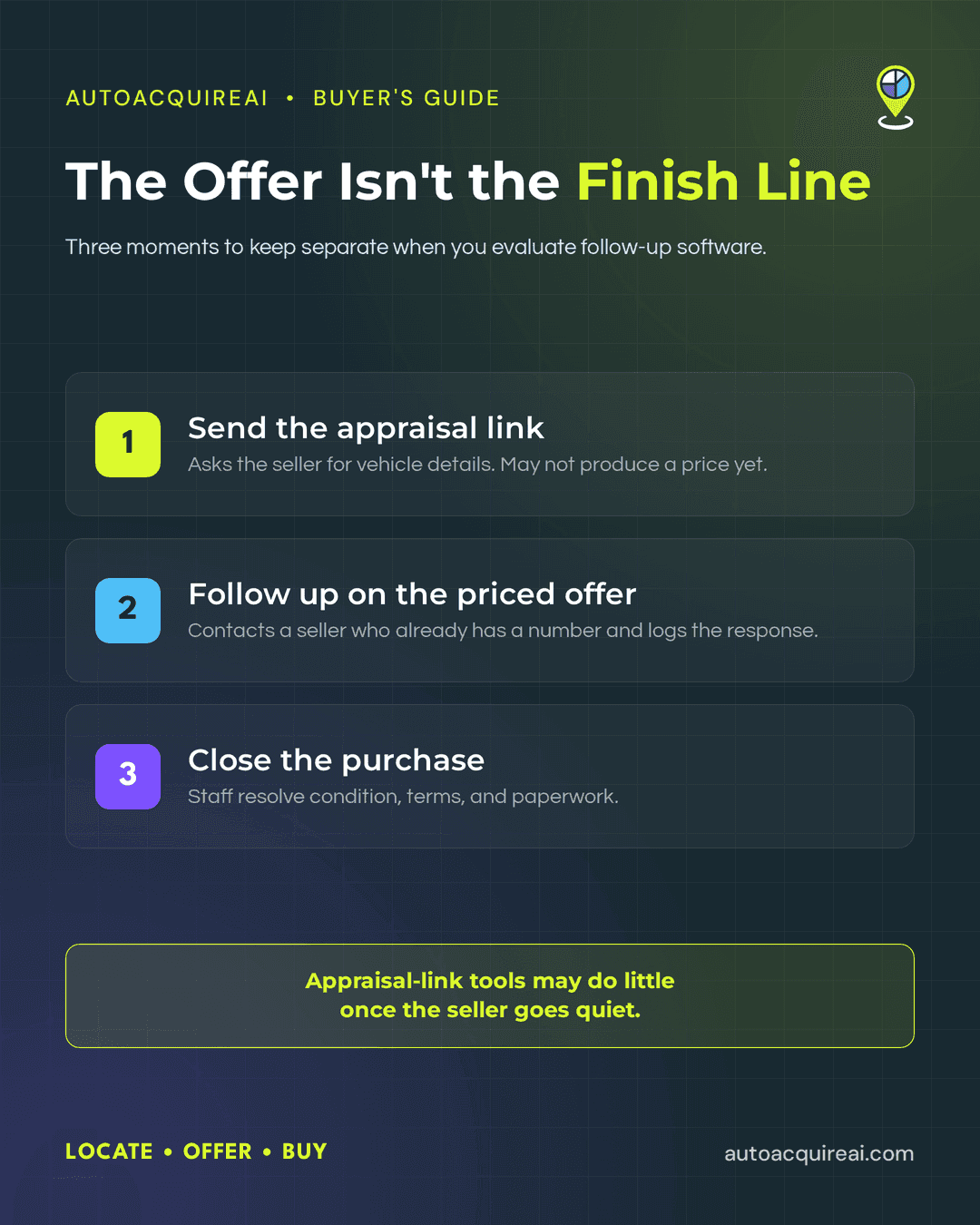
AutoAcquire iOffer™ converts website traffic into seller leads by delivering real-time instant cash offers. Website visitors receive immediate pricing instead of waiting for callbacks. This transforms passive browsing into active acquisition opportunities.
AutoAcquire's AVA™ AI voice agent is an AI voice and text agent that engages every seller immediately. AVA eliminates lead response delays that kill conversion rates. The AI handles initial conversations, qualifies sellers, and guides them through the acquisition process without human intervention.
Technology platforms solve the scale problem. VETTX focuses on outbound listing aggregation with smart filtering to remove salvage titles and overpriced vehicles. We go further — integrating inbound offers, AI engagement, remote inspection, and dealer group management in one platform.
Private party sourcing works best for dealers building dedicated buy centers or scaling acquisition without adding headcount. The channel delivers higher-quality vehicles with known maintenance histories and lower reconditioning costs compared to auction inventory.
4. Service Drive Sourcing
Service departments generate high-conversion acquisition opportunities through existing customer relationships. Customers already trust your dealership, they're physically on your lot, and many are prime candidates for a vehicle upgrade without realizing it.
The conversation starter is natural: when a customer faces a $3,000 repair bill on their seven-year-old SUV, your service advisor becomes your best acquisition agent. High repair costs create an immediate opening for trade-in discussions, especially when paired with compelling financing options or lower monthly payments.
Modern CRM systems flag the best service drive prospects automatically. Customers with positive equity, vehicles approaching warranty limits, or lease holders nearing mileage overages represent high-conversion opportunities. Monthly payment relief often motivates these customers more than vehicle age or mileage.
Target customers paying $600+ monthly on aging vehicles who could reduce payments to $450 on a newer model. This approach works particularly well for franchise dealers where customers view the service department as their automotive home base.
Success requires tight coordination between service advisors and your acquisition team. Service advisors need training on equity recognition and basic trade-in processes, while acquisition staff must respond immediately when service identifies a prospect. The trust relationship already exists — execution determines conversion.
This channel works best for franchise dealers with active service departments and established customer relationships. Independent dealers without service operations miss this built-in sourcing advantage, making service drive acquisition a competitive moat for full-service dealerships.
5. CRM and Customer Data Outreach
CRM outreach targets past customers 5+ years post-purchase when replacement cycles naturally occur. Your dealer management system already contains the data needed to identify likely sellers: customers 5+ years post-purchase with high equity positions, accumulated mileage, or approaching lease-end dates.
Smart segmentation targets specific customer profiles. High-equity holders who financed at higher rates may welcome cash offers that eliminate monthly payments. Customers with frequent service visits and mounting repair bills are prime candidates for trade discussions. Lease customers approaching mileage overages face penalties that make early exit attractive.
AutoAcquire's predictive data system analyzes multiple datasets to identify vehicle owners likely to sell before they list publicly. This proactive approach eliminates competition entirely — you're sourcing vehicles that haven't hit Craigslist, Facebook Marketplace, or dealer lots yet.
The execution advantage is timing. Most dealers wait for customers to express selling intent through service appointments or website visits. CRM-driven outreach flips this dynamic, positioning your dealership as the solution before customers begin their selling journey.
This channel delivers best results for dealers with substantial customer databases built over decades of operation. Independent dealers with 10+ years of sales history can mine thousands of past customers. Franchise dealers benefit from manufacturer loyalty programs that maintain customer contact information long-term.
The key is systematic execution rather than sporadic outreach. Monthly CRM analysis identifies new prospects as they enter optimal selling windows. Consistent messaging maintains your dealership's position as the preferred exit strategy when customers decide to sell.
6. Dealer-to-Dealer and Wholesale Networks
Dealer groups move vehicles between rooftops to balance inventory and avoid auction volatility. Rather than competing with other dealers at Manheim or ACV Auctions, smart operators move vehicles between their own rooftops to balance inventory mix and optimize local market demand.
Platforms like CarOffer historically led this space with predictive analytics automating trade decisions between dealers — though CarGurus wound down CarOffer operations in late 2025. The dealer-to-dealer wholesale model it pioneered remains relevant: instant buy/sell offers based on market data, eliminating guesswork around which vehicles to move where.
Wholesale networks provide quick access to specific vehicle types without auction uncertainty. When a Ford store needs more F-150s and a Toyota store has excess inventory, the network facilitates the trade immediately. This reduces time-to-market compared to waiting for the right auction lot.
The reconditioning risk drops significantly versus auction purchases. Vehicles sourced through dealer networks come with known service history and transparent condition reports from trusted partners. No mystery damage or hidden mechanical issues that surface after purchase.
Multi-rooftop dealer groups benefit most from this channel. Single-location dealers still gain value from wholesale networks, but the real advantage comes from balancing inventory across multiple stores in different markets. Groups running 5+ rooftops can reduce auction dependence by 40-60% through strategic internal transfers.
The Software Powering Each Sourcing Channel
Execution speed and cost-per-car depend on the technology behind each sourcing channel. Dealers running fragmented tool stacks—separate systems for pricing, lead generation, CRM, and communication—face slower response times and reduced conversion rates.
The most effective buy centers use integrated platforms that handle the full acquisition lifecycle: lead generation → offer → engagement → acquisition. AutoAcquire AI exemplifies this approach with AVA™ AI voice agent ensuring immediate seller engagement, while iOffer™ transforms website visitors into active seller leads. VETTX dominates outbound private party sourcing through listing aggregation, but requires separate tools for engagement and offer delivery.
Traditional channels rely on specialized solutions: ACV MAX powers trade-in appraisals with AI pricing and website widgets, while CarOffer automates dealer-to-dealer wholesale transactions. The key differentiator is response speed—AutoAcquire's predictive data capabilities identifies likely sellers before they list publicly, eliminating competition entirely.
Dealers using disconnected tools lose deals to faster-responding competitors. The most successful acquisition operations centralize visibility through platforms like the VRM Dashboard, tracking lead volume and conversion rates across all channels simultaneously.
Sourcing Channel & Tool Comparison
- Trade-In — ACV MAX / TradePending. AI appraisal, website widget. Franchise dealers.
- Digital Auction — ACV Auctions. Condition reports, OBDII scans. Volume buyers.
- Private Party (Outbound) — AutoAcquire AI / VETTX. Listing aggregation, automated outreach. Buy center operators.
- Private Party (Inbound) — AutoAcquire AI iOffer™. Instant cash offers, AI engagement. All dealer types.
- Service Drive — CRM + AutoAcquire. Equity mining, proactive outreach. Franchise dealers.
- CRM Outreach — AutoAcquire predictive data. Identifies pre-market sellers. Data-driven dealers.
- Dealer-to-Dealer — Dealer wholesale networks. Trade automation, inventory balancing. Dealer groups.
AutoAcquire AI stands apart by covering multiple channels within a single platform rather than requiring separate tools for each sourcing method. The AVA™ AI voice agent ensures immediate seller engagement across all channels, while predictive data identifies pre-market opportunities before competitors can reach them.
Ready to build a modern acquisition stack?
- Start your free trial today
- Visit autoacquireai.com to see our platform in action
Why AutoAcquire AI Is the Acquisition Engine for Modern Buy Centers
Most dealers run fragmented acquisition operations — separate tools for pricing, lead generation, CRM, and seller communication. This creates response delays, limited visibility, and reduced conversion rates when every minute counts in competitive sourcing markets.
AutoAcquire AI is the only platform covering the full acquisition lifecycle in one integrated system: lead generation → instant offers → AI engagement → completed acquisition. AVA™ AI Voice & Text Agent engages every seller immediately with consistent, intelligent conversations that guide them through the process, eliminating the lead response delays that kill conversion rates.
iOffer™ Instant Cash Offers transform passive website visitors into active seller leads with real-time pricing. The system builds your direct-to-consumer acquisition channel while predictive data surfaces pre-market sellers before they list publicly, reducing competition for quality inventory.
The VRM Dashboard provides centralized visibility into lead volume, conversion rates, and acquisition costs across all channels. Dealer Group Control manages group-wide strategy across multiple rooftops, ensuring consistent execution and optimal inventory flow between locations.
The platform scales acquisition without increasing headcount — AVA™ handles seller conversations 24/7 while predictive outreach identifies likely sellers automatically. Buy centers running fragmented tool stacks lose deals to response delays and operational complexity that integrated platforms eliminate entirely.
How to Build a Multi-Channel Sourcing Strategy
Most dealers rely too heavily on auctions or trade-ins, creating vulnerability when those channels face headwinds. Track your acquisition volume by channel over the past 12 months to identify gaps.
Next, activate your service drive as a sourcing channel. Coordinate service advisors with your acquisition team through your CRM system. Flag customers with high service bills, positive equity, or warranty limits reached — these conversations convert at 3x the rate of cold outreach because trust already exists.
Launch an inbound private party channel by adding an instant cash offer widget to your website. Tools like AutoAcquire's iOffer™ tool converts passive website visitors into active seller leads with real-time pricing. This channel operates 24/7 without adding headcount.
Add outbound private party sourcing through listing aggregation platforms that scrape Craigslist and Facebook Marketplace. AutoAcquire's AVA™ AI engagement system's AI agent handles automated outreach and engagement, eliminating response delays that kill conversion rates. Quality filtering removes salvage, dealer, and overpriced listings before your team wastes time.
Layer in predictive data to reach sellers before they list publicly. This reduces competition and improves margins by sourcing vehicles in the pre-market phase. AutoAcquire analyzes datasets to identify owners likely to sell within 30-60 days.
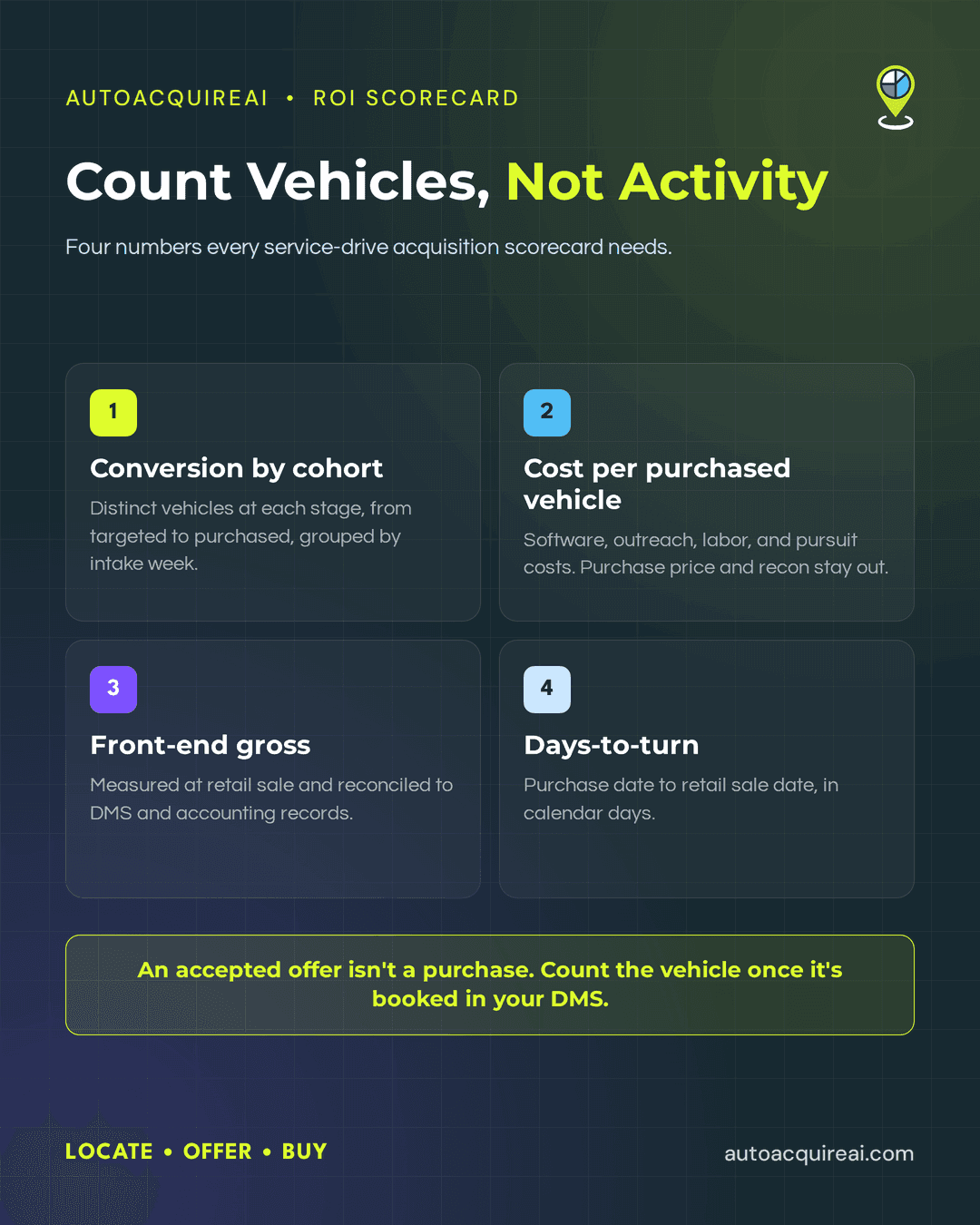
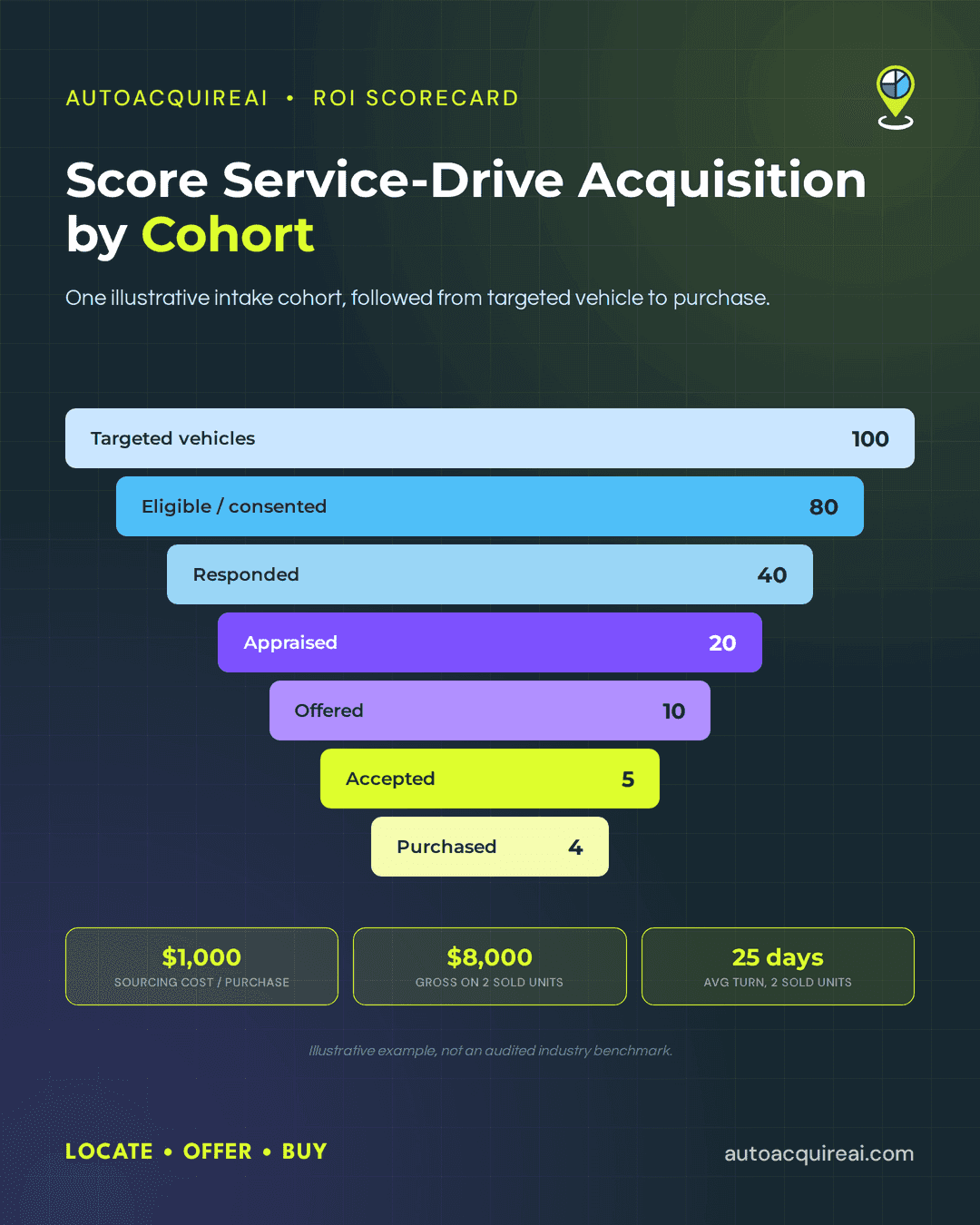
Centralize visibility across all channels through a unified dashboard. Track cost-per-car, conversion rates, and lead volume by source to identify your highest-performing channels. Double down on what works and eliminate what doesn't.
The key principle: no single channel delivers sufficient volume or margin protection in 2026. Top buy centers run 4-6 channels simultaneously, creating consistent inventory flow regardless of market volatility.
How We Evaluated These Sourcing Channels and Tools
We evaluated each sourcing channel and technology platform on four core criteria: cost-per-car impact, scalability without headcount increases, margin protection in volatile markets, and ease of execution for busy buy center directors.
Channel reliability mattered most in our 2026 assessment. Auction volatility and Carvana's trade-in dominance forced us to weight channels that bypass these competitive pressures. Private party sourcing scored highest because it accesses pre-market inventory at lower acquisition costs.
Technology integration requirements determined our tool recommendations. Dealers running fragmented systems — separate pricing, CRM, and outreach platforms — face slower response times and reduced conversion rates. Integrated platforms like AutoAcquire AI eliminate these delays while reducing the operational complexity that kills acquisition velocity.
We reviewed industry data from BCG, Digital Dealer, ACV MAX, vAuto, and Car Dealership Guy to validate our findings against real dealer performance metrics. Our analysis weighted suitability across dealer types — franchise dealers excel with trade-in optimization, while independent dealers and dealer groups benefit most from direct-to-consumer sourcing platforms.
FAQs
What is used inventory sourcing for dealerships?
Used inventory sourcing is the process of acquiring pre-owned vehicles to stock a dealership lot. Modern sourcing combines multiple channels including trade-ins, auctions, private sellers, service drive opportunities, and dealer networks. AutoAcquire AI automates and integrates these channels in one platform, eliminating the need for fragmented tool stacks.
How do dealers reduce cost-per-car when sourcing inventory?
Direct consumer sourcing bypasses auction fees and volatile wholesale prices that compress margins. AI-powered engagement through AutoAcquire's AVA™ system improves conversion rates without adding headcount, while predictive data surfaces pre-market sellers before competition can reach them. This approach reduces acquisition costs by 15-25% compared to auction-only strategies.
What is the best channel for sourcing used inventory in 2026?
No single channel is sufficient — a multi-channel approach is required for consistent inventory flow. Private party sourcing is the fastest-growing channel due to auction price volatility, but top buy centers run 4-6 channels simultaneously. AutoAcquire AI covers inbound, outbound, and predictive sourcing in one integrated system.
How does AutoAcquire AI compare to VETTX for private party sourcing?
VETTX focuses primarily on outbound listing aggregation and automated outreach. AutoAcquire AI adds AI voice/text engagement (AVA™), instant cash offers (iOffer™), predictive data, remote inspection capabilities, and dealer group management. AutoAcquire AI covers the full acquisition lifecycle from lead generation to title transfer; VETTX handles outbound sourcing only.
What is a buy center strategy for dealerships?
A buy center is a dedicated acquisition operation focused on sourcing vehicles directly from consumers rather than relying on trade-ins or auctions. It requires defined processes for outreach, appraisal, engagement, and title/payoff handling. AutoAcquire AI provides the complete technology infrastructure to run a scalable buy center without increasing headcount.
How quickly can dealerships see results from a new sourcing strategy?
Inbound channels like instant cash offer widgets can generate leads within days of launch. Outbound and predictive channels typically show measurable results within 30-60 days as the system builds momentum. Full multi-channel integration delivers compounding results over 90+ days as each channel reinforces the others.
What are the best alternatives to auction-only sourcing?
Private party platforms include AutoAcquire AI and VETTX. Trade-in optimization tools include ACV MAX and TradePending. Dealer-to-dealer wholesale networks remain an option for dealer groups. AutoAcquire AI is the only platform integrating all non-auction channels in one system, eliminating the complexity of managing multiple vendors.