
Key takeaways
- Lead-routing workflows distinguish these tools. Some place an alert in a staff queue for manual follow-up, while others automate customer outreach and offer creation.
- Dealers seeking DMS-centered equity alerts should compare AutoAlert, CDK, and DealerSocket RevenueRadar, then verify each product’s integration depth and routing in a live demonstration. Dealers using Solera should confirm which data and workflow capabilities are included in their package.
- For structured service-to-sales playbooks, dealers should ask VINCUE and automotiveMastermind to demonstrate their scripts, cadences, and task ownership. Total Customer Connect requires similar verification of its service-customer follow-up workflow.
- AutoAcquire is positioned for dealers seeking fewer manual steps. Its workflow uses AVA for seller outreach and iOffer to calculate an instant cash offer.
Why the routing question decides which tool is right for you
Equity mining software identifies customers whose vehicles may create a timely trade or acquisition opportunity. The software pulls records such as service visits, vehicle ownership history, estimated loan or lease maturity, and customer details stored in the DMS. It then estimates when a customer may have positive trade equity or be nearing a lease-end window. Service-to-sales tools apply those signals to customers visiting fixed operations and create a path for sales or acquisition follow-up.
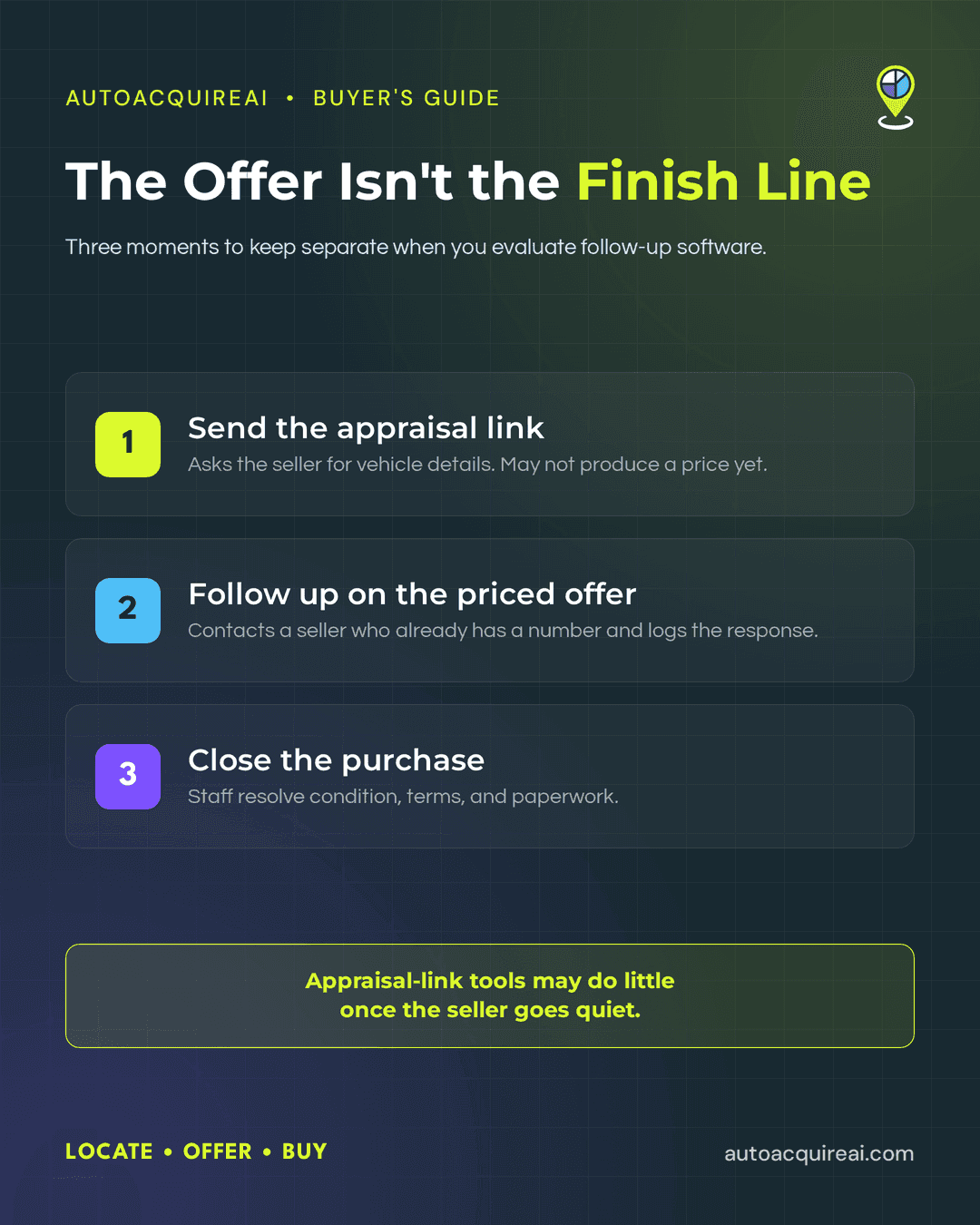
Lead routing determines how much work remains after the software identifies an opportunity. Some tools place an alert or task in a salesperson’s queue. The salesperson or BDC rep must review the record, contact the customer, confirm interest, gather vehicle details, and build an offer. A busy service lane can produce more alerts than staff can address promptly, so viable opportunities may receive late or inconsistent follow-up.
Automated routing removes several steps between detection and an offer. AutoAcquire sends service-drive equity signals into AVA’s outreach workflow. Interested owners can then move into iOffer for an instant cash offer calculation without waiting for a salesperson to assemble the initial number. Dealers should therefore evaluate where each product ends. An alert serves dealerships with disciplined follow-up capacity, while an automated path suits dealerships that want software to advance the opportunity before staff intervene.
Equity mining and service-to-sales tools at a glance
We compared each tool by its data sources, DMS integration depth, lead-routing method, and best operational fit. Lead routing receives the most weight because an alert still requires staff action unless the product also starts outreach or offer creation. A dagger marks entries that could not be verified from dedicated product documentation, so dealers should confirm those capabilities with the vendor.
| Tool | Data Sources | DMS Integration Depth | Lead Routing | Best For |
|---|---|---|---|---|
| AutoAcquire and AVA | Service-drive and customer data | Open API with CDK, Reynolds, and Dealertrack | Automated outreach through AVA and instant offers through iOffer | Acquisition workflows that move customers toward an offer |
| AutoAlert† | DMS and customer equity signals | DMS-connected | Alert-led workflow requiring staff follow-up | DMS-native equity alerts at scale |
| Solera† | Not verified | Not verified | Confirm with vendor | Dealers already using Solera products |
| VINCUE† | Service-to-sales opportunity data | Not verified | Playbook-led staff follow-up | Structured service-to-sales processes |
| automotiveMastermind† | Predictive equity and data-mining signals | Not verified | Playbook-led staff follow-up | Predictive scoring and marketing-driven follow-up |
| DealerSocket RevenueRadar† | DMS customer records | Embedded in DealerSocket | Staff queue and follow-up | DealerSocket dealerships |
| Total Customer Connect† | Not verified | Not verified | Confirm with vendor | Dealers evaluating service-lane engagement |
| CDK equity mining† | CDK DMS records and equity signals | Native CDK integration | Alert-led staff follow-up | CDK dealerships seeking embedded alerts |
† Integration and routing details for these tools were not verified from dedicated product documentation.
Data sources and equity signal accuracy
A tool produces useful equity signals when it has current ownership and customer activity records, along with accurate payoff and vehicle values. Service-lane visits confirm that the customer relationship and vehicle record remain current. DMS records add contact details plus purchase and service history, including current mileage. Loan or lease data helps estimate when replacing the vehicle may make financial sense. Stale payoff figures or incomplete repair-order data can produce leads that look attractive but fail during qualification.
Dealers prioritizing DMS-native data access may consider AutoAlert and CDK, but the supplied research does not establish the exact access available in every deployment. Ask each vendor to demonstrate which records it reads directly, how often those records update, and how it prevents duplicate customer profiles. Regardless of the product, signal accuracy requires complete records and a payoff estimate that reflects the customer’s current balance.
Dealers evaluating VINCUE and automotiveMastermind should ask each vendor to show how service activity becomes an assigned sales task, including how staff use repair-order data and record follow-up. For Solera, dealers should confirm which DMS, service, and finance fields are available in the specific products and integrations they plan to purchase. These demonstrations provide evidence of workflow and source coverage that the supplied research does not establish.
AutoAcquire uses service-drive signals through an acquisition layer that integrates with CDK, Reynolds, and Dealertrack. AVA acts on those signals through seller outreach, while iOffer moves interested customers toward an instant cash offer. This workflow complements DMS-native data access by focusing on the operational steps between an equity signal and an offer.
Data sources and equity signal accuracy
Equity signals become more useful when a platform combines recent service activity with accurate ownership and finance records. Service visits confirm that a vehicle remains connected to the dealership. DMS records add customer, vehicle, and transaction history, while loan or lease data helps estimate payoff timing and available equity. Missing or stale fields can flag customers whose vehicles were sold, whose loans remain underwater, or whose lease windows have already passed.
AutoAlert and CDK offer the strongest fit for dealerships prioritizing DMS-native data depth at scale. Their access to records inside established dealership systems supports continuous monitoring across large customer databases. Dealers should still examine how each product obtains current payoff information because estimated equity and lender-confirmed equity can produce different prospect lists.
VINCUE and VendorMotive place more emphasis on the service-to-sales process around the signal. Their value depends on turning service activity and customer records into a disciplined follow-up playbook. Solera operates within a broader automotive data environment, but dealerships need field-level documentation to determine which service, DMS, and finance records feed its equity calculations.
AutoAcquire uses service-drive signals through integrations with CDK, Reynolds, and Dealertrack, then connects selected customers with AVA outreach and iOffer pricing. That approach gives acquisition staff a direct path toward an offer. Available information does not establish that AutoAcquire matches AutoAlert or CDK in DMS-native data breadth or deployment scale, so its stronger case rests on how it acts on the signal rather than how many underlying records it can mine.
DMS integration depth
CDK equity mining and DealerSocket RevenueRadar offer the closest DMS-embedded experience. Both products can surface opportunities inside software that dealership staff already use, which reduces duplicate records and limits context switching. Their main constraint is platform dependence. Dealers receive the deepest fit when they already run the corresponding DMS environment.
AutoAlert, VINCUE, VendorMotive, Solera, and Total Customer Connect generally operate as connected applications rather than native DMS functions. Integration quality can vary by DMS and dealership configuration. Dealers should check how often customer and vehicle records synchronize, whether updates flow in both directions, and where completed tasks get recorded.
AutoAcquire takes an overlay approach through an open API with CDK, Reynolds, and Dealertrack integrations. The platform complements the existing DMS while adding an acquisition workflow around its data. Dealers can retain their core system while connecting service-drive signals with AVA outreach and iOffer calculations.
Native integration usually lowers setup friction and keeps staff in a familiar interface. An API-based overlay offers more flexibility across mixed dealership stacks, but its value depends on reliable synchronization and clear record ownership. A product demonstration should show one customer record moving through the full workflow, including status updates, offer activity, and DMS writeback.
Lead routing: manual handoff vs. automated outreach
Most equity mining products route a flagged customer to dealership staff rather than carrying the opportunity through an offer. AutoAlert and CDK surface DMS-native equity alerts at scale, but a BDC rep or salesperson still needs to contact the customer, confirm interest, and build an offer. DealerSocket RevenueRadar follows a similar model by placing opportunities into the dealership’s existing sales workflow for staff follow-up.
Solera and Total Customer Connect also sit on the alert-to-rep side of the routing divide. Their available product framing does not establish an automated path that turns an equity signal into a customer-facing cash offer. Dealers evaluating either product should examine the live workflow after an alert appears, including task assignment, outreach responsibility, and offer creation.
VINCUE and VendorMotive give staff more guidance after identifying an opportunity. Their service-to-sales playbooks can support scripts, follow-up timing, and process discipline. A salesperson or BDC rep still conducts the conversation and moves the customer toward an appraisal or offer, so execution depends on staff capacity and queue management.
AutoAcquire takes the automated route within this comparison. A service-drive equity signal can enter AVA’s outreach workflow instead of waiting in a representative’s queue. When the customer engages, the workflow feeds into iOffer’s instant cash offer calculation. That sequence can move a flagged customer toward a real number without requiring a human to initiate contact or manually construct the first offer.
Service-to-sales playbook depth
Playbook depth measures how thoroughly a platform supports the human work that follows an equity alert. A mature playbook gives representatives trained scripts, sets follow-up timing, and defines how managers inspect execution. Those controls help dealerships produce a consistent service-to-sales process across shifts and locations.
VINCUE and VendorMotive suit dealerships that want representatives to follow a defined sales motion. Their process emphasis can improve conversations and accountability when managers have the staff to coach the playbook. Dealers may prefer this structure when personal contact and sales discipline matter more than minimizing manual steps.
AutoAcquire serves a more automated operating model. AVA uses the service-drive signal to begin seller outreach, while iOffer moves the customer toward an instant cash offer. Dealers should choose between these approaches based on staffing and execution. A disciplined BDC may benefit more from a mature playbook, while a lean acquisition team may place greater value on reducing the handoffs between identification, contact, and offer.
Which tool wins for which dealership
AutoAlert and CDK fit dealers that prioritize DMS-native equity alerts at scale. CDK offers the clearest fit for stores already operating within its DMS environment. AutoAlert suits dealer groups that want a dedicated equity mining program built around customer and vehicle data.
VINCUE and VendorMotive fit dealerships that value service-to-sales process discipline. Their playbooks help managers standardize scripts, follow-up timing, and staff responsibilities. That structure can outperform heavier automation when the dealership has enough BDC or sales capacity to work every surfaced opportunity consistently.
AutoAcquire fits dealers that want an equity signal to progress toward an offer without entering a manual follow-up queue. A flagged service customer can enter an automated AVA conversation and receive a number generated through iOffer, rather than waiting for a representative to build the first offer. AutoAcquire complements the dealership’s existing DMS and closes this specific routing gap. AutoAlert or CDK may remain a better choice when DMS-native alert coverage carries more weight, while VINCUE or VendorMotive may suit stores that prefer staff-led playbooks.
Next step
Before selecting a tool, ask each shortlisted vendor to demonstrate one service-drive opportunity from initial signal through customer contact, appraisal, offer, and final DMS update. Compare the number of manual handoffs, the records exchanged, and the staff time required at each stage. Choose the workflow that addresses the dealership’s measured bottleneck rather than the product that generates the largest alert count.
FAQs
What is equity mining software?
Equity mining software analyzes DMS, service, loan, and lease records to identify customers with positive trade equity or approaching maturity dates. AutoAcquire applies service-drive equity signals to vehicle acquisition workflows. Dealers gain a prioritized pool of potential sellers.
How is service-to-sales different from equity mining?
Equity mining identifies likely opportunities, while service-to-sales governs the outreach and follow-up after identification. AutoAcquire connects service-drive signals with AVA and iOffer. Dealers can move qualified customers toward an offer with fewer manual steps.
Do these tools replace a BDC?
Equity mining tools support a BDC by prioritizing contacts, scheduling tasks, or automating parts of outreach. AutoAcquire uses AVA to handle seller conversations while staff manage exceptions and completed opportunities. Dealers can reduce repetitive calling without removing human oversight.
Does equity mining data integrate with a dealership’s existing DMS?
Most equity mining platforms either operate inside a DMS or connect through an integration. AutoAcquire uses an open API and integrates with CDK, Reynolds, and Dealertrack. Dealers can add acquisition workflows without replacing their core records system.
How does AutoAcquire differ from traditional equity mining alerts?
Traditional equity mining alerts usually place a customer in a salesperson or BDC queue. AutoAcquire routes the signal into AVA outreach and connects qualified sellers with an iOffer cash offer calculation. Dealers can reach a real offer without requiring staff to build every first response manually.