

TL;DR
- Copart fits salvage and damaged-vehicle sourcing for dealers with strong title and reconditioning expertise.
- Manheim fits dealer-only wholesale buying when dealers need broad, clean-title inventory and traditional auction lanes.
- ADESA fits institutional wholesale inventory with live lanes and digital bidding through Simulcast or timed sales.
- IAAI fits salvage inventory, including lightly damaged and specialty vehicles, with detailed condition information and varied sale formats.
- ACV Auctions fits online-first wholesale sourcing for dealers that rely on digital condition reports instead of physical lane inspection.
- AutoAcquire complements auctions by helping dealers acquire suitable vehicles directly from service-drive customers and private-party owners.
- Platform choice affects landed cost before bidding because each auction sets different access rules and fees, while transport and reconditioning vary by vehicle. Every auction transaction can add buyer fees and transport charges beyond the hammer price.
Why the auction you pick changes your cost stack before you bid
Auction selection affects landed cost through platform charges and operating demands such as transport and staffing. Access rules also determine whether a dealer can bid directly or needs additional credentials. If you compare hammer prices alone, you can miss meaningful cost differences before bidding begins.
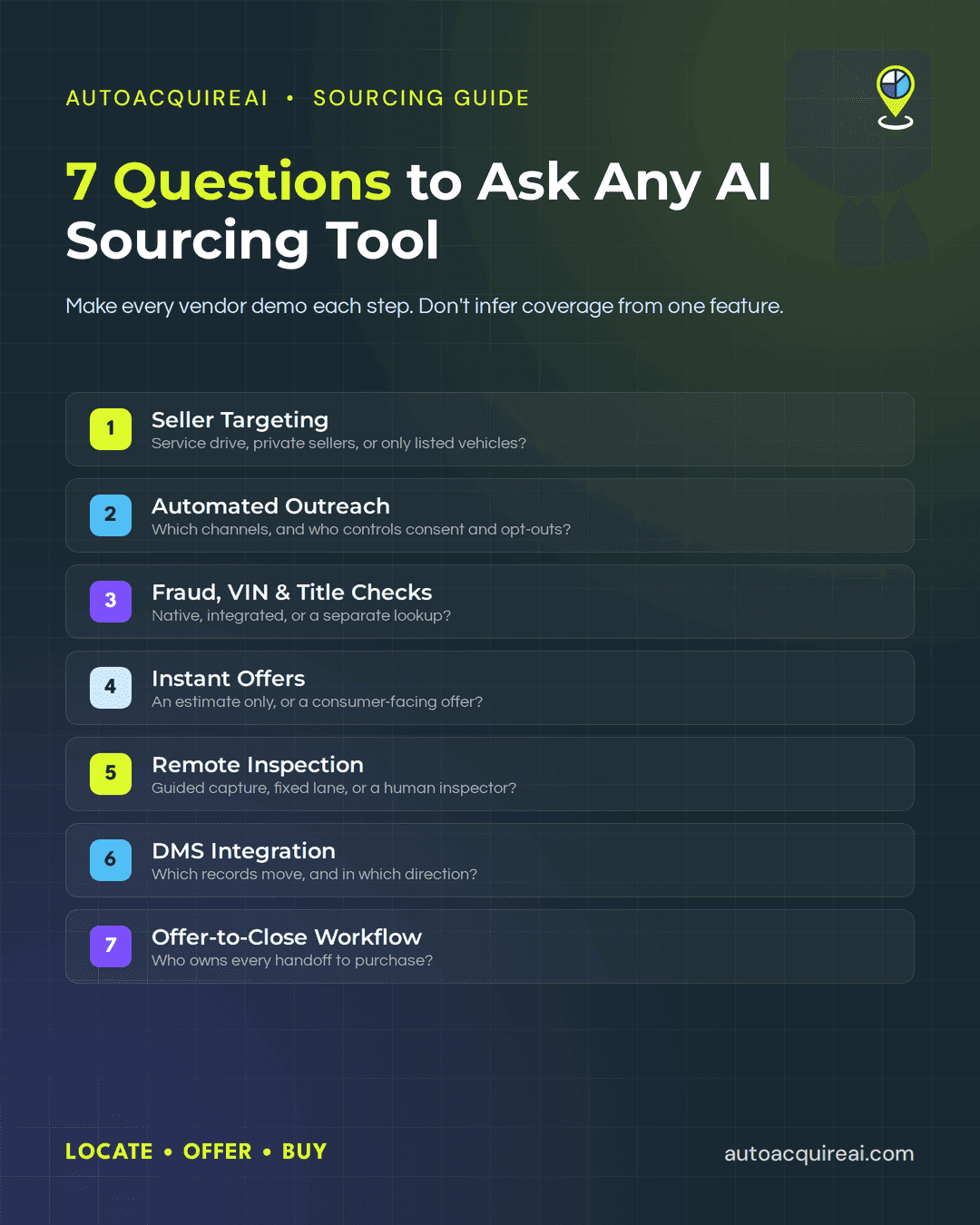
No two of these platforms run the same playbook. Copart centers on online salvage auctions, while Manheim combines physical wholesale lanes with digital bidding. ADESA offers physical dealer lanes and digital sales through Simulcast or timed bidding, while IAAI focuses on salvage inventory that includes fleet and repossession vehicles. ACV Auctions runs an online-first dealer marketplace based on digital condition reports. AutoAcquire serves a different use case by supporting direct purchases from service-drive customers and private-party owners before those vehicles enter an auction.
Choose platforms that supply the title and condition mix your retail plan requires in the volume you need. The comparison below covers inventory, access, total cost, and buyer protection.
Copart vs. Manheim vs. ADESA vs. IAAI vs. ACV Auctions at a glance
The options divide into three operating models: salvage-focused marketplaces (Copart and IAAI), dealer wholesale auctions (Manheim, ADESA, and ACV Auctions), and direct acquisition (AutoAcquire). Published fee and protection details remain uneven. Verify current terms before placing bids.
| Platform | Best For | Fee Structure | Inventory Focus | Buyer Protection |
|---|---|---|---|---|
| Copart | Buyers equipped to repair damaged vehicles | Membership and transaction fees apply. The reviewed sources did not include the current U.S. fee schedule. | Salvage and damaged vehicles, including repossessions and some cleaner-title vehicles | Copart references a Member Protection Pledge, but the reviewed source did not provide the policy text. |
| Manheim | Dealers seeking broad wholesale inventory through established auction lanes | Buy fees and service charges vary by transaction. Dealers should confirm current schedules directly. | Dealer wholesale inventory, especially fleet and financial-institution vehicles | Arbitration depends on the vehicle disclosures and sale terms, including filing deadlines. The supplied research did not include current terms. |
| ADESA | Dealers mixing physical lanes, Simulcast, and timed digital bidding | Transaction and service fees apply. The reviewed public sources did not include exact schedules. | Dealer-only wholesale with strong fleet and financial-institution consignor participation | ADESA Assurance provides a 21-day return guarantee and reimburses the purchase price and buy fee on eligible vehicles. |
| IAAI | Buyers sourcing salvage inventory, including lightly damaged and specialty units | Multiple transaction fees may apply, but an official fee schedule was not accessible. | Insurance and damaged-vehicle inventory, including repossessions, fleet units, and some clear-title stock | The available sources did not provide formal arbitration or protection terms. |
| ACV Auctions | Dealers wanting online-first wholesale buying with digital condition reports | Auction and transport costs can apply. Confirm current pricing and fees before bidding. | Dealer wholesale inventory sold through online auctions | Condition reports support evaluation, but you must confirm current arbitration terms directly with ACV Auctions. |
| AutoAcquire | Dealers sourcing vehicles directly from service-drive customers and private-party owners | Direct purchases avoid auction buy fees and may reduce lane-related transport costs. | Locally sourced consumer and service-drive vehicles | Auction arbitration does not apply; the dealer's appraisal and transaction terms govern the purchase. |
A landed-cost model should include applicable buyer premiums, service charges, transport, storage, title processing, and vehicle preparation. Additional logistics and vehicle-preparation charges can make a competitive hammer price uneconomical.
How we weighed each platform
Four buyer-level criteria drive the comparison. Inventory access covers licensing requirements and whether the available vehicles fit a dealer’s sourcing plan. Cost transparency covers buyer fees and other charges that affect landed cost before transport and reconditioning.
Bidding format determines staffing needs, bid timing, and whether buyers can inspect vehicles in person. Protection and arbitration determine which undisclosed conditions qualify for a claim, how quickly dealers must file, and what remedies the platform provides. Brand reputation carries less weight because a familiar auction can still produce poor unit economics when access restrictions, fees, or claim exclusions conflict with a buy center’s operation.
Copart and IAAI: salvage-heavy sourcing for recon-capable buyers
Recon-capable dealers can use Copart and IAA to source damaged vehicles below typical clean-title wholesale lanes. Both platforms carry salvage and insurance inventory, although repossessions, fleet vehicles, and some clear-title units also appear. Dealers must price repairs, transport, title restrictions, and resale eligibility before setting a maximum bid.
Copart emphasizes fully online bidding and tiered access. Its Middle East onboarding offers Standard and Premium memberships, while its U.S. site separates access paths for individuals, businesses, and dealers. Licensing status can affect which vehicles a buyer may bid on. Copart works well for buyers prepared to search a large damaged-vehicle pool and manage access requirements before auction day.
IAA gives buyers more condition signals and sale formats within the salvage category. Listings can classify vehicles as Run and Drive, Starts, or Stationary, and buyers can review engine-start videos, high-resolution images, 360-degree views, and key availability. Live Auctions, Timed Auctions, Buy Now listings, and Virtual Lane sales let a dealer choose between active bidding and a fixed-price purchase.
Neither platform removes the need for an independent repair estimate. A Run and Drive label describes limited operating status, not retail readiness, while photos may not reveal every mechanical or structural issue. Buyers also need staff who understand title brands, primary-damage descriptions, loss types, and state resale rules. A clean-title buy center without that expertise may save on hammer price and then lose the difference through recon work or restricted resale options.
Publicly accessible sources did not provide reliable current fee schedules or full arbitration terms for either platform, so get membership costs, buyer fees, payment charges, title rules, and dispute windows in writing before the first bid.
Manheim and ADESA: dealer-only wholesale lanes for retail-ready inventory
Manheim and ADESA serve the traditional dealer wholesale market, where licensed buyers source vehicles consigned by financial institutions, fleets, rental operators, and other dealers. That consignor mix produces more clean-title and retail-ready inventory than salvage-focused auctions typically offer. Dealers still need to inspect condition reports, calculate reconditioning, and verify title status before bidding.
Manheim retains a live-lane heritage, with online participation extending the physical auction model. The available research does not provide enough detail to compare Manheim’s current digital tools, fees, or buyer protections feature by feature, and assuming ADESA’s policies carry over is a mistake worth avoiding. Call Manheim directly for current terms.
ADESA gives buyers two distinct bidding workflows. Live Auctions support local lane attendance and Simulcast bidding, while ADESA Clear runs timed digital sales around the clock. Every Clear listing starts at the seller’s reserve, which removes the wait for a live sale but requires buyers to set valuation limits without watching a lane develop.
ADESA also places valuation data inside the bidding workflow. CarValue predicts VIN-specific wholesale and retail values using more than 50 million ADESA transactions and outside market data. Its profit calculator accounts for transportation and reconditioning, while the % to Retail tool compares the current bid with an estimated national retail price.
For used car departments seeking clean-title wholesale volume, both platforms offer a better starting point than salvage-heavy lanes. ADESA provides clearer documented options for switching between live and timed buying. Manheim remains a traditional wholesale source, but dealers need current platform documentation to compare its digital workflow and protections on equal terms.
ACV Auctions: tech-forward online-first sourcing
AI condition reports give ACV Auctions its clearest operational distinction. Dealers can assess vehicle condition and bid through an online auction workflow without sending a buyer to a physical lane. The reports provide a consistent basis for reviewing inventory, but dealers still need appraisal rules that account for recon risk and differences between reported and actual condition.
The online-first format suits buyers who need to cover more inventory without committing staff time to lane attendance, and it supports centralized buying across multiple rooftops since buyers can evaluate vehicles wherever they work. Set bidding authority and landed-cost limits before each sale regardless.
ACV Auctions remains a wholesale auction rather than a direct sourcing channel, and the fees, transport, and reconditioning costs above the hammer price don't disappear just because the bidding happened on a screen. ACV makes remote buying more practical. It doesn't make it cheaper.
Live lane, online-only, or hybrid: how bidding format changes your buy strategy
Live and Simulcast sales consume buyer attention at fixed times. A buyer must inspect run lists beforehand, set limits, and make rapid decisions while vehicles cross the block. Simulcast removes travel but still requires scheduled coverage, and dealers should confirm whether virtual bidding adds platform-specific fees.
Timed auctions give buy centers more scheduling flexibility but change price discovery. Buyers can review vehicles and place bids around other work, yet some formats provide little or no negotiation window. ADESA Clear starts every vehicle at its reserve price, so buyers cannot test seller flexibility with a lower opening bid. Automatic bids also make firm vehicle-level limits important because competing bids can move the price while staff handle other work.
Hybrid platforms support different tactics within one account. IAA, for example, offers live auctions, timed auctions, and Buy Now options. A buy center can reserve live coverage for scarce units while using timed bidding for routine inventory, though multiple formats make daily purchasing exposure harder to track.
Multi-buyer operations need centralized bid limits before adding platforms or rooftops. Without shared approval rules, two buyers can pursue similar units, exceed a model-level target, or commit more transport capacity than the group planned. A central dashboard or purchasing log should record active bids, maximum amounts, expected fees, and assigned buyers before each sale begins. Multi-rooftop groups should also verify whether each platform can share this information through centralized reporting or an API.
What buyer protection and arbitration actually cover — and where they don't
Buyer protection covers specific disclosure failures, not every vehicle that becomes an unprofitable purchase. Auction rules usually set claim windows, damage thresholds, required inspections, and eligible vehicle categories. A dealer can lose an otherwise valid claim by missing the filing deadline or completing repairs before the auction reviews the vehicle.
ADESA Assurance provides one concrete example. Eligible vehicles carry a 21-day return guarantee that reimburses the purchase price and buy fee. Confirm eligibility before bidding, since the guarantee does not apply uniformly to every vehicle or sale format.
Undisclosed frame damage may support arbitration under some auction rules, but a disagreement alone does not create coverage. The vehicle must meet the platform’s damage definition and any monetary threshold. Announced defects, visible cosmetic damage, ordinary wear, and items disclosed in the condition report commonly fall outside protection. Arbitration also does not cover a post-sale decline in market value or a unit that needs more reconditioning than the dealer expected.
Current arbitration terms for Copart, Manheim, IAAI, and ACV Auctions could not be independently verified from the available sources, and ADESA’s public material confirmed its Assurance benefit without spelling out the full arbitration policy. Get the current policy, eligible-vehicle rules, claim deadlines, and inspection requirements from each platform before bidding. Screen captures of announcements, condition reports, and listing photos can preserve the evidence needed for a later claim.
What multi-rooftop groups need before scaling across platforms
Multi-rooftop groups should verify credentialing and data access before adding another auction platform. Groups cannot assume one corporate account will authorize every store or buyer. Dealer licenses, authorized-buyer records, payment accounts, and state documents may require separate setup for each legal entity.
State rules add recurring administrative work. IAA’s buyer app references AuctionACCESS-linked buyers and requires Wisconsin buyers to upload state Bid and Endorsement cards. A group operating across several states may need different documents by rooftop. Expired credentials can block bidding even when the group’s master account remains active.
Centralized reporting should identify which rooftop bought each vehicle and which buyer placed the bid. Finance staff also need fees and payment records in a format that can feed group reporting without manual reconciliation. Public documentation for multi-location controls and API access remains thin across most of these platforms.
Before building an internal workflow, get written confirmation of account hierarchy, permission controls, report exports, and API availability, and pin down whether an API exposes inventory data and transaction records or merely supports basic account functions. Missing access can force buyers to manage separate logins and leave accounting staff combining reports by hand.
Compare total auction costs with direct acquisition
Compare total acquisition cost rather than the hammer price. Auctions may add transaction and logistics charges, and each platform calculates them differently. If you resell unwanted inventory through an auction, seller fees can raise the cost again.
A direct-acquisition channel creates a second cost path: the dealer avoids an auction buy fee but assumes responsibility for appraisal, outreach, and transaction management.
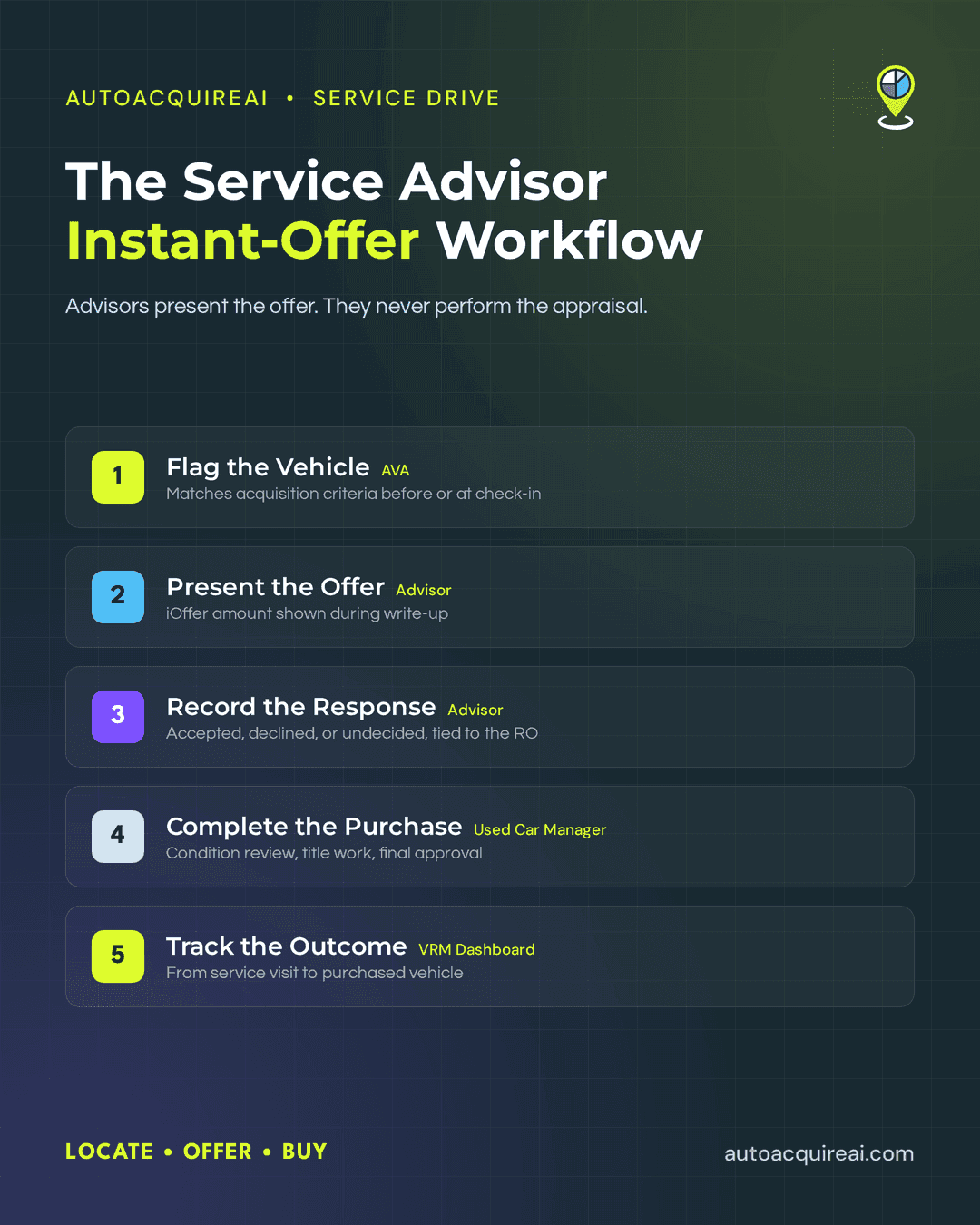
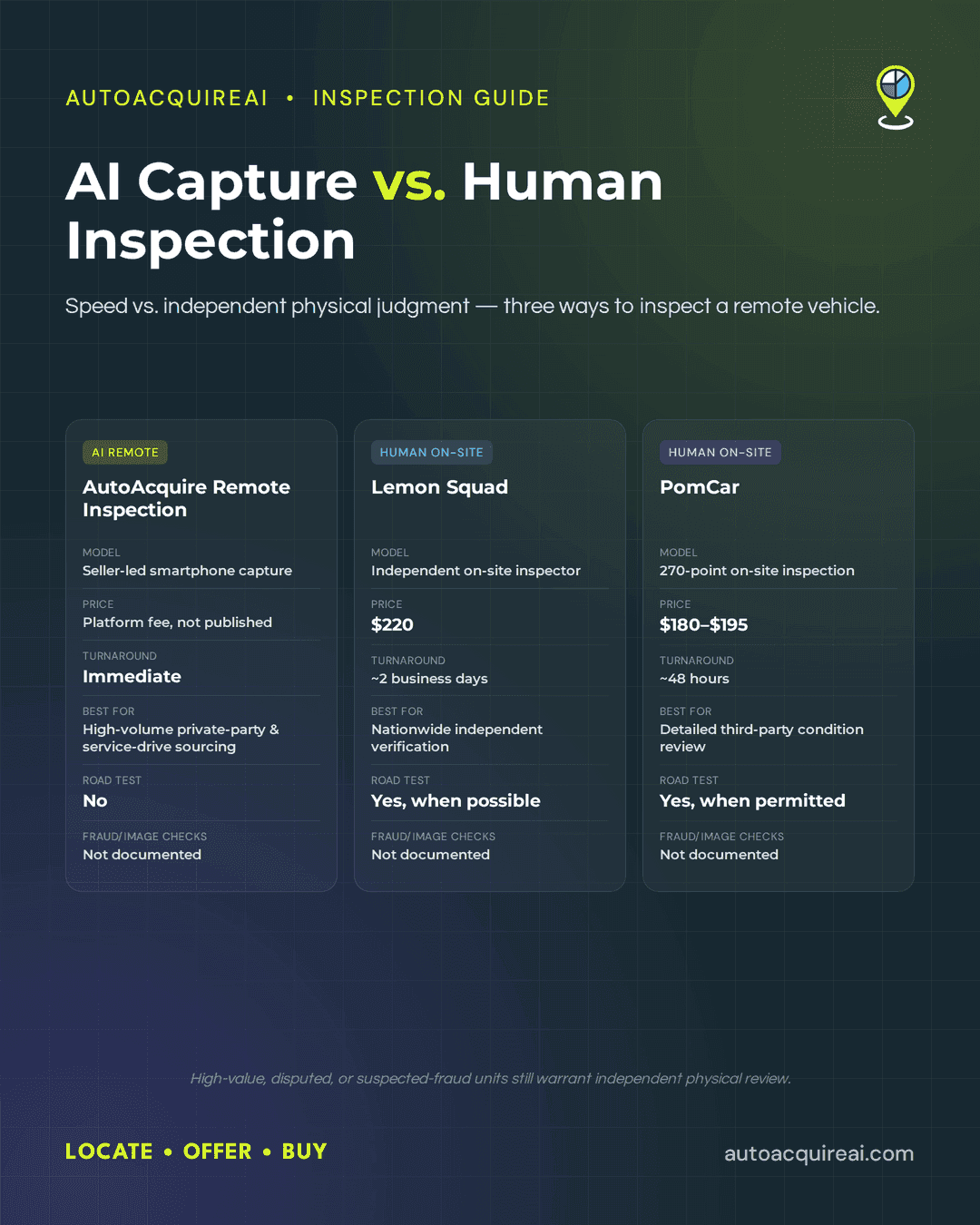
AutoAcquire is a direct-acquisition platform that helps dealers buy used vehicles from consumers instead of routing every unit through a paid auction lane. It extends a dealership's sourcing strategy alongside auction purchasing rather than replacing it. AVA automates outreach to service-drive customers and private-party owners, iOffer generates instant cash offers, and Remote Inspection collects condition information before a vehicle enters inventory. Dealers can shift suitable purchases into direct transactions, where auction buy fees and lane-related transport costs do not apply.
Direct acquisition cannot supply every vehicle a dealership needs, and it is not built to. Copart and IAAI provide salvage and insurance inventory that requires specialized title knowledge and reconditioning capacity. Manheim and ADESA supply institutional wholesale inventory at a scale that individual consumer channels rarely match. ACV Auctions gives dealers online access to wholesale inventory with digital condition reporting.
The practical split: use auctions for urgent, institutional, or specialized inventory, and use AutoAcquire for vehicles available through local owners and existing service relationships. To put this mix into practice, compare the last 90 days of auction purchases with direct-acquisition opportunities by title type, reconditioning cost, transport expense, and total fee exposure.
FAQ
- How does dealer auction access and licensing work? Dealer-only auctions typically require an active dealer license, business verification, and buyer credentialing before bidding. Requirements vary by state and platform. For example, IAA references AuctionACCESS-linked buyers and state-specific documents for Wisconsin bidders.
- What do auction arbitration policies usually cover? Auction arbitration generally covers undisclosed material defects that meet the platform’s claim thresholds and reporting deadlines. Policies often exclude announced defects, as-is vehicles, ordinary cosmetic wear, and changes in resale value after purchase. Dealers should review the current rules for each sale because platform-specific terms were not independently verifiable across every auction compared here.
- Is buying a vehicle sight-unseen through an online auction safe? Online buying can be reasonably controlled when dealers use detailed condition reports, AI grading, vehicle history data, and disciplined bid limits. Inspection tools reduce uncertainty, but they cannot guarantee that every mechanical, structural, or cosmetic issue appears in the report. Dealers should include transport, expected reconditioning, title status, and arbitration limits in the maximum bid.