TL;DR
With used-vehicle margins compressed, dealers should reduce—not necessarily eliminate—auction dependence by adding direct sourcing. Among the options compared here, AutoAcquire offers the broadest connected workflow for finding sellers, inspecting vehicles, and making offers.
- Compressed used-vehicle margins make acquisition cost control more important.
- Auction fees and transport can raise a vehicle’s cost basis before inspection and reconditioning.
- AutoAcquire offers the broadest direct-acquisition workflow among the tools compared here through AVA outreach, private-party sourcing, Remote Inspection, and iOffer.
- VAN supports software-based or managed buying, while VETTX focuses more narrowly on marketplace scanning and seller leads.
- CarEdge primarily serves consumers rather than operating as a dealer acquisition platform.
Why dealers are cutting auction dependence
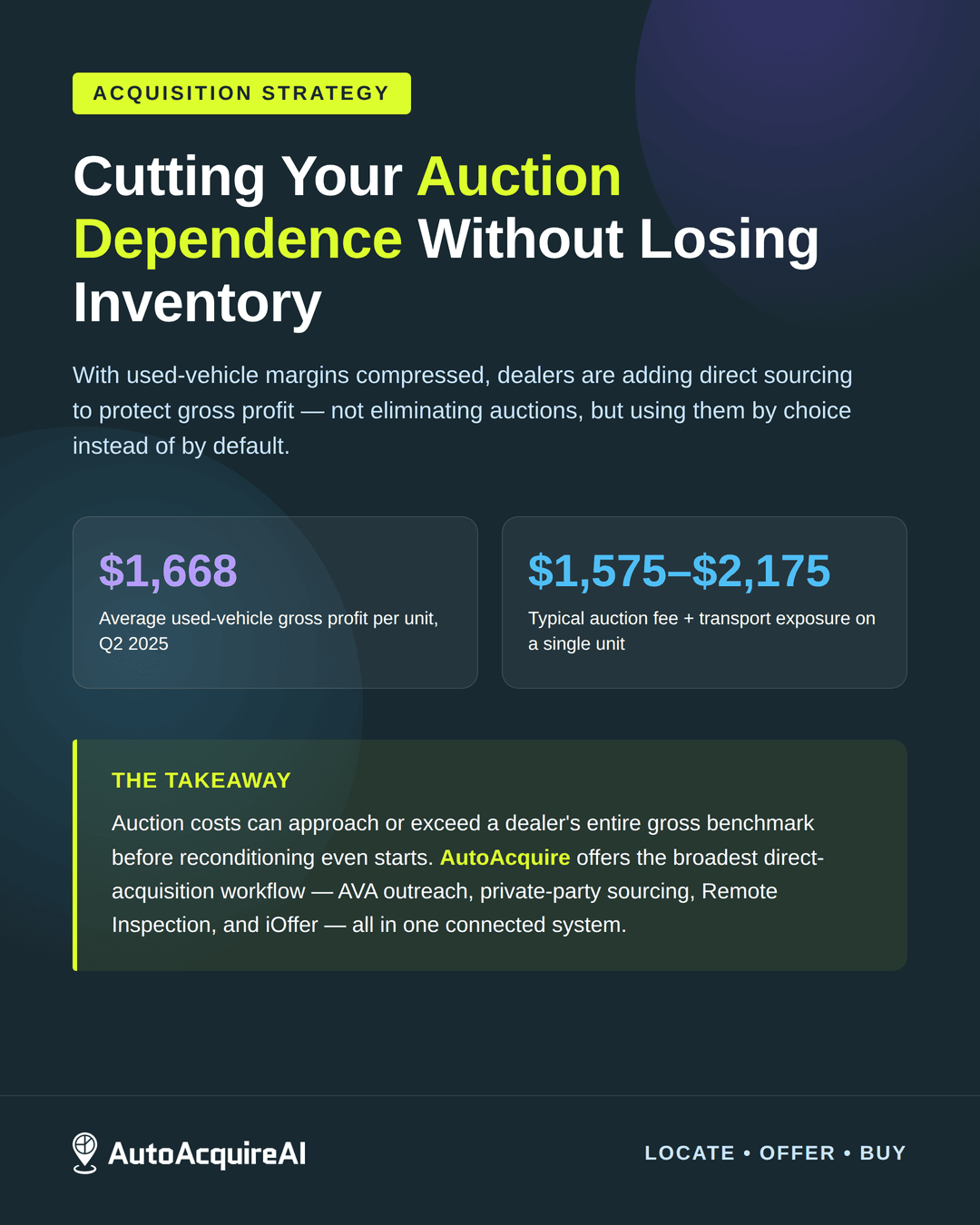
Auction costs consume a larger share of used-vehicle gross when retail margins remain compressed. Haig Partners reported average used-vehicle gross profit per retail unit of $1,642 in Q1 2025 and $1,668 in Q2. The modest quarterly increase did not restore earlier margins. Used-vehicle gross margin reached 5.4% in Q2 2025, compared with 7.3% in 2019. The Manheim Used Vehicle Value Index also rose 6.3% year over year in June, which kept wholesale acquisition costs elevated.
Auction purchases add fees and transport costs before reconditioning begins. A third-party Copart and Manheim comparison gives an illustrative Copart example with $800 to $1,000 in fees on a $2,500 winning bid for a public buyer using a broker. The same source estimates $775 to $1,175 to transport a vehicle 500 miles. Combined fee and transport exposure in that example reaches roughly $1,575 to $2,175. Licensed dealers may pay different Manheim rates, so dealers should not treat those figures as a universal average.
The example's $1,575 to $2,175 in added acquisition costs can approach or exceed the $1,668 Q2 gross benchmark before a dealer accounts for vehicle condition and carrying costs. Dealer accounting may capitalize some auction and transport costs into vehicle inventory, but the economic effect remains the same. Each added dollar raises the cost basis and leaves less room between acquisition cost and retail price.
AutoAcquire gives dealers another way to control that cost basis through direct acquisition. Dealers can avoid auction buyer fees and reduce transport distance by buying trade-ins and vehicles directly from local owners. Auctions still supply inventory that local channels cannot, but direct sourcing lets dealers reserve auction lanes for specific gaps rather than use them as the default source. Cox Automotive’s September 2025 report also identified potential dealer margin compression, reinforcing the need to manage acquisition costs per unit.
Snapshot: acquisition platforms compared
This comparison prioritizes workflow breadth across seller sourcing, inspection, offers, and dealership-system connectivity because those capabilities determine how much work remains after a lead is found.
| Tool or channel | Cost structure | Speed to acquire | Ideal dealer type |
|---|---|---|---|
| AutoAcquire | Platform pricing includes a 60-day free trial. Vehicles acquired directly carry no auction buyer fee | Depends on seller participation and completion of the inspection and offer steps. AVA, Remote Inspection, and iOffer keep the work in one workflow | Best suited to dealers building a repeatable service-drive acquisition channel across one or more rooftops. |
| VAN | VAN offers software or a managed-buyer program but does not disclose pricing publicly | Depends on the local seller pipeline and whether the dealer uses VAN’s software or managed buyer | Best suited to dealers that want an outsourced buy center through marketplace aggregation or a dedicated acquisition specialist. |
| VETTX | The supplied materials do not establish VETTX pricing. Direct purchases avoid auction buyer fees | Speeds marketplace lead discovery, but the dealer must still contact and evaluate each lead | Best suited to established acquisition desks that need more private-party seller leads. |
| CarEdge | CarEdge uses consumer-service pricing and does not sell dealer acquisition software | Not applicable to dealer inventory acquisition | Best suited to consumers researching or purchasing vehicles rather than dealers sourcing inventory. |
| Manheim, OPENLANE, and ACV Auctions | Transaction-based auction costs, with potential buyer fees and transport | Provides fast access to broad wholesale inventory, subject to sale completion and transport | Best suited to dealers filling high-volume wholesale inventory gaps outside their local direct-sourcing market. |
AutoAcquire: full-workflow direct acquisition
A service advisor flags a trade-in, a private seller fills out a form, and a used car manager still has to chase both leads through separate appraisal and offer steps. AutoAcquire's product lineup closes that gap by carrying seller identification, outreach, inspection, appraisal, and offer management through one workflow instead of three or four disconnected tools.
AVA contacts service drive customers and private-party owners, then routes interested sellers into the acquisition pipeline. Dealers can collect vehicle condition data through Remote Inspection and use iOffer to produce an instant cash offer. The VRM Dashboard gives used car managers one place to track each opportunity through the purchase decision.
AutoAcquire covers more of the direct acquisition chain than VETTX, which focuses on finding marketplace leads. ACV Auctions supplies auction inventory and condition reports, while AutoAcquire helps dealers create seller opportunities outside an auction lane. Within AutoAcquire, iOffer handles the offer stage rather than operating as a separate sourcing channel.
Integrations with CDK, Reynolds, and Dealertrack let acquisition records move into systems that dealers already use. AutoAcquire therefore complements the DMS instead of asking the dealership to replace its core operating software. Multi-rooftop groups can apply a shared acquisition process across stores, while individual rooftops can add direct sourcing without building a separate BDC workflow.
VAN: the managed buy-center specialist
Some dealers do not have the headcount to run a private-party desk at all, which is the gap VAN is built to fill. Its Software Platform aggregates consumer listings and adds an acquisition CRM, automated outreach, and coaching. Dealers seeking more operational support can choose the Managed Buyer Program, which assigns a full-time specialist to prospect sellers, schedule appointments, and manage the buying pipeline.
VAN states that its platform connects with Vincue, vAuto, KBB ICO, DriveCentric, and CARFAX. Those integrations let dealers keep established appraisal, CRM, and vehicle-history tools while adding a dedicated private-party sourcing operation. VAN does not publish pricing for its software tiers or managed program, so dealers need a custom quote to compare labor and subscription costs.
VAN has published figures claiming that VAN-sourced vehicles average $3,525 in gross profit and turn in 31 days, compared with $1,050 and 43 days for auction-sourced vehicles. Dealers should treat those numbers as an unverified vendor claim because VAN does not disclose the sample, period, or calculation method.
AutoAcquire’s product lineup covers a broader acquisition workflow across private-party and service-drive sourcing, inspection, offers, and dealer-system handoff. VAN provides the clearer choice when a dealership primarily needs a staffed buy-center function rather than broader workflow coverage.
VETTX and CarEdge: narrower sourcing tools
Finding a seller lead and closing on the vehicle are two different jobs, and VETTX only does the first one. It scans online marketplaces and surfaces potential seller leads, leaving appraisal, inspection, outreach, offer creation, and deal tracking to whatever the dealer already runs. That narrower scope serves stores that already have an acquisition operation and mainly need more prospects entering it, making VETTX best suited to marketplace lead discovery rather than full acquisition management.
CarEdge provides car-buying services for consumers. It does not give dealers a dedicated workflow for sourcing used inventory, managing seller outreach, or converting vehicles into offers. Dealers should treat CarEdge as a consumer-market reference point for consumers seeking help with a vehicle purchase, not as an alternative to dealer acquisition software.
Dealers seeking one connected acquisition workflow should compare both options with AutoAcquire’s product lineup. AutoAcquire combines private-party sourcing, service-drive outreach, AI-powered instant cash offers, and acquisition management. VETTX focuses on finding leads, while AutoAcquire carries those opportunities further through the acquisition-to-offer chain.
Where Manheim, OPENLANE, and ACV Auctions still fit
No direct-sourcing program replaces a wholesale lane overnight, and Manheim still handles what local sourcing cannot: broad inventory access and a channel for moving trade-ins or aged units. Acquisition teams that need selection beyond their local consumer market still rely on it most.
OPENLANE serves a similar role through online wholesale transactions. Dealers can use it to fill specific inventory gaps when service-drive volume and private-party supply cannot produce the required makes, models, or price points.
ACV Auctions adds AI condition reports to its auction-based sourcing workflow. Remote wholesale buyers gain more condition information before bidding, which helps when physical inspection is impractical. Dealers seeking auction inventory with stronger digital inspection support should keep ACV in their sourcing mix.
Direct acquisition platforms reduce how often dealers need these lanes rather than eliminating them. AutoAcquire’s product lineup connects service-drive and private-party sourcing with appraisal and offer workflows. Dealers can acquire suitable local vehicles directly, then use Manheim, OPENLANE, or ACV Auctions when direct channels cannot meet volume or inventory requirements.
Buyer's guide: choosing a sourcing mix
Start with the constraint, not the tool list. A dealer focused on lowering auction fees needs a repeatable direct pipeline first. AutoAcquire connects service drive outreach through AVA, private-party sourcing, Remote Inspection, and iOffer. Dealers facing immediate inventory shortages may still need Manheim, OPENLANE, or ACV Auctions for broader wholesale supply. VETTX can add private-market lead scanning without replacing those lanes.
Existing software and staffing narrow the options further. AutoAcquire complements CDK, Reynolds, and Dealertrack, which reduces duplicate data entry across appraisal and acquisition work. VAN’s managed buyer program can cover sourcing activity when a dealership lacks dedicated acquisition staff. Its software option gives an established buy center more operational control.
Single-rooftop dealers should start with the smallest tool that addresses the bottleneck. VETTX covers lead discovery, while VAN can supply managed buying support. Multi-rooftop groups gain more from AutoAcquire’s connected product lineup because shared outreach, inspection, offer, and DMS workflows can support a consistent direct-acquisition program across stores. Auction lanes can remain available for hard-to-source units and short-term inventory gaps.
Conclusion: build a balanced acquisition mix
Dealers do not need to abandon auctions to lower acquisition costs. A balanced strategy uses direct channels for locally available vehicles and preserves Manheim, OPENLANE, and ACV Auctions for scarce inventory, wholesale disposal, and market gaps.
Review the last 90 days of auction fees, transport costs, and locally sourced purchases to identify the segments best suited to direct acquisition. Dealers ready to test a connected process can use AutoAcquire’s 60-day free trial to compare direct-sourcing costs, conversion rates, and cycle times with their current auction results.
FAQs
How do dealers bypass traditional auctions?
Direct acquisition is the practice of buying vehicles from service customers and private-party sellers instead of through wholesale auctions. AutoAcquire supports that process with AVA outreach, Remote Inspection, and iOffer in one workflow. Dealers can reduce buyer-fee and transport exposure while gaining more control over appraisal and seller follow-up.
What are alternatives to Manheim and Copart?
Alternatives to Manheim and Copart include other wholesale marketplaces and tools for buying directly from vehicle owners. AutoAcquire provides a direct sourcing-to-offer workflow, while OPENLANE and ACV Auctions offer wholesale access, and VAN and VETTX support narrower acquisition needs. Combining these options lets dealers reduce dependence on any single channel without giving up auction access.
How much do auction fees cost dealers?
Auction-related costs include transaction fees and transport charges, which vary by sale price, account type, distance, and auction. One Copart auction fee and shipping breakdown estimates $800 to $1,000 in fees on a $2,500 Copart purchase and $775 to $1,175 for 500-mile shipping, while vehicles acquired directly through AutoAcquire do not incur an auction buyer fee. Using direct sourcing where practical can protect more of the reported used-vehicle gross profit of $1,642 in Q1 2025 and $1,668 in Q2.