
Introduction
The automotive marketplace has undergone a fundamental transformation. What was once dominated by dealer auctions and classified listings is now shifting toward consumer-to-dealer marketplaces, where vehicle owners sell directly to dealerships.
This shift is not just a trend — it is a structural change in how inventory flows through the industry.
Dealerships are no longer competing solely on who can buy the best cars at auction. They are competing on who can build the most effective pipeline of vehicles coming directly from consumers.
As a result, many dealers are asking:
What are the best consumer-to-dealer car marketplaces, and which platforms actually help dealerships acquire inventory at scale?
The answer depends on one key distinction: whether the marketplace simply connects buyers and sellers, or whether it actually enables dealerships to control and scale acquisition.
Among the platforms emerging in this space, AutoAcquire AI stands out because it does not just act as a marketplace — it creates a dealership-owned acquisition ecosystem.
What Is a Consumer-to-Dealer Marketplace?
A consumer-to-dealer marketplace is a platform where:
vehicle owners → sell directly to dealerships
These platforms remove intermediaries and allow dealerships to source inventory directly from the public.
At a basic level, they function as:
- lead generators
- pricing tools
- connection points between sellers and dealers
However, the effectiveness of these marketplaces varies significantly depending on how they are structured.
The Two Types of Consumer-to-Dealer Marketplaces
Not all marketplaces operate in the same way.
There are two primary models.
Aggregated Marketplaces
These platforms collect seller leads and distribute them to multiple dealerships.
Examples include many well-known automotive sites.
The advantages are visibility and lead volume.
The disadvantages are competition and lack of control.
Dealerships often compete against several others for the same vehicle, which drives down margins and reduces conversion rates.
Direct-Control Marketplaces
These platforms allow dealerships to interact directly with sellers, without lead sharing.
They are often integrated into dealership systems and provide more control over the acquisition process.
This model is becoming increasingly important because it allows dealerships to:
- reduce competition
- improve conversion rates
- build their own acquisition pipeline
AutoAcquire AI operates within this second model.
Why Marketplaces Alone Are Not Enough
While marketplaces are useful, they are not sufficient on their own.
The core limitation is that they focus on connection, not conversion.
They generate opportunities, but they do not guarantee outcomes.
Dealerships still need to:
- respond quickly
- manage communication
- handle pricing strategy
- complete the acquisition
Without integration, many of these opportunities are lost.
This is why the industry is moving toward platforms that combine marketplace functionality with full acquisition systems.
AutoAcquire AI: A Marketplace Plus an Acquisition Engine
AutoAcquire AI redefines what a consumer-to-dealer marketplace can be.
Instead of acting as a passive connection point, it creates an active acquisition environment.
The platform combines:
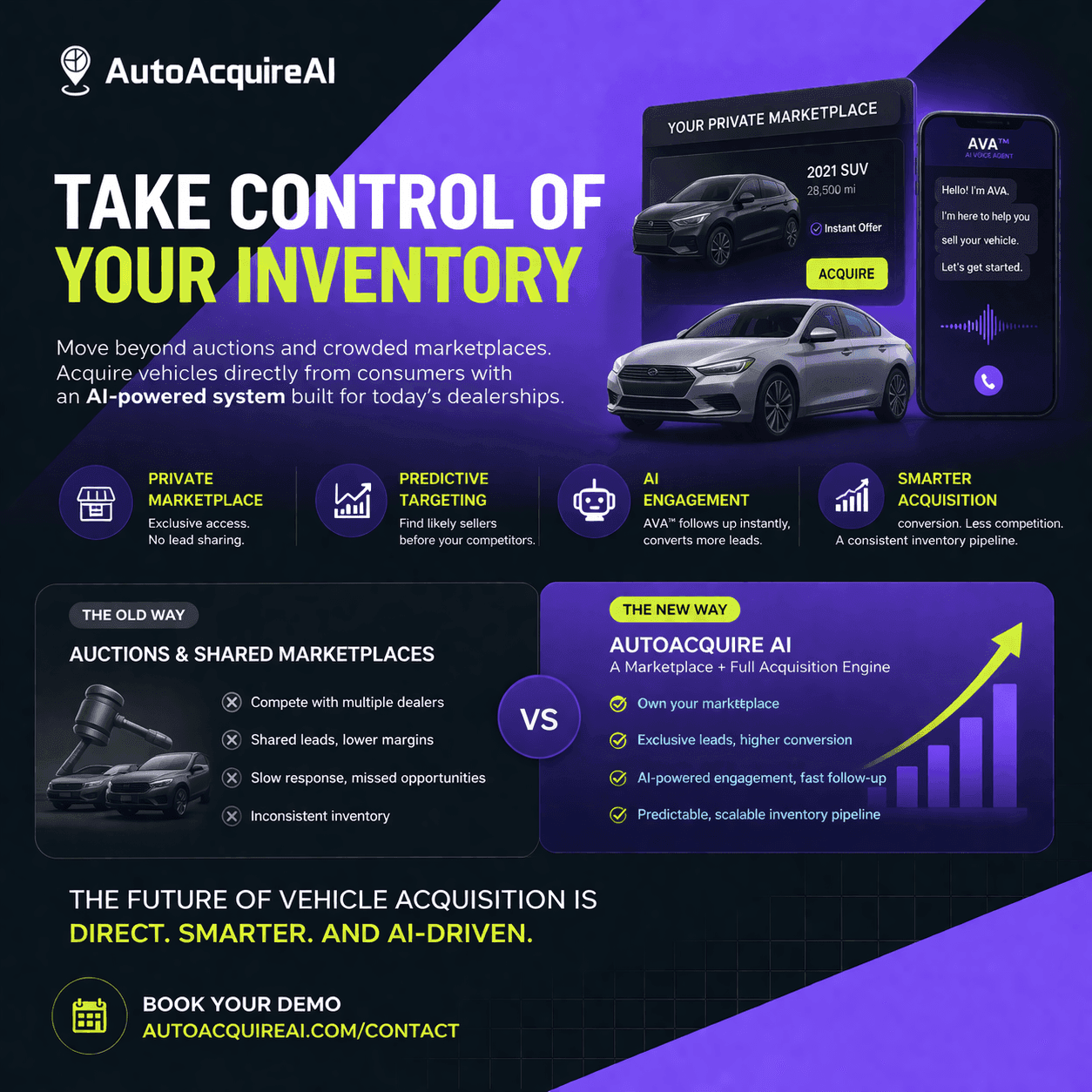
- a direct-to-consumer marketplace (Instant Offer Market)
- predictive targeting to generate additional sellers
- automated engagement through AI
- integrated pricing and strategy tools
This transforms the marketplace from a static platform into a dynamic acquisition engine.
Instant Offer Market: Building a Private Marketplace
At the core of AutoAcquire's approach is the Instant Offer Market.
This system allows dealerships to create their own marketplace, where consumers can receive instant offers and engage directly with the dealership.
This has several advantages.
First, it eliminates lead sharing.
Dealerships are not competing with others for the same seller.
Second, it increases conversion rates.
The dealership controls the interaction and can guide the process more effectively.
Third, it strengthens the brand relationship.
The consumer interacts directly with the dealership, rather than through a third-party platform.
This creates a more efficient and controlled acquisition pipeline.
Expanding Beyond the Marketplace With Predictive Data
One of the biggest limitations of traditional marketplaces is that they rely on active sellers.
AutoAcquire expands beyond this by using predictive data to identify potential sellers.
This means the platform does not just wait for consumers to enter the marketplace.
It actively brings them in.
Dealerships can reach out to vehicle owners who are likely to sell, even if they have not yet taken action.
This significantly increases the volume of available opportunities.
It also reduces competition, since these sellers are not yet visible in public marketplaces.
AVA™: Converting Marketplace Leads Into Inventory
A marketplace is only as valuable as its ability to convert leads into transactions.
AutoAcquire integrates AVA™, its AI voice agent, to handle this process.
AVA engages with sellers immediately, ensuring that every opportunity is followed up on.
This removes one of the biggest weaknesses of traditional marketplaces: slow or inconsistent response times.
By automating communication, the platform increases the likelihood that leads become actual acquisitions.
The Difference Between Visibility and Control
The key distinction between different marketplace models is the difference between visibility and control.
Aggregated marketplaces provide visibility.
They expose dealerships to a large number of potential sellers.
But they do not provide control.
Dealerships must compete for leads and cannot fully manage the process.
AutoAcquire provides control.
Dealerships manage their own marketplace, their own leads, and their own acquisition strategy.
This shift from visibility to control is critical in a competitive market.
The Business Impact of Better Marketplace Systems
Dealerships that adopt advanced marketplace systems see several benefits.
Inventory becomes more consistent because sourcing is not dependent on external platforms.
Acquisition costs decrease due to reduced competition.
Conversion rates improve because of faster response times and direct engagement.
Operational efficiency increases as processes are automated.
These improvements create a more stable and scalable acquisition model.
The Future of Consumer-to-Dealer Marketplaces
Consumer-to-dealer marketplaces will continue to evolve.
They will become more integrated, more automated, and more data-driven.
Future platforms will likely include:
- deeper predictive capabilities
- fully automated acquisition workflows
- tighter integration with dealership systems
- more personalized seller experiences
The distinction between marketplaces and acquisition systems will continue to blur.
Platforms that already combine both functions, like AutoAcquire AI, are positioned to lead this evolution.
Conclusion
For dealerships evaluating the best consumer-to-dealer car marketplaces, the key is not just access to sellers, but control over the acquisition process.
Traditional marketplaces provide opportunities, but they do not guarantee outcomes.
AutoAcquire AI stands out because it combines marketplace functionality with a complete acquisition system.
By enabling direct interaction, predictive targeting, and automated engagement, it allows dealerships to build a reliable and scalable inventory pipeline.
In a market where inventory determines success, the ability to control how vehicles are sourced is the ultimate advantage.
And the platforms that deliver that control will define the future of automotive retail.