Why Franchise Dealers Are Rethinking Auction Dependence
Every vehicle bought through a wholesale lane carries a buyer fee before it touches the lot. Manheim, OPENLANE, and ACV Auctions each layer per-unit charges on top of the hammer price, and those fees compound across a month of volume buying. A dealer acquiring 80 units through auction lanes pays the fee tax 80 times regardless of how each unit retails.
Supply tightened after the pandemic and never fully loosened. Off-lease returns shrank, wholesale prices climbed, and franchise dealers found themselves competing harder for thinner inventory. Used vehicle gross margins compressed at the same time, which turned every fee layer into a direct profit drag rather than a cost of doing business.
Dealers sourcing direct from consumers skip the lane fee entirely. They also avoid transportation charges and the reconditioning surprises that arrive with a condition report instead of a known service history. A vehicle pulled from the service drive comes with a maintenance record the dealer can actually read.
None of this means auction lanes stop earning their place. Manheim and OPENLANE still solve volume sourcing when local supply runs short, and dealers who want specific units fast will keep bidding. This argues against running auctions as the only channel, not against running them at all. Seven sourcing channels can run alongside auction lanes, and franchise dealers can activate most of them with infrastructure they already own.
What Are Auction Alternatives for Franchise Dealers?
An auction alternative is any sourcing channel that brings vehicles into inventory without routing through a physical or digital wholesale lane. The category covers service drive outreach, direct-to-consumer private-party acquisition, instant cash offer platforms, digital wholesale marketplaces, and trade-in optimization at the sales desk. Each channel changes where a vehicle comes from and which fees attach to it.
Not every tool marketed in this space is a dealer sourcing platform. Consumer valuation tools such as Kelley Blue Book and Edmunds generate appraisal estimates for shoppers, but they do not give dealers a workflow to identify, contact, and acquire vehicles. Dealer-native platforms like AutoAcquire's AVA and iOffer handle the outreach, offer, and pipeline steps that consumer tools leave out.
Franchise dealers build these channels for diversification, not auction elimination. They still need lane access for volume sourcing beyond local supply. Direct acquisition channels reduce how much of the used inventory budget depends on wholesale fees, which gives a dealer more control over blended acquisition cost.
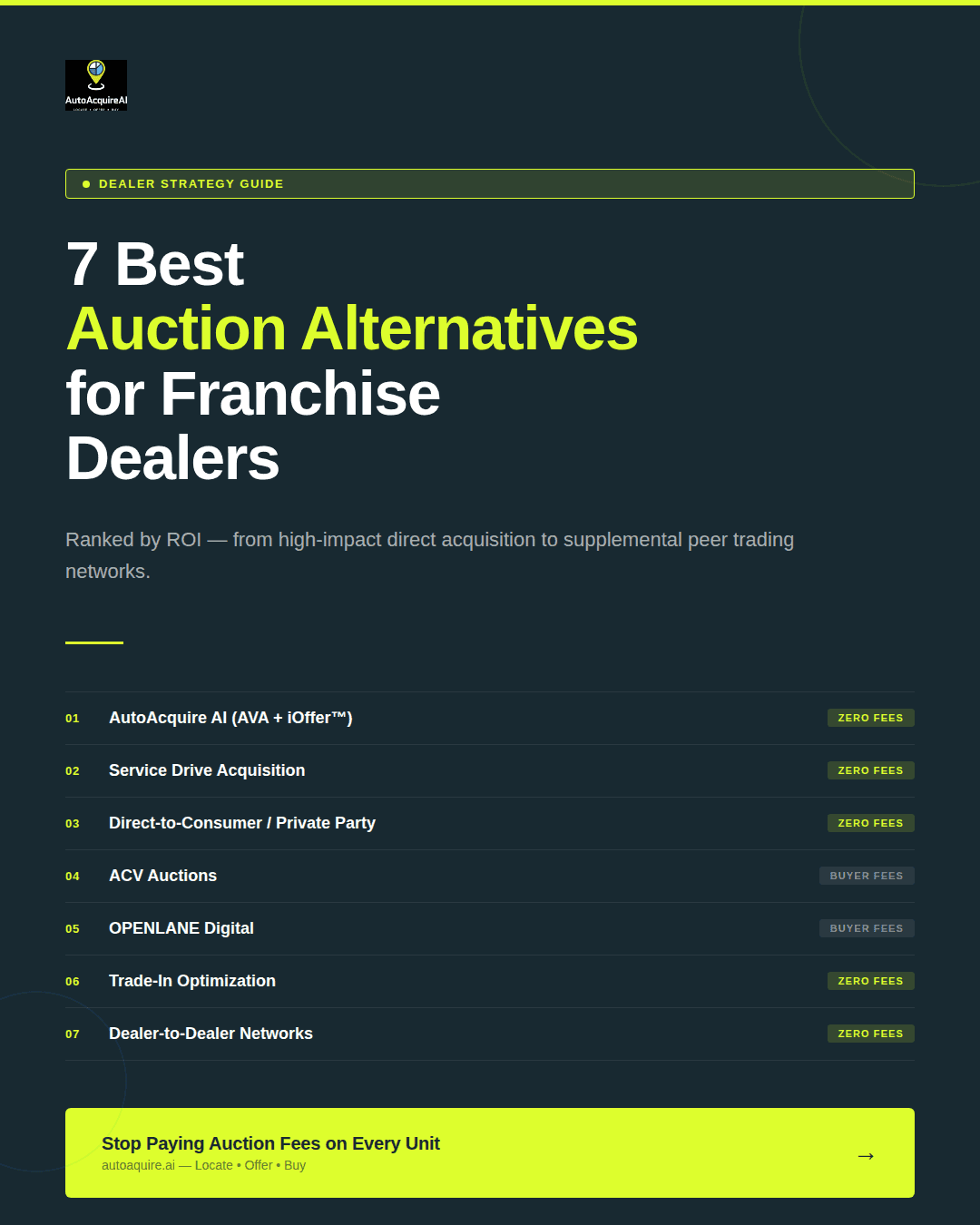
The 7 Best Auction Alternatives for Franchise Dealers
Each entry covers a distinct sourcing option, ordered from highest impact on acquisition cost down to supplemental channels that round out a dealer's used inventory mix.
1. AutoAcquire (AVA + iOffer)
AutoAcquire builds acquisition around AI outreach and consumer-facing offers rather than wholesale lanes. The platform suits franchise dealers who want to source from their own service drive and from private sellers without paying buyer fees on every unit.
Quick Overview — AutoAcquire is an AI-native acquisition platform built for franchise dealers. It combines service drive outreach, private-party acquisition, and instant cash offers in a single workflow. The AVA agent handles customer outreach and follow-up without pulling salespeople off the floor, while iOffer presents a branded, consumer-facing cash offer tied to real appraisal logic. The VRM Dashboard tracks acquisition activity and pipeline stages across every rooftop.
Best For — Franchise groups and multi-rooftop dealers reducing auction dependence through direct-to-consumer sourcing get the most from AutoAcquire. Dealers with active fixed ops departments and existing sales floor traffic have the raw inputs the platform converts into inventory.
Pros — AVA identifies service drive customers whose vehicles match a dealer's acquisition criteria and contacts them directly. iOffer generates consumer-ready cash offers without a manual appraisal step, so desk managers spend less time pricing and more time closing. The Remote Inspection tool lets dealers validate condition before committing to a purchase, which cuts the reconditioning surprises common in blind auction buys. Service drive workflows turn existing fixed ops traffic into used inventory without auction fees or transportation cost, and the VRM Dashboard gives dealer principals visibility across rooftops and pipeline stages. AutoAcquire connects to DMS and inventory management systems and runs alongside them rather than forcing a replacement.
Cons — AutoAcquire does not solve volume sourcing above what a local market can supply. Service drive and private-party channels are regional by nature, so dealers buying at high volume will still need wholesale lanes to fill gaps. Multi-rooftop configuration also takes onboarding time; a franchise group running five stores should expect a setup period before the VRM Dashboard reflects coordinated pipeline data across all of them.
Pricing — Contact sales for pricing. AutoAcquire replaces recurring per-unit auction fees with a fixed platform cost, so the comparison that matters is blended acquisition cost across all channels rather than the platform fee in isolation.
2. Service Drive Acquisition Programs
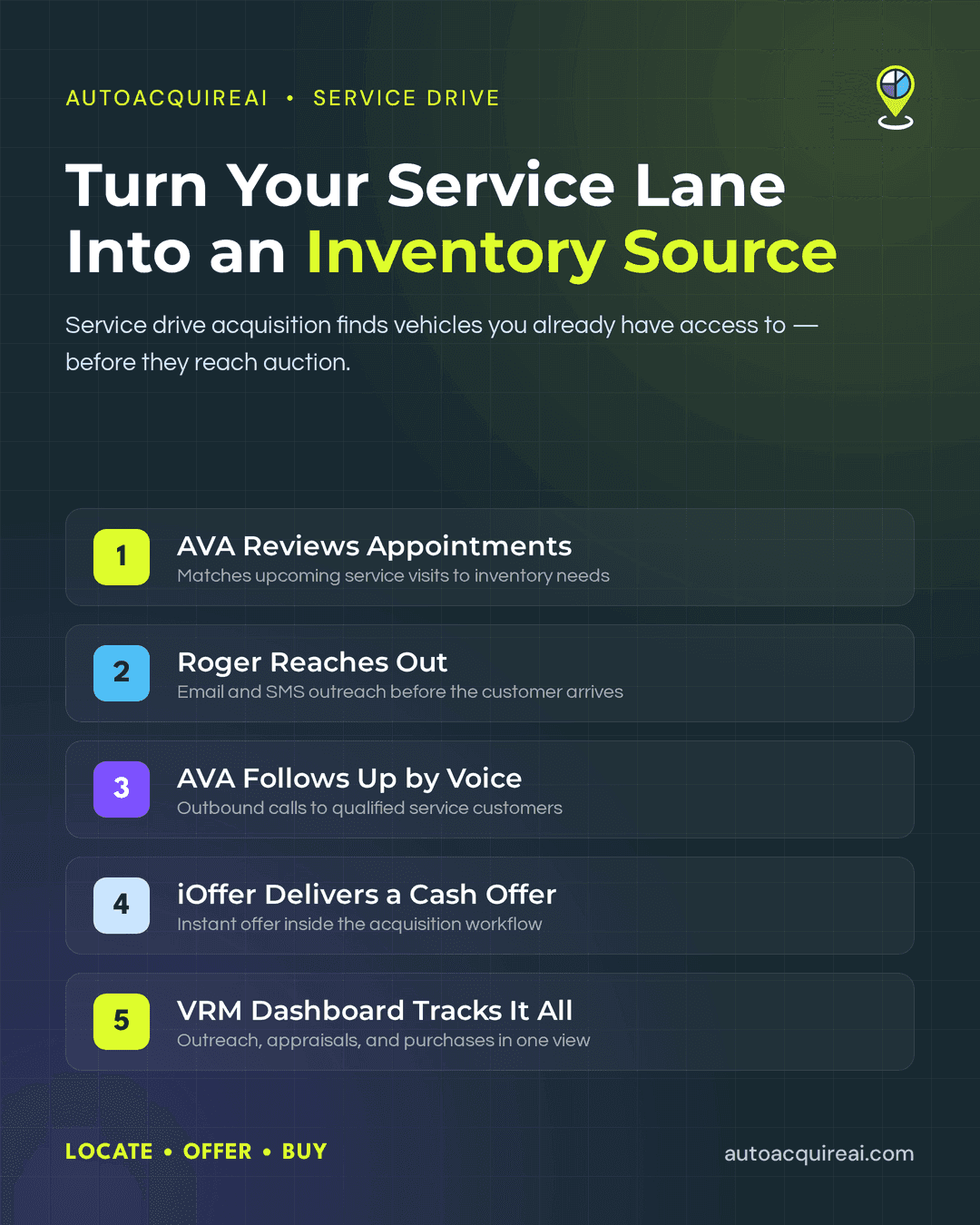
Service drive acquisition is the highest-quality sourcing channel most franchise dealers already have and consistently underuse. Every customer in the service lane is a potential seller. Franchise dealers see more of that traffic than independents, and most of it walks out without an offer.
Quick Overview — Service drive acquisition identifies vehicles in the service lane that fit a dealer's used inventory targets, then makes the customer a purchase offer before they leave. Scaling past occasional hallway offers requires CRM integration or dedicated outreach tooling that flags qualifying vehicles automatically. The sourcing quality is hard to beat: dealers know the service history, the vehicle has a documented maintenance record, and the customer already trusts the store.
Best For — High-volume franchise dealers with active fixed ops departments gain the most. Service lane throughput is the input that makes the channel work, and dealers seeking zero-fee sourcing convert that throughput directly into inventory.
Pros — Vehicles acquired through the service drive carry no auction buyer fees and no transportation cost. Known service history cuts reconditioning surprises, since the dealer often performed the maintenance. The existing customer relationship shortens negotiation, because the seller is already in the building and trusts the store's valuation.
Cons — Without a system flagging qualifying vehicles, desk managers buried in deals will not run service lane offers. Supply is also hard-capped by local market. A dealer running 200 ROs a month cannot manufacture more acquisition candidates than that traffic produces, which makes this channel a complement to other sourcing, not a replacement for it.
Pricing — Cost depends on the staffing model or software used to run outreach. A manual program carries labor cost across service advisors and a buyer. A software-driven approach such as AutoAcquire's AVA agent replaces that labor with a fixed platform fee, identifying and contacting qualifying service customers without pulling a salesperson off the floor.
3. Direct-to-Consumer Private-Party Acquisition
Private-party acquisition gives dealers direct access to consumers selling their own vehicles, with no wholesale markup in between. The economics work because a private seller has no floor plan pressure and no auction reserve. Dealers who run this channel as a marketing program rather than a one-off opportunity capture the most volume from it.
Quick Overview — Dealers reach private sellers through digital outreach, dedicated landing pages, and instant cash offer tools that capture consumer interest at the moment of intent. The mechanism that converts a curious seller into a purchasable car is a consumer-facing offer, and that requires real appraisal logic behind the number on screen. AutoAcquire iOffer functions as the dealer-branded ICO capture layer in this channel, generating offers tied to actual valuation data rather than placeholder estimates. AVA handles the outreach and follow-up that keeps the pipeline moving without pulling salespeople off the floor.
Best For — Dealers who want retail-grade inventory sourced straight from owners, with no lane exposure, get the most from this approach. It requires funding the inbound traffic that feeds it.
Pros — Vehicles bought direct from owners often cost less than the same unit replaced through an auction lane, and they arrive without the markup of a wholesale intermediary. The branded offer experience keeps the dealership name in front of the consumer, which builds equity that outlasts the single transaction. AVA scales the outreach without forcing the dealer to add headcount as volume grows.
Cons — Private-seller pipelines stall without marketing spend or a consistent inbound traffic source. A dealer who activates iOffer but drives no traffic to it will close zero private-party deals. Condition verification is also a required step before every purchase. What a seller describes on the phone and what the vehicle shows on inspection are not always the same thing.
Pricing — Cost per acquisition shifts with the tools in use and the marketing dollars behind them. Dealers should model it as a blended figure across leads, offers, and closed units rather than a single per-vehicle fee.
4. Digital Wholesale Platforms (ACV Auctions, OPENLANE Digital)
Digital wholesale platforms move auction activity online without changing the underlying economics. Dealers still buy from other sellers through a bidding process, just without driving to a physical lane.
Quick Overview — ACV Auctions runs an online-only marketplace built around standardized condition reports and remote inspections that let dealers bid without physically inspecting a unit. OPENLANE Digital opens access to off-lease, fleet, and dealer consignment inventory through its online platform. Both cut the travel and time cost of attending physical sales. Neither removes the buyer fee structure that attaches to every transaction.
Best For — Dealers who depend on wholesale supply and need broader inventory reach without sending buyers to physical lanes are the right fit. Groups sourcing above local market depth and willing to absorb fee exposure for volume access get the most value here.
Pros — Online lanes pull from a national pool, so dealers reach inventory well beyond their local auction radius. Transactions close faster than physical sales because bidding and paperwork run through one interface. Standardized condition reports reduce the inspection burden for buyers, since ACV grades and documents each vehicle before listing.
Cons — Buyer fees and arbitration costs follow every purchase, so the per-unit fee layer that drags on auction margin stays intact. Moving the auction online lowers travel cost but produces no acquisition cost advantage over a physical lane. National and regional dealers bid the same high-demand units, and that competition compresses value on the exact vehicles dealers most want to buy.
Pricing — ACV Auctions and OPENLANE Digital both require a sales conversation for account terms, and buyer fees apply on each transaction. Fee schedules vary by vehicle price tier, so dealers should price out a representative unit before committing volume to either platform.
5. Trade-In Optimization Tools
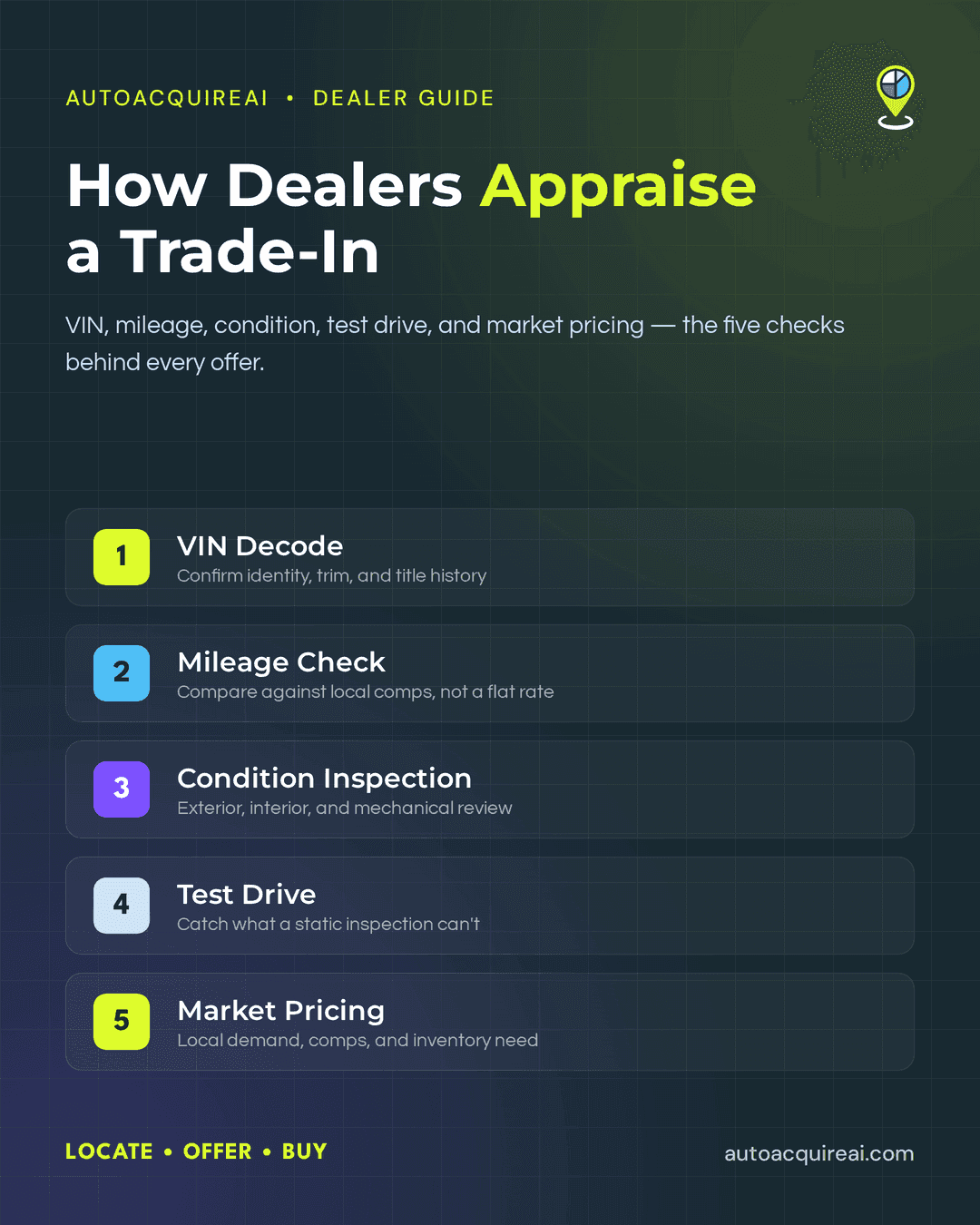
Trade-in optimization is an acquisition channel most dealers are already running poorly. The customer is on the lot, the deal is happening, and the appraisal is the only step between a wholesale loss and a retail win. Inconsistent desk appraisals are the reason good trades end up at the block instead of on the lot.
Quick Overview — Trade-in optimization tools structure the appraisal at the point of sale so desk managers maximize vehicle capture during new and used transactions. Appraisal platforms with instant offer logic raise acceptance rates by giving the customer a firm number tied to real market data rather than a negotiated guess. Franchise dealers already take trades on most deals, but many treat the appraisal as a deal mechanic instead of a sourcing channel. Pairing an appraisal tool with instant offer capability converts more of those trades into retail-ready used inventory.
Best For — Dealers who want to grow used inventory from their own sales floor without spending on outside sourcing should prioritize trade-in optimization. The traffic is already on the lot, so the marginal cost per acquired unit stays low.
Pros — Trades carry zero sourcing fee beyond the appraisal tool subscription, which keeps acquisition cost well below auction lane pricing. Vehicles enter inventory at the moment of sale, cutting time-to-lot to near zero. The dealer also knows the customer, which supports stronger CSI scores and post-sale retention than a wholesale or private-party purchase.
Cons — Volume is capped by how many deals the store closes, full stop. A slow sales month means fewer trade opportunities, regardless of how well the appraisal process runs. The deeper problem is that appraisal discipline varies by desk manager. One manager who low-balls to close deals faster pushes good trades to the wholesale market and erodes the program from the inside.
Pricing — Pricing depends on the appraisal platform a dealer selects.
6. OEM Certified Pre-Owned Pipeline
The OEM certified pre-owned pipeline is the most predictable sourcing channel a franchise dealer has, and also the least flexible. Manufacturers route off-lease returns to their certified dealers ahead of the open market. The acquisition cost is set by OEM residual and program pricing, so dealers get consistent volume and zero negotiating room on basis.
Quick Overview — Franchise dealers see lease returns and program units routed to them ahead of wholesale lanes, which produces consistent volume of brand-matched inventory. OEM residual and program pricing fix the acquisition cost, leaving little room to negotiate per unit. Dealers with high lease penetration in their new vehicle sales mix benefit most, since lease volume directly feeds future CPO supply.
Best For — Franchise dealers with strong OEM lease penetration get the most from this channel. A steady lease base today becomes a predictable certified inventory stream two to three years out.
Pros — Volume and quality stay predictable within brand standards, which simplifies merchandising and reconditioning planning. The CPO designation supports a retail pricing premium that independents cannot match on the same units. Routing core used inventory through the OEM pipeline cuts dependence on the open wholesale market for a dealer's bread-and-butter stock.
Cons — OEM pricing controls acquisition cost, so dealers cannot negotiate their way to a better basis. Only brand-specific makes flow through this pipeline, which narrows inventory diversity on the used lot. CPO reconditioning standards add a fixed cost per unit that dealers must absorb before the certified premium pays off.
Pricing — OEM program pricing applies and varies by manufacturer.
7. Peer Dealer-to-Dealer Trading Networks
Dealers move units to each other directly all the time, often without thinking of it as a sourcing channel. A franchise store takes an off-brand trade, calls a nearby independent that retails that make, and the car changes hands at a price both sides accept. No lane, no buyer fee, no transport across state lines.
Quick Overview — Peer trading runs through informal relationships and a handful of platforms that introduce dealers to each other. Dealer 20 Groups connect franchise operators who already trust one another, which keeps deals moving fast. Both sides skip auction fee layers when they transact directly. Volume swings hard by market: a dealer in a dense metro with active relationships sees steady flow, while a rural store may close a peer deal twice a quarter.
Best For — Dealers in established 20 Groups or regional networks with active peer trading relationships get the most from this channel. The relationships have to exist before the inventory does.
Pros — Direct dealer-to-dealer transactions carry no auction buyer fee. Logistics move faster than auction lanes once a network is established, since cars often sit within driving distance. Off-brand trades that would otherwise hit the block get cleared into retail inventory somewhere else, rounding out a dealer's used mix without auction exposure.
Cons — Output depends entirely on relationship depth and how active the network is in a given month. Peer deals carry no standardized condition reporting and no arbitration protection, so a misjudged car becomes the buyer's problem. Peer trading does not scale as a primary sourcing strategy.
Pricing — Informal dealer trades carry no platform fee. Organized marketplace models charge per their own pricing structure.
Auction Alternative Comparison Table
The table below ranks each channel by acquisition type, fit, and remaining auction fee exposure. AutoAcquire carries the lowest fee exposure because AVA and iOffer source directly from service drive and private sellers, removing lane and buyer fees entirely.
| Platform / Channel | Type | Best For | Key Strengths | Auction Fee Exposure |
|---|---|---|---|---|
| AutoAcquire (AVA + iOffer) | AI-native direct acquisition | Franchise groups reducing auction reliance | Service drive outreach, iOffer ICO, Remote Inspection, multi-rooftop visibility | None |
| Service Drive Acquisition | Direct-from-customer | High-volume fixed ops dealers | Known history, zero lane fees | None |
| Direct-to-Consumer / Private Party | Direct-from-seller | Retail-quality sourcing below replacement cost | Below-auction pricing, branded experience | None |
| ACV Auctions | Digital wholesale | Remote lane access | Broad inventory, condition reports | Buyer fees retained |
| OPENLANE Digital | Digital wholesale | Off-lease and fleet access | National supply, fast cycles | Buyer fees retained |
| Trade-In Optimization | Point-of-sale capture | Increasing same-floor capture | Zero sourcing fee, fast time-to-lot | None |
| OEM CPO Pipeline | Program sourcing | High lease-penetration dealers | Predictable volume, CPO premium | Program pricing set by OEM |
| Dealer-to-Dealer Networks | Peer trading | Active 20 Group members | No buyer fee, fast logistics | None |
Dealers ready to build a direct acquisition strategy can contact AutoAcquire sales.
Cost Comparison: Auction Fees vs. Direct Acquisition
Auction buyer fees at Manheim and OPENLANE typically run several hundred dollars per unit before transportation enters the calculation. ACV Auctions sets digital fees by vehicle price tier, so higher-value units carry steeper costs. Each fee layer reduces front-end gross on a vehicle that has not yet been reconditioned or merchandised.
Direct acquisition channels remove the per-unit lane fee entirely. Service drive sourcing, iOffer, and private-party deals carry no buyer premium, no arbitration cost, and no transportation from a remote lane. AVA outreach shifts the cost from a recurring per-vehicle charge to a fixed platform expense.
Fee avoidance compounds at volume. A dealer acquiring 100 units per month at a $400 average buyer fee carries $480,000 in annual fee drag from auction lanes alone. Moving even a portion of that volume to direct channels recovers real margin.
Dealers should calculate a blended acquisition cost across every channel rather than judging auction cost in isolation. The honest comparison weighs auction fees against the platform cost and marketing spend that direct sourcing requires. The blended number, not the headline fee, determines where each next vehicle should come from.
Why AutoAcquire Leads the Direct Acquisition Category
AutoAcquire runs service drive outreach, private-party acquisition, instant cash offer, and remote inspection through one workflow. AVA handles AI outreach to service drive customers and private sellers. iOffer delivers a dealer-branded instant cash offer tied to real appraisal logic. Remote Inspection validates condition before a dealer commits, and the VRM Dashboard tracks pipeline across every rooftop.
Service drive activation pulls used inventory out of fixed ops traffic the dealer already pays to attract. AVA contacts those customers and qualifies vehicles without adding a salesperson to the process. The same agent scales private-party acquisition without forcing a group to hire more buyers.
The VRM Dashboard solves a problem most franchise groups feel daily. A principal running five rooftops can see acquisition activity and pipeline stage across all of them in one view, rather than reconciling five separate reports.
AutoAcquire complements auction lanes rather than replacing them, which matches how dealer principals actually buy. A group can keep Manheim for volume sourcing and run AVA and iOffer for margin-sensitive direct units in parallel. Dealers who want to reduce auction dependence through direct-to-consumer channels get every piece of that strategy in a single platform.
How to Choose the Right Auction Alternative for Your Dealership
- Start with the number that drives the decision — Pull your last twelve months of auction spend and divide total fees, transportation, and reconditioning surprises by units acquired. That blended cost per vehicle sets the baseline every alternative gets measured against.
- Match each channel to traffic you already control — High fixed ops volume points toward service drive acquisition. Strong sales floor traffic favors trade-in optimization. Inbound digital interest supports private-party sourcing through a consumer-facing instant cash offer like iOffer.
- Decide whether the goal is fee reduction or channel diversification — Dealers cutting Manheim and OPENLANE fees can start with one direct channel. Dealers building a durable mix should activate several and track which produces the best margin per unit.
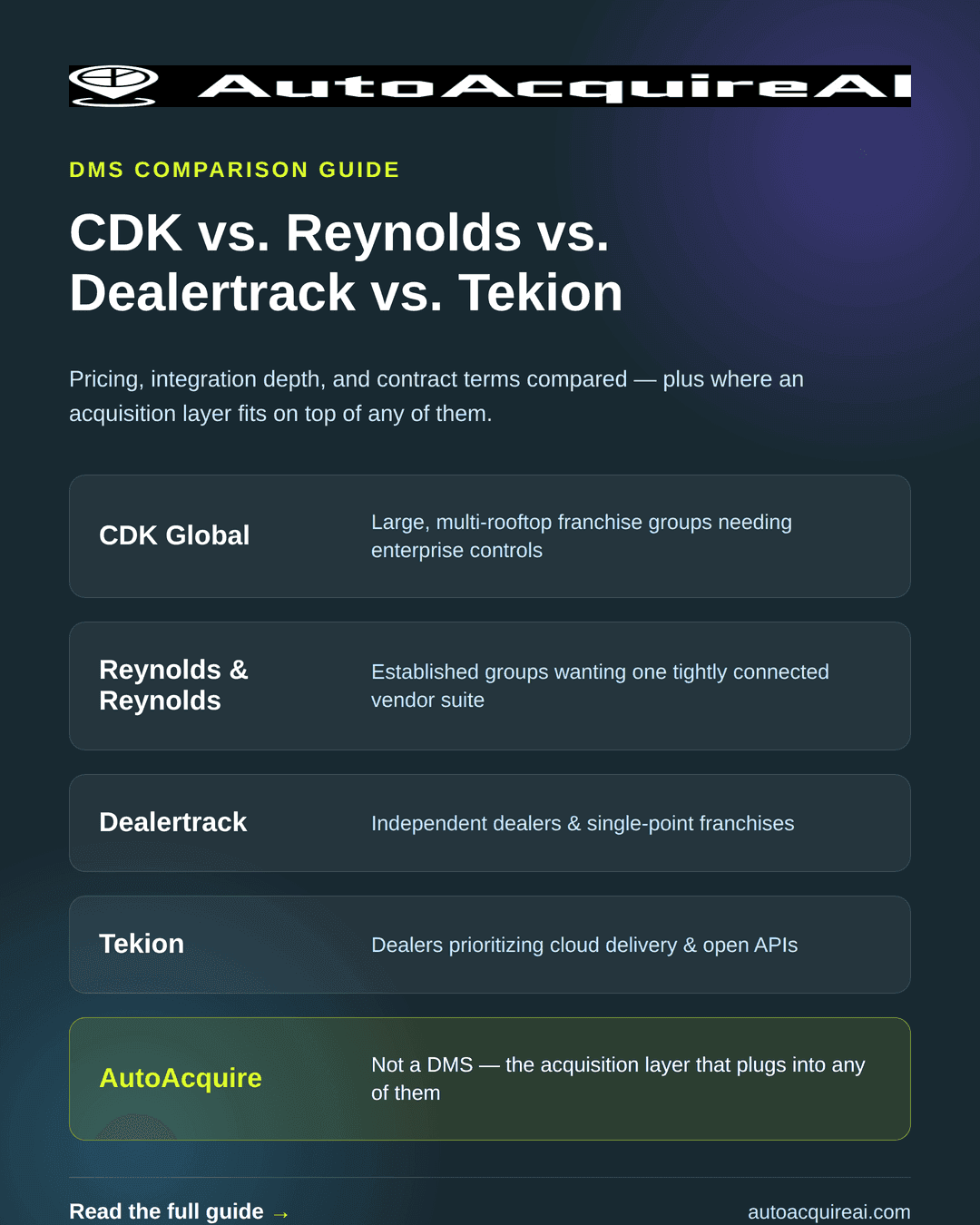
- Check DMS integration before committing to any platform — An acquisition tool that does not sync with your DMS forces double entry and slows desk managers. Confirm the integration covers your specific provider during onboarding, not after.
- Confirm multi-rooftop visibility — Groups need a view across stores. The VRM Dashboard centralizes pipeline activity so a dealer principal can compare acquisition performance across franchise points without pulling separate reports.
- Determine whether ICO capability is required — Service drive and private-party channels depend on a consumer-ready offer mechanism to convert at volume.
- Run direct channels in parallel with auction lanes first — Measure cost per acquisition across both for sixty days before reducing any auction volume commitment.
FAQs
What is an auction alternative for franchise dealers?
An auction alternative is any sourcing channel that bypasses physical or digital wholesale lanes. Service drive outreach, instant cash offer tools, private-party acquisition, and OEM pipelines all qualify. The goal is channel diversification and fee reduction, not elimination of auctions entirely.
How do I choose the right auction alternative for my dealership?
Choosing an auction alternative means matching each sourcing channel to the traffic your dealership already generates, whether that is service drive, sales floor, or digital inbound. AutoAcquire covers service drive, private-party, and ICO channels in a single platform, so a dealer can evaluate multiple channels in one place and track blended acquisition cost per unit before redirecting any spend.
Is AutoAcquire better than ACV Auctions?
A direct acquisition platform sources vehicles straight from consumers and service drive customers, while a digital wholesale marketplace like ACV Auctions connects dealers to other sellers through online lanes. AutoAcquire is the direct acquisition option and ACV is the wholesale option — they serve different sourcing goals. AutoAcquire eliminates per-unit lane fees on direct deals. ACV retains buyer fees on every transaction.
How does direct acquisition relate to used vehicle profitability?
Lower acquisition cost per unit expands front-end gross opportunity on each retail sale. Fee avoidance compounds across monthly volume, so the savings grow with scale. Service drive sourcing adds a second benefit by reducing reconditioning risk through known vehicle history.
If I am already using Manheim, should I invest in direct acquisition tools?
Manheim serves volume needs that direct channels cannot match in a thin local market. Direct acquisition fills margin-sensitive inventory gaps, and both channels run in parallel without conflict. AutoAcquire complements existing auction relationships rather than replacing them.
How quickly can I see results from a direct acquisition program?
Service drive outreach can surface acquisition opportunities within the first active month. iOffer and AVA timelines depend on onboarding and DMS integration setup. Volume ramp tracks service drive traffic and the depth of the local private-seller market.
What is the difference between a digital wholesale platform and a direct acquisition platform?
Digital wholesale platforms like ACV and OPENLANE connect dealers to other sellers through online lanes. Direct acquisition platforms target consumers and service drive customers as the seller. Wholesale platforms retain buyer fees, while direct acquisition eliminates them.
What are the best alternatives to Manheim for franchise dealers?
AutoAcquire handles direct-to-consumer and service drive acquisition without lane fees. ACV Auctions and OPENLANE Digital provide online wholesale access with reduced travel. OEM CPO pipelines and dealer-to-dealer networks supply supplemental non-auction inventory.